Recognition: unknown
Enhanced squeezing for quantum gravimetry in a Bose-Einstein condensate with focussing
Pith reviewed 2026-05-10 16:33 UTC · model grok-4.3
The pith
A delta kick to focus the Bose-Einstein condensate boosts spin squeezing and improves gravimetry phase sensitivity fourfold.
A machine-rendered reading of the paper's core claim, the machinery that carries it, and where it could break.
Core claim
The delta kick increases condensate density early on, which strengthens the one-axis twisting interactions and produces greater spin squeezing; for the best kick strength this yields phase sensitivity that beats the standard quantum limit by a factor of roughly 20, four times better than the original proposal.
What carries the argument
The delta kick, a sudden trapping potential that focuses the condensate to raise its density and thereby intensify the one-axis twisting that generates spin squeezing.
If this is right
- Optimal kick strength produces phase sensitivity 20 times better than the standard quantum limit.
- The gain is four times larger than in the scheme without the delta kick.
- A simple two-mode approximation already captures the essential dynamics and performance.
- The focusing step improves sensitivity while leaving the rest of the interferometer sequence unchanged.
Where Pith is reading between the lines
- The same focusing step might be combined with other squeezing methods to reach even higher sensitivity.
- Real devices would still need to confirm that the kick itself does not introduce heating or phase noise that cancels the gain.
- The approach could apply to other ultracold-atom systems where interaction strength limits squeezing.
Load-bearing premise
The multimode simulations accurately describe the real condensate evolution and that the delta kick can be applied without adding significant decoherence or technical noise.
What would settle it
An experiment that applies the delta kick, measures the resulting spin squeezing or interferometer phase sensitivity, and checks whether the fourfold improvement over the no-kick case appears.
Figures


read the original abstract
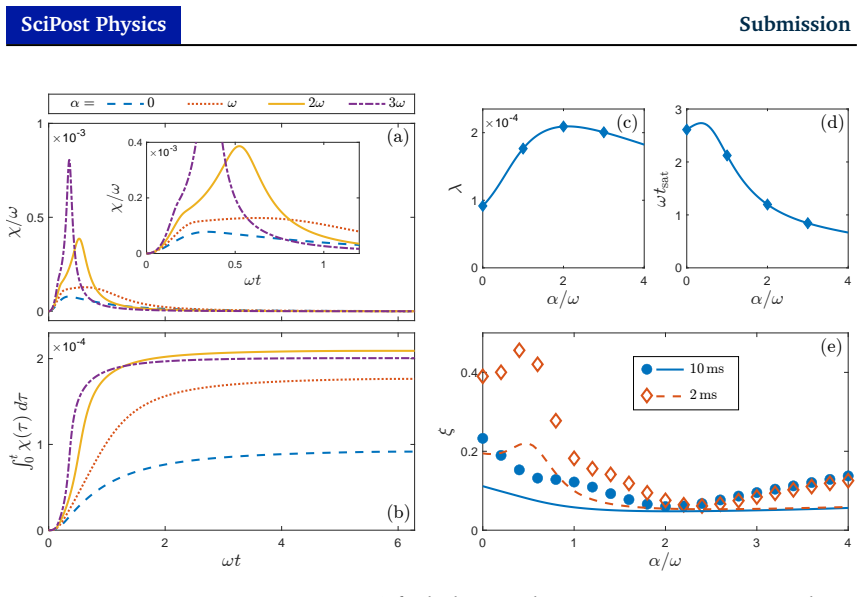
Free-fall atom interferometers offer a powerful platform for accurate, absolute gravitational sensing. Szigeti et al. [Phys. Rev. Lett. 125, 100402 (2020)] recently proposed a quantum-enhanced scheme that uses a spin-squeezed Bose-Einstein condensate as an input state to improve the phase sensitivity of the interferometer. The spin squeezing, generated via one-axis twisting interactions, was limited by condensate expansion. Here we present an improved state preparation in which a sudden trapping potential -- a delta kick -- is initially applied to focus the condensate. The resulting increase in density enhances the one-axis-twisting interactions and produces greater spin squeezing. Using multimode truncated-Wigner simulations, we quantify the performance of the interferometer and find that, for an optimal kick strength, the phase sensitivity surpasses the standard quantum limit by a factor of $\sim 20$. This represents a fourfold improvement over the original scheme without the delta kick and is well captured by a two-mode approximation.
Editorial analysis
A structured set of objections, weighed in public.
Referee Report
Summary. The manuscript proposes an enhancement to the quantum-enhanced free-fall atom interferometry scheme of Szigeti et al. by applying an initial delta-kick focusing potential to a spin-squeezed BEC. This increases the condensate density, strengthens one-axis twisting, and produces greater spin squeezing. Multimode truncated-Wigner simulations show that an optimal kick strength yields a phase sensitivity surpassing the standard quantum limit by a factor of ~20, a fourfold improvement over the original unfocused scheme; the improvement is stated to be well captured by a two-mode approximation.
Significance. If the numerical results hold under realistic conditions, the scheme offers a practical route to stronger squeezing in BEC-based gravimeters without increasing atom number or interaction time, potentially improving absolute gravity sensing. The provision of both multimode TWA data and a two-mode model that reproduces the trend is a strength, as is the direct quantification of the sensitivity gain relative to the SQL and the prior scheme.
major comments (3)
- [Numerical simulations / results] The central quantitative claim (~20× SQL sensitivity and fourfold improvement) rests on multimode truncated-Wigner simulations, yet the manuscript provides no details on mode truncation number, grid size, time-step convergence, or ensemble size. Without these, it is impossible to judge whether the reported squeezing parameter and phase sensitivity are numerically converged (see the results section describing the TWA implementation).
- [State-preparation protocol] The delta kick is modeled as an instantaneous potential change that instantly raises density and squeezing. The manuscript does not examine finite rise time, amplitude jitter, or mode coupling that would accompany any real implementation; even modest additional decoherence would reduce the effective squeezing and could eliminate the claimed fourfold gain over the no-kick case.
- [Two-mode model comparison] The two-mode approximation is asserted to capture the trend, but the manuscript does not quantify the range of validity (e.g., maximum deviation in squeezing parameter or phase sensitivity between two-mode and multimode results) or the conditions under which the approximation breaks down.
minor comments (2)
- [Figures] Figure captions and axis labels should explicitly state the kick strength values used and the precise definition of the phase sensitivity metric (e.g., whether it is the standard deviation or the Cramér-Rao bound).
- [Abstract and results] The abstract states the improvement factor as ∼20; the main text should give the exact numerical value extracted from the simulations together with the corresponding kick strength.
Simulated Author's Rebuttal
We thank the referee for the constructive feedback and positive assessment of the significance of our proposed scheme. We address each major comment point by point below and will incorporate revisions to strengthen the manuscript.
read point-by-point responses
-
Referee: The central quantitative claim (~20× SQL sensitivity and fourfold improvement) rests on multimode truncated-Wigner simulations, yet the manuscript provides no details on mode truncation number, grid size, time-step convergence, or ensemble size. Without these, it is impossible to judge whether the reported squeezing parameter and phase sensitivity are numerically converged (see the results section describing the TWA implementation).
Authors: We agree that explicit documentation of the numerical parameters is necessary to establish convergence. In the revised manuscript we will add a new paragraph (or subsection) in the methods/results section specifying the mode truncation, spatial grid resolution, time-step size, and ensemble size used in the multimode TWA runs, together with brief statements of the convergence tests performed. These details were checked during the original simulations and the reported sensitivity gain remains stable under refinement. revision: yes
-
Referee: The delta kick is modeled as an instantaneous potential change that instantly raises density and squeezing. The manuscript does not examine finite rise time, amplitude jitter, or mode coupling that would accompany any real implementation; even modest additional decoherence would reduce the effective squeezing and could eliminate the claimed fourfold gain over the no-kick case.
Authors: The instantaneous delta-kick model is a standard idealization in the atom-optics literature for theoretical studies. We acknowledge that real implementations involve finite rise times and possible jitter. In the revision we will add a short discussion paragraph noting that, for experimentally accessible optical delta kicks with rise times much shorter than the one-axis twisting timescale, the additional decoherence is expected to be small. We will also provide a rough estimate of the sensitivity degradation under 1–2 % amplitude jitter, showing that a substantial fraction of the fourfold improvement is retained. Full time-dependent multimode simulations with realistic pulse shapes lie beyond the present scope but are identified as a natural extension. revision: partial
-
Referee: The two-mode approximation is asserted to capture the trend, but the manuscript does not quantify the range of validity (e.g., maximum deviation in squeezing parameter or phase sensitivity between two-mode and multimode results) or the conditions under which the approximation breaks down.
Authors: We will revise the text to include a quantitative comparison. A new sentence (and, if space permits, a supplementary figure) will report the maximum relative deviation between the two-mode and multimode results for both the squeezing parameter and the phase sensitivity across the scanned kick strengths. The two-mode model reproduces the multimode trend to within ~10 % up to the optimal kick strength; beyond that point multimode effects cause larger deviations, which we will explicitly state. revision: yes
Circularity Check
No significant circularity; central result from independent numerical simulations
full rationale
The claimed ~20x SQL sensitivity and fourfold improvement are quantified directly from multimode truncated-Wigner simulations of the focused condensate dynamics, which constitute an independent computational evaluation rather than a redefinition or fit of input quantities. The two-mode approximation is presented as capturing the simulation outcome without reducing the result to the input model by construction. The citation to Szigeti et al. establishes only the baseline scheme for comparison; the delta-kick enhancement and its performance metric are new and externally falsifiable via the simulations. No self-definitional, fitted-prediction, or load-bearing self-citation reductions are present.
Axiom & Free-Parameter Ledger
free parameters (1)
- kick strength
axioms (1)
- domain assumption The truncated-Wigner method provides a faithful description of the condensate evolution under one-axis twisting and the delta kick.
Reference graph
Works this paper leans on
-
[1]
A. Peters, K. Y. Chung and S. Chu, Measurement of gravitational acceleration by dropping atoms, Nature 400(6747), 849 (1999), doi:https://doi.org/10.1038/23655
-
[2]
A. Peters, K. Y. Chung and S. Chu, High-precision gravity measurements using atom interferometry, Metrologia 38(1), 25 (2001), doi:10.1088/0026-1394/38/1/4
-
[3]
Z.-K. Hu, B.-L. Sun, X.-C. Duan, M.-K. Zhou, L.-L. Chen, S. Zhan, Q.-Z. Zhang and J. Luo, Demonstration of an ultrahigh-sensitivity atom-interferometry absolute gravimeter, Phys. Rev. A 88, 043610 (2013), doi:10.1103/PhysRevA.88.043610
-
[4]
M. Hauth, C. Freier, V. Schkolnik, A. Senger, M. Schmidt and A. Peters, First gravity measurements using the mobile atom interferometer GAIN , Appl. Phys. B 113(1), 49 (2013), doi:10.1007/s00340-013-5413-6
-
[5]
P. A. Altin, M. T. Johnsson, V. Negnevitsky, G. R. Dennis, R. P. Anderson, J. E. Debs, S. S. Szigeti, K. S. Hardman, S. Bennetts, G. D. McDonald, L. D. Turner, J. D. Close et al., Precision atomic gravimeter based on Bragg diffraction , New J. Phys. 15(2), 023009 (2013), doi:10.1088/1367-2630/15/2/023009
-
[6]
T. Farah, C. Guerlin, A. Landragin, P. Bouyer, S. Gaffet, F. Pereira Dos Santos and S. Merlet, Underground operation at best sensitivity of the mobile LNE - SYRTE cold atom gravimeter , Gyroscopy Navig. 5(4), 266 (2014), doi:https://doi.org/10.1134/S2075108714040051
-
[7]
C. Freier, M. Hauth, V. Schkolnik, B. Leykauf, M. Schilling, H. Wziontek, H.-G. Scherneck, J. M \"u ller and A. Peters, Mobile quantum gravity sensor with unprecedented stability, J. Phys.: Conf. Ser. 723, 012050 (2016), doi:10.1088/1742-6596/723/1/012050
-
[8]
V. M \'e noret, P. Vermeulen, N. Le Moigne, S. Bonvalot, P. Bouyer, A. Landragin and B. Desruelle, Gravity measurements below 10^ -9 g with a transportable absolute quantum gravimeter , Sci. Rep. 8(1), 12300 (2018), doi:10.1038/s41598-018-30608-1
-
[9]
T. Zhang, L.-L. Chen, Y.-B. Shu, W.-J. Xu, Y. Cheng, Q. Luo, Z.-K. Hu and M.-K. Zhou, Ultrahigh-sensitivity Bragg atom gravimeter and its application in testing Lorentz violation , Phys. Rev. Appl. 20, 014067 (2023), doi:10.1103/PhysRevApplied.20.014067
-
[10]
J. C. Saywell, M. S. Carey, P. S. Light, S. S. Szigeti, A. R. Milne, K. S. Gill, M. L. Goh, V. S. Perunicic, N. M. Wilson, C. D. Macrae et al., Enhancing the sensitivity of atom-interferometric inertial sensors using robust control, Nat. Commun. 14(1), 7626 (2023), doi:https://doi.org/10.1038/s41467-023-43374-0
-
[11]
M. J. Snadden, J. M. McGuirk, P. Bouyer, K. G. Haritos and M. A. Kasevich, Measurement of the earth's gravity gradient with an atom interferometer-based gravity gradiometer, Phys. Rev. Lett. 81, 971 (1998), doi:10.1103/PhysRevLett.81.971
-
[12]
Sorrentino,et al., Sensitivity limits of a Raman atom interferometer as a gravity gradiometer
F. Sorrentino, Q. Bodart, L. Cacciapuoti, Y.-H. Lien, M. Prevedelli, G. Rosi, L. Salvi and G. M. Tino, Sensitivity limits of a Raman atom interferometer as a gravity gradiometer , Phys. Rev. A 89, 023607 (2014), doi:10.1103/PhysRevA.89.023607
-
[13]
G. W. Biedermann, X. Wu, L. Deslauriers, S. Roy, C. Mahadeswaraswamy and M. A. Kasevich, Testing gravity with cold-atom interferometers, Phys. Rev. A 91, 033629 (2015), doi:10.1103/PhysRevA.91.033629
-
[14]
K. S. Hardman, P. J. Everitt, G. D. McDonald, P. Manju, P. B. Wigley, M. A. Sooriyabandara, C. C. N. Kuhn, J. E. Debs, J. D. Close and N. P. Robins, Simultaneous precision gravimetry and magnetic gradiometry with a Bose - Einstein condensate: A high precision, quantum sensor , Phys. Rev. Lett. 117, 138501 (2016), doi:10.1103/PhysRevLett.117.138501
-
[15]
G. D'Amico, F. Borselli, L. Cacciapuoti, M. Prevedelli, G. Rosi, F. Sorrentino and G. M. Tino, Bragg interferometer for gravity gradient measurements, Phys. Rev. A 93, 063628 (2016), doi:10.1103/PhysRevA.93.063628
-
[16]
P. Asenbaum, C. Overstreet, T. Kovachy, D. D. Brown, J. M. Hogan and M. A. Kasevich, Phase shift in an atom interferometer due to spacetime curvature across its wave function, Phys. Rev. Lett. 118, 183602 (2017), doi:10.1103/PhysRevLett.118.183602
-
[17]
C. Janvier, V. M\'enoret, B. Desruelle, S. Merlet, A. Landragin and F. Pereira dos Santos, Compact differential gravimeter at the quantum projection-noise limit, Phys. Rev. A 105, 022801 (2022), doi:10.1103/PhysRevA.105.022801
-
[18]
Canuel,et al., Six-Axis Inertial Sensor Using Cold-Atom Interferometry.Phys
B. Canuel, F. Leduc, D. Holleville, A. Gauguet, J. Fils, A. Virdis, A. Clairon, N. Dimarcq, C. J. Bord\'e, A. Landragin and P. Bouyer, Six-axis inertial sensor using cold-atom interferometry, Phys. Rev. Lett. 97, 010402 (2006), doi:10.1103/PhysRevLett.97.010402
-
[19]
S. Templier, P. Cheiney, Q. d'Armagnac de Castanet, B. Gouraud, H. Porte, F. Napolitano, P. Bouyer, B. Battelier and B. Barrett, Tracking the vector acceleration with a hybrid quantum accelerometer triad, Sci. Adv. 8(45), eadd3854 (2022), doi:10.1126/sciadv.add3854
-
[20]
T. L. Gustavson, P. Bouyer and M. A. Kasevich, Precision rotation measurements with an atom interferometer gyroscope, Phys. Rev. Lett. 78, 2046 (1997), doi:10.1103/PhysRevLett.78.2046
-
[21]
T. L. Gustavson, A. Landragin and M. A. Kasevich, Rotation sensing with a dual atom-interferometer Sagnac gyroscope , Class. Quantum Grav. 17(12), 2385 (2000), doi:10.1088/0264-9381/17/12/311
-
[22]
D. S. Durfee, Y. K. Shaham and M. A. Kasevich, Long-term stability of an area-reversible atom-interferometer Sagnac gyroscope , Phys. Rev. Lett. 97, 240801 (2006), doi:10.1103/PhysRevLett.97.240801
-
[23]
A. Gauguet, B. Canuel, T. L\'ev\`eque, W. Chaibi and A. Landragin, Characterization and limits of a cold-atom Sagnac interferometer , Phys. Rev. A 80, 063604 (2009), doi:10.1103/PhysRevA.80.063604
-
[24]
B. Barrett, R. Geiger, I. Dutta, M. Meunier, B. Canuel, A. Gauguet, P. Bouyer and A. Landragin, The Sagnac effect: 20 years of development in matter-wave interferometry , Comptes Rendus Physique 15(10), 875 (2014), doi:http://dx.doi.org/10.1016/j.crhy.2014.10.009
-
[25]
R. Gautier, M. Guessoum, L. A. Sidorenkov, Q. Bouton, A. Landragin and R. Geiger, Accurate measurement of the Sagnac effect for matter waves , Sci. Adv. 8(23), eabn8009 (2022), doi:10.1126/sciadv.abn8009
-
[26]
C. W. Woffinden, A. J. Groszek, G. Gauthier, B. J. Mommers, M. W. J. Bromley, S. A. Haine, H. Rubinsztein-Dunlop, M. J. Davis, T. W. Neely and M. Baker, Viability of rotation sensing using phonon interferometry in Bose-Einstein condensates , SciPost Phys. 15, 128 (2023), doi:10.21468/SciPostPhys.15.4.128
-
[27]
K. Bongs, M. Holynski, J. Vovrosh, P. Bouyer, G. Condon, E. Rasel, C. Schubert, W. P. Schleich and A. Roura, Taking atom interferometric quantum sensors from the laboratory to real-world applications, Nat. Rev. Phys. 1(12), 731 (2019), doi:10.1038/s42254-019-0117-4
-
[28]
C. Jekeli, Navigation error analysis of atom interferometer inertial sensor, Navigation 52(1), 1 (2005), doi:https://doi.org/10.1002/j.2161-4296.2005.tb01726.x
-
[29]
B. Battelier, B. Barrett, L. Fouche, L. Chichet, L. Antoni-Micollier, H. Porte, F. Napolitano, J. Lautier, A. Landragin and P. Bouyer, Development of compact cold-atom sensors for inertial navigation , In J. Stuhler and A. J. Shields, eds., Quantum Optics, vol. 9900, p. 990004. International Society for Optics and Photonics, SPIE, doi:10.1117/12.2228351 (2016)
-
[30]
F. A. Narducci, A. T. Black and J. H. Burke, Advances toward fieldable atom interferometers, Adv. Phys. X 7(1), 1946426 (2022), doi:https://doi.org/10.1080/23746149.2021.1946426
-
[31]
M. J. Wright, L. Anastassiou, C. Mishra, J. M. Davies, A. M. Phillips, S. Maskell and J. F. Ralph, Cold atom inertial sensors for navigation applications, Front. Phys. 10, 994459 (2022), doi:https://doi.org/10.3389/fphy.2022.994459
-
[32]
A. M. Phillips, M. J. Wright, I. Riou, S. Maddox, S. Maskell and J. F. Ralph, Position fixing with cold atom gravity gradiometers, AVS Quantum Sci. 4(2), 024404 (2022), doi:https://doi.org/10.1116/5.0095677
-
[33]
X. Wang, A. Kealy, C. Gilliam, S. Haine, J. Close, B. Moran, K. Talbot, S. Williams, K. Hardman, C. Freier, P. Wigley, A. White et al., Improving measurement performance via fusion of classical and quantum accelerometers, Journal of Navigation 76, 91 (2023), doi:10.1017/S0373463322000637
-
[34]
E. H. van Leeuwen, BHP develops airborne gravity gradiometer for mineral exploration , The Leading Edge 19(12), 1296 (2000), doi:https://doi.org/10.1190/1.1438526
-
[35]
M. I. Evstifeev, The state of the art in the development of onboard gravity gradiometers, Gyroscopy Navig. 8(1), 68 (2017), doi:10.1134/S2075108717010047
-
[36]
Scientific Reports , keywords =
B. Canuel, A. Bertoldi, L. Amand, E. Pozzo di Borgo, T. Chantrait, C. Danquigny, M. Dovale Alvarez, B. Fang, A. Freise, R. Geiger, J. Gillot, S. Henry et al., Exploring gravity with the MIGA large scale atom interferometer , Sci. Rep. 8(1), 14064 (2018), doi:10.1038/s41598-018-32165-z
-
[37]
M. Schilling, \'E . Wodey, L. Timmen, D. Tell, K. H. Zipfel, D. Schlippert, C. Schubert, E. M. Rasel and J. M \"u ller, Gravity field modelling for the Hannover 10 m atom interferometer , J. Geod. 94, 122 (2020), doi:https://doi.org/10.1007/s00190-020-01451-y
-
[38]
D. Aguilera, H. Ahlers, B. Battelier, A. Bawamia, A. Bertoldi, R. Bondarescu, K. Bongs, P. Bouyer, C. Braxmaier, L. Cacciapuoti et al., STE - QUEST --test of the universality of free fall using cold atom interferometry , Class. Quantum Grav. 31(11), 115010 (2014), doi:10.1088/0264-9381/31/11/115010
-
[39]
J. Williams, S.-w. Chiow, N. Yu and H. M \"u ller, Quantum test of the equivalence principle and space-time aboard the international space station, New J. Phys. 18(2), 025018 (2016), doi:10.1088/1367-2630/18/2/025018
-
[40]
D. Becker, M. D. Lachmann, S. T. Seidel, H. Ahlers, A. N. Dinkelaker, J. Grosse, O. Hellmig, H. M \"u ntinga, V. Schkolnik, T. Wendrich et al., Space-borne Bose -- Einstein condensation for precision interferometry , Nature 562(7727), 391 (2018), doi:https://doi.org/10.1038/s41586-018-0605-1
-
[41]
G. Rosi, F. Sorrentino, L. Cacciapuoti, M. Prevedelli and G. M. Tino, Precision measurement of the Newtonian gravitational constant using cold atoms , Nature (7506), 518, doi:https://doi.org/10.1038/nature13433
-
[42]
S. Dimopoulos, P. W. Graham, J. M. Hogan and M. A. Kasevich, Testing general relativity with atom interferometry, Phys. Rev. Lett. 98(11), 111102 (2007), doi:10.1103/PhysRevLett.98.111102
-
[43]
G. M. Tino, Testing gravity with cold atom interferometry: results and prospects, Quantum Sci. Technol. 6(2), 024014 (2021), doi:10.1088/2058-9565/abd83e
-
[44]
D. J. Wineland, J. J. Bollinger, W. M. Itano, F. L. Moore and D. J. Heinzen, Spin squeezing and reduced quantum noise in spectroscopy, Phys. Rev. A 46, R6797 (1992), doi:10.1103/PhysRevA.46.R6797
-
[45]
L. Pezze, A. Smerzi, M. K. Oberthaler, R. Schmied and P. Treutlein, Quantum metrology with nonclassical states of atomic ensembles, Rev. Mod. Phys. 90, 035005 (2018), doi:10.1103/RevModPhys.90.035005
-
[46]
V. Giovannetti, S. Lloyd and L. Maccone, Quantum-enhanced measurements: Beating the standard quantum limit, Science 306(5700), 1330 (2004), doi:10.1126/science.1104149, https://science.sciencemag.org/content/306/5700/1330.full.pdf
-
[47]
S. S. Szigeti, O. Hosten and S. A. Haine, Improving cold-atom sensors with quantum entanglement: Prospects and challenges, Appl. Phys. Lett. 118(14), 140501 (2021), doi:https://doi.org/10.1063/5.0050235
-
[48]
R. Corgier, M. Malitesta, A. Smerzi and L. Pezz \` e , Quantum-enhanced differential atom interferometers and clocks with spin-squeezing swapping, Quantum 7, 965 (2023), doi:10.22331/q-2023-03-30-965
-
[49]
R. Corgier, M. Malitesta, L. A. Sidorenkov, F. Pereira Dos Santos, G. Rosi, G. M. Tino, A. Smerzi, L. Salvi and L. Pezzè, Optimized squeezing for accurate differential sensing under large phase noise, Quantum Sci. Technol. 10(4), 045016 (2025), doi:10.1088/2058-9565/adf2d8
-
[50]
J. Appel, P. J. Windpassinger, D. Oblak, U. B. Hoff, N. Kjaergaard and E. S. Polzik, Mesoscopic atomic entanglement for precision measurements beyond the standard quantum limit, Proc. Natl. Acad. Sci. U.S.A. 106(27), 10960 (2009), doi:10.1073/pnas.0901550106
-
[51]
I. D. Leroux, M. H. Schleier-Smith and V. Vuletic, Implementation of cavity squeezing of a collective atomic spin, Phys. Rev. Lett. 104, 073602 (2010), doi:10.1103/PhysRevLett.104.073602
-
[52]
ohi, Y. Li, T. W. H\
M. F. Riedel, P. B\"ohi, Y. Li, T. W. H\"ansch, A. Sinatra and P. Treutlein, Atom-chip-based generation of entanglement for quantum metrology, Nature 464(7292), 1170 (2010)
2010
-
[53]
Gross, T
C. Gross, T. Zibold, E. Nicklas, J. Esteve and M. K. Oberthaler, Nonlinear atom interferometer surpasses classical precision limit, Nature 464(7292), 1165 (2010)
2010
-
[54]
H. Strobel, W. Muessel, D. Linnemann, T. Zibold, D. B. Hume, L. Pezz \`e , A. Smerzi and M. K. Oberthaler, Fisher information and entanglement of non- Gaussian spin states , Science 345(6195), 424 (2014), doi:10.1126/science.1250147
-
[55]
F. Anders, A. Idel, P. Feldmann, D. Bondarenko, S. Loriani, K. Lange, J. Peise, M. Gersemann, B. Meyer-Hoppe, S. Abend, N. Gaaloul, C. Schubert et al., Momentum entanglement for atom interferometry, Phys. Rev. Lett. 127, 140402 (2021), doi:10.1103/PhysRevLett.127.140402
-
[56]
C. F. Ockeloen, R. Schmied, M. F. Riedel and P. Treutlein, Quantum metrology with a scanning probe atom interferometer, Phys. Rev. Lett. 111, 143001 (2013), doi:10.1103/PhysRevLett.111.143001
-
[57]
W. Muessel, H. Strobel, D. Linnemann, D. B. Hume and M. K. Oberthaler, Scalable spin squeezing for quantum-enhanced magnetometry with Bose - Einstein condensates , Phys. Rev. Lett. 113, 103004 (2014), doi:10.1103/PhysRevLett.113.103004
-
[58]
I. Kruse, K. Lange, J. Peise, B. L\"ucke, L. Pezz\`e, J. Arlt, W. Ertmer, C. Lisdat, L. Santos, A. Smerzi and C. Klempt, Improvement of an atomic clock using squeezed vacuum, Phys. Rev. Lett. 117, 143004 (2016), doi:10.1103/PhysRevLett.117.143004
-
[59]
C. Cassens, B. Meyer-Hoppe, E. Rasel and C. Klempt, Entanglement-enhanced atomic gravimeter, Phys. Rev. X 15, 011029 (2025), doi:10.1103/PhysRevX.15.011029
-
[60]
S. S. Szigeti, S. P. Nolan, J. D. Close and S. A. Haine, High-precision quantum-enhanced gravimetry with a Bose - Einstein condensate , Phys. Rev. Lett. 125, 100402 (2020), doi:10.1103/PhysRevLett.125.100402
-
[61]
M. Kitagawa and M. Ueda, Squeezed spin states, Phys. Rev. A 47, 5138 (1993), doi:10.1103/PhysRevA.47.5138
-
[62]
R. Corgier, N. Gaaloul, A. Smerzi and L. Pezz\`e, Delta-kick squeezing, Phys. Rev. Lett. 127, 183401 (2021), doi:10.1103/PhysRevLett.127.183401
-
[63]
H. Ammann and N. Christensen, Delta kick cooling: A new method for cooling atoms, Phys. Rev. Lett. 78, 2088 (1997), doi:10.1103/PhysRevLett.78.2088
-
[64]
H. M\"untinga, H. Ahlers, M. Krutzik, A. Wenzlawski, S. Arnold, D. Becker, K. Bongs, H. Dittus, H. Duncker, N. Gaaloul, C. Gherasim, E. Giese et al., Interferometry with Bose - Einstein condensates in microgravity , Phys. Rev. Lett. 110, 093602 (2013), doi:10.1103/PhysRevLett.110.093602
-
[65]
T. Kovachy, J. M. Hogan, A. Sugarbaker, S. M. Dickerson, C. A. Donnelly, C. Overstreet and M. A. Kasevich, Matter wave lensing to picokelvin temperatures, Phys. Rev. Lett. 114, 143004 (2015), doi:10.1103/PhysRevLett.114.143004
-
[66]
C. Deppner, W. Herr, M. Cornelius, P. Stromberger, T. Sternke, C. Grzeschik, A. Grote, J. Rudolph, S. Herrmann, M. Krutzik, A. Wenzlawski, R. Corgier et al., Collective-mode enhanced matter-wave optics, Phys. Rev. Lett. 127, 100401 (2021), doi:10.1103/PhysRevLett.127.100401
-
[67]
M. Kasevich and S. Chu, Measurement of the gravitational acceleration of an atom with a light-pulse atom interferometer, Appl. Phys. B 54, 321 (1992), doi:https://doi.org/10.1007/BF00325375
-
[68]
A. S rensen, L. M. Duan, J. I. Cirac and P. Zoller, Many-particle entanglement with Bose -- Einstein condensates , Nature 409(6816), 63 (2001), doi:10.1038/35051038
-
[69]
D. J. Wineland, J. J. Bollinger, W. M. Itano and D. J. Heinzen, Squeezed atomic states and projection noise in spectroscopy, Phys. Rev. A 50, 67 (1994), doi:10.1103/PhysRevA.50.67
-
[70]
M. J. Steel, M. K. Olsen, L. I. Plimak, P. D. Drummond, S. M. Tan, M. J. Collett, D. F. Walls and R. Graham, Dynamical quantum noise in trapped Bose-Einstein condensates , Phys. Rev. A 58, 4824 (1998), doi:10.1103/PhysRevA.58.4824
-
[71]
A. Sinatra, C. Lobo and Y. Castin, The truncated Wigner method for Bose -condensed gases: limits of validity and applications , J. Phys. B 35(17), 3599 (2002), doi:10.1088/0953-4075/35/17/301
-
[72]
P. B. Blakie, A. S. Bradley, M. J. Davis, R. J. Ballagh and C. W. Gardiner, Dynamics and statistical mechanics of ultra-cold Bose gases using c-field techniques , Adv. Phys. 57(5), 363 (2008), doi:10.1080/00018730802564254
-
[73]
S. A. Haine and A. J. Ferris, Surpassing the standard quantum limit in an atom interferometer with four-mode entanglement produced from four-wave mixing, Phys. Rev. A 84, 043624 (2011), doi:10.1103/PhysRevA.84.043624
-
[74]
S. A. Haine, Quantum noise in bright soliton matterwave interferometry, New J. Phys. 20(3), 033009 (2018), doi:10.1088/1367-2630/aab47f
-
[75]
A. J. Ferris, M. J. Davis, R. W. Geursen, P. B. Blakie and A. C. Wilson, Dynamical instabilities of Bose - Einstein condensates at the band edge in one-dimensional optical lattices , Phys. Rev. A 77, 012712 (2008), doi:10.1103/PhysRevA.77.012712
-
[76]
Y. Castin and R. Dum, Bose - Einstein condensates in time dependent traps , Phys. Rev. Lett. 77, 5315 (1996), doi:10.1103/PhysRevLett.77.5315
-
[77]
K. M. Mertes, J. W. Merrill, R. Carretero-Gonz\'alez, D. J. Frantzeskakis, P. G. Kevrekidis and D. S. Hall, Nonequilibrium dynamics and superfluid ring excitations in binary Bose - Einstein condensates , Phys. Rev. Lett. 99, 190402 (2007), doi:10.1103/PhysRevLett.99.190402
-
[78]
J. Ye, S. Swartz, P. Jungner and J. L. Hall, Hyperfine structure and absolute frequency of the ^ 87 Rb 5 P _ 3/2 state , Opt. Lett. 21(16), 1280 (1996), doi:10.1364/OL.21.001280
-
[79]
L. Dupays, D. C. Spierings, A. M. Steinberg and A. del Campo, Delta-kick cooling, time-optimal control of scale-invariant dynamics, and shortcuts to adiabaticity assisted by kicks, Phys. Rev. Res. 3, 033261 (2021), doi:10.1103/PhysRevResearch.3.033261
-
[80]
Stringari, Collective excitations of a trapped Bose -condensed gas , Phys
S. Stringari, Collective excitations of a trapped Bose -condensed gas , Phys. Rev. Lett. 77, 2360 (1996), doi:10.1103/PhysRevLett.77.2360
discussion (0)
Sign in with ORCID, Apple, or X to comment. Anyone can read and Pith papers without signing in.