Recognition: unknown
Resonant Leptogenesis in a Two-Triplet Type-II Seesaw: A Dynamical Origin of Suppressed Lepton Flavor Violation
Pith reviewed 2026-05-10 16:15 UTC · model grok-4.3
The pith
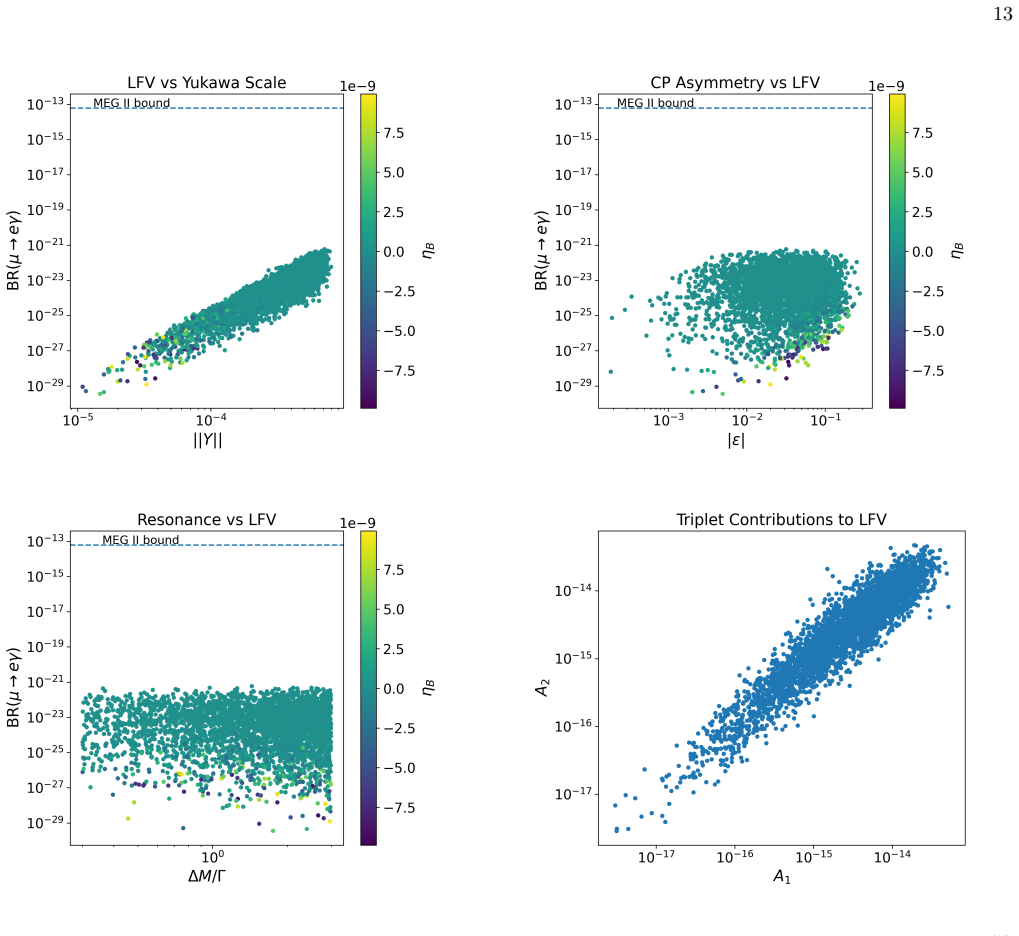
In a two-triplet Type-II seesaw, the resonant leptogenesis conditions that produce the baryon asymmetry also force small Yukawa couplings that suppress lepton flavor violation.
A machine-rendered reading of the paper's core claim, the machinery that carries it, and where it could break.
Core claim
Quasi-degenerate scalar triplets in the Type-II seesaw generate light neutrino masses through their Yukawa couplings. Self-energy contributions from the mass splitting produce a resonant enhancement of the CP asymmetry in triplet decays, allowing successful leptogenesis at the TeV scale. Numerical integration of the Boltzmann equations demonstrates that viable baryogenesis occurs only in a narrow region of near-resonant splittings and moderate-to-strong washout, where the required Yukawa couplings remain small enough to satisfy neutrino data. This regime automatically yields strongly suppressed rates for lepton flavor violating processes.
What carries the argument
The resonant enhancement of CP asymmetry from the mass splitting between two quasi-degenerate scalar triplets, which compensates for the small Yukawa couplings needed to match neutrino data while controlling washout.
If this is right
- Successful baryogenesis occurs at the TeV scale when the triplets are quasi-degenerate and washout is moderate to strong.
- The allowed parameter space is restricted to values where resonant enhancement exactly offsets the suppression from small Yukawas.
- Lepton flavor violation rates remain far below experimental sensitivity across all viable solutions.
- Neutrino oscillation data and the requirement of baryogenesis together select a unique class of Yukawa structures.
Where Pith is reading between the lines
- Precision measurements of neutrino mixing parameters could further narrow the allowed triplet mass splittings.
- Non-observation of LFV in upcoming experiments would be consistent with the model rather than merely inconclusive.
- The same resonant mechanism might appear in other multi-scalar extensions that generate neutrino masses.
Load-bearing premise
The two scalar triplets must have precisely tuned near-degenerate masses so that resonant self-energy effects dominate the CP asymmetry, and the Boltzmann equations must include every relevant washout and scattering process without missing flavor or thermal corrections that would change the allowed region.
What would settle it
Detection of a lepton flavor violating decay such as muon to electron plus photon at a branching ratio larger than the upper limit set by the small Yukawa couplings in the viable leptogenesis parameter space.
Figures


read the original abstract
We investigate resonant leptogenesis in a two-triplet Type-II seesaw framework and demonstrate a coherent and predictive connection between neutrino mass generation, baryogenesis, and charge lepton flavor violation (LFV). In the presence of quasi-degenerate scalar triplets, self-energy effects induce a resonant enhancement of the CP asymmetry, enabling successful baryogenesis at the TeV scale. We construct Yukawa couplings consistent with neutrino oscillation data and perform a comprehensive numerical analysis by solving the Boltzmann equations across a wide parameter space. We find that viable solutions arise only within a restricted region characterized by near-resonant mass splittings and moderate-to-strong washout. In this regime, successful leptogenesis is achieved through resonant enhancement, which compensates for suppressed Yukawa couplings. A key prediction of the framework is that the allowed parameter space dynamically favors small Yukawa couplings, leading to strongly suppressed LFV rates. The near-absence of observable LFV signals therefore emerges as a direct consequence of the dynamics responsible for baryogenesis. Our results highlight a distinctive feature of the two-triplet Type-II scenario: the simultaneous realization of resonant enhancement and LFV suppression within a unified and testable framework.
Editorial analysis
A structured set of objections, weighed in public.
Referee Report
Summary. The paper claims to establish a connection between neutrino mass generation via the Type-II seesaw with two scalar triplets, resonant leptogenesis at the TeV scale enabled by quasi-degenerate triplets, and the dynamical suppression of lepton flavor violation. Through numerical solution of the Boltzmann equations, viable baryogenesis is found only in a restricted parameter space with near-resonant splittings and moderate-to-strong washout, which favors small Yukawa couplings and thus strongly suppressed LFV rates as a consequence.
Significance. If the numerical results are confirmed to include all relevant processes, this work would be significant in providing a coherent framework where the dynamics of baryogenesis naturally explain the lack of observable LFV signals, offering testable predictions for future experiments. The comprehensive parameter scan and consistency with neutrino data are notable strengths.
major comments (1)
- [Boltzmann equations analysis] The identification of the viable region with moderate-to-strong washout (as described in the numerical analysis) is load-bearing for the claim of dynamically favored small Yukawas. The manuscript must verify that the Boltzmann solver incorporates the complete set of flavor-dependent Delta L=2 scattering terms and any thermal mass effects on the triplets; without this, the washout rates may be underestimated, allowing larger Yukawa values and observable LFV, which would undermine the central prediction.
minor comments (2)
- Clarify the exact parametrization of the Yukawa coupling matrix in the section on model setup to ensure reproducibility of the neutrino data fits.
- The figures showing the parameter space scans would benefit from explicit labeling of the moderate-to-strong washout boundaries.
Simulated Author's Rebuttal
We thank the referee for their careful reading of the manuscript, positive assessment of its significance, and constructive comment on the Boltzmann equations analysis. We address the major comment in detail below and will incorporate the requested verification in the revised version.
read point-by-point responses
-
Referee: [Boltzmann equations analysis] The identification of the viable region with moderate-to-strong washout (as described in the numerical analysis) is load-bearing for the claim of dynamically favored small Yukawas. The manuscript must verify that the Boltzmann solver incorporates the complete set of flavor-dependent Delta L=2 scattering terms and any thermal mass effects on the triplets; without this, the washout rates may be underestimated, allowing larger Yukawa values and observable LFV, which would undermine the central prediction.
Authors: We agree that the completeness of the Boltzmann equations is essential to the robustness of our central claim that viable resonant leptogenesis dynamically selects small Yukawa couplings. In the original analysis, the Boltzmann solver was constructed to include the full set of flavor-dependent ΔL=2 scattering processes (both s- and t-channel) together with thermal mass corrections to the triplet propagators, following the standard treatment in the resonant leptogenesis literature. Nevertheless, to make this explicit and address the referee’s concern directly, we will add a dedicated subsection in the revised manuscript that (i) writes out the complete set of Boltzmann equations with all included terms, (ii) specifies the thermal-mass implementation, and (iii) provides a brief comparison showing that omitting these contributions would indeed allow larger Yukawas. With this addition the restricted viable region and the consequent suppression of LFV rates remain unchanged. revision: yes
Circularity Check
No circularity: numerical Boltzmann scan yields independent viable region with small Yukawas
full rationale
The paper constructs Yukawa couplings to match neutrino oscillation data, then numerically solves the Boltzmann equations over a scanned parameter space of mass splittings and couplings. Viable leptogenesis solutions are found only for near-resonant splittings with moderate-to-strong washout; within that region the required Yukawas are small, which in turn suppresses LFV rates. This correlation is an output of the dynamics encoded in the Boltzmann equations and the resonant self-energy formula, not a definitional identity or a fitted input relabeled as a prediction. No self-citation chain, ansatz smuggling, or renaming of known results is used to reach the central claim. The derivation remains self-contained against external benchmarks such as the observed baryon asymmetry and neutrino masses.
Axiom & Free-Parameter Ledger
free parameters (2)
- triplet mass splitting
- Yukawa coupling matrix elements
axioms (2)
- domain assumption Type-II seesaw with two scalar triplets generates observed neutrino masses and mixings
- domain assumption Thermal leptogenesis via out-of-equilibrium decays of the triplets with resonant self-energy CP violation
invented entities (1)
-
Two scalar triplets
no independent evidence
Reference graph
Works this paper leans on
-
[1]
The neutrino mass-squared differences are taken from global fits, with ∆m 2 21 and ∆m2 31 determined with percent-level precision [63]. and the PMNS matrix is U= c12c13 s12c13 s13e−iδ −s12c23 −c 12s23s13eiδ c12c23 −s 12s23s13eiδ s23c13 s12s23 −c 12c23s13eiδ −c12s23 −s 12c23s13eiδ c23c13 .(19) The values of the mixing anglesθ 12,θ 13, andθ 23 are t...
-
[2]
A. D. Sakharov, JETP Lett.5, 24 (1967)
1967
-
[3]
V. A. Kuzmin, V. A. Rubakov and M. E. Shaposhnikov, Phys. Lett. B155, 36 (1985)
1985
-
[4]
Fukugita and T
M. Fukugita and T. Yanagida, Phys. Lett. B174, 45 (1986)
1986
-
[5]
Davidson et al., Phys
S. Davidson et al., Phys. Rept.466, 105 (2008)
2008
-
[7]
Drewes et al., JCAP01, 025 (2017)
M. Drewes et al., JCAP01, 025 (2017)
2017
-
[8]
Trodden, Rev
M. Trodden, Rev. Mod. Phys.71, 1463 (1999)
1999
-
[9]
D. E. Morrissey et al., New J. Phys.14, 125003 (2012)
2012
-
[10]
Affleck and M
I. Affleck and M. Dine, Nucl. Phys. B249, 361 (1985)
1985
-
[11]
Dine et al., Nucl
M. Dine et al., Nucl. Phys. B458, 291 (1996)
1996
-
[12]
M. A. Luty, Phys. Rev. D45, 455 (1992)
1992
-
[14]
Plumacher, Z
M. Plumacher, Z. Phys. C74, 549 (1997)
1997
-
[15]
Arnold and L
P. Arnold and L. McLerran, Phys. Rev. D36, 581 (1987)
1987
-
[16]
Khlebnikov and M
S. Khlebnikov and M. Shaposhnikov, Nucl. Phys. B308, 885 (1988)
1988
-
[17]
Harvey and M
J. Harvey and M. Turner, Phys. Rev. D42, 3344 (1990)
1990
-
[18]
Minkowski, Phys
P. Minkowski, Phys. Lett. B67, 421 (1977)
1977
-
[19]
Gell-Mann et al., Supergravity Workshop (1979)
M. Gell-Mann et al., Supergravity Workshop (1979)
1979
-
[20]
Yanagida, Prog
T. Yanagida, Prog. Theor. Phys.64, 1103 (1980)
1980
-
[21]
Mohapatra and G
R. Mohapatra and G. Senjanovic, Phys. Rev. Lett.44, 912 (1980)
1980
-
[22]
Schechter and J
J. Schechter and J. Valle, Phys. Rev. D22, 2227 (1980)
1980
-
[23]
Covi et al., Phys
L. Covi et al., Phys. Lett. B399, 113 (1997)
1997
-
[24]
Buchmuller et al., Annals Phys.315, 305 (2005)
W. Buchmuller et al., Annals Phys.315, 305 (2005)
2005
-
[25]
Davidson and A
S. Davidson and A. Ibarra, Phys. Lett. B535, 25 (2002)
2002
-
[26]
Ma and U
E. Ma and U. Sarkar, Phys. Rev. Lett.80, 5716 (1998)
1998
-
[27]
Antusch and S
S. Antusch and S. King, Phys. Lett. B597, 199 (2004)
2004
-
[28]
Aristizabal Sierra, Nucl
D. Aristizabal Sierra, Nucl. Phys. B743, 130 (2006)
2006
-
[29]
Hambye, Nucl
T. Hambye, Nucl. Phys. B633, 171 (2002)
2002
-
[30]
Hambye et al., Phys
T. Hambye et al., Phys. Lett. B632, 667 (2006)
2006
-
[31]
Hambye et al., Nucl
T. Hambye et al., Nucl. Phys. B695, 169 (2004)
2004
-
[32]
Strumia, Nucl
A. Strumia, Nucl. Phys. B809, 308 (2009)
2009
-
[33]
Abada et al., JCAP0609, 010 (2006)
A. Abada et al., JCAP0609, 010 (2006)
2006
-
[34]
Vatsyayan et al., Phys
D. Vatsyayan et al., Phys. Rev. D107, 035014 (2023)
2023
-
[35]
Akhmedov et al., Phys
E. Akhmedov et al., Phys. Rev. Lett.81, 1359 (1998)
1998
-
[36]
Asaka and M
T. Asaka and M. Shaposhnikov, Phys. Lett. B620, 17 (2005)
2005
-
[37]
Canetti et al., New J
L. Canetti et al., New J. Phys.14, 095012 (2012)
2012
-
[38]
Shuve and I
B. Shuve and I. Yavin, Phys. Rev. D89, 075014 (2014)
2014
-
[39]
Kersten and A
J. Kersten and A. Smirnov, Phys. Rev. D76, 073005 (2007)
2007
-
[40]
Mohapatra and J
R. Mohapatra and J. Valle, Phys. Rev. D34, 1642 (1986)
1986
-
[41]
Shaposhnikov, Nucl
M. Shaposhnikov, Nucl. Phys. B763, 49 (2007)
2007
-
[42]
Drewes, Int
M. Drewes, Int. J. Mod. Phys. E22, 1330019 (2013)
2013
-
[43]
Pilaftsis and T
A. Pilaftsis and T. Underwood, Nucl. Phys. B692, 303 (2004)
2004
-
[44]
Pilaftsis and T
A. Pilaftsis and T. Underwood, Phys. Rev. D72, 113001 (2005). 16
2005
-
[45]
Dev et al., Nucl
P. Dev et al., Nucl. Phys. B886, 569 (2014)
2014
-
[46]
Garny et al., Phys
M. Garny et al., Phys. Rev. D81, 085027 (2010)
2010
-
[47]
Beneke et al., Nucl
M. Beneke et al., Nucl. Phys. B838, 1 (2010)
2010
-
[48]
Kartavtsev et al., Phys
A. Kartavtsev et al., Phys. Rev. D93, 065011 (2016)
2016
-
[49]
Magg and C
M. Magg and C. Wetterich, Neutrino mass problem and gauge hierarchy, Phys. Lett. B94, 61 (1980)
1980
-
[50]
T. P. Cheng and L. F. Li, Neutrino masses, mixings and oscillations in SU(2)×U(1) models of electroweak interactions, Phys. Rev. D22, 2860 (1980)
1980
-
[51]
Lazarides, Q
G. Lazarides, Q. Shafi and C. Wetterich, Proton lifetime and fermion masses in an SO(10) model, Nucl. Phys. B181, 287 (1981)
1981
-
[52]
R. N. Mohapatra and G. Senjanovic, Neutrino masses and mixings in gauge models with spontaneous parity violation, Phys. Rev. D23, 165 (1981)
1981
- [53]
- [54]
-
[55]
P. Fileviez Perez, T. Han, G. Y. Huang, T. Li and K. Wang, Neutrino masses and the CERN LHC: Testing Type II seesaw, Phys. Rev. D78, 015018 (2008), arXiv:0805.3536
- [56]
-
[57]
S. Chakrabarti, D. Choudhury, R. M. Godbole and B. Mukhopadhyaya, Observing doubly charged Higgs bosons in photon- photon collisions, Phys. Lett. B434, 347 (1998), arXiv:hep-ph/9804297
-
[58]
A. Chaudhuri, M. Chakraborty and S. Goswami, Neutrino mass from triplet and dark matter, JHEP01, 043 (2015), arXiv:1409.0881
-
[59]
W. Grimus and L. Lavoura, The seesaw mechanism at arbitrary order: disentangling the small scale from the large scale, JHEP11, 042 (2000), arXiv:hep-ph/0008179
-
[60]
F. del Aguila and J. A. Aguilar-Saavedra, Distinguishing seesaw models at LHC with multi-lepton signals, Nucl. Phys. B 813, 22 (2009), arXiv:0808.2468
-
[61]
Hambye, Leptogenesis: beyond the minimal type-I seesaw scenario, New J
T. Hambye, Leptogenesis: beyond the minimal type-I seesaw scenario, New J. Phys.14, 125014 (2012), arXiv:1212.2888
-
[62]
Pontecorvo, Mesonium and anti-mesonium, Sov
B. Pontecorvo, Mesonium and anti-mesonium, Sov. Phys. JETP6, 429 (1957)
1957
-
[63]
Z. Maki, M. Nakagawa and S. Sakata, Remarks on the unified model of elementary particles, Prog. Theor. Phys.28, 870 (1962)
1962
-
[64]
I. Esteban, M. C. Gonzalez-Garcia, M. Maltoni, T. Schwetz and A. Zhou, The fate of hints: updated global analysis of three-flavor neutrino oscillations, JHEP09, 178 (2020), arXiv:2007.14792; NuFIT 5.2 (2024), https://www.nu-fit.org
- [65]
- [66]
- [67]
-
[68]
Pilaftsis, Phys
A. Pilaftsis, Phys. Rev. D56, 5431 (1997)
1997
-
[69]
J. A. Casas and A. Ibarra, Oscillating neutrinos andµ→eγ, Nucl. Phys. B618, 171 (2001), arXiv:hep-ph/0103065
work page Pith review arXiv 2001
-
[70]
Search for the lepton flavour violating decayµ + →e +γwith the full dataset of the MEG experiment,
A. M. Baldiniet al.(MEG Collaboration), “Search for the lepton flavour violating decayµ + →e +γwith the full dataset of the MEG experiment,” Eur. Phys. J. C76, 434 (2016), arXiv:1605.05081
-
[71]
Search forµ + →e +γwith the first dataset of the MEG II experiment,
K. Afanacievet al.(MEG II Collaboration), “Search forµ + →e +γwith the first dataset of the MEG II experiment,” Eur. Phys. J. C84, 190 (2024), arXiv:2310.11902
discussion (0)
Sign in with ORCID, Apple, or X to comment. Anyone can read and Pith papers without signing in.