Recognition: unknown
Inversion of Hydrogen-rich Atmosphere and Water Content for GJ 486b
Pith reviewed 2026-05-10 16:31 UTC · model grok-4.3
The pith
Models show a modest primordial hydrogen atmosphere on GJ 486b can delay water loss and lower the initial water needed to match current density.
A machine-rendered reading of the paper's core claim, the machinery that carries it, and where it could break.
Core claim
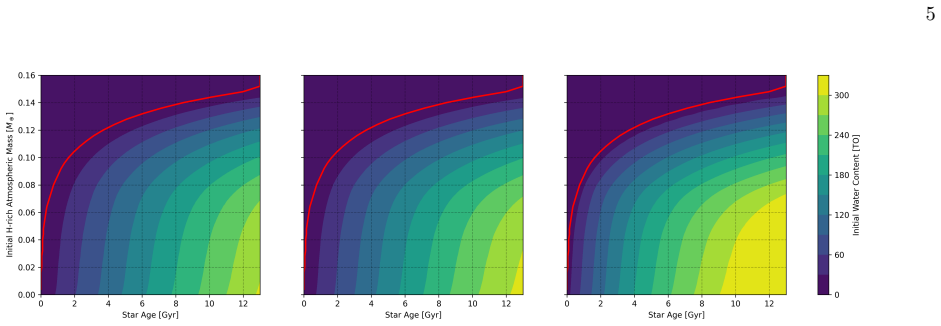
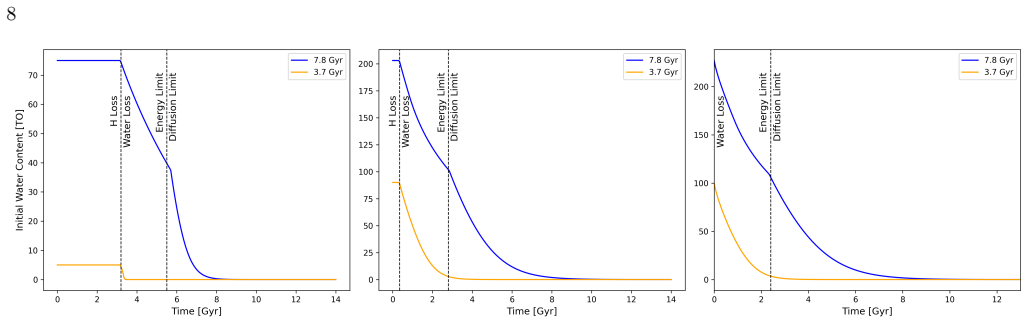
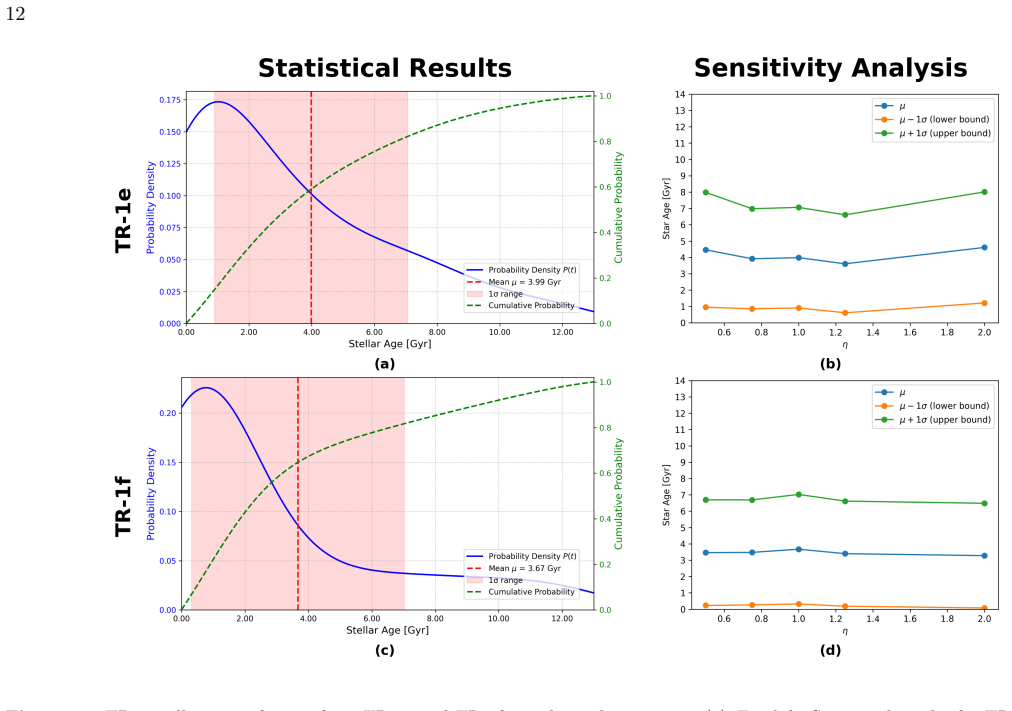
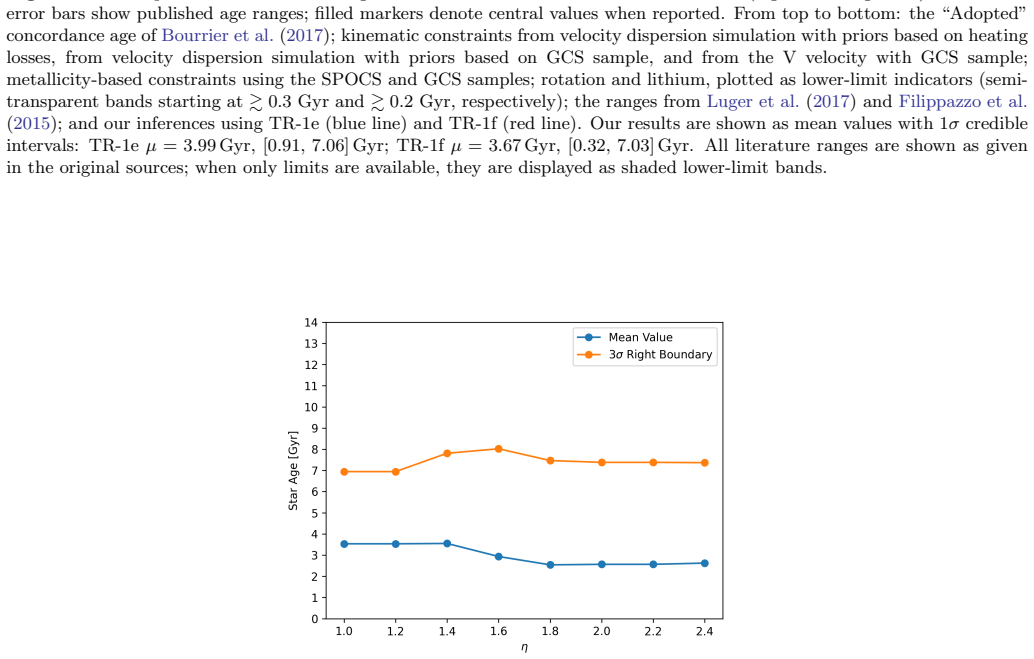
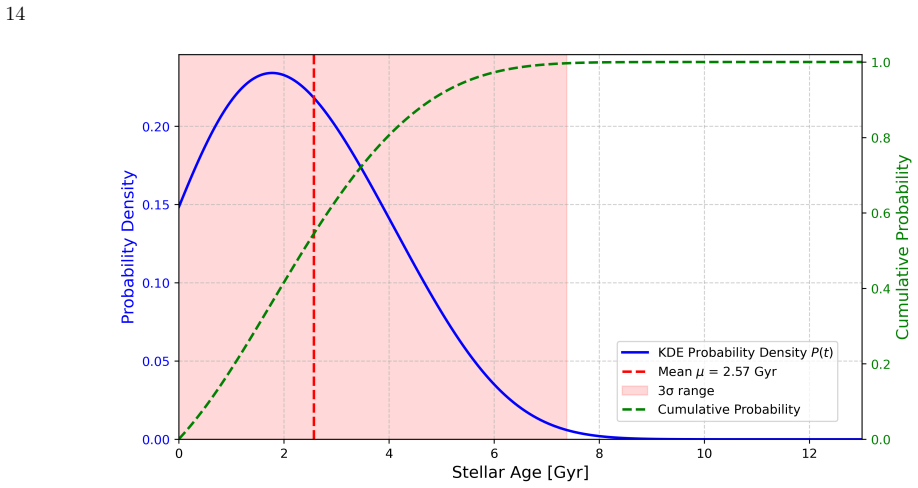
By scanning a broad parameter space across different stellar ages with VPLanet escape models, we invert for the initial hydrogen-rich atmospheric mass and water inventory consistent with the current water content implied by bulk density measurements. Our results reveal a strong degeneracy between the water reservoir and the initial hydrogen-rich atmosphere. Even a modest hydrogen-rich atmosphere can significantly delay early escape of the water and reduce the water inventory required to reproduce the current water content. The inferred initial conditions are also strongly age dependent, and incorporating a planet formation dataset as a prior yields an expected host star age of 2.90^{+2.47}_{
What carries the argument
VPLanet simulation of sequential loss from an initial hydrogen-rich atmosphere followed by a water-dominated atmosphere, used to invert initial masses from present-day bulk density.
If this is right
- A range of initial water inventories can produce the observed density once a hydrogen envelope is included.
- The initial hydrogen and water amounts required change markedly with the planet's age.
- Planet formation priors can be combined with escape models to produce age estimates for M dwarf hosts.
- Interpreting bulk density as water content requires accounting for the full escape history.
Where Pith is reading between the lines
- Similar modeling on other close-in M dwarf planets could show that early hydrogen envelopes help many of them retain water.
- Bulk density alone may not pin down water content without independent constraints on atmospheric history.
- Future transmission spectra could test the degeneracy by searching for leftover hydrogen or water features.
- The derived age distribution offers a way to cross-check other techniques for dating M dwarfs.
Load-bearing premise
Bulk density measurements give an accurate and unique value for the planet's current water content, and the escape model includes every relevant physical process.
What would settle it
A direct measurement of current atmospheric composition or total mass that shows a water abundance or hydrogen remnant inconsistent with the escape histories predicted for the derived age and initial conditions.
Figures






read the original abstract
GJ~486b is a close-in planet orbiting an M dwarf and is therefore expected to have undergone strong atmospheric escape. Motivated by theoretical and observational studies on the constraints of its water and atmosphere, we investigate which combinations of an primordial hydrogen-rich atmosphere and water inventory could fit the current water content implied by bulk density measurements. We model the atmosphere escape using VPLanet, following the loss of an initial hydrogen-rich atmosphere and the subsequent escape of a water-dominated atmosphere. By scanning a broad parameter space across different stellar ages, we invert for the initial hydrogen-rich atmospheric mass and water inventory consistent with the current constraints. Our results reveal a strong degeneracy between the water reservoir and the initial hydrogen-rich atmosphere. Even a modest hydrogen-rich atmosphere can significantly delay early escape of the water and reduce the water inventory required to reproduce the current water content. We also find that the inferred initial conditions are also strongly age dependent. Incorporating a planet formation dataset as a prior, we derive a probabilistic constraint on the host star age, yielding an expected age of $2.90^{+2.47}_{-2.27}$~Gyr, which is consistent with the results obtained from other methods to determine M dwarf ages.
Editorial analysis
A structured set of objections, weighed in public.
Referee Report
Summary. The paper models atmospheric escape for GJ 486b using VPLanet to invert for initial hydrogen-rich atmosphere mass and water inventory that evolve to match the current water content implied by bulk density. It reports a strong degeneracy in which modest initial H-rich envelopes delay water loss, lowering the required initial water mass, and derives a stellar age of 2.90^{+2.47}_{-2.27} Gyr by using a planet-formation dataset as a prior.
Significance. If robust, the degeneracy result would show that primordial H-rich atmospheres can substantially alter water retention timelines for close-in M-dwarf planets, with implications for interpreting density-derived compositions. The age posterior being consistent with independent M-dwarf methods is a modest positive contribution, though the overall impact is limited by the fixed nature of the inversion target.
major comments (2)
- [Inversion setup and target definition (abstract and methods)] The inversion target (current water content) is derived from bulk density under fixed core properties without marginalizing over core iron fraction or mantle Fe/Si variations. For a ~2.8 R⊕ planet at fixed mass and radius, water mass fraction trades directly with core composition in standard two- or three-layer interior models; this assumption is load-bearing for the claimed degeneracy and reduced water inventory.
- [Atmospheric escape modeling and results] No validation, sensitivity tests, or error propagation for the VPLanet escape rates (including possible missing physics such as outgassing or magnetic effects) are described, leaving the quantitative delay in water escape and the age posterior sensitive to untested model assumptions.
minor comments (1)
- [Abstract and §3] The abstract and text could more explicitly state the scanned ranges for initial H mass and water inventory and the precise density-derived water fraction used as the matching target.
Simulated Author's Rebuttal
We thank the referee for their constructive and detailed comments on our manuscript. We have addressed each major point below, clarifying our assumptions and adding material to the revised version where the concerns are valid. Our responses focus on the scientific content and limitations of the current analysis.
read point-by-point responses
-
Referee: [Inversion setup and target definition (abstract and methods)] The inversion target (current water content) is derived from bulk density under fixed core properties without marginalizing over core iron fraction or mantle Fe/Si variations. For a ~2.8 R⊕ planet at fixed mass and radius, water mass fraction trades directly with core composition in standard two- or three-layer interior models; this assumption is load-bearing for the claimed degeneracy and reduced water inventory.
Authors: We agree that the current water mass fraction is estimated using a standard two-layer interior model with fixed core iron fraction, without marginalizing over core composition or mantle Fe/Si ratio. This is a common simplification in mass-radius composition studies for super-Earths, but it does introduce a direct trade-off. In the revised manuscript we have expanded the methods section to state the exact core parameters adopted and added a dedicated paragraph in the discussion quantifying how plausible variations in core iron fraction (e.g., 0.2–0.4) would shift the target water inventory by up to ~30 %. We show that the reported degeneracy between initial H-rich envelope mass and water reservoir remains present across this range, although the absolute water masses change. Full Bayesian marginalization over interior parameters is noted as future work requiring a coupled interior-atmosphere code. revision: partial
-
Referee: [Atmospheric escape modeling and results] No validation, sensitivity tests, or error propagation for the VPLanet escape rates (including possible missing physics such as outgassing or magnetic effects) are described, leaving the quantitative delay in water escape and the age posterior sensitive to untested model assumptions.
Authors: VPLanet’s escape modules have been benchmarked in the literature against other codes and applied to similar M-dwarf planets. Our original grid already spans a wide range of XUV fluxes and efficiencies, providing a basic robustness check. Nevertheless, we accept that explicit sensitivity tests and discussion of omitted physics were missing. The revised manuscript now includes (i) a new limitations subsection describing the potential roles of outgassing and planetary magnetic fields, (ii) additional VPLanet runs varying escape efficiency by ±50 % and XUV saturation time, and (iii) a statement that the age posterior width already incorporates Monte-Carlo sampling over the prior and escape parameters. These additions demonstrate that the qualitative degeneracy result is insensitive to the tested variations, while acknowledging that a full propagation including magnetic suppression would require new model development. revision: yes
Circularity Check
No significant circularity; derivation is self-contained
full rationale
The paper uses the external VPLanet code to forward-model atmospheric escape and performs a parameter scan over initial hydrogen-rich atmosphere mass and water inventory to identify combinations consistent with the current water content inferred from bulk density. This is a standard inversion procedure whose outputs are not forced by construction or renamed fits. The age posterior is obtained by applying an external planet formation dataset as prior and is reported as consistent with independent M-dwarf age methods. No self-definitional equations, fitted inputs presented as predictions, load-bearing self-citations, uniqueness theorems imported from the same authors, or smuggled ansatzes appear in the derivation chain. The reported degeneracy is a model-derived outcome rather than an imposed identity.
Axiom & Free-Parameter Ledger
free parameters (3)
- initial hydrogen-rich atmospheric mass
- initial water inventory
- stellar age
axioms (2)
- domain assumption VPLanet correctly implements the physics of hydrogen and subsequent water atmospheric escape
- domain assumption Bulk density measurements yield a reliable estimate of the planet's current water mass fraction
Reference graph
Works this paper leans on
-
[1]
Adibekyan, V., Dorn, C., Sousa, S. G., et al. 2021, Science, 374, 330, doi: 10.1126/science.abg8794
-
[2]
Agol, E., Dorn, C., Grimm, S. L., et al. 2021, PSJ, 2, 1, doi: 10.3847/PSJ/abd022
-
[3]
2005, A&A, 434, 343, doi: 10.1051/0004-6361:20042032
Alibert, Y., Mordasini, C., Benz, W., & Winisdoerffer, C. 2005, A&A, 434, 343, doi: 10.1051/0004-6361:20042032
-
[4]
Ansdell, M., Williams, J. P., Trapman, L., et al. 2018, ApJ, 859, 21, doi: 10.3847/1538-4357/aab890 20 Astropy Collaboration, Robitaille, T. P., Tollerud, E. J., et al. 2013, A&A, 558, A33, doi: 10.1051/0004-6361/201322068 Astropy Collaboration, Price-Whelan, A. M., Sip˝ ocz, B. M., et al. 2018, AJ, 156, 123, doi: 10.3847/1538-3881/aabc4f
-
[5]
Ballester, G. E., & Ben-Jaffel, L. 2015, ApJ, 804, 116, doi: 10.1088/0004-637X/804/2/116
-
[6]
Baraffe, I., Homeier, D., Allard, F., & Chabrier, G. 2015, A&A, 577, A42, doi: 10.1051/0004-6361/201425481
-
[7]
2020, PASP, 132, 024502, doi: 10.1088/1538-3873/ab3ce8
Barnes, R., Luger, R., Deitrick, R., et al. 2020, PASP, 132, 024502, doi: 10.1088/1538-3873/ab3ce8
-
[8]
2021, Astrobiology, 21, 1325, doi: 10.1089/ast.2020.2277
Barth, P., Carone, L., Barnes, R., et al. 2021, Astrobiology, 21, 1325, doi: 10.1089/ast.2020.2277
-
[9]
Bensby, T., Feltzing, S., & Oey, M. S. 2014, A&A, 562, A71, doi: 10.1051/0004-6361/201322631
-
[10]
2014, in Protostars and Planets VI, ed
Benz, W., Ida, S., Alibert, Y., Lin, D., & Mordasini, C. 2014, in Protostars and Planets VI, ed. H. Beuther, R. S
2014
-
[11]
Klessen, C. P. Dullemond, & T. Henning, 691–713, doi: 10.2458/azu uapress 9780816531240-ch030
-
[12]
Birky, J., Barnes, R., & Fleming, D. P. 2021, Research Notes of the American Astronomical Society, 5, 122, doi: 10.3847/2515-5172/ac034c
-
[13]
Bolmont, E., Selsis, F., Owen, J. E., et al. 2017, MNRAS, 464, 3728, doi: 10.1093/mnras/stw2578
-
[14]
2013, A&A, 551, A63, doi: 10.1051/0004-6361/201220533
Bourrier, V., Lecavelier des Etangs, A., Dupuy, H., et al. 2013, A&A, 551, A63, doi: 10.1051/0004-6361/201220533
-
[15]
Bourrier, V., Ehrenreich, D., Wheatley, P. J., et al. 2017, A&A, 599, L3, doi: 10.1051/0004-6361/201630238
-
[16]
Burgasser, A. J., & Mamajek, E. E. 2017, ApJ, 845, 110, doi: 10.3847/1538-4357/aa7fea
-
[17]
A., Gonz´ alez-´Alvarez, E., Brady, M., et al
Caballero, J. A., Gonz´ alez-´Alvarez, E., Brady, M., et al. 2022, A&A, 665, A120, doi: 10.1051/0004-6361/202243548
-
[18]
Cantrell, J. R., Henry, T. J., & White, R. J. 2013, AJ, 146, 99, doi: 10.1088/0004-6256/146/4/99 Chassefi` ere, E. 1996, Icarus, 124, 537, doi: 10.1006/icar.1996.0229
-
[19]
2021a, ApJ, 909, 115, doi: 10.3847/1538-4357/abd5be
Chen, D.-C., Xie, J.-W., Zhou, J.-L., et al. 2021a, ApJ, 909, 115, doi: 10.3847/1538-4357/abd5be
-
[20]
2021b, AJ, 162, 100, doi: 10.3847/1538-3881/ac0f08
Chen, D.-C., Yang, J.-Y., Xie, J.-W., et al. 2021b, AJ, 162, 100, doi: 10.3847/1538-3881/ac0f08
-
[21]
Diamond-Lowe, H., King, G. W., Youngblood, A., et al. 2024, A&A, 689, A48, doi: 10.1051/0004-6361/202450107
-
[22]
2021, A&A, 656, A69, doi: 10.1051/0004-6361/202038553
Emsenhuber, A., Mordasini, C., Burn, R., et al. 2021a, A&A, 656, A69, doi: 10.1051/0004-6361/202038553 —. 2021b, A&A, 656, A70, doi: 10.1051/0004-6361/202038863
-
[23]
Engle, S. G., & Guinan, E. F. 2023, ApJL, 954, L50, doi: 10.3847/2041-8213/acf472
-
[24]
Erkaev, N. V., Kulikov, Y. N., Lammer, H., et al. 2007, A&A, 472, 329, doi: 10.1051/0004-6361:20066929
-
[25]
Filippazzo, J. C., Rice, E. L., Faherty, J., et al. 2015, ApJ, 810, 158, doi: 10.1088/0004-637X/810/2/158
-
[26]
Gialluca, M. T., Barnes, R., Meadows, V. S., et al. 2024, PSJ, 5, 137, doi: 10.3847/PSJ/ad4454
-
[27]
Greene, T. P., Bell, T. J., Ducrot, E., et al. 2023, Nature, 618, 39, doi: 10.1038/s41586-023-05951-7
-
[28]
Guo, J. H. 2019, ApJ, 872, 99, doi: 10.3847/1538-4357/aaffd4 —. 2024, Nature Astronomy, 8, 920, doi: 10.1038/s41550-024-02269-w
-
[29]
Harris, C. R., Millman, K. J., van der Walt, S. J., et al. 2020, Nature, 585, 357, doi: 10.1038/s41586-020-2649-2
-
[30]
Hunten, D. M., Pepin, R. O., & Walker, J. C. G. 1987, Icarus, 69, 532, doi: 10.1016/0019-1035(87)90022-4
-
[31]
Hunter, J. D. 2007, Computing in Science & Engineering, 9, 90, doi: 10.1109/MCSE.2007.55
-
[32]
Kimura, T., & Ikoma, M. 2022, Nature Astronomy, 6, 1296, doi: 10.1038/s41550-022-01781-1
-
[33]
Kulow, J. R., France, K., Linsky, J., & Loyd, R. O. P. 2014, ApJ, 786, 132, doi: 10.1088/0004-637X/786/2/132
-
[34]
2019, A&A, 631, A47, doi: 10.1051/0004-6361/201935234
Kushniruk, I., & Bensby, T. 2019, A&A, 631, A47, doi: 10.1051/0004-6361/201935234
-
[35]
Lammer, H., Erkaev, N. V., Odert, P., et al. 2013, MNRAS, 430, 1247, doi: 10.1093/mnras/sts705 L´ eger, A., Rouan, D., Schneider, J., et al. 2009, A&A, 506, 287, doi: 10.1051/0004-6361/200911933
-
[36]
Lichtenegger, H. I. M., Kislyakova, K. G., Odert, P., et al. 2016, Journal of Geophysical Research (Space Physics), 121, 4718, doi: 10.1002/2015JA022226
-
[37]
Lopez, E. D., Fortney, J. J., & Miller, N. 2012, ApJ, 761, 59, doi: 10.1088/0004-637X/761/1/59
-
[38]
2015, Astrobiology, 15, 119, doi: 10.1089/ast.2014.1231
Luger, R., & Barnes, R. 2015, Astrobiology, 15, 119, doi: 10.1089/ast.2014.1231
-
[39]
2017, Nature Astronomy, 1, 0129, doi: 10.1038/s41550-017-0129
Luger, R., Sestovic, M., Kruse, E., et al. 2017, Nature Astronomy, 1, 0129, doi: 10.1038/s41550-017-0129
-
[40]
Lustig-Yaeger, J., Fu, G., May, E. M., et al. 2023, Nature Astronomy, 7, 1317, doi: 10.1038/s41550-023-02064-z
-
[41]
Mamajek, E. E. 2009, in American Institute of Physics Conference Series, Vol. 1158, Exoplanets and Disks: Their Formation and Diversity, ed. T. Usuda, M. Tamura, & M. Ishii, 3–10, doi: 10.1063/1.3215910
-
[42]
2019, Icarus, 321, 379, doi: 10.1016/j.icarus.2018.11.017
Masunaga, K., Futaana, Y., Persson, M., et al. 2019, Icarus, 321, 379, doi: 10.1016/j.icarus.2018.11.017
-
[43]
Moore, K., Cowan, N. B., & Boukar´ e, C.-´E. 2023, MNRAS, 526, 6235, doi: 10.1093/mnras/stad3138
-
[44]
Moran, S. E., Stevenson, K. B., Sing, D. K., et al. 2023, ApJL, 948, L11, doi: 10.3847/2041-8213/accb9c 21
-
[45]
2012, A&A, 547, A111, doi: 10.1051/0004-6361/201118457
Mordasini, C., Alibert, Y., Klahr, H., & Henning, T. 2012, A&A, 547, A111, doi: 10.1051/0004-6361/201118457
-
[46]
2023, Icarus, 393, 114610, doi: 10.1016/j.icarus.2021.114610 Oklopˇ ci´ c, A., & Hirata, C
Nilsson, H., Zhang, Q., Stenberg Wieser, G., et al. 2023, Icarus, 393, 114610, doi: 10.1016/j.icarus.2021.114610 Oklopˇ ci´ c, A., & Hirata, C. M. 2018, ApJL, 855, L11, doi: 10.3847/2041-8213/aaada9 O’Malley-James, J. T., & Kaltenegger, L. 2017, MNRAS, 469, L26, doi: 10.1093/mnrasl/slx047
-
[47]
2011, Journal of Machine Learning Research, 12, 2825 Ribas, ´A., Mer´ ın, B., Bouy, H., & Maud, L
Pedregosa, F., Varoquaux, G., Gramfort, A., et al. 2011, Journal of Machine Learning Research, 12, 2825 Ribas, ´A., Mer´ ın, B., Bouy, H., & Maud, L. T. 2014, A&A, 561, A54, doi: 10.1051/0004-6361/201322597
-
[48]
Ribas, I., Guinan, E. F., G¨ udel, M., & Audard, M. 2005, ApJ, 622, 680, doi: 10.1086/427977
-
[49]
K., Majumdar, L., Mridha, S., & Krishna, H
Sahu, C. K., Majumdar, L., Mridha, S., & Krishna, H. 2025, ApJ, 981, 80, doi: 10.3847/1538-4357/adabbe
-
[50]
Sasselov, D. 2016, ApJ, 829, 63, doi: 10.3847/0004-637X/829/2/63
-
[51]
2024, arXiv e-prints, arXiv:2412.05258, doi: 10.48550/arXiv.2412.05258
Schulik, M., & Owen, J. 2024, arXiv e-prints, arXiv:2412.05258, doi: 10.48550/arXiv.2412.05258
- [52]
-
[53]
Scott, D. W. 2015, Multivariate Density Estimation:
2015
-
[54]
Silverman, B. W. 1986, Density estimation for statistics and data analysis, CRC Press
1986
-
[55]
Spake, J. J., Sing, D. K., Evans, T. M., et al. 2018, Nature, 557, 68, doi: 10.1038/s41586-018-0067-5 St¨ okl, A., Dorfi, E. A., Johnstone, C. P., & Lammer, H. 2016, ApJ, 825, 86, doi: 10.3847/0004-637X/825/2/86
-
[56]
Tarter, J. C., Backus, P. R., Mancinelli, R. L., et al. 2007, Astrobiology, 7, 30, doi: 10.1089/ast.2006.0124
-
[57]
Trifonov, T., Caballero, J. A., Morales, J. C., et al. 2021, Science, 371, 1038, doi: 10.1126/science.abd7645
-
[58]
, year = 2003, month = mar, volume = 422, pages =
Vidal-Madjar, A., Lecavelier des Etangs, A., D´ esert, J. M., et al. 2003, Nature, 422, 143, doi: 10.1038/nature01448
-
[59]
Virtanen, P., Gommers, R., Oliphant, T. E., et al. 2020, Nature Methods, 17, 261, doi: 10.1038/s41592-019-0686-2
-
[60]
Volkov, A. N., & Johnson, R. E. 2013, ApJ, 765, 90, doi: 10.1088/0004-637X/765/2/90
-
[61]
Watson, A. J., Donahue, T. M., & Walker, J. C. G. 1981, Icarus, 48, 150, doi: 10.1016/0019-1035(81)90101-9 Weiner Mansfield, M., Xue, Q., Zhang, M., et al. 2024, ApJL, 975, L22, doi: 10.3847/2041-8213/ad8161
-
[62]
2024, Research in Astronomy and Astrophysics, 24, 065022, doi: 10.1088/1674-4527/ad47de
Xing, L., Guo, J., Yang, C., & Yan, D. 2024, Research in Astronomy and Astrophysics, 24, 065022, doi: 10.1088/1674-4527/ad47de
-
[63]
2023, ApJ, 953, 166, doi: 10.3847/1538-4357/ace43f
Xing, L., Yan, D., & Guo, J. 2023, ApJ, 953, 166, doi: 10.3847/1538-4357/ace43f
-
[64]
2023, AJ, 166, 243, doi: 10.3847/1538-3881/ad0368
Yang, J.-Y., Chen, D.-C., Xie, J.-W., et al. 2023, AJ, 166, 243, doi: 10.3847/1538-3881/ad0368
-
[65]
2023, Nature, 620, 746, doi: 10.1038/s41586-023-06232-z
Zieba, S., Kreidberg, L., Ducrot, E., et al. 2023, Nature, 620, 746, doi: 10.1038/s41586-023-06232-z
discussion (0)
Sign in with ORCID, Apple, or X to comment. Anyone can read and Pith papers without signing in.