Protecting Quantum Simulations of Lattice Gauge Theories through Engineered Emergent Hierarchical Symmetries
Pith reviewed 2026-05-10 16:01 UTC · model grok-4.3
The pith
Floquet engineering can restructure errors in quantum simulations so that emergent symmetries appear hierarchically in time and protect the target gauge sector of U(1) lattice gauge theories.
A machine-rendered reading of the paper's core claim, the machinery that carries it, and where it could break.
Core claim
Applying a carefully chosen Floquet drive restructures departures from the target sector into a time-ordered hierarchy of emergent local symmetries; the resulting dynamical selection rules strongly restrict inter-sector couplings and thereby create a symmetry-controlled hierarchy of lifetimes in which the target sector remains long-lived while other sectors destabilize on shorter timescales.
What carries the argument
The Floquet-engineering framework that induces a controllable series of emergent local symmetries hierarchically in time.
If this is right
- U(1) lattice gauge theories acquire a protected target sector whose violations are suppressed on long timescales.
- Some gauge sectors remain very long-lived while others decay faster, establishing a controllable lifetime hierarchy.
- Gauge-violating defects become mobile only with assistance from intra-sector dynamics, as captured by an effective quantum marble model.
- The same mechanism supplies a form of passive error correction for approximate implementations of local symmetries in many-body simulations.
Where Pith is reading between the lines
- The approach could be tested in existing trapped-ion or superconducting-qubit platforms by monitoring sector populations under periodic driving.
- Similar hierarchical driving might extend coherence in other constrained systems such as Rydberg-atom arrays or Hubbard models with approximate conservation laws.
- Combining the emergent-symmetry protection with existing active error-correction protocols could yield multiplicative gains in simulation lifetime.
Load-bearing premise
The periodic driving can be realized with enough experimental precision to establish the intended hierarchy of emergent symmetries without introducing uncontrolled decoherence or extra errors that destroy the timescale separation.
What would settle it
In the one-dimensional U(1) quantum link model, measure the population decay rates out of the target gauge sector under the proposed drive and check whether the observed lifetimes follow the predicted symmetry-controlled hierarchy.
Figures


read the original abstract
We present a strategy for the quantum simulation of many-body lattice models with constrained Hilbert spaces. We focus on lattice gauge theories (LGTs), which underlie a wide range of phenomena in particle physics, condensed matter, and quantum information. In present-day quantum computing platforms, perfect restrictions of the Hilbert space to the desired gauge sectors are beyond reach: for LGTs, violations of the local constraint are unavoidable, posing a formidable challenge for the emulation of the underlying physics. Here, we develop a Floquet-engineering framework that restructures departures from a target sector such that a series of emergent local symmetries occurs hierarchically in time and in a controllable way. This leads to a set of approximate dynamical selection rules that strongly restrict inter-sector couplings, resulting in a pronounced, symmetry-controlled hierarchy of lifetimes for the state population to spread among sectors. Concretely, this protects $U(1)$ LGTs against violations of the {defining} local symmetry. While some sectors remain very long-lived, others are destabilized on shorter timescales. We numerically verify our theory for the one-dimensional $U(1)$ quantum link model. In addition, we reveal that `defects', whose movement accounts for violations of the gauge constraint, are kinetically constrained, becoming mobile only through the assistance of intra-sector dynamics, which we describe using an effective quantum marble model. Our results can thus be used to extend the lifetime, in the spirit of passive error correction, of quantum simulations of complex many-body problems when emergent or desired local symmetries are only implemented approximately.
Editorial analysis
A structured set of objections, weighed in public.
Referee Report
Summary. The manuscript develops a Floquet-engineering framework that imposes a controllable temporal hierarchy of emergent local symmetries on departures from a target gauge sector in lattice gauge theories. This generates approximate dynamical selection rules that restrict inter-sector couplings and produce a symmetry-controlled hierarchy of state lifetimes. The approach is applied to protect U(1) LGTs against local gauge violations; it is numerically verified for the one-dimensional U(1) quantum link model and supplemented by an effective quantum marble model that accounts for the kinetic constraints on defect motion.
Significance. If the central claims hold, the work provides a concrete passive-error-correction strategy for quantum simulations of constrained many-body systems. By converting uncontrolled gauge violations into a tunable hierarchy of lifetimes rather than demanding perfect Hilbert-space restrictions, the method is directly relevant to current quantum hardware. The combination of Floquet analysis, explicit 1D numerics, and a reduced effective model for defects constitutes a reproducible and falsifiable contribution that could guide experimental implementations.
minor comments (3)
- Abstract, line containing 'violations of the {defining} local symmetry': the curly braces appear to be a LaTeX artifact and should be removed for readability.
- Numerical verification section: while the abstract states that the theory is verified for the 1D U(1) quantum link model, the manuscript would benefit from explicit reporting of system sizes, driving frequencies, and quantitative measures (e.g., extracted lifetime ratios with error bars) to allow independent assessment of the timescale separation.
- Effective marble model: the derivation of the kinetic constraints on defects is only sketched; a short appendix or paragraph clarifying the mapping from the microscopic Floquet Hamiltonian to the marble dynamics would improve transparency.
Simulated Author's Rebuttal
We thank the referee for their careful reading and positive assessment of our manuscript. The summary accurately reflects our Floquet-engineering approach to creating a temporal hierarchy of emergent local symmetries that protect U(1) lattice gauge theories against gauge violations. We appreciate the recognition of the method's relevance to current quantum hardware and the combination of analytical, numerical, and effective-model results. Since the report raises no specific major comments or requests for changes, we have no point-by-point revisions to address.
Circularity Check
No significant circularity detected
full rationale
The paper's central derivation introduces a Floquet-engineering protocol that imposes a controllable temporal hierarchy of emergent local symmetries on departures from the target gauge sector. This is constructed from standard Floquet theory and symmetry considerations, then verified by independent 1D quantum-link-model numerics and an effective marble model for defect mobility. No load-bearing step reduces by construction to a fitted parameter, self-definition, or self-citation chain; the approximate dynamical selection rules and lifetime hierarchy follow directly from the engineered driving Hamiltonian without presupposing the target protection result.
Axiom & Free-Parameter Ledger
axioms (2)
- standard math Floquet theory applies to periodically driven quantum many-body systems and generates effective time-dependent symmetries
- domain assumption Local gauge constraints define the target sectors whose violations can be restructured by driving
Reference graph
Works this paper leans on
-
[1]
The Fundamental Research Funds for the Central Universities, Peking Univer- sity
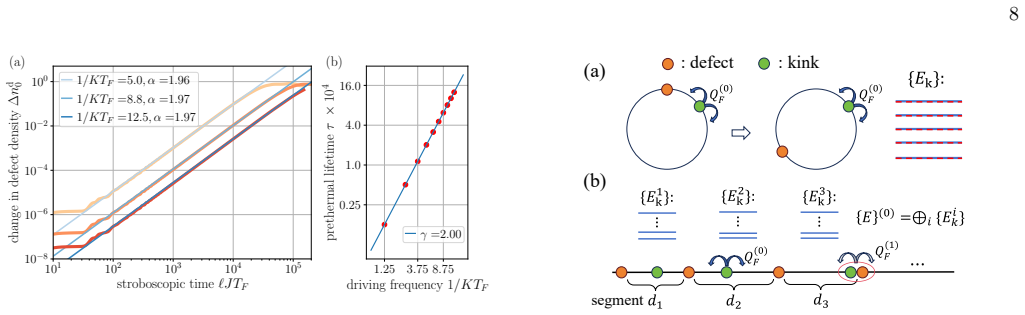
Over a long time scale, the defect density exhibits an al- gebraic scaling ∆n d j ∼t α at sitej= 0, whereαis close to 2. (b) Scaling of the lifetime of theU(1) local prethermal plateau with respect to the driving frequencyτ∼T −γ F . The life- time is defined as the time forn d j decays toe −0.4. Combining the results in (a) and (b), the dynamics show that...
work page 2026
-
[2]
J. B. Kogut, An introduction to lattice gauge theory and spin systems, Reviews of Modern Physics51, 659 (1979)
work page 1979
-
[3]
F. J. Wegner, Duality in generalized ising models and phase transitions without local order parameters, Journal of Mathematical Physics12, 2259 (1971)
work page 1971
-
[4]
P. W. Anderson, The resonating valence bond state in 10 la2cuo4 and superconductivity, science235, 1196 (1987)
work page 1987
-
[5]
S. A. Kivelson, D. S. Rokhsar, and J. P. Sethna, Topology of the resonating valence-bond state: Solitons and high-t c superconductivity, Physical Review B35, 8865 (1987)
work page 1987
-
[6]
S. C. Zhang, T. H. Hansson, and S. Kivelson, Effective- field-theory model for the fractional quantum hall effect, Physical review letters62, 82 (1989)
work page 1989
-
[7]
C. Castelnovo, R. Moessner, and S. L. Sondhi, Magnetic monopoles in spin ice, Nature451, 42 (2008)
work page 2008
-
[8]
K. A. Ross, L. Savary, B. D. Gaulin, and L. Balents, Quantum excitations in quantum spin ice, Physical Re- view X1, 021002 (2011)
work page 2011
-
[9]
A. Y. Kitaev, Fault-tolerant quantum computation by anyons, Annals of physics303, 2 (2003)
work page 2003
-
[10]
H. Bombin and M. A. Martin-Delgado, Topological quantum distillation, Physical review letters97, 180501 (2006)
work page 2006
- [11]
- [12]
-
[13]
D. A. Lidar and T. A. Brun, Quantum error correction (Cambridge university press, 2013)
work page 2013
- [14]
-
[15]
G. Cassella, P. d’Ornellas, T. Hodson, W. M. Natori, and J. Knolle, An exact chiral amorphous spin liquid, Nature Communications14, 6663 (2023)
work page 2023
- [16]
-
[17]
Indeed, there is some non-uniformity with respect to nomenclature here. The sectors obeying Gauss’ law may or may not include gauge charges as sources and sinks of gauge flux. These charges may or may not be mobile. In cases where Gauss’ law is violated, one can retain the language of charges by assigning so-called background charges, the presence of whic...
-
[18]
Y. Cheng and H. Zhai, Emergent u (1) lattice gauge the- ory in rydberg atom arrays, Nature Reviews Physics6, 566 (2024)
work page 2024
-
[19]
J. C. Halimeh, M. Aidelsburger, F. Grusdt, P. Hauke, and B. Yang, Cold-atom quantum simulators of gauge theories, Nature Physics21, 25 (2025)
work page 2025
-
[20]
D. Banerjee, M. B¨ ogli, M. Dalmonte, E. Rico, P. Stebler, U.-J. Wiese, and P. Zoller, Atomic quantum simulation of u (n) and su (n) non-abelian lattice gauge theories, Physical review letters110, 125303 (2013)
work page 2013
- [21]
-
[22]
L. Tagliacozzo, A. Celi, P. Orland, M. Mitchell, and M. Lewenstein, Simulation of non-abelian gauge theo- ries with optical lattices, Nature communications4, 2615 (2013)
work page 2013
- [23]
-
[24]
E. A. Martinez, C. A. Muschik, P. Schindler, D. Nigg, A. Erhard, M. Heyl, P. Hauke, M. Dalmonte, T. Monz, P. Zoller, et al., Real-time dynamics of lattice gauge the- ories with a few-qubit quantum computer, Nature534, 516 (2016)
work page 2016
-
[25]
C. Schweizer, F. Grusdt, M. Berngruber, L. Barbiero, E. Demler, N. Goldman, I. Bloch, and M. Aidelsburger, Floquet approach toZ 2 lattice gauge theories with ultra- cold atoms in optical lattices, Nature Physics15, 1168 (2019)
work page 2019
-
[26]
F. M. Surace, P. P. Mazza, G. Giudici, A. Lerose, A. Gambassi, and M. Dalmonte, Lattice gauge theories and string dynamics in rydberg atom quantum simula- tors, Physical Review X10, 021041 (2020)
work page 2020
-
[27]
D. Luo, G. Carleo, B. K. Clark, and J. Stokes, Gauge equivariant neural networks for quantum lattice gauge theories, Physical review letters127, 276402 (2021)
work page 2021
-
[28]
Z.-Y. Zhou, G.-X. Su, J. C. Halimeh, R. Ott, H. Sun, P. Hauke, B. Yang, Z.-S. Yuan, J. Berges, and J.-W. Pan, Thermalization dynamics of a gauge theory on a quantum simulator, Science377, 311 (2022)
work page 2022
-
[29]
N. Mueller, T. V. Zache, and R. Ott, Thermalization of gauge theories from their entanglement spectrum, Phys- ical Review Letters129, 011601 (2022)
work page 2022
-
[30]
B. Buˇ ca, Unified theory of local quantum many-body dy- namics: Eigenoperator thermalization theorems, Physi- cal Review X13, 031013 (2023)
work page 2023
-
[31]
L. Homeier, A. Bohrdt, S. Linsel, E. Demler, J. C. Hal- imeh, and F. Grusdt, Realistic scheme for quantum simu- lation ofZ 2 lattice gauge theories with dynamical matter in (2+1) d, Communications Physics6, 127 (2023)
work page 2023
-
[32]
B.-Y. Sun, N. Goldman, M. Aidelsburger, and M. Bukov, Engineering and probing non-abelian chiral spin liquids using periodically driven ultracold atoms, PRX Quantum 4, 020329 (2023)
work page 2023
-
[33]
H.-K. Jin, J. Knolle, and M. Knap, Fractionalized prethermalization in a driven quantum spin liquid, Phys- ical Review Letters130, 226701 (2023)
work page 2023
-
[34]
E. C. Domanti, D. Zappal` a, A. Bermudez, and L. Amico, Floquet-rydberg quantum simulator for confinement in Z2 gauge theories, Physical Review Research6, L022059 (2024)
work page 2024
-
[35]
M. Meth, J. Zhang, J. F. Haase, C. Edmunds, L. Postler, A. J. Jena, A. Steiner, L. Dellantonio, R. Blatt, P. Zoller, et al., Simulating two-dimensional lattice gauge theories on a qudit quantum computer, Nature Physics , 1 (2025)
work page 2025
- [36]
-
[37]
M. Will, T. Cochran, E. Rosenberg, B. Jobst, N. M. Eassa, P. Roushan, M. Knap, A. Gammon-Smith, and F. Pollmann, Probing non-equilibrium topological order on a quantum processor, Nature645, 348 (2025)
work page 2025
-
[38]
N. Mueller, T. Wang, O. Katz, Z. Davoudi, and M. Cetina, Quantum computing universal thermalization dynamics in a (2+ 1) d lattice gauge theory, Nature Com- munications16, 5492 (2025)
work page 2025
-
[39]
Y.-M. Hu, Z. Wang, B. Lian, and Z. Wang, Many-body non-hermitian skin effect with exact steady states in the dissipative quantum link model, Physical Review Letters 135, 260401 (2025)
work page 2025
-
[40]
P. R. Datla, L. Zhao, W. W. Ho, N. Klco, and H. Loh, Statistical localization of u (1) lattice gauge theory in a 11 rydberg simulator, Nature Physics , 1 (2026)
work page 2026
-
[41]
J. Feldmeier, N. Maskara, N. U. K¨ oyl¨ uo˘ glu, and M. D. Lukin, Quantum simulation of dynamical gauge theo- ries in periodically driven rydberg atom arrays, arXiv preprint arXiv:2408.02733 (2024)
-
[42]
A. A. Geim, N. U. Koyluoglu, S. J. Evered, R. Sa- hay, S. H. Li, M. Xu, D. Bluvstein, N. O. Gjonbalaj, N. Maskara, M. Kalinowski, T. Manovitz, R. Verre- sen, S. F. Yelin, J. Feldmeier, M. Greiner, V. Vuletic, and M. D. Lukin, Engineering quantum criticality and dynamics on an analog-digital simulator (2026), arXiv:2602.18555 [quant-ph]
-
[43]
B. Yang, H. Sun, R. Ott, H.-Y. Wang, T. V. Zache, J. C. Halimeh, Z.-S. Yuan, P. Hauke, and J.-W. Pan, Observa- tion of gauge invariance in a 71-site bose–hubbard quan- tum simulator, Nature587, 392 (2020)
work page 2020
- [44]
- [45]
-
[46]
J. Mildenberger, W. Mruczkiewicz, J. C. Halimeh, Z. Jiang, and P. Hauke, Confinement in a z 2 lattice gauge theory on a quantum computer, Nature Physics 21, 312 (2025)
work page 2025
-
[47]
Concretely, we have [W j, HLGT] = 0, withW j =e −iθj Gj for anyjand an arbitrary angleθ j
-
[48]
In the presence of additional terms that break globalU(1) symmetry, it is also feasible to achieve HSB structure with potentially more complex driving protocols
-
[49]
The symmetry group here satisfiesU local(1)⊃Z local 2 × U(1) global ⊃E. In Floquet dynamics, due to the struc- ture of the effective Hamiltonian, the system sequentially enters prethermal plateaus that preserve the correspond- ing symmetry along the direction of the arrow
-
[50]
X. Mi, M. Ippoliti, C. Quintana, A. Greene, Z. Chen, J. Gross, F. Arute, K. Arya, J. Atalaya, R. Babbush, et al., Time-crystalline eigenstate order on a quantum processor, Nature601, 531 (2022)
work page 2022
-
[51]
W. Beatrez, C. Fleckenstein, A. Pillai, E. de Leon Sanchez, A. Akkiraju, J. Diaz Alcala, S. Conti, P. Reshetikhin, E. Druga, M. Bukov, et al., Critical prethermal discrete time crystal created by two-frequency driving, Nature Physics19, 407 (2023)
work page 2023
- [52]
-
[53]
P. T. Dumitrescu, J. G. Bohnet, J. P. Gaebler, A. Han- kin, D. Hayes, A. Kumar, B. Neyenhuis, R. Vasseur, and A. C. Potter, Dynamical topological phase realized in a trapped-ion quantum simulator, Nature607, 463 (2022)
work page 2022
-
[54]
Z. Fu, R. Moessner, H. Zhao, and M. Bukov, Engineering hierarchical symmetries, Physical Review X14, 041070 (2024)
work page 2024
-
[55]
For simplicity, here we focus on systems with open boundary conditions (OBC); generalization for periodic boundary conditions can be found in the Supplementary Material
- [56]
-
[57]
L. Homeier, A. Pizzi, H. Zhao, J. C. Halimeh, F. Grusdt, and A. M. Rey, Prethermal gauge structure and sur- face growth inZ 2 lattice gauge theories, arXiv preprint arXiv:2510.12800 (2025)
-
[58]
A. Hudomal, I. Vasi´ c, N. Regnault, and Z. Papi´ c, Quan- tum scars of bosons with correlated hopping, Communi- cations Physics3, 99 (2020)
work page 2020
-
[59]
C.-J. Lin, V. Calvera, and T. H. Hsieh, Quantum many- body scar states in two-dimensional rydberg atom arrays, Physical Review B101, 220304 (2020)
work page 2020
-
[60]
P. Sala, T. Rakovszky, R. Verresen, M. Knap, and F. Poll- mann, Ergodicity breaking arising from hilbert space fragmentation in dipole-conserving hamiltonians, Phys- ical Review X10, 011047 (2020)
work page 2020
-
[61]
S. Gopalakrishnan, D. A. Huse, V. Khemani, and R. Vasseur, Hydrodynamics of operator spreading and quasiparticle diffusion in interacting integrable systems, Physical Review B98, 220303 (2018)
work page 2018
-
[62]
B. Bertini, F. Heidrich-Meisner, C. Karrasch, T. Prosen, R. Steinigeweg, and M. ˇZnidariˇ c, Finite-temperature transport in one-dimensional quantum lattice models, Rev. Mod. Phys.93, 025003 (2021)
work page 2021
-
[63]
J. F. Wienand, S. Karch, A. Impertro, C. Schweizer, E. McCulloch, R. Vasseur, S. Gopalakrishnan, M. Aidels- burger, and I. Bloch, Emergence of fluctuating hydrody- namics in chaotic quantum systems, Nature Physics20, 1732 (2024)
work page 2024
-
[64]
I. Papaefstathiou, A. Smith, and J. Knolle, Disorder-free localization in a simple u (1) lattice gauge theory, Phys- ical Review B102, 165132 (2020)
work page 2020
-
[65]
P. A. McClarty, M. Haque, A. Sen, and J. Richter, Disorder-free localization and many-body quantum scars from magnetic frustration, Physical Review B102, 224303 (2020)
work page 2020
- [66]
-
[67]
J. C. Halimeh, L. Homeier, H. Zhao, A. Bohrdt, F. Grusdt, P. Hauke, and J. Knolle, Enhancing disorder- free localization through dynamically emergent local symmetries, PRX Quantum3, 020345 (2022)
work page 2022
-
[68]
N. Chakraborty, M. Heyl, P. Karpov, and R. Moessner, Disorder-free localization transition in a two-dimensional lattice gauge theory, Physical Review B106, L060308 (2022)
work page 2022
-
[69]
T. Pichler, M. Dalmonte, E. Rico, P. Zoller, and S. Mon- tangero, Real-time dynamics in u (1) lattice gauge theo- ries with tensor networks, Physical Review X6, 011023 (2016)
work page 2016
-
[70]
T. N. Ikeda and A. Polkovnikov, Fermi’s golden rule for heating in strongly driven floquet systems, Physical Re- view B104, 134308 (2021)
work page 2021
-
[71]
H.-C. Yeh, A. Rosch, and A. Mitra, Decay rates of almost strong modes in floquet spin chains beyond fermi’s golden rule, Physical Review B108, 075112 (2023). 1 Supplementary Material Protecting Quantum Simulations of Lattice Gauge Theories through Engineered Emergent Hierarchical Symmetries CONTENTS SM 1. Lattice gauge theory represented as a spin system ...
work page 2023
-
[72]
Open chains with single defect and kink 3
-
[73]
Mapping for closed chain and multiple defects and kinks 4
-
[74]
Floquet protocol for systems with general perturbation (h̸= 0) 6
Numerical results for multiple defects and kinks dynamics 5 SM 5. Floquet protocol for systems with general perturbation (h̸= 0) 6
-
[75]
Perturbation theory for the dynamics of local charge 8 SM 7
Effective Hamiltonian for the driving protocol 7 SM 6. Perturbation theory for the dynamics of local charge 8 SM 7. Generalization to arbitrary spin-S gauge fields 11 SM 1. LATTICE GAUGE THEORY REPRESENTED AS A SPIN SYSTEM The traditional fermionic lattice gauge theory [68] is described byH LGT =P j ψ† j Uj,j+1ψj+1 +h.c.Hereψ j (ψ† j) are fermionic annihi...
-
[76]
Open chains with single defect and kink We first show that under OBC the HamiltoniansH LGT andH 1 can be mapped to simple hopping models for the kink and defect by defining the creation operators for kinkκ † j and defect ∆ † j as Case 1 (defect on the left-hand side of kink):κ † j = L−1Y k=j τ + k,k+1σ+ j ,∆ † j = jY k=0 τ + k−1,kσ+ j Case 2 (defect on th...
-
[77]
Mapping for closed chain and multiple defects and kinks From the discussion in the main text, we know that the dynamics of the charges in the system underZlocal 2 symmetry are primarily described by the dynamics of kinks and defects. However, although the mapping of the operators defined 5 in the previous section is direct, it only works for the case with...
-
[78]
Specifically, we considerh= 0, and compare the dynamics of the effective Hamiltonian in Eq
Numerical results for multiple defects and kinks dynamics For systems with multiple defects and kinks, with exact mapping as above, our numerical results demonstrate that the QMM can still describe the early dynamics of such systems. Specifically, we considerh= 0, and compare the dynamics of the effective Hamiltonian in Eq. (S.11) with the corresponding Q...
-
[79]
The driving period isT F = 8(2+ J K )T
Driving protocol The explicit form of our driving protocol is U0 =e −iH J+K K T , U1 =P z† τ P x† τ e−iHT P x τ P z τ ≡e −iH(1)T , U2 =P z† τ P z† σ e−iH J K T P z σ P z τ ≡e −iH(2) J+K K T ,(S.20) U3 =P x† τ P z† σ e−iHT P z σ P x τ ≡e −iH(3)T , UF =U 0U1U2U3U2U3U0U1 ≡e −iQF TF , whereH=J H LGT +KH 1 +hH 0,H LGT = P j σ+ j τ + j,j+1σ− j+1 +h.c.preserves ...
-
[80]
Effective Hamiltonian for the driving protocol Using the Baker-Campbell-Hausdorff lemma, one can check that the effective HamiltonianQ F has the structure QF =Q (0) F +Q (1) F +· · ·, Q (n) F =O(T n F ) Q(0) F =J H LGT, (S.24) Q(1) F = 0, Q(2) F = −(J+K)J 2KT 2 F 128(J+ 2K) + (J+K)KJ 3T 2 F 768(J+ 2K) 2 [HLGT,[H LGT, H1]] + 2(J+K) 2K2J T2 F 768(J+ 2K) 2 [...
work page 2026
discussion (0)
Sign in with ORCID, Apple, or X to comment. Anyone can read and Pith papers without signing in.