Recognition: unknown
Measurement of inclusive production of charmonium states in b-hadron decays via their decay into φ φ
Pith reviewed 2026-05-10 16:05 UTC · model grok-4.3
The pith
Inclusive branching fractions for χ_c states in b-hadron decays are measured via φφ decays, with an updated η_c(1S) mass.
A machine-rendered reading of the paper's core claim, the machinery that carries it, and where it could break.
Core claim
The central claim is that the inclusive branching fractions for b-hadron decays into χ_c states via the φφ channel are B(b→χ_c0 X)=(1.34±0.13±0.06±0.37)×10^{-3}, B(b→χ_c1 X)=(1.58±0.12±0.09±0.44)×10^{-3}, B(b→χ_c2 X)=(0.55±0.08±0.05±0.15)×10^{-3}, with the η_c(2S) product branching fraction B(b→η_c(2S) X)×B(η_c(2S)→φφ)=(4.0±0.6±0.6±1.1)×10^{-7}, and the η_c(1S) mass measured as 2984.1±0.5±0.5 MeV with the highest precision to date.
What carries the argument
The φφ decay channel serving as the common signature for detecting and normalizing the production of different charmonium states in b-hadron decays.
Load-bearing premise
The reported absolute branching fractions scale directly with the value of the reference branching fraction B(η_c(1S) → φφ), which is taken from prior measurements.
What would settle it
An independent determination of B(η_c(1S) → φφ) that deviates from the assumed value by more than the quoted uncertainty would invalidate the absolute scales of the reported branching fractions.
Figures

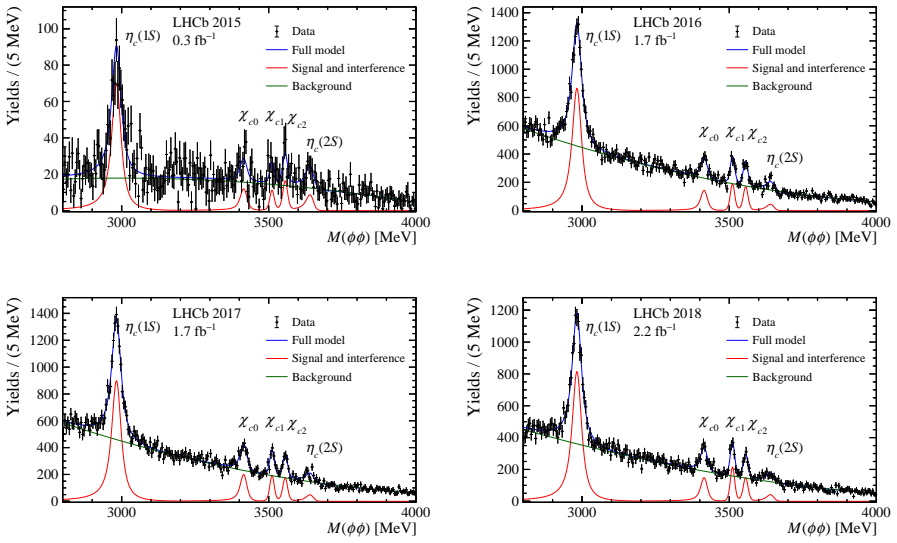


read the original abstract
The inclusive production of the $\eta_c(1S)$, $\eta_c(2S)$ and $\chi_{c}$ charmonium states in $b$-hadron decays is studied with LHCb Run~2 data, corresponding to an integrated luminosity of $5.9~\text{fb}^{-1}$, using charmonia decays to $\phi\phi$ pairs. The production branching fractions of the $\chi_{c}(1P)$ states in $b$-hadron decays are measured, using $b \to \eta_c(1S) (\to \phi \phi) X$ as a normalisation channel, with $X$ indicating any additional particles. The results are \begin{align*} &{\cal{B}} (b \to \chi_{c0} X) = (1.34 \pm 0.13 \pm 0.06 \pm 0.37) \times 10^{-3}, &{\cal{B}} (b \to \chi_{c1} X) = (1.58 \pm 0.12 \pm 0.09 \pm 0.44) \times 10^{-3}, &{\cal{B}} (b \to \chi_{c2} X) = (0.55 \pm 0.08 \pm 0.05 \pm 0.15) \times 10^{-3}, \end{align*} where the first uncertainty is statistical, the second systematic and the last is due to the limited knowledge of externally measured branching fractions. The production branching fraction of $\eta_c(2S)$ times the branching fraction of its decay into $\phi \phi$ is measured as ${\cal{B}} (b \to \eta_c(2S) X) \times {\cal{B}} (\eta_c(2S) \to \phi \phi) = (4.0 \pm 0.6 \pm 0.6 \pm 1.1) \times 10^{-7}$. Furthermore, the mass of the $\eta_c(1S)$ state is measured to be $M_{\eta_c(1S)} = 2984.1 \pm 0.5 \pm 0.5$ MeV with the best precision to date.
Editorial analysis
A structured set of objections, weighed in public.
Referee Report
Summary. The manuscript reports measurements of inclusive branching fractions for b-hadron decays to the χ_c0, χ_c1, χ_c2 and η_c(2S) charmonium states via their decays to φφ pairs, using 5.9 fb^{-1} of LHCb Run 2 data. The χ_c results are normalized to the b → η_c(1S)(→φφ)X reference channel and converted to absolute branching fractions using external inputs; the η_c(2S) result is reported as a product branching fraction. The paper also presents a high-precision measurement of the η_c(1S) mass.
Significance. These results provide updated experimental inputs on charmonium production in b decays that can test heavy-quark fragmentation models and serve as references for other analyses. The separation of statistical, systematic and external uncertainties is a clear strength, as is the use of an independent normalization channel. The dominant external uncertainties correctly flag the dependence on reference branching fractions such as B(η_c(1S)→φφ).
major comments (1)
- Abstract and Results: the absolute branching fractions for the χ_c states scale directly with the external B(η_c(1S)→φφ) (and related inputs), as indicated by the third uncertainty term. The manuscript should explicitly quote the numerical value adopted for this external branching fraction, state its source, and quantify the sensitivity of the final results to plausible variations in that input.
minor comments (2)
- Abstract: the branching-fraction results are presented inside a LaTeX align* environment that does not render cleanly in plain text or some journal formats; a bulleted list or compact table would improve readability.
- Abstract: the claim that the η_c(1S) mass has 'the best precision to date' should be supported by a brief comparison to the current PDG average or previous measurements.
Simulated Author's Rebuttal
We thank the referee for the careful reading of the manuscript, the positive assessment, and the constructive suggestion. We address the comment below.
read point-by-point responses
-
Referee: Abstract and Results: the absolute branching fractions for the χ_c states scale directly with the external B(η_c(1S)→φφ) (and related inputs), as indicated by the third uncertainty term. The manuscript should explicitly quote the numerical value adopted for this external branching fraction, state its source, and quantify the sensitivity of the final results to plausible variations in that input.
Authors: We agree that explicitly quoting the adopted value of the external branching fraction improves clarity for the reader. In the revised manuscript we will state the numerical value of B(η_c(1S) → φφ) used in the analysis, cite its source (the PDG average employed for the external inputs), and add a short sentence noting that the third uncertainty term already quantifies the propagation of the uncertainty on this input; any plausible variation within the quoted external uncertainty is therefore directly reflected in the reported third uncertainty on the χ_c branching fractions. revision: yes
Circularity Check
No significant circularity; direct experimental measurements normalized to independent external references
full rationale
The paper performs a standard LHCb branching-fraction measurement that normalizes the χ_c and η_c(2S) yields to the b→η_c(1S)(→φφ)X reference channel, extracts relative efficiencies from simulation and data-driven methods, and converts the ratio to absolute B(b→χ_c X) by multiplying by the external B(η_c(1S)→φφ) taken from the PDG or prior experiments. The third uncertainty term is explicitly attributed to that external input. No equation, fit, or ansatz inside the paper reduces to a self-definition, a fitted parameter renamed as prediction, or a load-bearing self-citation chain. The mass measurement is likewise a direct fit to the invariant-mass distribution. The derivation chain is therefore self-contained against external benchmarks and receives the default non-circularity finding.
Axiom & Free-Parameter Ledger
axioms (1)
- domain assumption Standard assumptions in particle-physics data analysis such as accurate detector simulation and background modeling hold.
Reference graph
Works this paper leans on
-
[1]
G. T. Bodwin, E. Braaten, and G. P. Lepage,Rigorous QCD analysis of inclusive annihilation and production of heavy quarkonium, Phys. Rev.D51(1995) 1125, Erratum ibid.D55(1997) 5853,arXiv:hep-ph/9407339
work page Pith review arXiv 1995
- [2]
- [3]
- [4]
- [5]
-
[6]
Aaijet al.,Measurement of J/ ψproduction in pp collisions at √s= 7TeV, Eur
LHCb collaboration, R. Aaijet al.,Measurement of J/ ψproduction in pp collisions at √s= 7TeV, Eur. Phys. J.C71(2011) 1645,arXiv:1103.0423
-
[7]
LHCb collaboration, R. Aaijet al.,Measurement of forward J/ ψproduction cross- sections in pp collisions at √s= 13TeV , JHEP10(2015) 172, Erratum ibid.05 (2017) 063,arXiv:1509.00771
-
[8]
LHCb collaboration, R. Aaijet al.,Measurement of ψ(2S) production cross-sections in proton-proton collisions at √s = 7and13 TeV, Eur. Phys. J.C80(2020) 185, arXiv:1908.03099
-
[9]
LHCb collaboration, R. Aaijet al.,Study of charmonium production in b-hadron decays and first evidence for the decay B0 s →ϕϕϕ , Eur. Phys. J.C77(2017) 609, arXiv:1706.07013
-
[10]
LHCb collaboration, R. Aaijet al.,Measurement of the ηc(1S)production cross-section inppcollisions at √s= 13TeV, Eur. Phys. J.C80(2020) 191,arXiv:1911.03326
-
[11]
Aaijet al.,Study of charmonium production via the decay to p¯pat √s= 13TeV, Eur
LHCb collaboration, R. Aaijet al.,Study of charmonium production via the decay to p¯pat √s= 13TeV, Eur. Phys. J.C84(2024) 1274,arXiv:2407.14261
-
[12]
Aaijet al.,Observation of ηc(2S)→p p and search for X(3872)→p pdecays, Phys
LHCb collaboration, R. Aaijet al.,Observation of ηc(2S)→p p and search for X(3872)→p pdecays, Phys. Lett.B769(2017) 305,arXiv:1607.06446
-
[13]
Aaijet al.,Study of charmonium decays to K 0 SKπ in the B→(K 0 SKπ)Kchannels, Phys
LHCb collaboration, R. Aaijet al.,Study of charmonium decays to K 0 SKπ in the B→(K 0 SKπ)Kchannels, Phys. Rev.D108(2023) 032010,arXiv:2304.14891
-
[14]
Ablikimet al.,Measurements of the mass and width of the ηc using the decay ψ′ →γη c, Phys
BESIII collaboration, M. Ablikimet al.,Measurements of the mass and width of the ηc using the decay ψ′ →γη c, Phys. Rev. Lett.108(2012) 222002, arXiv:1111.0398
-
[15]
Ablikimet al.,Study of ψ(3686) →π 0hc, hc →γη c via ηc exclusive decays, Phys
BESIII collaboration, M. Ablikimet al.,Study of ψ(3686) →π 0hc, hc →γη c via ηc exclusive decays, Phys. Rev.D86(2012) 092009,arXiv:1209.4963. 14
-
[16]
BaBar collaboration, P. del Amo Sanchezet al.,Observation of ηc(1S)and ηc(2S) decays to K +K −π+π−π0 in two-photon interactions, Phys. Rev.D84(2011) 012004, arXiv:1103.3971
-
[17]
Ablikimet al.,Updated measurements of the M1 transi- tion ψ(3686) →γη c(2S)with ηc(2S) →K Kπ, Phys
BESIII collaboration, M. Ablikimet al.,Updated measurements of the M1 transi- tion ψ(3686) →γη c(2S)with ηc(2S) →K Kπ, Phys. Rev.D109(2024) 032004, arXiv:2309.14689
- [18]
-
[19]
BES collaboration, M. Ablikimet al.,Precise measurement of spin-averaged χcJ(1P ) mass using photon conversions in ψ(2S)→γχ cJ, Phys. Rev.D71(2005) 092002, arXiv:hep-ex/0502031
-
[20]
Bagnascoet al.,New measurements of the resonance parameters of theχ c0(13P0)state of charmonium, Phys
E835 collaboration, S. Bagnascoet al.,New measurements of the resonance parameters of theχ c0(13P0)state of charmonium, Phys. Lett.B533(2002) 237
2002
-
[21]
Andreottiet al.,Interference study of the χc0(13P0)in the reactionp p→π 0π0, Phys
E835 collaboration, M. Andreottiet al.,Interference study of the χc0(13P0)in the reactionp p→π 0π0, Phys. Rev. Lett.91(2003) 091801,arXiv:hep-ex/0308055
-
[22]
E760 collaboration, T. A. Armstronget al.,Study of the χ1 and χ2 charmonium states formed in ppannihilations, Nucl. Phys.B373(1992) 35
1992
-
[23]
E835 collaboration, M. Andreottiet al.,Measurement of the resonance parameters of the χ1(13P1)and χ2(13P2)states of charmonium formed in antiproton-proton annihilations, Nucl. Phys.B717(2005) 34,arXiv:hep-ex/0503022
-
[24]
Aaijet al., χc1 and χc2 resonance parameters with the decays χc1,c2 →J/ ψµ+µ−, Phys
LHCb collaboration, R. Aaijet al., χc1 and χc2 resonance parameters with the decays χc1,c2 →J/ ψµ+µ−, Phys. Rev. Lett.119(2017) 221801,arXiv:1709.04247
-
[25]
LHCb collaboration, A. A. Alves Jr.et al.,The LHCb detector at the LHC, JINST3 (2008) S08005
2008
-
[26]
Aaijet al.,LHCb detector performance, Int
LHCb collaboration, R. Aaijet al.,LHCb detector performance, Int. J. Mod. Phys. A30(2015) 1530022,arXiv:1412.6352
-
[27]
Aaijet al.,Performance of the LHCb Vertex Locator, JINST9(2014) P09007, arXiv:1405.7808
R. Aaijet al.,Performance of the LHCb Vertex Locator, JINST9(2014) P09007, arXiv:1405.7808
-
[28]
P. d’Argentet al.,Improved performance of the LHCb Outer Tracker in LHC Run 2, JINST12(2017) P11016,arXiv:1708.00819
-
[29]
Adinolfi et al., Performance of the LHCb RICH detector at the LHC , Eur
M. Adinolfiet al.,Performance of the LHCb RICH detector at the LHC, Eur. Phys. J.C73(2013) 2431,arXiv:1211.6759
- [30]
-
[31]
Aaijet al.,The LHCb trigger and its performance in 2011, JINST8(2013) P04022, arXiv:1211.3055
R. Aaijet al.,The LHCb trigger and its performance in 2011, JINST8(2013) P04022, arXiv:1211.3055. 15
- [32]
-
[33]
Likhomanenkoet al.,LHCb topological trigger reoptimization, J
T. Likhomanenkoet al.,LHCb topological trigger reoptimization, J. Phys. Conf. Ser. 664(2015) 082025,arXiv:1510.00572
-
[34]
Navaset al.,Review of particle physics, Phys
Particle Data Group, S. Navaset al.,Review of particle physics, Phys. Rev.D110 (2024) 030001
2024
-
[35]
N. Grieseret al.,The LHCb stripping project: Sustainable legacy data processing for high-energy physics, Comput. Softw. Big. Sci.9(2025) 21,arXiv:2509.05294
-
[36]
Aaijet al.,Measurements of the Λ0 b, Ξ − b , and Ω− b baryon masses, Phys
LHCb collaboration, R. Aaijet al.,Measurements of the Λ0 b, Ξ − b , and Ω− b baryon masses, Phys. Rev. Lett.110(2013) 182001,arXiv:1302.1072
-
[37]
Aaijet al.,Precision measurement of D meson mass differ- ences, JHEP06(2013) 065,arXiv:1304.6865
LHCb collaboration, R. Aaijet al.,Precision measurement of D meson mass differ- ences, JHEP06(2013) 065,arXiv:1304.6865
-
[38]
A Brief Introduction to PYTHIA 8.1
T. Sj¨ ostrand, S. Mrenna, and P. Skands,A brief introduction to PYTHIA 8.1, Comput. Phys. Commun.178(2008) 852, arXiv:0710.3820; T. Sj¨ ostrand, S. Mrenna, and P. Skands,PYTHIA 6.4 physics and manual, JHEP05(2006) 026, arXiv:hep-ph/0603175
work page internal anchor Pith review arXiv 2008
-
[39]
Belyaevet al.,Handling of the generation of primary events in Gauss, the LHCb simulation framework, J
I. Belyaevet al.,Handling of the generation of primary events in Gauss, the LHCb simulation framework, J. Phys. Conf. Ser.331(2011) 032047
2011
-
[40]
D. J. Lange,The EvtGen particle decay simulation package, Nucl. Instrum. Meth. A462(2001) 152
2001
-
[41]
N. Davidson, T. Przedzinski, and Z. Was,PHOTOS interface in C++: Technical and physics documentation, Comput. Phys. Commun.199(2016) 86, arXiv:1011.0937
-
[42]
Allisonet al.,Geant4 developments and applications, IEEE Trans
Geant4 collaboration, J. Allisonet al.,Geant4 developments and applications, IEEE Trans. Nucl. Sci.53(2006) 270; Geant4 collaboration, S. Agostinelliet al.,Geant4: A simulation toolkit, Nucl. Instrum. Meth.A506(2003) 250
2006
-
[43]
Clemencicet al.,The LHCb simulation application, Gauss: Design, evolution and experience, J
M. Clemencicet al.,The LHCb simulation application, Gauss: Design, evolution and experience, J. Phys. Conf. Ser.331(2011) 032023
2011
-
[44]
J. M. Blatt and V. F. Weisskopf,Theoretical nuclear physics, Springer, New York, 1952
1952
-
[45]
Yang,Selection rules for the dematerialization of a particle into two photons, Phys
C.-N. Yang,Selection rules for the dematerialization of a particle into two photons, Phys. Rev.77(1950) 242
1950
-
[46]
S. S. Wilks,The large-sample distribution of the likelihood ratio for testing composite hypotheses, Ann. Math. Stat.9(1938) 60
1938
-
[47]
LHCb collaboration, R. Aaijet al.,Measurement of the track reconstruction efficiency at LHCb, JINST10(2015) P02007,arXiv:1408.1251
-
[48]
Anderliniet al.,The PIDCalib package, LHCb-PUB-2016-021, 2016
L. Anderliniet al.,The PIDCalib package, LHCb-PUB-2016-021, 2016. 16
2016
-
[49]
ATLAS collaboration, G. Aadet al.,Measurement of χc1 and χc2 production with√s= 7TeVppcollisions at ATLAS, JHEP07(2014) 154,arXiv:1404.7035
-
[50]
LHCb collaboration, R. Aaijet al.,Momentum scale calibration of the LHCb spec- trometer, JINST19(2024) P02008,arXiv:2312.01772. 17 LHCb collaboration R. Aaij38 , A.S.W. Abdelmotteleb 58 , C. Abellan Beteta 52 , F. Abudin´ en60 , T. Ackernley62 , A. A. Adefisoye 70 , B. Adeva48 , M. Adinolfi 56 , P. Adlarson86 , C. Agapopoulou 14 , C.A. Aidala 88 , Z. Ajal...
discussion (0)
Sign in with ORCID, Apple, or X to comment. Anyone can read and Pith papers without signing in.