Mutual Coupling-Aware Beamforming in Multi-User Continuous Aperture Array Systems
Pith reviewed 2026-05-10 15:39 UTC · model grok-4.3
The pith
A kernel-approximation WMMSE algorithm designs mutual coupling-aware beamforming for continuous aperture array systems.
A machine-rendered reading of the paper's core claim, the machinery that carries it, and where it could break.
Core claim
The central discovery is a KA-based WMMSE algorithm that solves the mutual coupling-aware sum-rate maximization problem for CAPA systems by deriving the optimal beamforming via calculus of variations and approximating the kernel with Gauss-Legendre quadrature in the wavenumber domain.
What carries the argument
The transmit coupling kernel, which explicitly captures mutual coupling effects in continuous aperture arrays and enables the formulation of the functional optimization problem.
If this is right
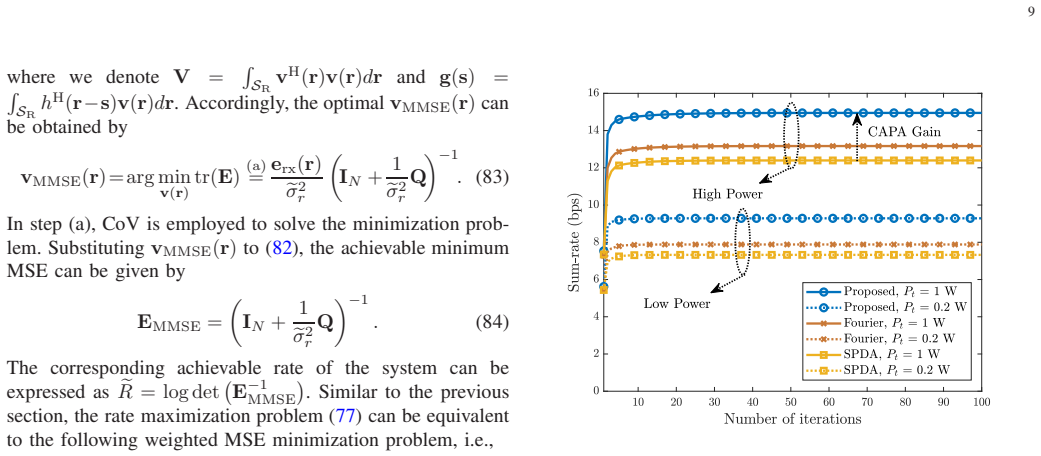
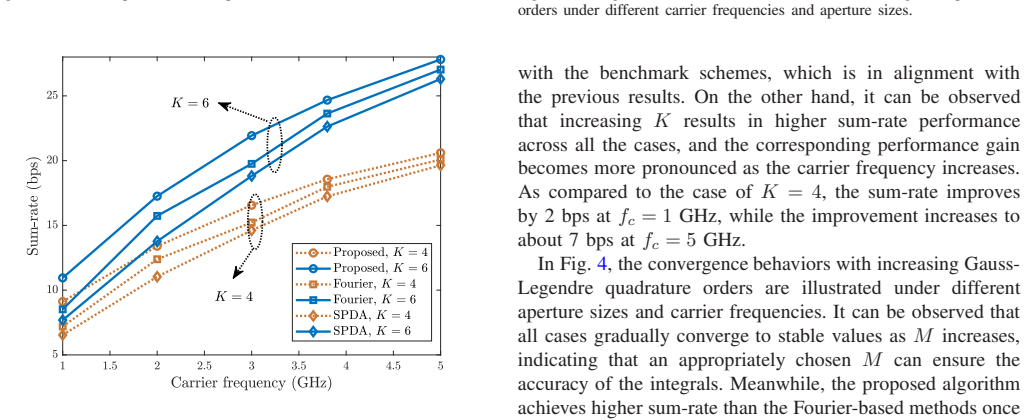
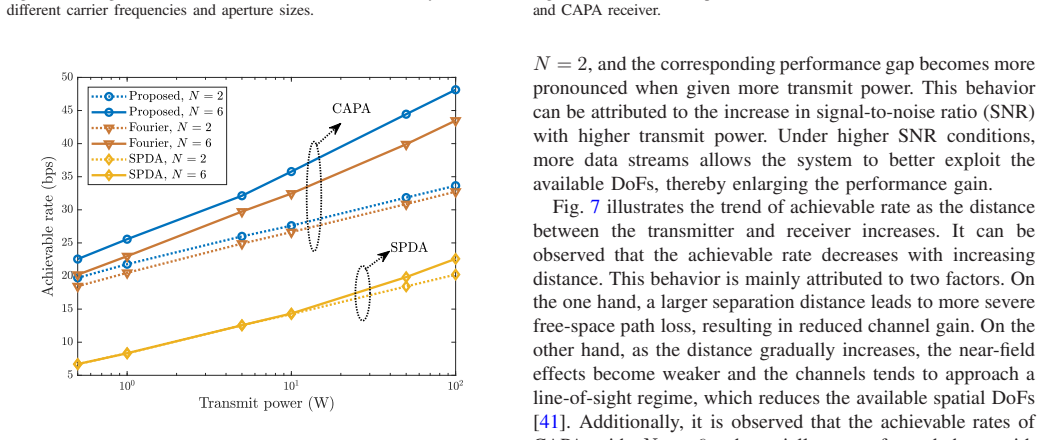
- The proposed KA-based WMMSE algorithm achieves improved sum-rate performance compared to benchmark schemes.
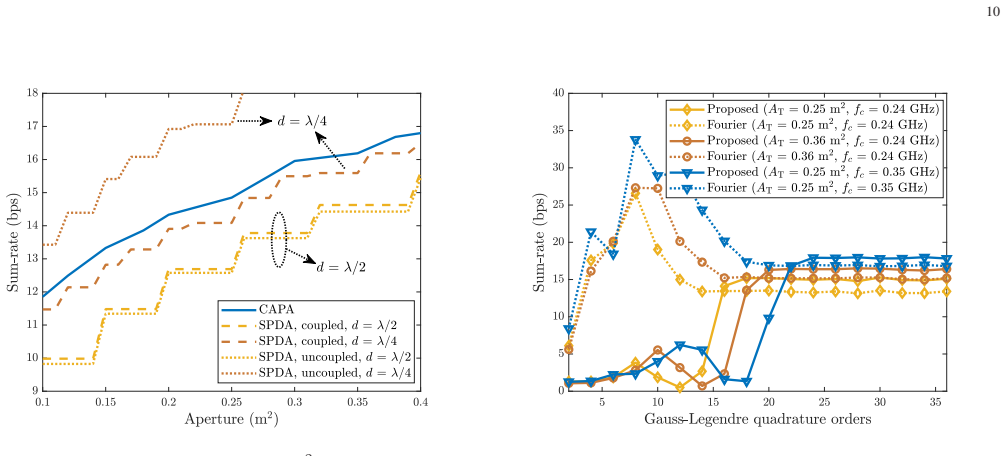
- The modeled coupling effects are physically rational, as the performance of spatially discrete arrays converges to that of CAPAs.
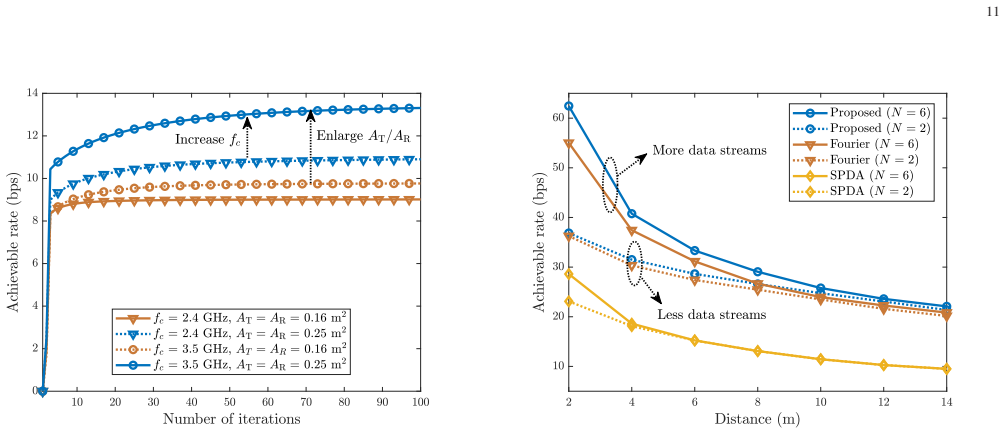
- CAPA-to-CAPA MIMO systems achieve higher degrees of freedom when the transceivers are placed in close proximity.
- Closed-form beamforming solutions are obtained through wavenumber-domain Fourier transforms and Gauss-Legendre quadrature.
Where Pith is reading between the lines
- Practical implementations of CAPA systems could benefit from pre-calibrating the coupling kernel using measured data to further close the gap to theoretical performance.
- Extending this framework to dynamic environments might require adaptive kernel updates as array positions or frequencies change.
- Comparison with electromagnetic simulation tools could validate the kernel's accuracy beyond the numerical results presented.
- Integration with other wireless techniques like reconfigurable intelligent surfaces may yield additional gains in coupled environments.
Load-bearing premise
The transmit coupling kernel accurately represents the physical mutual coupling effects in the continuous aperture array, and the kernel approximation preserves the optimality of the beamforming solution.
What would settle it
A physical experiment measuring the actual mutual coupling matrix in a fabricated CAPA prototype and comparing it to the kernel-predicted performance degradation versus an ideal uncoupled model.
Figures
read the original abstract
A mutual coupling-aware beamforming design for continuous aperture array (CAPA)-aided multi-user systems is investigated. First, a transmit coupling kernel is characterized to explicitly capture the mutual coupling effects inherent in CAPAs, based on which a mutual coupling-aware sum-rate maximization functional optimization problem is formulated. To address this problem, a kernel approximation (KA)-based weighted minimum mean-squared error (WMMSE) algorithm is developed. The optimal beamforming condition is derived within the WMMSE framework using the calculus of variations, while KA is employed to obtain a closed-form beamforming solution via wavenumber-domain Fourier transforms and Gauss-Legendre quadrature. Furthermore, the proposed framework is extended to CAPA-to-CAPA multiple-input multiple-output (MIMO) systems. Finally, numerical results demonstrate that: 1) the proposed algorithm achieves improved performance compared to benchmark schemes; 2) the modeled coupling effects are physically rational, where the performance of spatially discrete arrays converges to that of CAPAs; and 3) CAPA-to-CAPA MIMO systems can achieve higher degrees of freedom when the transceivers are placed in close proximity.
Editorial analysis
A structured set of objections, weighed in public.
Referee Report
Summary. The paper investigates mutual coupling-aware beamforming for continuous aperture array (CAPA) systems in multi-user downlink scenarios. It introduces a transmit coupling kernel to model mutual coupling effects, formulates a continuous functional sum-rate maximization problem, and develops a kernel approximation (KA)-based weighted minimum mean-squared error (WMMSE) algorithm. The optimal beamforming condition is derived via calculus of variations, after which KA, wavenumber-domain Fourier transforms, and Gauss-Legendre quadrature yield a closed-form solution. The approach is extended to CAPA-to-CAPA MIMO systems. Numerical results are presented to claim improved performance over benchmarks, physical rationality of the modeled coupling (with discrete arrays converging to CAPA performance), and higher degrees of freedom in close-proximity MIMO configurations.
Significance. If the kernel approximation and quadrature steps preserve the stationary point of the original functional optimization problem, the work would offer a valuable closed-form beamforming framework for dense CAPA systems that explicitly accounts for mutual coupling, potentially advancing practical designs in 6G and integrated sensing/communication. The extension to MIMO and the reported DoF gains under proximity are of interest to the field. The paper ships a parameter-free derivation of the beamforming condition from the coupling kernel and WMMSE framework, which is a strength.
major comments (2)
- [algorithm derivation and numerical results section] The central performance claim rests on the KA-based WMMSE algorithm achieving improved sum-rate. However, the derivation applies kernel approximation followed by Fourier transforms and Gauss-Legendre quadrature to obtain the closed-form solution; no error bound, convergence rate, or direct comparison against a non-approximated numerical optimizer of the original functional problem is provided to confirm that the approximation does not materially shift the stationary point. This is load-bearing for the headline result that the proposed algorithm outperforms benchmarks.
- [transmit coupling kernel characterization] The transmit coupling kernel is introduced to capture mutual coupling and is used to formulate the functional optimization problem. The physical rationality claim (including convergence of discrete arrays to CAPA performance) depends on this kernel accurately representing electromagnetic effects, yet the manuscript provides no explicit validation against full-wave simulations, measurements, or established mutual coupling models beyond the numerical results themselves.
minor comments (2)
- [preliminaries] Notation for the coupling kernel and the wavenumber-domain transforms should be introduced with explicit definitions and units to improve readability for readers outside the immediate subfield.
- [numerical results] The numerical results would benefit from reporting the number of Monte Carlo trials, error bars, and the specific parameter settings (e.g., aperture sizes, user locations) used to generate the convergence and DoF plots.
Simulated Author's Rebuttal
We thank the referee for the constructive and insightful comments, which help improve the clarity and rigor of our work on mutual coupling-aware beamforming for CAPA systems. We address each major comment point by point below, indicating the revisions planned for the next manuscript version.
read point-by-point responses
-
Referee: [algorithm derivation and numerical results section] The central performance claim rests on the KA-based WMMSE algorithm achieving improved sum-rate. However, the derivation applies kernel approximation followed by Fourier transforms and Gauss-Legendre quadrature to obtain the closed-form solution; no error bound, convergence rate, or direct comparison against a non-approximated numerical optimizer of the original functional problem is provided to confirm that the approximation does not materially shift the stationary point. This is load-bearing for the headline result that the proposed algorithm outperforms benchmarks.
Authors: We appreciate the referee highlighting the importance of validating the approximation steps for the headline claims. The kernel approximation is specifically designed to retain the dominant wavenumber-domain characteristics of the coupling kernel, enabling the closed-form solution via Fourier transforms while the Gauss-Legendre quadrature provides controllable accuracy for the aperture integrals. Although explicit error bounds and direct comparisons to a non-approximated optimizer were not included in the original manuscript, the numerical results consistently show performance gains and the expected convergence behaviors. In the revised manuscript, we will add a dedicated subsection analyzing the approximation error (e.g., objective value deviation from a finely discretized numerical solver of the original functional problem) and the convergence rate with respect to quadrature order, confirming that the stationary point is preserved to high accuracy for the parameter regimes considered. revision: yes
-
Referee: [transmit coupling kernel characterization] The transmit coupling kernel is introduced to capture mutual coupling and is used to formulate the functional optimization problem. The physical rationality claim (including convergence of discrete arrays to CAPA performance) depends on this kernel accurately representing electromagnetic effects, yet the manuscript provides no explicit validation against full-wave simulations, measurements, or established mutual coupling models beyond the numerical results themselves.
Authors: The transmit coupling kernel is derived directly from electromagnetic theory using the free-space dyadic Green's function to model the mutual coupling integral over the continuous aperture, which is a standard first-principles approach consistent with prior CAPA literature. The physical rationality is evidenced numerically by the convergence of discretized array performance to the CAPA limit as element density increases, aligning with the continuous approximation. We agree that additional substantiation would strengthen the presentation. In the revised manuscript, we will expand the kernel derivation section with explicit references to established mutual coupling models in the antenna literature and cite related works that have performed full-wave validations of similar kernels, while clarifying that the numerical convergence serves as supporting evidence within the theoretical framework. revision: yes
Circularity Check
No significant circularity; derivation chain remains self-contained
full rationale
The paper begins by characterizing a transmit coupling kernel from electromagnetic principles to model mutual coupling, formulates a continuous functional sum-rate maximization problem, derives the stationary beamforming condition via calculus of variations inside the WMMSE framework, and then introduces explicit kernel approximation (KA), wavenumber Fourier transforms, and Gauss-Legendre quadrature solely to obtain a closed-form numerical solution. Performance claims are supported by direct numerical comparisons against benchmarks rather than by any reduction of outputs to fitted inputs or self-citations. No step equates a claimed result to its modeling assumptions by construction; the approximations are presented as computational tools whose error is left for empirical validation.
Axiom & Free-Parameter Ledger
axioms (2)
- standard math Calculus of variations can be applied to derive the optimal beamforming condition within the WMMSE framework for the continuous-aperture functional problem.
- domain assumption Wavenumber-domain Fourier transforms and Gauss-Legendre quadrature accurately approximate the coupling kernel for closed-form solution.
invented entities (1)
-
Transmit coupling kernel
no independent evidence
Reference graph
Works this paper leans on
-
[1]
Y . Wu, C. Xiao, Z. Ding, X. Gao, and S. Jin, “A survey on MIMO transmission with finite input signals: Technical challeng es, advances, and future trends,” Proc. IEEE , vol. 106, no. 10, pp. 1779–1833, Oct. 2018
work page 2018
-
[2]
An overview of enhance d massive MIMO with array signal processing techniques,
M. Wang, F. Gao, S. Jin, and H. Lin, “An overview of enhance d massive MIMO with array signal processing techniques,” IEEE J. Sel. Top. Signal Process., vol. 13, no. 5, pp. 886–901, Sept. 2019
work page 2019
-
[3]
Multiuser beamfo rming for partially-connected millimeter wave massive MIMO,
C. Qi, J. Hu, Y . Du, and A. Nallanathan, “Multiuser beamfo rming for partially-connected millimeter wave massive MIMO,” IEEE Trans. V eh. Technol., vol. 73, no. 4, pp. 5977–5981, Apr. 2024
work page 2024
-
[4]
K. Chen, C. Qi, and O. A. Dobre, “Integrated user grouping , subcarrier allocation, and hybrid beamforming for wideband multiuser mmwave massive MIMO,” IEEE Trans. Commun. , vol. 74, pp. 3313–3328, Jan. 2026
work page 2026
-
[5]
Z. Liu, J. Zhang, J. Zheng, A. Nallanathan, B. Ai, and D. Wi ng Kwan Ng, “Distributed URLLC beamforming for partially conn ected cell-free massive MIMO systems with scalable graph neural n etworks,” IEEE Trans. Commun. , vol. 73, no. 11, pp. 11 992–12 007, Nov. 2025
work page 2025
-
[6]
Deep unfolding hybrid beamfo rming designs for THz massive MIMO systems,
N. T. Nguyen, M. Ma, O. Lavi, N. Shlezinger, Y . C. Eldar, A. L. Swindlehurst, and M. Juntti, “Deep unfolding hybrid beamfo rming designs for THz massive MIMO systems,” IEEE Trans. Signal Process. , vol. 71, pp. 3788–3804, Oct. 2023
work page 2023
-
[7]
F. Shu, Y . Qin, T. Liu, L. Gui, Y . Zhang, J. Li, and Z. Han, “L ow- complexity and high-resolution DOA estimation for hybrid a nalog and digital massive MIMO receive array,” IEEE Trans. Commun. , vol. 66, no. 6, pp. 2487–2501, Jun. 2018
work page 2018
-
[8]
Q. Peng, Q. Luo, Z. Chu, Z. Lin, M. Elkashlan, P . Xiao, G. K. Karagiannidis, and C. Masouros, “Latency-aware resou rce allocation for integrated communications, computation, a nd sensing in cell-free mMIMO systems,” Feb. 2025. [Online]. Availabl e: https://arxiv.org/abs/2502.17013
-
[9]
Massive MIMO do wnlink transmission for multiple LEO satellite communication,
Z. Xiang, X. Gao, K.-X. Li, and X.-G. Xia, “Massive MIMO do wnlink transmission for multiple LEO satellite communication,” IEEE Trans. Commun., vol. 72, no. 6, pp. 3352–3364, Jun. 2024
work page 2024
-
[10]
Reconfigurable intelligent surfaces: Principles and oppo rtunities,
Y . Liu, X. Liu, X. Mu, T. Hou, J. Xu, M. Di Renzo, and N. Al-D hahir, “Reconfigurable intelligent surfaces: Principles and oppo rtunities,” IEEE Commun. Surv. Tutorials , vol. 23, no. 3, pp. 1546–1577, Aug. 2021
work page 2021
-
[11]
Weighte d sum- rate maximization for reconfigurable intelligent surface a ided wireless networks,
H. Guo, Y .-C. Liang, J. Chen, and E. G. Larsson, “Weighte d sum- rate maximization for reconfigurable intelligent surface a ided wireless networks,” IEEE Trans. Wireless Commun. , vol. 19, no. 5, pp. 3064– 3076, May 2020
work page 2020
-
[12]
Sum-rate ma ximization of RIS-aided multi-user MIMO systems with statistical CSI,
H. Zhang, S. Ma, Z. Shi, X. Zhao, and G. Y ang, “Sum-rate ma ximization of RIS-aided multi-user MIMO systems with statistical CSI, ” IEEE Trans. Wireless Commun. , vol. 22, no. 7, pp. 4788–4801, Jul. 2023
work page 2023
-
[13]
H. Guo, Z. Y ang, Y . Zou, B. Lyu, Y . Jiang, and L. Hanzo, “Joint reconfig- urable intelligent surface location and passive beamformi ng optimization for maximizing the secrecy-rate,” IEEE Trans. V eh. Technol. , vol. 72, no. 2, pp. 2098–2110, Feb. 2023
work page 2098
-
[14]
Robust an d secure wireless communications via intelligent reflecting surfac es,
X. Y u, D. Xu, Y . Sun, D. W. K. Ng, and R. Schober, “Robust an d secure wireless communications via intelligent reflecting surfac es,” IEEE J. Sel. Areas Commun. , vol. 38, no. 11, pp. 2637–2652, Nov. 2020
work page 2020
-
[15]
An RIS- aided interference mitigation-based design for MIMO-NOMA in cellular networks,
J. Li, Z. Song, T. Hou, J. Gao, A. Li, and Z. Tang, “An RIS- aided interference mitigation-based design for MIMO-NOMA in cellular networks,” IEEE Trans. Green Commun. Networking , vol. 8, no. 1, pp. 317–329, Mar. 2024
work page 2024
-
[16]
Z. Zheng, W. Jing, Z. Lu, Q. Wu, H. Zhang, and D. Gesbert, “ Coopera- tive multi-satellite and multi-RIS beamforming: Enhancin g LEO satcom and mitigating LEO-GEO intersystem interference,” IEEE J. Sel. Areas Commun., vol. 43, no. 1, pp. 279–296, Jan. 2025
work page 2025
-
[17]
Unsuper vised learning for joint beamforming design in RIS-aided ISAC sys tems,
J. Y e, L. Huang, Z. Chen, P . Zhang, and M. Rihan, “Unsuper vised learning for joint beamforming design in RIS-aided ISAC sys tems,” IEEE Wireless Commun. Lett., vol. 13, no. 8, pp. 2100–2104, Aug. 2024
work page 2024
-
[18]
Joint bea mforming and position optimization for fluid RIS-aided ISAC systems,
J. Y e, P . Zhang, X.-P . Li, L. Huang, and Y . Liu, “Joint bea mforming and position optimization for fluid RIS-aided ISAC systems, ” 2026. [Online]. Available: https://arxiv.org/abs/2501.13339
-
[19]
Stacked intelligent metasurf aces for wireless communications: Applications and challenges,
H. Liu, J. An, X. Jia, L. Gan, G. K. Karagiannidis, B. Cler ckx, M. Ben- nis, M. Debbah, and T. J. Cui, “Stacked intelligent metasurf aces for wireless communications: Applications and challenges,” IEEE Wireless Commun., vol. 32, no. 4, pp. 46–53, Aug. 2025
work page 2025
-
[20]
Stacked intelligent metasurfaces for multiuser downlink beamform ing in the wave domain,
J. An, M. Di Renzo, M. Debbah, H. Vincent Poor, and C. Y uen , “Stacked intelligent metasurfaces for multiuser downlink beamform ing in the wave domain,” IEEE Trans. Wireless Commun., vol. 24, no. 7, pp. 5525– 5538, Jul. 2025
work page 2025
-
[21]
J. Fang, C. Zhang, J. An, H. Y u, Q. Wu, M. Debbah, and C. Y ue n, “Stacked intelligent metasurface assisted multiuser comm unications: From a rate fairness perspective,” IEEE Trans. Commun. , vol. 74, pp. 1253–1268, Jan. 2026
work page 2026
-
[22]
S tacked intelligent metasurface-based transceiver design for nea r-field wideband systems,
Q. Li, M. El-Hajjar, C. Xu, J. An, C. Y uen, and L. Hanzo, “S tacked intelligent metasurface-based transceiver design for nea r-field wideband systems,” IEEE Trans. Commun. , vol. 73, no. 9, pp. 8125–8139, Sept. 2025
work page 2025
-
[23]
Transmit beamforming design for ISAC with stacked intelli gent meta- surfaces,
S. Li, F. Zhang, T. Mao, R. Na, Z. Wang, and G. K. Karagiann idis, “Transmit beamforming design for ISAC with stacked intelli gent meta- surfaces,” IEEE Trans. V eh. Technol. , vol. 74, no. 4, pp. 6767–6772, Apr. 2025
work page 2025
-
[24]
Generative ai-enhanced low-altitude UA V-mounte d stacked intelligent metasurfaces,
G. Sun, M. Fan, L. Zhang, H. Pan, J. Li, C. Zhang, L. Li, C. Z hao, and C. Y uen, “Generative ai-enhanced low-altitude UA V-mounte d stacked intelligent metasurfaces,” IEEE Trans. Cognit. Commun. Networking , vol. 12, pp. 5320–5336, Jan. 2026
work page 2026
-
[25]
CAPA : Continuous-aperture arrays for revolutionizing 6G wirele ss communica- tions,
Y . Liu, C. Ouyang, Z. Wang, J. Xu, X. Mu, and Z. Ding, “CAPA : Continuous-aperture arrays for revolutionizing 6G wirele ss communica- tions,” IEEE Wireless Commun. , vol. 32, no. 4, pp. 38–45, Aug. 2025
work page 2025
-
[26]
Perform ance analysis for near-field MIMO: Discrete and continuous aperture anten nas,
Z. Xie, Y . Liu, J. Xu, X. Wu, and A. Nallanathan, “Perform ance analysis for near-field MIMO: Discrete and continuous aperture anten nas,” IEEE Wireless Commun. Lett. , vol. 12, no. 12, pp. 2258–2262, Dec. 2023
work page 2023
-
[27]
SINR analysis and interferen ce mitigation for continuous-aperture holographic MIMO uplink,
Z. Sun, Y . Jing, and X. Y u, “SINR analysis and interferen ce mitigation for continuous-aperture holographic MIMO uplink,” IEEE Trans. V eh. Technol., vol. 74, no. 1, pp. 1747–1752, Jan. 2025
work page 2025
-
[28]
The shannon information capacity of an arbit rary radiating surface: An electromagnetic approach,
S. Mikki, “The shannon information capacity of an arbit rary radiating surface: An electromagnetic approach,” IEEE Trans. Antennas Propag. , vol. 71, no. 3, pp. 2556–2570, Apr. 2023
work page 2023
-
[29]
Wavenumb er-division multiplexing in line-of-sight holographic MIMO communica tions,
L. Sanguinetti, A. A. D’Amico, and M. Debbah, “Wavenumb er-division multiplexing in line-of-sight holographic MIMO communica tions,” IEEE Trans. Wireless Commun. , vol. 22, no. 4, pp. 2186–2201, Apr. 2023
work page 2023
-
[30]
Pattern-division multiplexing fo r multi-user continuous-aperture MIMO,
Z. Zhang and L. Dai, “Pattern-division multiplexing fo r multi-user continuous-aperture MIMO,” IEEE J. Sel. Areas Commun. , vol. 41, no. 8, pp. 2350–2366, Aug. 2023
work page 2023
-
[31]
Beamforming optimizati on for continuous aperture array (CAPA)-based communications,
Z. Wang, C. Ouyang, and Y . Liu, “Beamforming optimizati on for continuous aperture array (CAPA)-based communications,” IEEE Trans. Wireless Commun., vol. 24, no. 6, pp. 5099–5113, Jun. 2025
work page 2025
-
[32]
Beamforming design for continuous aperture array (CAPA)-based MIMO systems,
——, “Beamforming design for continuous aperture array (CAPA)-based MIMO systems,” IEEE Trans. Wireless Commun. , pp. 1–1, 2025, early access, doi: 10.1109/TWC.2025.3595157
-
[33]
Cram´ er– Rao bound optimization for near-field sensing with continuous-apert ure arrays,
H. Jiang, Z. Wang, Y . Liu, and A. Nallanathan, “Cram´ er– Rao bound optimization for near-field sensing with continuous-apert ure arrays,” IEEE Trans. Wireless Commun. , vol. 25, pp. 7032–7047, Dec. 2025
work page 2025
-
[34]
Optimal waveform design for continuous ap erture array (CAPA)-aided ISAC systems,
J. Y e, Z. Wang, Y . Liu, P . Zhang, L. Huang, and A. Nallanathan, “Optimal waveform design for continuous ap erture array (CAPA)-aided ISAC systems,” 2025. [Online]. Availab le: https://arxiv.org/abs/2511.20203
-
[35]
S. S. A. Y uan, X. Chen, C. Huang, and W. E. I. Sha, “Effects of mutual coupling on degree of freedom and antenna efficiency in holog raphic MIMO communications,” IEEE Open J. Antennas Propag. , vol. 4, pp. 237–244, Mar. 2023
work page 2023
-
[36]
Mutual coupling in holographic MIMO: Physical modeling and information-theoretic analysis,
A. Pizzo and A. Lozano, “Mutual coupling in holographic MIMO: Physical modeling and information-theoretic analysis,” IEEE J. Sel. Areas Inf. Theory , vol. 6, pp. 111–126, Jun. 2025
work page 2025
-
[37]
arXiv pr eprint arXiv:2511.11225 (2025)
Z. Wang, K. R. R. Ranasinghe, G. T. F. de Abreu, and Y . Liu, “Mutual coupling in continuous aperture arrays: Phy sical modeling and beamforming design,” 2025. [Online]. Availab le: https://arxiv.org/abs/2511.11225
-
[38]
D. M. Pozar, Microwave engineering. Hoboken, NJ, USA: Wiley, 2011
work page 2011
-
[39]
Weighted sum-rate maximization using weighted MMSE for MI MO- BC beamforming design,
S. S. Christensen, R. Agarwal, E. De Carvalho, and J. M. C ioffi, “Weighted sum-rate maximization using weighted MMSE for MI MO- BC beamforming design,” IEEE Trans. Wireless Commun., vol. 7, no. 12, pp. 4792–4799, Dec. 2008
work page 2008
-
[40]
Optimal beamforming for multi- user continuous aperture array (CAPA) systems,
Z. Wang, C. Ouyang, and Y . Liu, “Optimal beamforming for multi- user continuous aperture array (CAPA) systems,” IEEE Trans. Commun., vol. 73, no. 10, pp. 9207–9221, Oct. 2025
work page 2025
-
[41]
N ear- field communications: A tutorial review,
Y . Liu, Z. Wang, J. Xu, C. Ouyang, X. Mu, and R. Schober, “N ear- field communications: A tutorial review,” IEEE Open J. Commun. Soc. , vol. 4, pp. 1999–2049, Aug. 2023
work page 1999
discussion (0)
Sign in with ORCID, Apple, or X to comment. Anyone can read and Pith papers without signing in.