Recognition: unknown
Searching for apparent baryon number violation in Λ_c^+ decays at the Super Tau-Charm Facility
Pith reviewed 2026-05-10 16:24 UTC · model grok-4.3
The pith
STCF with 1 ab^{-1} can probe apparent baryon number violation in Lambda_c+ decays to several TeV in new physics models.
A machine-rendered reading of the paper's core claim, the machinery that carries it, and where it could break.
Core claim
Observation of baryon number violation in laboratory experiments would constitute unambiguous evidence for physics beyond the Standard Model. Dedicated searches are proposed for apparent BNV in charm-baryon decays Lambda_c+ to M+ plus missing energy, where M is pi or K and the missing energy stems from a resonance. State-of-the-art Monte Carlo simulations for the Super Tau-Charm Facility evaluate signal efficiencies and derive projected model-independent sensitivities assuming negligible background. These sensitivities are interpreted in a sterile-neutrino-extended low-energy effective field theory and in R-parity-violating supersymmetry, showing that 1 ab^{-1} integrated luminosity allows a
What carries the argument
The decay channels Lambda_c+ to pi+ or K+ plus missing energy from a resonance, analyzed via Monte Carlo simulation of signal efficiencies at STCF to extract projected limits.
If this is right
- Model-independent limits on apparent BNV can be set in the proposed Lambda_c+ decay channels.
- New-physics scales of several TeV become accessible in the nuLEFT framework.
- The RPV supersymmetry parameter lambda''_212 over m^2_qtilde is constrained down to about 0.1 TeV^{-2}.
- STCF provides a competitive opportunity to probe BNV interactions in rare charm-baryon decays.
Where Pith is reading between the lines
- If backgrounds prove non-negligible in real data, dedicated background-rejection techniques would be required to preserve the projected reach.
- The resonance hypothesis for the missing energy could be tested directly by reconstructing the invariant mass of the missing system.
- These channels complement existing searches for BNV at higher-energy colliders by accessing lower-mass scales with different systematic uncertainties.
Load-bearing premise
Backgrounds remain negligible in the signal regions of the proposed decay channels, as assumed in the Monte Carlo simulations.
What would settle it
Observation of a non-negligible number of background events in the signal regions during actual data collection at STCF would invalidate the projected sensitivities.
Figures



read the original abstract
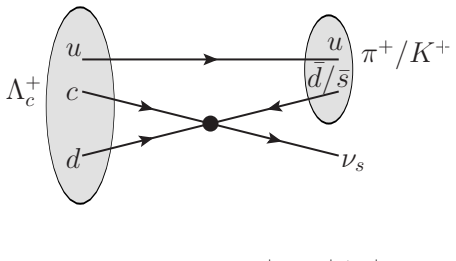
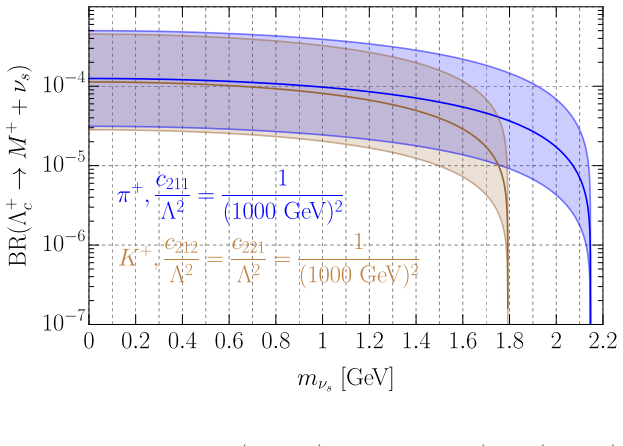
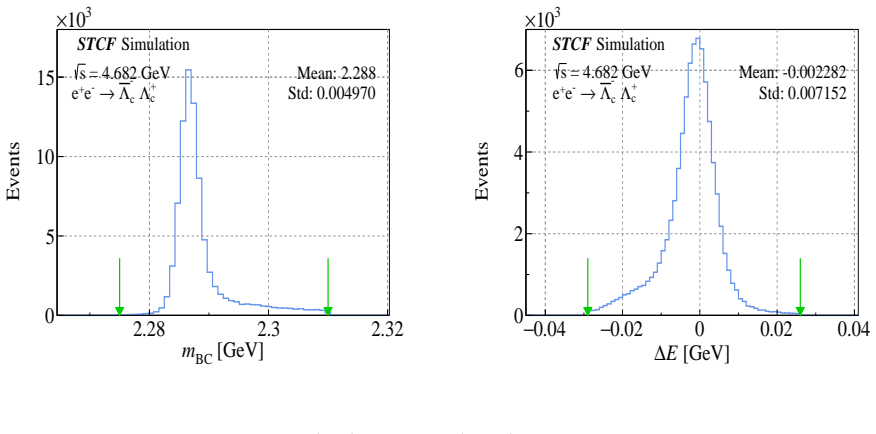
Observation of baryon number violation (BNV) in laboratory experiments would constitute unambiguous evidence for physics beyond the Standard Model. We propose dedicated searches for \textit{apparent} BNV in charm-baryon decays, $\Lambda_c^+\to M^+ +$ missing energy ($M=\pi, K$) where the missing energy stems from a resonance. These channels have not been explored experimentally so far, despite the relatively clean environment potentially provided by near $\Lambda_c^+\overline{\Lambda}_c^-$ threshold production at $e^+e^-$ colliders. Performing state-of-the-art Monte Carlo simulations for the proposed Super Tau-Charm Facility (STCF), we evaluate the signal efficiencies and derive projected model-independent sensitivities under the assumption of negligible background. We further interpret these sensitivities within two theoretical frameworks: a sterile-neutrino-extended low-energy effective field theory ($\nu$LEFT) and R-parity-violating (RPV) supersymmetry. With an integrated luminosity of 1 ab$^{-1}$, STCF can probe new-physics scales of several TeV in the $\nu$LEFT description and constrain the RPV model parameter $\lambda''_{212}/m^2_{\tilde{q}}$ down to about $0.1~\mathrm{TeV}^{-2}$. Our results demonstrate that STCF provides a highly competitive opportunity for probing BNV interactions in rare charm-baryon decays.
Editorial analysis
A structured set of objections, weighed in public.
Referee Report
Summary. The paper proposes dedicated searches for apparent baryon-number violation in the decays Λ_c^+ → M^+ + missing energy (M=π,K) at the Super Tau-Charm Facility. It performs state-of-the-art Monte Carlo simulations to evaluate signal efficiencies, derives projected sensitivities under the assumption of negligible background, and interprets the results in a sterile-neutrino-extended low-energy effective theory (νLEFT) and in R-parity-violating supersymmetry, claiming that 1 ab^{-1} of data can probe new-physics scales of several TeV and constrain λ''_{212}/m^2_{q̃} to ~0.1 TeV^{-2}.
Significance. If the negligible-background assumption is substantiated, the work would provide a competitive, previously unexplored probe of baryon-number violation in the charm sector, yielding model-independent constraints in νLEFT and concrete bounds in RPV SUSY. The use of state-of-the-art Monte Carlo simulations for signal efficiencies is a clear technical strength that supports the projected reach.
major comments (1)
- [Monte Carlo simulations and sensitivity projections] The projected sensitivities quoted in the abstract and derived from the Monte Carlo studies (several TeV in νLEFT; λ''_{212}/m^2_{q̃} ≲ 0.1 TeV^{-2} at 1 ab^{-1}) rest entirely on the assumption that background is negligible after all selection cuts. No quantitative background estimate, sideband extrapolation, or simulation of irreducible sources (mis-reconstructed Λ_c decays containing neutrinos, combinatorial missing energy from π^0/γ, beam-related backgrounds, or detector-material interactions) is presented to justify that expected background events are ≪1 in the signal window. This assumption is load-bearing: even a few surviving background events would weaken the limits by a factor ∼√(S+B)/S.
minor comments (2)
- [Abstract and Monte Carlo section] The abstract and main text refer to 'state-of-the-art Monte Carlo simulations' without naming the specific generators, detector simulation package, or luminosity scaling procedure; adding these details would improve reproducibility.
- [Throughout] Notation for the RPV coupling (λ''_{212}/m^2_{q̃}) should be checked for consistency between the abstract, text, and any tables or equations.
Simulated Author's Rebuttal
We thank the referee for the positive assessment of our work's significance and for the detailed, constructive comment. We address the major concern below and will revise the manuscript accordingly.
read point-by-point responses
-
Referee: [Monte Carlo simulations and sensitivity projections] The projected sensitivities quoted in the abstract and derived from the Monte Carlo studies (several TeV in νLEFT; λ''_{212}/m^2_{q̃} ≲ 0.1 TeV^{-2} at 1 ab^{-1}) rest entirely on the assumption that background is negligible after all selection cuts. No quantitative background estimate, sideband extrapolation, or simulation of irreducible sources (mis-reconstructed Λ_c decays containing neutrinos, combinatorial missing energy from π^0/γ, beam-related backgrounds, or detector-material interactions) is presented to justify that expected background events are ≪1 in the signal window. This assumption is load-bearing: even a few surviving background events would weaken the limits by a factor ∼√(S+B)/S.
Authors: We agree that the sensitivity projections rest on the negligible-background assumption stated in the manuscript and that a quantitative justification is needed to make the results more robust. The assumption is motivated by the clean kinematic environment of near-threshold Λ_c^+ Λ_c^- production at STCF, where the total energy is precisely known and missing-energy reconstruction can suppress many backgrounds. However, we acknowledge that no dedicated background simulation or estimate was included in the current version. In the revised manuscript we will add Monte Carlo studies of the dominant potential background sources (mis-reconstructed Λ_c decays with neutrinos, combinatorial π^0/γ contributions, beam-related backgrounds, and detector-material interactions) after the full selection chain. These studies will either substantiate that residual background remains ≪1 event or provide revised sensitivity projections that account for a small but non-zero background level. We believe this addition will directly address the referee's concern without altering the overall conclusions. revision: yes
Circularity Check
No circularity: sensitivities derived from explicit MC signal efficiencies plus stated background assumption
full rationale
The paper computes signal efficiencies via standard Monte Carlo simulation of the proposed STCF detector response for the channels Λ_c^+ → M^+ + missing energy, then converts these efficiencies into projected 90% CL limits at 1 ab^{-1} luminosity by assuming background is negligible. This assumption is declared explicitly rather than derived from any equation or prior result within the paper. No parameter is fitted to data and then relabeled as a prediction, no self-citation supplies a load-bearing uniqueness theorem, and no ansatz is smuggled in. The derivation chain is therefore self-contained and non-circular; the quoted reach follows directly from the stated inputs and the conventional Poisson limit formula under B=0.
Axiom & Free-Parameter Ledger
axioms (2)
- domain assumption Backgrounds in the signal region can be reduced to negligible levels by kinematic selection at STCF
- domain assumption Standard Model plus the chosen BSM extensions (νLEFT, RPV SUSY) correctly describe the relevant processes
Reference graph
Works this paper leans on
-
[1]
pole” and “non-pole
We show how to match this UV-completion to the EFT. Both the sterile neutrino and the light bino neutralino are very long-lived, appearing as missing energy at STCF. We will confine ourselves to the mass range roughly betweenm p andm Λ+ c −m M +, where mp/Λ+ c /M+ labels the mass of proton, Λ + c baryon, and the charged meson (π + orK +). For lower masses...
-
[2]
(14), only terms with right-chiral quarks or squarks are given, since we assume absence of squark mixing and the BNV terms as shown in Eq
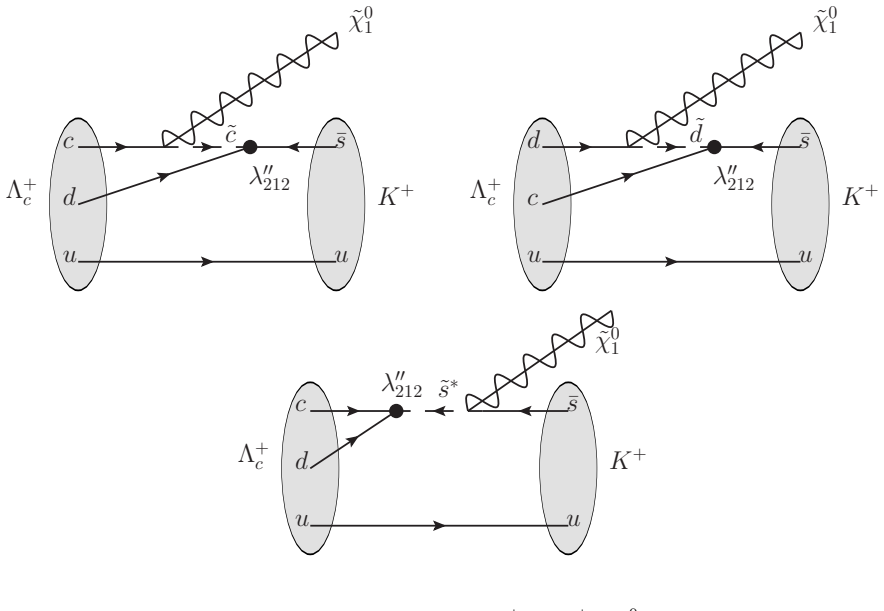
We note that in Eq. (14), only terms with right-chiral quarks or squarks are given, since we assume absence of squark mixing and the BNV terms as shown in Eq. (15) involve only such fields. Besides assuming vanishing squark mixing, we confine ourselves to the case of degenerate squark massesm ˜qfor simplicity of discussion. The corresponding parton-level ...
-
[3]
+ g ˜d 1Rλ′′ 212 m2 ˜d (sRcc R)(dR ˜χ0
-
[4]
(2) and Eq
+ g˜c 1Rλ′′ 212 m2 ˜c (sRdc R)(cR ˜χ0 1),(22) where the first two terms entail operators that match with the Hermitian-conjugated (h.c.) counterparts of the operators given in Eq. (2) and Eq. (3), respectively. The operator in the third term can be re-expressed via a Fierz transformation as (sRdc R)(cR ˜χ0 1) Fierz ≈ 1 2(sR ˜χ0 1)(cRdc R) =− 1 2(dRcc R)(s...
-
[5]
+ g ˜d 1Rλ′′ 212 m2 ˜q (sRcc R)(dR ˜χ0 1),(24) where we have assumed squark-mass degeneracy and exploited the relationg ˜c 1R =−2g ˜s 1R derived from Eq. (16). Matching the UV Lagrangian to the effective Lagrangian (5), we obtain the following relations, c212 Λ2 = 2λ′′ 212g˜s 1R m2 ˜q , c221 Λ2 = λ′′ 212g ˜d 1R m2 ˜q ,(25) wherec 212/Λ2 andc 221/Λ2 are, r...
-
[6]
For the considered mass range of interest, their decays are highly suppressed. For the sterile neutrino, the decay amplitudes are proportional to the small values of the coefficientsc/Λ 2 and are further reduced by off-shell propagators (aW-boson and a down-type quark). Similarly, the light bino neutralino has its decays suppressed by three off-shell prop...
-
[7]
F. R. Klinkhamer and N. S. Manton, Phys. Rev. D30, 2212 (1984)
1984
-
[8]
A. M. Polyakov, Phys. Lett. B59, 82 (1975)
1975
-
[9]
A. A. Belavin, A. M. Polyakov, A. S. Schwartz, and Y. S. Tyupkin, Phys. Lett. B59, 85 (1975)
1975
-
[10]
’t Hooft, Phys
G. ’t Hooft, Phys. Rev. Lett.37, 8 (1976)
1976
-
[11]
’t Hooft, Phys
G. ’t Hooft, Phys. Rev. D14, 3432 (1976), [Erratum: Phys.Rev.D 18, 2199 (1978)]
1976
-
[12]
Ringwald, Nucl
A. Ringwald, Nucl. Phys. B330, 1 (1990)
1990
-
[13]
P. B. Arnold and L. D. McLerran, Phys. Rev. D36, 581 (1987)
1987
-
[14]
Finite temperature field theory and phase transitions
M. Quiros, inICTP Summer School in High-Energy Physics and Cosmology(1999) pp. 187– 259, arXiv:hep-ph/9901312
work page internal anchor Pith review arXiv 1999
-
[15]
D. E. Morrissey and M. J. Ramsey-Musolf, New J. Phys.14, 125003 (2012), arXiv:1206.2942 [hep-ph]
work page Pith review arXiv 2012
- [16]
-
[17]
Planck 2018 results. VI. Cosmological parameters
N. Aghanimet al.(Planck), Astron. Astrophys.641, A6 (2020), [Erratum: Astron.Astrophys. 652, C4 (2021)], arXiv:1807.06209 [astro-ph.CO]
work page internal anchor Pith review Pith/arXiv arXiv 2020
-
[18]
A. D. Dolgov, Phys. Rept.222, 309 (1992)
1992
-
[19]
Recent Progress in Baryogenesis
A. Riotto and M. Trodden, Ann. Rev. Nucl. Part. Sci.49, 35 (1999), arXiv:hep-ph/9901362
work page Pith review arXiv 1999
-
[20]
A. D. Sakharov, Pisma Zh. Eksp. Teor. Fiz.5, 32 (1967)
1967
-
[21]
Navaset al.(Particle Data Group), Phys
S. Navaset al.(Particle Data Group), Phys. Rev. D110, 030001 (2024). 19
2024
-
[22]
F. del Aguila, S. Bar-Shalom, A. Soni, and J. Wudka, Phys. Lett. B670, 399 (2009), arXiv:0806.0876 [hep-ph]
-
[23]
A. Aparici, K. Kim, A. Santamaria, and J. Wudka, Phys. Rev. D80, 013010 (2009), arXiv:0904.3244 [hep-ph]
-
[24]
Y. Liao and X.-D. Ma, Phys. Rev. D96, 015012 (2017), arXiv:1612.04527 [hep-ph]
- [25]
- [26]
-
[27]
I. Bischer and W. Rodejohann, Nucl. Phys. B947, 114746 (2019), arXiv:1905.08699 [hep-ph]
-
[28]
M. Chala and A. Titov, JHEP05, 139 (2020), arXiv:2001.07732 [hep-ph]
- [29]
- [30]
-
[31]
Claudson, M
M. Claudson, M. B. Wise, and L. J. Hall, Nucl. Phys. B195, 297 (1982)
1982
-
[32]
E. E. Jenkins and A. V. Manohar, inWorkshop on Effective Field Theories of the Standard Model(1991)
1991
-
[33]
R. Beltr´ an, G. Cottin, J. G¨ unther, M. Hirsch, A. Titov, and Z. S. Wang, JHEP05, 238 (2025), [Erratum: JHEP 08, 204 (2025)], arXiv:2501.09065 [hep-ph]
- [34]
- [35]
-
[36]
E. Bertholet, C. O. Dib, S. P. Gandelman, J. C. Helo, V. E. Lyubovitskij, M. Nayak, N. A. Neill, A. Soffer, and Z. S. Wang, JHEP10, 076 (2025), arXiv:2507.00359 [hep-ph]
- [37]
-
[38]
G. Elor, M. Escudero, and A. Nelson, Phys. Rev. D99, 035031 (2019), arXiv:1810.00880 [hep-ph]
work page Pith review arXiv 2019
- [39]
-
[40]
G. Alonso- ´Alvarez, G. Elor, A. E. Nelson, and H. Xiao, JHEP03, 046 (2020), arXiv:1907.10612 [hep-ph]. 20
-
[41]
G. Alonso- ´Alvarez, G. Elor, and M. Escudero, Phys. Rev. D104, 035028 (2021), arXiv:2101.02706 [hep-ph]
- [42]
- [43]
- [44]
-
[45]
Abumusabhet al.(Belle-II, Belle), (2026), arXiv:2601.07104 [hep-ex]
M. Abumusabhet al.(Belle-II, Belle), (2026), arXiv:2601.07104 [hep-ex]
- [46]
- [47]
-
[48]
R. Barbieret al., Phys. Rept.420, 1 (2005), arXiv:hep-ph/0406039
- [49]
-
[50]
H. Davoudiasl, D. E. Morrissey, K. Sigurdson, and S. Tulin, Phys. Rev. Lett.105, 211304 (2010), arXiv:1008.2399 [hep-ph]
- [51]
- [52]
-
[53]
J. Heeck, Phys. Lett. B813, 136043 (2021), arXiv:2009.01256 [hep-ph]
- [54]
-
[55]
A. Goudelis, D. Karamitros, P. Papachristou, and V. C. Spanos, Phys. Rev. D106, 023515 (2022), arXiv:2204.13554 [hep-ph]
-
[56]
M. C´ ıscar-Monsalvatje, A. Ibarra, and J. Vandecasteele, JCAP01, 028 (2024), [Erratum: JCAP 10, E01 (2024)], arXiv:2307.02592 [hep-ph]
- [57]
- [58]
-
[59]
J. Heeck and I. M. Shoemaker, Phys. Rev. Lett.135, 111804 (2025), arXiv:2506.08090 [hep- ph]
- [60]
- [61]
-
[62]
M. Achasovet al., Front. Phys. (Beijing)19, 14701 (2024), arXiv:2303.15790 [hep-ex]
-
[63]
X.-C. Aiet al., Nucl. Sci. Tech.36, 242 (2025), arXiv:2509.11522 [physics.acc-ph]
-
[64]
M. Ablikimet al.(BESIII), Phys. Rev. Lett.131, 191901 (2023), arXiv:2307.07316 [hep-ex]
-
[65]
W. H. Huang, T. Li, Q. Y. Li, H. Li, D. Liu, and X. T. Huang, J. Phys. Conf. Ser.2438, 012054 (2023)
2023
-
[66]
T. Li, W. Huang, X. Huang, X. Ai, H. Li, and D. Liu, EPJ Web Conf.295, 03025 (2024)
2024
-
[67]
X. Ai, X. Huang, T. Li, B. Qi, and X. Qin, Mod. Phys. Lett. A39, 2440006 (2024)
2024
-
[68]
Agostinelliet al.(GEANT4), Nucl
S. Agostinelliet al.(GEANT4), Nucl. Instrum. Meth. A506, 250 (2003)
2003
-
[69]
Allisonet al., Nucl
J. Allisonet al., Nucl. Instrum. Meth. A835, 186 (2016)
2016
-
[70]
J. A. Grifols, E. Masso, and S. Peris, Phys. Lett. B220, 591 (1989)
1989
-
[71]
J. R. Ellis, K. A. Olive, S. Sarkar, and D. W. Sciama, Phys. Lett. B215, 404 (1988)
1988
-
[72]
Lau, Phys
K. Lau, Phys. Rev. D47, 1087 (1993)
1993
- [73]
- [74]
-
[75]
S. Profumo, Phys. Rev. D78, 023507 (2008), arXiv:0806.2150 [hep-ph]
- [76]
- [77]
-
[78]
Aadet al.(ATLAS), JHEP10, 062 (2020), arXiv:2008.06032 [hep-ex]
G. Aadet al.(ATLAS), JHEP10, 062 (2020), arXiv:2008.06032 [hep-ex]
-
[79]
M. Ablikimet al.(BESIII), Nucl. Instrum. Meth. A614, 345 (2010), arXiv:0911.4960 [physics.ins-det]
-
[80]
Belle II Technical Design Report
T. Abeet al.(Belle-II), (2010), arXiv:1011.0352 [physics.ins-det]
work page Pith review arXiv 2010
discussion (0)
Sign in with ORCID, Apple, or X to comment. Anyone can read and Pith papers without signing in.