Recognition: unknown
Accuracy-Cost Trade-offs for Reference VQE Calculations of H₂ on IBM Quantum Hardware
Pith reviewed 2026-05-10 16:17 UTC · model grok-4.3
The pith
Tapered mappings deliver the most consistent accuracy gains for VQE ground-state calculations of H2 on IBM quantum processors.
A machine-rendered reading of the paper's core claim, the machinery that carries it, and where it could break.
Core claim
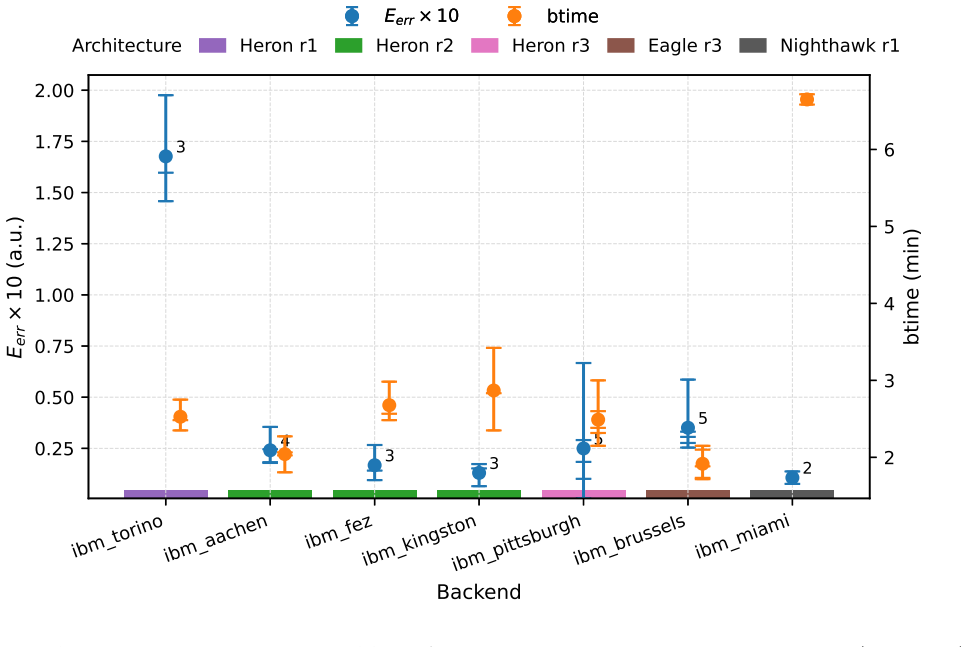
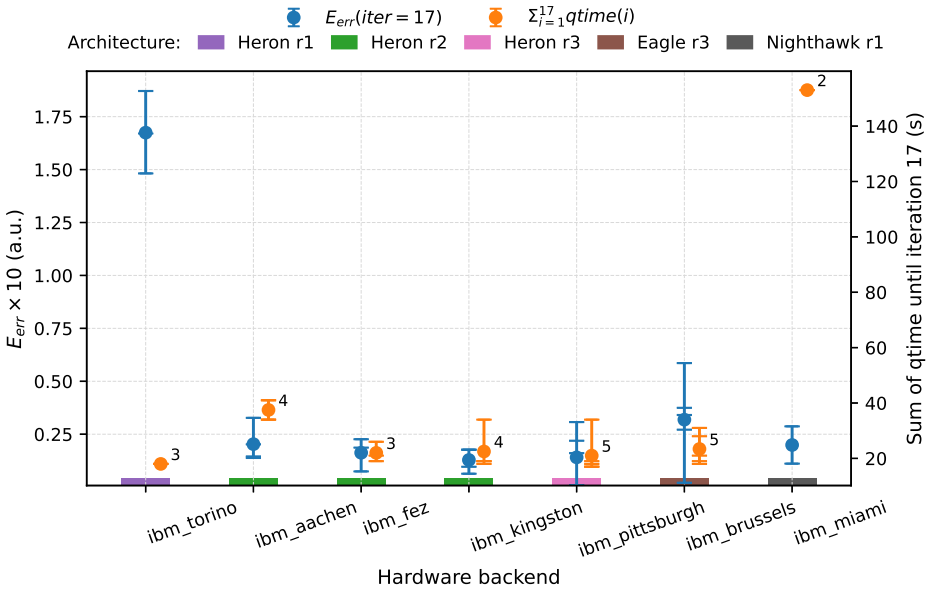
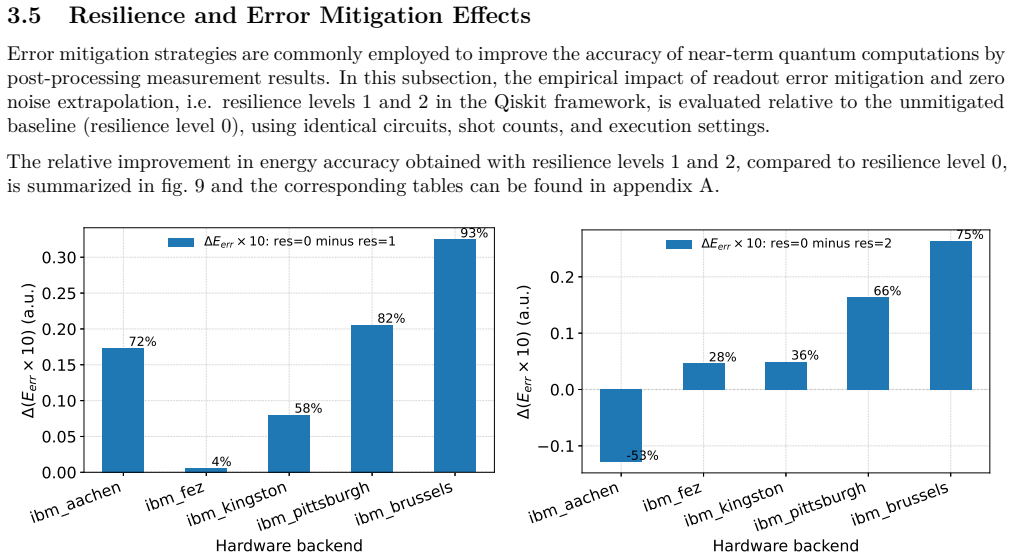
Across the configurations studied, circuit simplification through tapered mappings provides the most consistent accuracy gains, resilience level 1 improves accuracy at a substantial cost premium, and session-based execution yields no systematic accuracy advantage over single-job execution despite markedly higher billed time.
What carries the argument
The standardized benchmarking workflow that systematically varies shot count, backend, optimization strategy including tapered mappings, resilience settings, and session versus single-job execution to quantify accuracy-cost trade-offs for VQE on H2.
If this is right
- Tapered mappings should be applied early in similar VQE workflows to obtain accuracy improvements without increasing shot counts.
- Resilience level 1 can be chosen when accuracy is prioritized over cost, but the premium must be budgeted in advance.
- Single-job execution remains sufficient for accuracy in this H2 case, making it preferable when minimizing billed time.
- The released dataset lets practitioners estimate expected energy errors and run costs before launching their own calculations.
Where Pith is reading between the lines
- Extending the workflow to slightly larger molecules would test whether the accuracy advantage of tapered mappings persists as circuit depth increases.
- The lack of accuracy benefit from sessions implies that hardware drift during the experiment is not the dominant error source in these VQE runs.
- Future reductions in hardware noise could shrink the cost gap for resilience level 1 and change the observed trade-off.
Load-bearing premise
The standardized workflow and selected hardware configurations are representative of typical VQE usage in quantum chemistry and that observed variability generalizes beyond the tested backends and periods.
What would settle it
Repeating the full set of VQE runs for H2 on an additional IBM backend or with a different small molecule such as LiH and checking whether tapered mappings still produce the largest accuracy gains would test the central claim.
Figures






read the original abstract
We present a hardware-validated reference dataset for variational ground-state energy calculations of the hydrogen molecule H\(_2\) on several IBM Quantum processors available in 2026. Using a standardized workflow, we benchmark the impact of shot count, backend choice, optimization strategy, and runtime variability on the achievable energy accuracy relative to exact diagonalization. The resulting dataset and analysis provide a transparent baseline for assessing the current capabilities and limitations of IBM Quantum hardware for quantum-chemistry applications, and are meant to ease the entry for new users by providing a comprehensive overview of choices and their effects as well as runtime efforts and costs that can be expected. Across the configurations studied here, circuit simplification through tapered mappings provides the most consistent accuracy gains, resilience level 1 improves accuracy at a substantial cost premium, and session-based execution yields no systematic accuracy advantage over single-job execution despite markedly higher billed time.
Editorial analysis
A structured set of objections, weighed in public.
Referee Report
Summary. The manuscript presents a hardware-validated reference dataset for variational quantum eigensolver (VQE) ground-state energy calculations of the H₂ molecule on several 2026 IBM Quantum processors. Using a standardized workflow, it benchmarks the effects of shot count, backend choice, optimization strategy, and runtime variability (including single-job vs. session execution) on energy accuracy relative to exact diagonalization. The central descriptive findings are that tapered mappings yield the most consistent accuracy gains, resilience level 1 improves accuracy at a substantial cost premium, and session-based execution provides no systematic accuracy advantage despite higher billed time. The work positions the dataset and analysis as a transparent baseline to assist new users with accuracy-cost trade-offs in quantum chemistry applications.
Significance. If the empirical observations hold under the stated scope, the paper supplies a useful, reproducible reference point for current IBM Quantum hardware performance in small-molecule VQE calculations. The explicit scoping of claims to the tested configurations, the standardized workflow, and the focus on both accuracy and billed-time costs are strengths that could ease entry for practitioners and support future benchmarking studies. No parameter-free derivations or machine-checked proofs are present, but the direct hardware measurements against exact diagonalization provide falsifiable, configuration-specific data.
major comments (2)
- [§4] §4 (Results) and associated figures/tables: The headline claim of 'no systematic accuracy advantage' for session-based execution over single-job execution is presented without statistical tests, confidence intervals, or quantitative error-bar analysis to support the absence of a difference, despite the manuscript noting runtime variability; visual or qualitative comparison alone is insufficient to substantiate this load-bearing observation.
- [Methods] Methods section: The standardized workflow is outlined at a high level, but the manuscript does not include raw data tables, complete error-bar details, the full list of tested configurations, or explicit criteria used to avoid post-hoc selection; these omissions prevent independent verification of the three headline claims on accuracy gains from tapered mappings, resilience level 1, and session execution.
minor comments (3)
- [Abstract] Abstract: The number of backends, total configurations, and specific shot counts or resilience levels tested could be stated explicitly to give readers immediate context for the scope of the findings.
- [Figures] Figure captions and axis labels: Ensure all panels clearly indicate the metric (e.g., energy error in Hartree), error representation (standard deviation, etc.), and backend identifiers so that the accuracy-cost plots are self-contained.
- [References] References: Include the exact IBM backend names and calibration dates used in 2026 to allow precise reproduction of the hardware conditions.
Simulated Author's Rebuttal
We thank the referee for their careful and constructive review of our manuscript. We address each major comment point by point below, indicating the revisions we will make to improve clarity, reproducibility, and statistical rigor.
read point-by-point responses
-
Referee: [§4] §4 (Results) and associated figures/tables: The headline claim of 'no systematic accuracy advantage' for session-based execution over single-job execution is presented without statistical tests, confidence intervals, or quantitative error-bar analysis to support the absence of a difference, despite the manuscript noting runtime variability; visual or qualitative comparison alone is insufficient to substantiate this load-bearing observation.
Authors: We agree that formal statistical support would strengthen the claim. In the revised manuscript we will add quantitative error bars (derived from the observed runtime variability) to the relevant figures in §4. We will also include a statistical comparison between single-job and session results, using a paired test appropriate to the data distribution (e.g., Wilcoxon signed-rank test) together with 95 % confidence intervals on the mean energy difference. The text will explicitly discuss the limitations imposed by runtime variability and state that the conclusion of “no systematic advantage” is now supported by both visual inspection and the statistical analysis. revision: yes
-
Referee: [Methods] Methods section: The standardized workflow is outlined at a high level, but the manuscript does not include raw data tables, complete error-bar details, the full list of tested configurations, or explicit criteria used to avoid post-hoc selection; these omissions prevent independent verification of the three headline claims on accuracy gains from tapered mappings, resilience level 1, and session execution.
Authors: We accept that additional methodological detail is required for independent verification. We will expand the Methods section with a more granular description of the workflow. In addition, we will deposit a Supplementary Information file containing (i) raw data tables for every configuration, (ii) the exact formulas and values used for all error bars, (iii) the complete enumerated list of tested configurations together with all circuit and runtime parameters, and (iv) the explicit, a-priori selection criteria employed to avoid post-hoc bias. Cross-references to this supplementary material will be inserted in both the Methods and Results sections so that readers can directly verify the three headline claims. revision: yes
Circularity Check
No significant circularity
full rationale
The paper is a purely empirical benchmarking study that reports hardware measurements of VQE energies for H2 against exact diagonalization. All central claims (accuracy gains from tapered mappings, cost trade-offs for resilience levels, and lack of session advantage) are direct observational comparisons from a standardized experimental workflow on specific IBM backends. No equations, derivations, fitted parameters, or self-citations are invoked as load-bearing steps that reduce any result to its own inputs by construction. The work is self-contained against external benchmarks.
Axiom & Free-Parameter Ledger
axioms (1)
- domain assumption Exact diagonalization yields the true ground-state energy of H2
Reference graph
Works this paper leans on
-
[1]
A variational eigenvalue solver on a photonic quantum proc essor,
A. Peruzzo, J. McClean, P. Shadbolt, M.-H. Yung, X.-Q. Zh ou, P. J. Love, A. Aspuru-Guzik, and J. L. O’Brien, “A variational eigenvalue solver on a photonic quantum proc essor,” Nature Communications, vol. 5, p. 4213, 2014
work page 2014
-
[2]
Hardware- efficient variational quantum eigensolver for small molecul es and quantum magnets,
A. Kandala, A. Mezzacapo, K. Temme, M. Takita, M. Brink, J . M. Chow, and J. M. Gambetta, “Hardware- efficient variational quantum eigensolver for small molecul es and quantum magnets,” Nature, vol. 549, pp. 242–246, 2017
work page 2017
-
[3]
Quantum chemistry as a benchmark for near-term quantum computers,
A. J. McCaskey, Z. P. Parks, J. Jakowski, S. Moore, T. Morr is, and T. S. Humble, “Quantum chemistry as a benchmark for near-term quantum computers,” npj Quantum Information , vol. 5, p. 99, 2019
work page 2019
-
[4]
The variational quantum eigensolver: A review of methods and best practices ,
J. Tilly, H. Chen, Y. Cao, D. Picozzi, K. Setia, Y. Li, E. Gr ant, L. Wossnig, and I. Rungger, “The variational quantum eigensolver: A review of methods and best practices ,” Physics Reports, vol. 986, pp. 1–128, 2022
work page 2022
-
[5]
Hartree-fock on a superconducting qubit quantum compute r,
F. Arute, K. Arya, R. Babbush et al. , “Hartree-fock on a superconducting qubit quantum compute r,” Science, vol. 369, no. 6507, pp. 1084–1089, 2020
work page 2020
-
[6]
S. Sim, P. D. Johnson, and A. Aspuru-Guzik, “Expressibil ity and entangling capability of parameterized quantum circuits for hybrid quantum-classical algorithms ,” Advanced Quantum Technologies, vol. 2, no. 12, p. 1900070, 2019
work page 2019
-
[7]
Noise re silience of variational quantum compiling,
K. Sharma, S. Khatri, M. Cerezo, and P. J. Coles, “Noise re silience of variational quantum compiling,” New Journal of Physics , vol. 22, no. 4, p. 043006, apr 2020. [Online]. A vailable: https://doi.org/10.1088/1367-2630/ab784c
-
[8]
Hybrid quantum-class ical algorithms and quantum error mitigation,
S. Endo, S. C. Benjamin, and Y. Li, “Hybrid quantum-class ical algorithms and quantum error mitigation,” Journal of the Physical Society of Japan , vol. 90, no. 3, p. 032001, 2021
work page 2021
-
[9]
Progress towar ds practical quantum variational algorithms,
D. Wecker, M. B. Hastings, and M. Troyer, “Progress towar ds practical quantum variational algorithms,” Physical Review A , vol. 92, p. 042303, 2015
work page 2015
-
[10]
Unbiasing qubit noise with quantum error mitigation,
W. Huggins, J. Lee, B. O’Gorman et al. , “Unbiasing qubit noise with quantum error mitigation,” Nature, vol. 605, pp. 500–505, 2022
work page 2022
-
[11]
PySCF: the Python-based simulations of chemistry framework,
Q. Sun, T. C. Berkelbach, N. S. Blunt, G. H. Booth, S. Guo, Z. Li, J. Liu, J. D. McCl ain, E. R. Sayfutyarova, S. Sharma, S. Wouters, and G. K.-L. Chan, “Pys cf: the python-based simulations of chemistry framework,” WIREs Computational Molecular Science , vol. 8, no. 1, p. e1340, 2018. [Online]. A vailable: https://wires.onlinelibrary.wiley.com/doi/abs/10...
-
[12]
Array programming with NumPy ,
C. R. Harris, K. J. Millman, S. J. van der Walt, R. Gommers , P. Virtanen, D. Cournapeau, E. Wieser, J. Taylor, S. Berg, N. J. Smith, R. Kern, M. Picus, S. Hoyer, M. H. van Kerkwijk, M. Brett, A. Haldane, 19 J. F. del Río, M. Wiebe, P. Peterson, P. Gérard-Marchant, K. S heppard, T. Reddy, W. Weckesser, H. Abbasi, C. Gohlke, and T. E. Oliphant, “Array prog...
work page 2020
-
[13]
Über das paulische Äquivalenz verbot,
P. Jordan and E. Wigner, “Über das paulische Äquivalenz verbot,” Zeitschrift für Physik , vol. 47, pp. 631–651, 1928
work page 1928
-
[14]
The bravyi-k itaev transformation for quantum computation of electronic structure,
J. T. Seeley, M. J. Richard, and P. J. Love, “The bravyi-k itaev transformation for quantum computation of electronic structure,” The Journal of Chemical Physics , vol. 137, no. 22, p. 224109, 2012
work page 2012
-
[15]
Tapering off qubits to simulate fermionic Hamiltonians
S. Bravyi, J. M. Gambetta, A. Mezzacapo, and K. Temme, “T apering off qubits to simulate fermionic hamil- tonians,” arXiv preprint arXiv:1701.08213 , 2017
work page Pith review arXiv 2017
-
[16]
Error mitigation and resilience options in qiskit run time,
“Error mitigation and resilience options in qiskit run time,” https://quantum.cloud.ibm.com/docs/guides/con figure-error-mitiga accessed December 2025
work page 2025
-
[17]
Qiskit runtime estimator options: resilience,
“Qiskit runtime estimator options: resilience,” http s://quantum.cloud.ibm.com/docs/api/qiskit-ibm-runti me/options-resilien accessed December 2025
work page 2025
-
[18]
A quantum engineer’s guide to superconducting qubits,
P. Krantz, M. Kjaergaard, F. Yan, T. P. Orlando, S. Gusta vsson, and W. D. Oliver, “A quantum engineer’s guide to superconducting qubits,” Applied Physics Reviews , vol. 6, no. 2, p. 021318, 2019
work page 2019
- [19]
-
[20]
Multivariate stochastic approximation usi ng a simultaneous perturbation gradient approximation,
J. Spall, “Multivariate stochastic approximation usi ng a simultaneous perturbation gradient approximation,” IEEE Transactions on Automatic Control , vol. 37, no. 3, pp. 332–341, 1992
work page 1992
-
[21]
Spsa optimizer — qiskit algorit hms,
Qiskit Contributors, “Spsa optimizer — qiskit algorit hms,” https://qiskit-community.github.io/qiskit-algo rithms/stubs/qiskit_ 2024, accessed 2026-01
work page 2024
-
[22]
Evalua ting the impact of noise on the performance of the variational quantum eigensolver,
M. Oliv, A. Matic, T. Messerer, and J. M. Lorenz, “Evalua ting the impact of noise on the performance of the variational quantum eigensolver,” 2022. [Online]. A vaila ble: https://arxiv.org/abs/2209.12803
-
[23]
Scalability c hallenges in variational quantum optimiza- tion under stochastic noise,
A. Bärligea, B. Poggel, and J. M. Lorenz, “Scalability c hallenges in variational quantum optimiza- tion under stochastic noise,” Phys. Rev. A , vol. 112, p. 032407, Sep 2025. [Online]. A vailable: https://link.aps.org/doi/10.1103/rgyh-8xw8
-
[24]
Best-Practice Aspects of Quantum-Computer Calculations: A Case Study of the Hydroge n Molecule,
I. Miháliková, M. Friák, M. Pivoluska, M. Plesch, M. Sai p, and M. Šob, “Best-Practice Aspects of Quantum-Computer Calculations: A Case Study of the Hydroge n Molecule,” Molecules (Basel, Switzerland) , vol. 27, no. 3, p. 597, Jan. 2022. [Online]. A vailable: https ://arxiv.org/abs/2112.01208
-
[25]
Perfo rmance optimisation for drift-robust fidelity improvement of two-qubit gates,
G. A. L. White, C. D. Hill, and L. C. L. Hollenberg, “Perfo rmance optimisation for drift-robust fidelity improvement of two-qubit gates,” Nov. 2019, arXiv:1911.12 096 [quant-ph] version: 1. [Online]. A vailable: http://arxiv.org/abs/1911.12096
-
[26]
IBM Quantum System Two: the era of quantum utility is he re | IBM Quantum Computing Blog
“IBM Quantum System Two: the era of quantum utility is he re | IBM Quantum Computing Blog. ” [Online]. A vailable: https://www.ibm.com/quantum/blog/quantum-roadmap-2033
work page 2033
-
[27]
IBM launches Aachen, a 156-qubit quantum s ys- tem powered by Heron r2 processor,
C. Trueman, “IBM launches Aachen, a 156-qubit quantum s ys- tem powered by Heron r2 processor,” Apr. 2025. [Online]. A va ilable: https://www.sdxcentral.com/news/ibm-launches-aachen -a-156-qubit-quantum-system-powered-by-heron-r2-pro cessor/
work page 2025
-
[28]
Probing Context- Dependent Errors in Quantum Processors,
K. Rudinger, T. Proctor, D. Langharst, M. Sarovar, K. Yo ung, and R. Blume-Kohout, “Probing Context- Dependent Errors in Quantum Processors,” Physical Review X , vol. 9, no. 2, p. 021045, Jun. 2019, publisher: American Physical Society. [Online]. A vailable: https:// link.aps.org/doi/10.1103/PhysRevX.9.021045
-
[29]
Z. Boutakka, N. Innan, M. Shafique, M. Bennai, and Z. Sakh i, “Benchmarking VQE Configurations: Architectures, Initializations, and Optimizers for Silic on Ground State Energy,” Oct. 2025, arXiv:2510.23171 [quant-ph] version: 1. [Online]. A vailable: http://arxiv .org/abs/2510.23171
-
[30]
Variational quantum algorithms,
M. Cerezo, A. Arrasmith, R. Babbush et al., “Variational quantum algorithms,” Nature Reviews Physics, vol. 3, pp. 625–644, 2021
work page 2021
-
[31]
Error mitigati on for short-depth quantum circuits,
K. Temme, S. Bravyi, and J. M. Gambetta, “Error mitigati on for short-depth quantum circuits,” Physical Review Letters, vol. 119, p. 180509, 2017. 20 A Supporting Information A.1 VQE Workflow: Detailed Object-Level Overview This subsection expands the end-to-end VQE chain used in thi s paper, from molecular input to hardware-measured energy and timing outp...
work page 2017
-
[32]
Step 1: Driver (chemistry model instantiation)
provides a well structured review. Step 1: Driver (chemistry model instantiation). The workflow starts with PySCFDriver, which receives the molecular specification (atomic geometry, basis set, charg e, and spin). It executes the classical electronic-structu re setup and returns an ElectronicStructureProblem. At this stage, no quantum circuit exists yet: thi...
discussion (0)
Sign in with ORCID, Apple, or X to comment. Anyone can read and Pith papers without signing in.