Recognition: unknown
FIREFLY: heat load and particle exhaust approximations for rapid evaluation of divertor designs
Pith reviewed 2026-05-10 15:15 UTC · model grok-4.3
The pith
FIREFLY approximates divertor heat loads and particle exhaust to speed up design optimization.
A machine-rendered reading of the paper's core claim, the machinery that carries it, and where it could break.
Core claim
The FIREFLY package extends flux tube mesh field line reconstruction with a simplified heat transport model to approximate divertor loads, samples neutralized particles from the load distribution, and tracks molecules and atoms with EIRENE in a plasma background while accounting for dissociation, charge exchange, and ionization, removing particles on pumping surfaces to estimate exhaust efficiency for a given geometry, as explored through optimization and parameter sensitivity for the W7-X example.
What carries the argument
Simplified heat transport model on a flux tube mesh combined with Monte Carlo particle tracking to compute exhaust efficiency from sampled neutralized particles.
If this is right
- Divertor geometries can be optimized iteratively using fast exhaust efficiency estimates.
- Particle removal rates can be quantified for many design variants without running full plasma simulations.
- The effect of different plasma background parameters on exhaust performance can be checked quickly.
- Neutral particle sources derived from heat load distributions enable direct tracking of exhaust paths.
Where Pith is reading between the lines
- This approximation method could be linked to automated geometry generators to explore wider ranges of divertor shapes.
- Applying the same workflow to other magnetic configurations might identify common design features that improve exhaust.
- Validation against measured exhaust data from operating devices would clarify the range of geometries where the tool is reliable.
Load-bearing premise
The simplified heat transport model and chosen plasma background parameters are sufficiently accurate to produce useful exhaust-efficiency estimates for geometry optimization.
What would settle it
A side-by-side comparison of exhaust efficiency predictions from FIREFLY against a full detailed simulation or experimental measurement for the exact same divertor geometry would settle whether the approximations hold.
Figures



read the original abstract
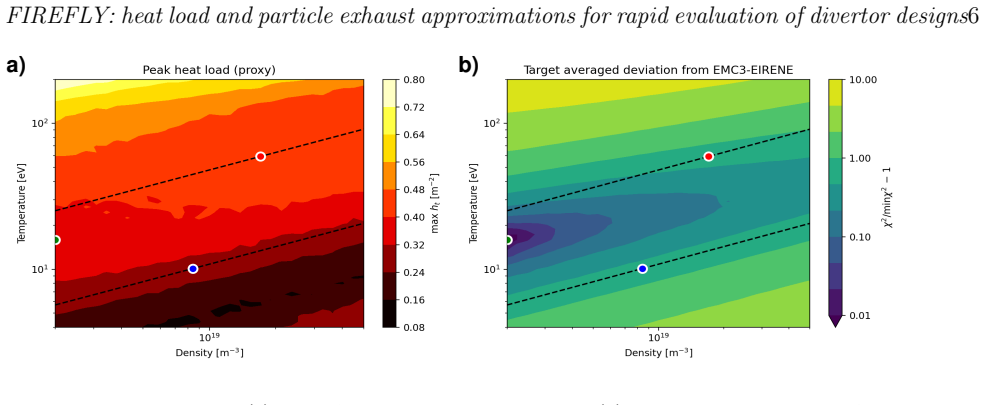
The divertor in a magnetic confinement fusion reactor is an essential component for power dissipation and particle removal. The FIREFLY package for rapid evaluation of divertor designs is presented as an extension of the FLARE code for field line reconstruction from a flux tube mesh. First, divertor loads are approximated with a simplified heat transport model. Neutralized particles are then sampled from the resulting load distribution, and the EIRENE code is used to track molecules and atoms in a plasma background while accounting for dissociation, charge exchange and ionization. Particles are removed on pumping surfaces in order to estimate the exhaust efficiency for a given divertor geometry. Optimization of the divertor geometry for more efficient particle exhaust is explored by using W7-X as an example, and the sensitivity to model parameters for the plasma background in the proxy calculations is evaluated.
Editorial analysis
A structured set of objections, weighed in public.
Referee Report
Summary. The paper presents the FIREFLY package as an extension of the FLARE code for rapid divertor design evaluation in fusion devices. Divertor heat loads are approximated via a simplified heat transport model on a flux tube mesh; neutralized particles are sampled from this distribution and tracked with EIRENE in a fixed plasma background to compute exhaust efficiency via pumping surface removal. The workflow is demonstrated on W7-X divertor geometry variants with sensitivity analysis to background plasma parameters.
Significance. If the proxy heat-load and fixed-background approximations correctly rank relative exhaust efficiencies across geometries, FIREFLY would enable useful rapid screening and optimization of divertor shapes without repeated full transport runs. The method builds on established codes (FLARE, EIRENE) and includes parameter sensitivity, but the lack of quantitative benchmarks against self-consistent simulations or data currently limits its assessed impact for design decisions.
major comments (2)
- [Abstract and results on W7-X optimization] The central claim that FIREFLY produces useful exhaust-efficiency estimates for geometry optimization rests on the simplified heat transport model and fixed plasma background preserving correct relative trends. No direct benchmark against self-consistent codes (e.g., SOLPS-ITER + EIRENE) or W7-X experimental data is provided to confirm ordering of exhaust efficiencies for different divertor variants; only parameter sensitivity is shown.
- [Methods: heat load approximation] The heat-load approximation step (prior to EIRENE sampling) is described as using a simplified transport model, yet no quantitative error metrics, comparison to full heat-flux calculations, or validation of the resulting load distribution against reference solutions are reported. This is load-bearing because the sampled particle distribution directly feeds the exhaust-efficiency calculation.
minor comments (2)
- [Methods] Notation for the plasma background parameters and the definition of exhaust efficiency should be clarified with explicit equations or a table of symbols to improve reproducibility.
- [Results] Figure captions for the W7-X geometry variants and exhaust-efficiency plots would benefit from stating the exact parameter values used in the sensitivity study.
Simulated Author's Rebuttal
We thank the referee for the detailed and constructive report. We address each major comment below, clarifying the intended scope of the FIREFLY approximations while acknowledging the value of additional validation. Revisions have been made to improve transparency on assumptions and limitations.
read point-by-point responses
-
Referee: [Abstract and results on W7-X optimization] The central claim that FIREFLY produces useful exhaust-efficiency estimates for geometry optimization rests on the simplified heat transport model and fixed plasma background preserving correct relative trends. No direct benchmark against self-consistent codes (e.g., SOLPS-ITER + EIRENE) or W7-X experimental data is provided to confirm ordering of exhaust efficiencies for different divertor variants; only parameter sensitivity is shown.
Authors: We agree that direct benchmarks against self-consistent codes would strengthen confidence in the preservation of relative trends across geometries. The manuscript presents FIREFLY as a rapid proxy tool for initial screening rather than a replacement for full transport simulations; the W7-X example and parameter sensitivity study are intended to illustrate workflow and robustness under the stated approximations. Performing new SOLPS-ITER runs for multiple divertor variants exceeds the scope of this methods-focused paper. In revision we have added an explicit discussion of the conditions under which relative ordering is expected to hold (fixed background, neglect of geometry-induced plasma response) and have expanded the conclusions to state that full validation remains future work. revision: partial
-
Referee: [Methods: heat load approximation] The heat-load approximation step (prior to EIRENE sampling) is described as using a simplified transport model, yet no quantitative error metrics, comparison to full heat-flux calculations, or validation of the resulting load distribution against reference solutions are reported. This is load-bearing because the sampled particle distribution directly feeds the exhaust-efficiency calculation.
Authors: The heat-load model extends the established FLARE flux-tube framework with a simplified conduction-convection balance; its purpose is to generate a plausible load distribution for subsequent neutral sampling rather than to reproduce absolute heat fluxes. We acknowledge that the original manuscript lacked quantitative error metrics or side-by-side comparisons. The revised version includes the governing equations of the proxy model, a clearer statement of its assumptions, and references to prior FLARE validations. New quantitative comparisons to full heat-flux solutions are not available from the present study and would require separate dedicated calculations. revision: partial
- Direct quantitative benchmarks of exhaust-efficiency ordering against self-consistent SOLPS-ITER + EIRENE simulations or W7-X experimental data for the tested divertor variants.
- Quantitative error metrics and validation of the simplified heat-load distribution against reference full-transport solutions.
Circularity Check
No significant circularity; approximations rely on external codes without self-referential reduction
full rationale
The paper presents FIREFLY as an extension of the established FLARE code for field-line tracing, followed by a simplified heat-transport proxy feeding into the independent EIRENE Monte-Carlo neutral code on a fixed background. No equations, fitted parameters, or self-citations are shown that make any output quantity (heat-load distribution or exhaust efficiency) identical to an input by construction. The central workflow is a forward approximation whose validity rests on external benchmarks and parameter sensitivity studies rather than on any definitional loop or renamed fit. This is the expected non-circular case for a proxy-tool paper.
Axiom & Free-Parameter Ledger
free parameters (1)
- plasma background parameters
Reference graph
Works this paper leans on
-
[1]
Performance of different tungsten grades under transient thermal loads
A. Loarte, B. Lipschultz, A. S. Kukushkin, G. F. Matthews, P. C. Stangeby, N. Asakura, G. F. Counsell, G. Federici, A. Kallenbach, K. Krieger, A. Mahdavi, V. Philipps, D. Reiter, J. Roth, J. Strachan, D. Whyte, R. Doerner, T. Eich, W. Fundamenski, A. Herrmann, M. Fenstermacher, P. Ghendrih, M. Groth, A. Kirschner, S. Konoshima, B. LaBombard, P. Lang, A. W...
-
[2]
K. Krieger, S. Brezinsek, J.W. Coenen, H. Frerichs, A. Kallenbach, A.W. Leonard, T. Loarer, S. Ratynskaia, N. Vianello, N. Asakura, M. Bernert, D. Carralero, R. Ding, D. Douai, T. Eich, Y. Gasparyan, A. Hakola, Y. Hatano, M. Jakubowski, M. Kobayashi, S. Krasheninnikov, S. Masuzaki, T. Nakano, R. Neu, R.A. Pitts, J. Rapp, K. Schmid, O. Schmitz, D. Tskhakay...
-
[3]
K¨ onig, P
R. K¨ onig, P. Grigull, K. McCormick, Y. Feng, J. Kisslinger, A. Komori, S. Masuzaki, K. Matsuoka, T. Obiki, N. Ohyabu, H. Renner, F. Sardei, F. Wagner, and A. Werner. The divertor program in stellarators.Plasma Phys. Control. Fusion,44(2002) (11) 2365–2422
2002
-
[4]
G. F. Matthews. Plasma detachment from divertor targets and limiters.J. Nucl. Mater.,220-222 (1995) 104–116. 10.1016/0022-3115(94)00450-1
-
[5]
S. I. Krasheninnikov and A. S. Kukushkin. Physics of ultimate detachment of a tokamak divertor plasma.J. Plasma Phys.,83(2017) (5) 155830501. 10.1017/s0022377817000654. FIREFLY: heat load and particle exhaust approximations for rapid evaluation of divertor designs17
-
[6]
P. C. Stangeby. Basic physical processes and reduced models for plasma detachment.Plasma Phys. Control. Fusion,60(2018) 044022. 10.1088/1361-6587/aaacf6
-
[7]
H.D. Pacher, A.S. Kukushkin, G.W. Pacher, V. Kotov, R.A. Pitts, and D. Reiter. Impurity seeding in ITER DT plasmas in a carbon-free environment.J. Nucl. Mater.,463(2015) 591. 10.1016/j.jnucmat.2014.11.104
-
[8]
R.A. Pitts, X. Bonnin, F. Escourbiac, H. Frerichs, J.P. Gunn, T. Hirai, A.S. Kukushkin, E. Kaveeva, M.A. Miller, D. Moulton, V. Rozhansky, I. Senichenkov, E. Sytova, O. Schmitz, P.C. Stangeby, G. De Temmerman, I. Veselova, and S. Wiesen. Physics basis for the first ITER tungsten divertor.Nuclear Materials and Energy,20(2019) 100696. ISSN 2352-1791. https:...
-
[9]
Y. Feng, F. Sardei, J. Kisslinger, P. Grigull, K. McCormick, and D. Reiter. 3D Edge Modeling and Island Divertor Physics.Contrib. Plasma Phys.,44(2004) (1-3) 57–69. 10.1002/ctpp.200410009
-
[10]
H. Frerichs, Y. Feng, X. Bonnin, R. A. Pitts, D. Reiter, and O. Schmitz. Volumetric recombination in EMC3-EIRENE: implementation, and first application to the pre-fusion power operation phase in ITER.Phys. Plasmas,28(2021) 102503. 10.1063/5.0062248
-
[11]
Validation of D–T fusion power prediction capability against 2021 JET D–T experiments
Yuhe Feng, Detlev Reiter, and Heinke Frerichs. A novel method for treating mar in emc3- eirene, and first applications to w7-x.Nuclear Fusion, (2025). ISSN 1741-4326. 10.1088/1741- 4326/add27a
-
[12]
Y Feng and W7-X-team. Review of magnetic islands from the divertor perspective and a simplified heat transport model for the island divertor.Plasma Physics and Controlled Fusion,64 (2022) (12) 125012. 10.1088/1361-6587/ac9ed9
-
[13]
T. Looby, M. Reinke, A. Wingen, J. Menard, S. Gerhardt, T. Gray, D. Donovan, E. Unterberg, J. Klabacha, and M. Messineo. A software package for plasma-facing component analysis and design: The heat flux engineering analysis toolkit (heat).Fusion Science and Technology,78 (2022) (1) 10–27. ISSN 1943-7641. 10.1080/15361055.2021.1951532
-
[14]
H. Frerichs. FLARE: field line analysis and reconstruction for 3D boundary plasma modeling. Nuclear Fusion,64(2024) 106034. 10.1088/1741-4326/ad7303
-
[15]
Y. Feng, F. Sardei, and J. Kisslinger. A simple highly accurate field-line mapping technique for three-dimensional Monte Carlo modeling of plasma edge transport.Phys. Plasmas,12 (2005) (052505) 1–7. 10.1063/1.1888959
-
[16]
Heinke Frerichs, Dieter Boeyaert, Yuhe Feng, and Kelly Adriana Garcia. Magnetic mesh generation and field line reconstruction for scrape-off layer and divertor modeling in stellarators.Plasma Physics and Controlled Fusion, (2025). ISSN 1361-6587. 10.1088/1361-6587/adbb8c
-
[17]
Yukihiro Tomita, Yasuyuki Nomura, Hiromu Momota, and Ryohei Itatani. Destruction of magnetic surfaces near a separatrix of a stellarator attributed to perturbations of magnetic fields.Journal of the Physical Society of Japan,44(1978) (2) 637–642. ISSN 1347-4073. 10.1143/JPSJ.44.637
-
[18]
Y. Feng, J. Kisslinger, and F. Sardei. Formulation of a Monte Carlo model for edge plasma trans- port. In27th EPS Conference on Contr. Fusion and Plasma Phys., volume 24B, pages 1188–
-
[19]
https://info.fusion.ciemat.es/OCS/EPS2000/pdf/p3˙098.pdf
Budapest, 12-16 June 2000. https://info.fusion.ciemat.es/OCS/EPS2000/pdf/p3˙098.pdf
2000
-
[20]
D. Boeyaert, Y. Feng, H. Frerichs, T. Kremeyer, D. Naujoks, Reimold F, O. Schmitz, V. Winters, Bozhenkov S, Fellinger J, V. Perseo, G. Schlisio, U. Wenzel, and W7-X team. Analysis of the neutral flows in the divertor region of Wendelstein 7-X under attached and detached conditions using EMC3-EIRENE.Plasma Phys. Control. Fusion,66(2024). 10.1088/1361-6587/ad0e22
-
[21]
D. Reiter, M. Baelmans, and P. Boerner. The EIRENE and B2-EIRENE codes.Fusion Science and Technology,47(2005) (2) 172. 10.13182/FST47-172
-
[22]
Springer Berlin Heidelberg,
Wolfgang Eckstein.Computer Simulation of Ion-Solid Interactions. Springer Berlin Heidelberg,
-
[23]
ISBN 9783642735134. 10.1007/978-3-642-73513-4
-
[24]
R. K. Janev, K. Evans Jr., W. D. Langer, and D. E. Post Jr.Elementary Processes in Hydrogen- Helium Plasmas. Springer, 1987. 10.1007/978-3-642-71935-6. FIREFLY: heat load and particle exhaust approximations for rapid evaluation of divertor designs18
-
[25]
Greenland and D
P.T. Greenland and D. Reiter. The role of Molecular Hydrogen in Plasma Recombination. Report J¨UL-3258, KFA-Juelich, 1996
1996
-
[26]
Hydrogenic fast-ion diagnostic using Balmer-alpha light
V. Kotov, D. Reiter, R. A. Pitts, S. Jachmich, A. Huber, D. P. Coster, and JET-EFDA contributors. Numerical modelling of high density JET divertor plasma with the SOLPS4.2 (B2-EIRENE) code.Plasma Phys. Control. Fusion,50(2008) 105012. 10.1088/0741- 3335/50/10/105012
-
[27]
J. Kennedy and R. Eberhart. Particle swarm optimization.Proceedings of ICNN’95 - International Conference on Neural Networks,4(1995) 1942–1948. 10.1109/ICNN.1995.488968
-
[28]
R. Eberhart and J. Kennedy. A new optimizer using particle swarm theory.Proceedings of the Sixth International Symposium on Micro Machine and Human Science, (1995) 39–43. 10.1109/MHS.1995.494215
-
[29]
Y. Shi and R. Eberhart. A modified particle swarm optimizer.IEEE International Conference on Evolutionary Computation Proceedings. IEEE World Congress on Computational Intelligence (Cat. No.98TH8360), (1998). 10.1109/ICEC.1998.699146
-
[30]
R.C. Eberhart and Y. Shi. Comparing inertia weights and constriction factors in particle swarm optimization.Proceedings of the 2000 Congress on Evolutionary Computation. CEC00 (Cat. No.00TH8512),1(2000) 84–88. 10.1109/CEC.2000.870279
-
[31]
M. Clerc and J. Kennedy. The particle swarm - explosion, stability, and convergence in a multidimensional complex space.IEEE Transactions on Evolutionary Computation,6(2002) (1) 58–73. ISSN 1089-778X. 10.1109/4235.985692
-
[32]
Ioan Cristian Trelea. The particle swarm optimization algorithm: convergence analysis and parameter selection.Information Processing Letters,85(2003) (6) 317–325. ISSN 0020-0190. 10.1016/S0020-0190(02)00447-7
-
[33]
Elsayed, Ruhul A
Saber M. Elsayed, Ruhul A. Sarker, and Efren Mezura-Montes. Particle swarm optimizer for constrained optimization. In2013 IEEE Congress on Evolutionary Computation, pages 2703–
-
[34]
IEEE, June 2013. 10.1109/CEC.2013.6557896
-
[35]
Taxonomy for evaluating the site-specific applicability of one-dimensional ground response analysis
Manoela Kohler, Marley M.B.R. Vellasco, and Ricardo Tanscheit. Pso+: A new particle swarm optimization algorithm for constrained problems.Applied Soft Computing,85(2019) 105865. ISSN 1568-4946. 10.1016/j.asoc.2019.105865
discussion (0)
Sign in with ORCID, Apple, or X to comment. Anyone can read and Pith papers without signing in.