Recognition: unknown
Tackling instabilities of quantum Krylov subspace methods: an analysis of the numerical and statistical errors
Pith reviewed 2026-05-10 16:04 UTC · model grok-4.3
The pith
In realistic noisy settings, statistical fluctuations dominate over ill-conditioning in quantum Krylov subspace methods and block reliable ground-state energies unless regularization or filtering is used.
A machine-rendered reading of the paper's core claim, the machinery that carries it, and where it could break.
Core claim
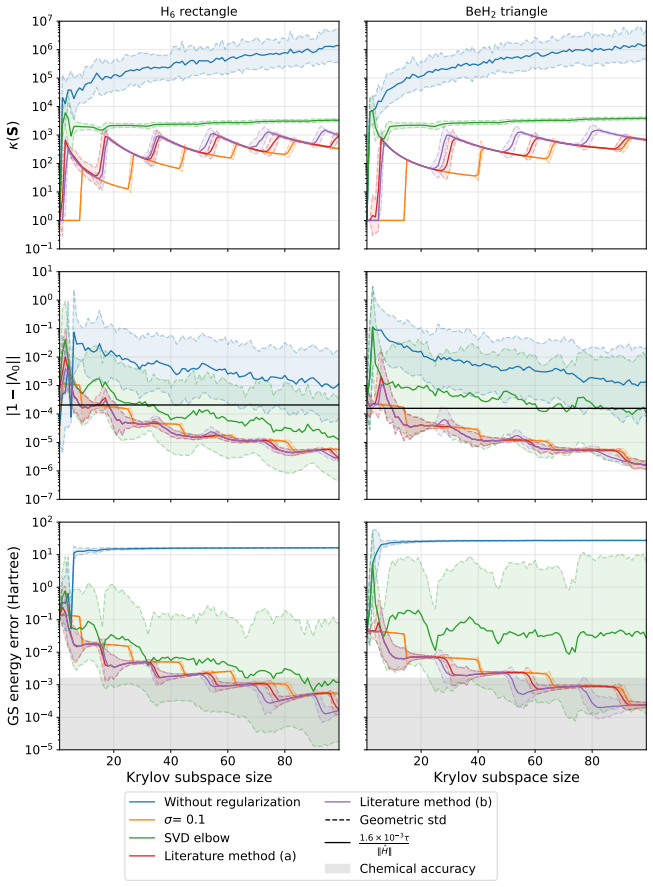
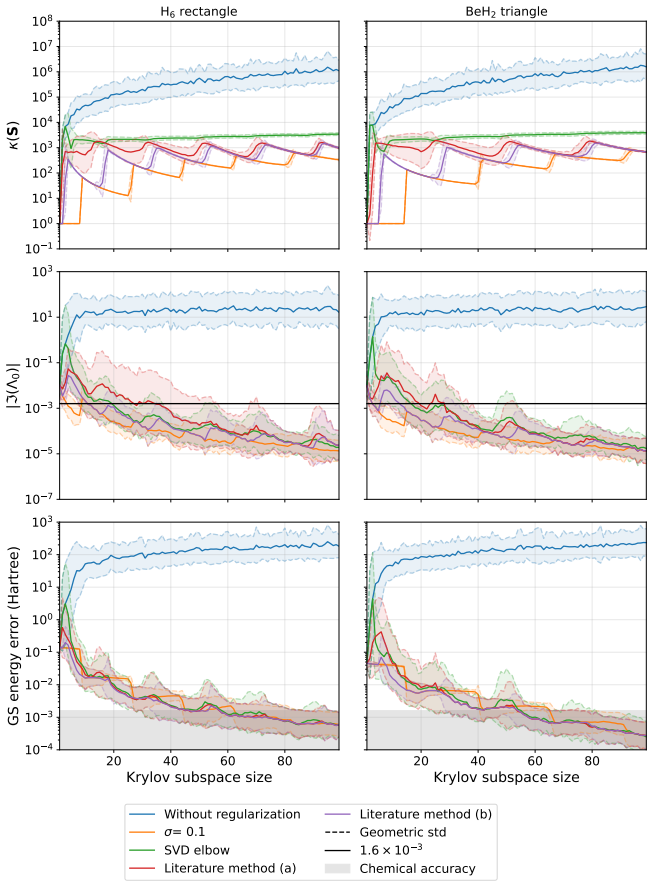
While the generalized eigenvalue problem in quantum Krylov methods becomes numerically unstable with larger subspaces under ideal conditions, realistic sampling noise shifts the primary obstacle to statistical fluctuations that can be mitigated by regularization or filtering. Two new metrics—the imaginary and unitary filters—successfully identify reliable solutions without any knowledge of the true eigenspectrum.
What carries the argument
The imaginary and unitary filters, which check consistency of candidate solutions under imaginary-time evolution and unitarity constraints to gauge reliability.
If this is right
- Regularization or filtering techniques become necessary to obtain usable energies from noisy Krylov simulations.
- The new filters provide a way to validate solutions without prior knowledge of the eigenspectrum.
- Efforts in early fault-tolerant algorithms should emphasize noise handling over simply enlarging the Krylov subspace.
- Statistical fluctuations set a practical limit on subspace size that is independent of numerical conditioning.
Where Pith is reading between the lines
- Hardware implementations may benefit more from improved shot allocation or error mitigation than from aggressive increases in subspace dimension.
- Similar consistency filters could be adapted to other variational or subspace quantum algorithms that rely on noisy expectation values.
- Direct comparison between simulated noise models and real-device data would test whether the identified statistical dominance persists beyond the current simulations.
Load-bearing premise
Numerical simulations that inject sampling noise accurately reproduce the dominant error sources and scaling behavior expected on actual early fault-tolerant quantum hardware.
What would settle it
Execute the Krylov method on a real quantum processor for a system whose ground-state energy is independently known, then verify whether the imaginary and unitary filters correctly flag reliable versus unreliable solutions without using that known energy value.
Figures


read the original abstract
Krylov subspace methods are among the most extensively studied early fault-tolerant quantum algorithms for estimating ground-state energies of quantum systems. However, the rapid onset of ill-conditioning might make accurate energies difficult or even impossible to retrieve. In this communication, we analyse the numerical stability and statistical problems of these methods using numerical simulations both in the presence and absence of sampling noise. While in ideal numerical simulations the generalized eigenvalue problem indeed becomes unstable with increased Krylov subspace size, we find that, in realistic noisy settings, these methods do not primarily suffer from ill-conditioning. Instead, statistical fluctuations dominate and can prevent reliable solution extraction unless appropriate regularization or filtering techniques are employed. We consequently introduce two new metrics, the imaginary and unitary filters, that successfully assess the reliability of the obtained solutions without any knowledge of the true eigenspectrum.
Editorial analysis
A structured set of objections, weighed in public.
Referee Report
Summary. The manuscript analyzes instabilities in quantum Krylov subspace methods for ground-state energy estimation on early fault-tolerant hardware. Using numerical simulations of the generalized eigenvalue problem in both ideal and noisy regimes, the authors conclude that ill-conditioning dominates only in the absence of noise, while statistical fluctuations from sampling noise become the primary obstacle to reliable eigenvalue extraction in realistic settings. They introduce two new metrics—the imaginary filter and the unitary filter—to assess solution reliability without knowledge of the true eigenspectrum and demonstrate their utility in filtering spurious solutions.
Significance. If the central claim holds, the work provides a practical reorientation for implementing Krylov methods on noisy quantum devices by emphasizing statistical error mitigation over purely numerical stabilization. The proposed filters offer a concrete, spectrum-independent diagnostic that could improve the usability of these algorithms; the numerical evidence for the dominance of statistical fluctuations, when properly controlled, would be a useful contribution to the growing literature on early fault-tolerant quantum algorithms.
major comments (2)
- [Numerical experiments / noise model] Numerical experiments section (around the description of noise injection): the simulations add independent shot noise or Gaussian perturbations to the overlap and Hamiltonian matrix elements. This independent-noise model is load-bearing for the claim that statistical fluctuations dominate ill-conditioning, yet the manuscript provides no tests or analysis of correlated errors (e.g., common phase drift or readout bias across basis elements) that are expected on hardware where circuits share gates and shots. Such correlations could alter the effective condition number or the distribution of spurious eigenvalues, potentially restoring ill-conditioning as the leading failure mode.
- [Filter definitions and validation] Section introducing the imaginary and unitary filters: the filters are shown to improve reliability on the independent-noise simulations, but their performance is not quantified against alternative regularization techniques (e.g., Tikhonov or truncated SVD) under varying noise strengths or subspace dimensions. Without such comparisons, it remains unclear whether the filters are the most effective or merely one workable choice.
minor comments (2)
- [Abstract / Introduction] The abstract and introduction use “realistic noisy settings” without a precise definition of the noise model or hardware assumptions; a short clarifying sentence would help readers map the simulations to specific device characteristics.
- [Figures] Figure captions for the simulation results should explicitly state the number of shots, the noise variance, and the system sizes used, rather than relegating these details solely to the main text.
Simulated Author's Rebuttal
We thank the referee for their constructive and insightful comments on our manuscript. These have prompted us to clarify several aspects of our analysis regarding the dominance of statistical fluctuations in noisy quantum Krylov subspace methods and the utility of the proposed filters. We address each major comment point by point below.
read point-by-point responses
-
Referee: [Numerical experiments / noise model] Numerical experiments section (around the description of noise injection): the simulations add independent shot noise or Gaussian perturbations to the overlap and Hamiltonian matrix elements. This independent-noise model is load-bearing for the claim that statistical fluctuations dominate ill-conditioning, yet the manuscript provides no tests or analysis of correlated errors (e.g., common phase drift or readout bias across basis elements) that are expected on hardware where circuits share gates and shots. Such correlations could alter the effective condition number or the distribution of spurious eigenvalues, potentially restoring ill-conditioning as the leading failure mode.
Authors: We appreciate the referee highlighting the importance of the noise model assumptions. Our simulations employ independent shot noise and Gaussian perturbations because these capture the leading statistical sampling errors when estimating overlap and Hamiltonian matrix elements from independent circuit executions, which is the standard model in the early fault-tolerant quantum algorithm literature. While we agree that correlated errors (such as shared phase drifts or readout biases) could in principle modify the effective conditioning or eigenvalue distributions, our central finding is that statistical fluctuations already dominate and prevent reliable extraction well before ill-conditioning becomes the limiting factor, even under this baseline independent model. In the revised manuscript we will add an explicit discussion of this modeling choice, including a qualitative analysis of how correlations might affect the results and a note that hardware-specific correlated noise models remain an important direction for future work. This addition will not change the main conclusions but will better contextualize the scope of our claims. revision: partial
-
Referee: [Filter definitions and validation] Section introducing the imaginary and unitary filters: the filters are shown to improve reliability on the independent-noise simulations, but their performance is not quantified against alternative regularization techniques (e.g., Tikhonov or truncated SVD) under varying noise strengths or subspace dimensions. Without such comparisons, it remains unclear whether the filters are the most effective or merely one workable choice.
Authors: We thank the referee for this valuable suggestion. The imaginary and unitary filters were designed specifically as spectrum-independent diagnostics that rely solely on intrinsic properties of the computed eigenvector (non-zero imaginary component and deviation from unitarity) and therefore require no knowledge of the true eigenspectrum or additional tunable parameters. Nevertheless, we agree that direct comparisons with established regularization methods such as Tikhonov regularization and truncated SVD would strengthen the presentation. In the revised manuscript we will add a new subsection containing numerical comparisons across a range of noise strengths and Krylov subspace dimensions. These results will demonstrate that the proposed filters achieve comparable or superior reliability in discarding spurious solutions while avoiding the need for spectrum-dependent hyperparameter tuning, thereby clarifying their practical advantage for early fault-tolerant implementations. revision: yes
Circularity Check
No circularity: empirical simulation analysis with independent noise injection
full rationale
The paper conducts numerical simulations of Krylov subspace methods both with and without added sampling noise, then observes that statistical fluctuations dominate ill-conditioning in the noisy case and proposes imaginary/unitary filters as reliability metrics. No load-bearing step reduces a claimed prediction or filter to a quantity fitted from the same data by construction, nor does any central claim rest on a self-citation chain. The work is self-contained against external benchmarks (ideal vs. noisy matrix ensembles) and does not invoke uniqueness theorems or ansatzes from prior author work.
Axiom & Free-Parameter Ledger
Reference graph
Works this paper leans on
-
[1]
Preskill, Quantum Computing in the NISQ era and beyond, Quantum2, 79 (2018)
J. Preskill, Quantum Computing in the NISQ era and beyond, Quantum2, 79 (2018)
2018
-
[2]
R. P. Feynman, Simulating physics with computers, Int. J. Theor. Phys.21, 467 (1982)
1982
-
[3]
R. M. Parrish and P. L. McMahon, Quantum Filter Diagonalization: Quantum Eigendecom- position without Full Quantum Phase Estimation (2019)
2019
-
[4]
Motta, C
M. Motta, C. Sun, A. T. K. Tan, M. J. O’Rourke, E. Ye, A. J. Minnich, F. G. S. L. Brand˜ ao, and G. K.-L. Chan, Determining eigenstates and thermal states on a quantum computer using quantum imaginary time evolution, Nat. Phys.16, 205 (2020)
2020
- [5]
-
[6]
N. H. Stair, R. Huang, and F. A. Evangelista, A Multireference Quantum Krylov Algorithm for Strongly Correlated Electrons, J. Chem. Theory Comput.16, 2236 (2020)
2020
-
[7]
T. E. Baker, Block Lanczos method for excited states on a quantum computer, Phys. Rev. A 110, 012420 (2024)
2024
-
[8]
Oumarou, P
O. Oumarou, P. J. Ollitrault, C. L. Cortes, M. Scheurer, R. M. Parrish, and C. Gogolin, Molec- ular Properties from Quantum Krylov Subspace Diagonalization, J. Chem. Theory Comput. 21, 4543 (2025)
2025
-
[9]
Klymko, C
K. Klymko, C. Mejuto-Zaera, S. J. Cotton, F. Wudarski, M. Urbanek, D. Hait, M. Head- Gordon, K. B. Whaley, J. Moussa, N. Wiebe, W. A. de Jong, and N. M. Tubman, Real-Time Evolution for Ultracompact Hamiltonian Eigenstates on Quantum Hardware, PRX Quantum 3, 020323 (2022)
2022
-
[10]
S. Kanasugi, Y. O. Nakagawa, N. Matsumoto, Y. Hidaka, K. Maruyama, and H. Oshima, Mirror subspace diagonalization: a quantum krylov algorithm with near-optimal sampling cost (2025), arXiv:2511.20998 [quant-ph]
-
[11]
Yeter-Aydeniz, R
K. Yeter-Aydeniz, R. C. Pooser, and G. Siopsis, Practical quantum computation of chemical and nuclear energy levels using quantum imaginary time evolution and Lanczos algorithms, npj Quantum Inf.6, 1 (2020)
2020
-
[12]
Zhang, A
Z. Zhang, A. Wang, X. Xu, and Y. Li, Measurement-efficient quantum krylov subspace diag- onalisation, Quantum8, 1438 (2023). 16
2023
-
[13]
P. F. Kwao, S. Poyyapakkam Sundar, B. Gupt, and A. Asthana, Generalized Eigenvalue Problem in Subspace-Based Excited-State Methods for Quantum Computers, J. Chem. Theory Comput.22, 2892 (2026)
2026
-
[14]
G. Lee, S. Choi, J. Huh, and A. F. Izmaylov, Efficient Strategies for Reducing Sampling Error in Quantum Krylov Subspace Diagonalization, Digit. Discov.4, 954 (2025)
2025
-
[15]
E. N. Epperly, L. Lin, and Y. Nakatsukasa, A theory of quantum subspace diagonalization, SIAM J. Matrix Anal. Appl.43, 1263 (2022)
2022
-
[16]
G. Lee, D. Lee, and J. Huh, Sampling Error Analysis in Quantum Krylov Subspace Diagonal- ization, Quantum8, 1477 (2024)
2024
-
[17]
Kirby, Analysis of quantum krylov algorithms with errors, Quantum8, 1457 (2024)
W. Kirby, Analysis of quantum krylov algorithms with errors, Quantum8, 1457 (2024)
2024
-
[18]
L. W. Anderson, M. Kiffner, T. O’Leary, J. Crain, and D. Jaksch, Solving lattice gauge theories using the quantum krylov algorithm and qubitization, Quantum9, 1669 (2025)
2025
-
[19]
M. G. J. Oliveira and N. Glaser, Quantum block Krylov subspace projector algorithm for computing low-lying eigenenergies, Phys. Rev. A112, 052442 (2025)
2025
-
[20]
Ritz, ¨Uber eine neue methode zur l¨ osung gewisser variationsprobleme der mathematischen physik., Journal f¨ ur die reine und angewandte Mathematik (Crelles Journal) , 1 (1909)
W. Ritz, ¨Uber eine neue methode zur l¨ osung gewisser variationsprobleme der mathematischen physik., Journal f¨ ur die reine und angewandte Mathematik (Crelles Journal) , 1 (1909)
1909
-
[21]
G. B. Arfken and H. J. Weber,Mathematical Methods for Physicists, 6th ed. (Elsevier Aca- demic Press, 2005) chapter 17
2005
-
[22]
Satopaa, J
V. Satopaa, J. Albrecht, D. Irwin, and B. Raghavan, Finding a ”kneedle” in a haystack: Detecting knee points in system behavior, in2011 31st International Conference on Distributed Computing Systems Workshops(2011) pp. 166–171
2011
-
[23]
A. Arrasmith, L. Cincio, R. D. Somma, and P. J. Coles, Operator sampling for shot-frugal optimization in variational algorithms (2020), arXiv:2004.06252 [quant-ph]
-
[24]
W. J. Hehre, R. F. Stewart, and J. A. Pople, Self-Consistent Molecular-Orbital Methods. I. Use of Gaussian Expansions of Slater-Type Atomic Orbitals, J. Chem. Phys.51, 2657 (1969)
1969
-
[25]
Jordan and E
P. Jordan and E. Wigner, ¨Uber das Paulische ¨Aquivalenzverbot, Zeitschrift fur Physik47, 631 (1928)
1928
-
[26]
A. Javadi-Abhari, M. Treinish, K. Krsulich, C. J. Wood, J. Lishman, J. Gacon, S. Martiel, P. D. Nation, L. S. Bishop, A. W. Cross, B. R. Johnson, and J. M. Gambetta, Quantum computing with Qiskit (2024), arXiv:2405.08810 [quant-ph]. 17 Supplementary information for: Tackling instabilities of quantum Krylov subspace methods: an analysis of the numerical an...
work page internal anchor Pith review arXiv 2024
discussion (0)
Sign in with ORCID, Apple, or X to comment. Anyone can read and Pith papers without signing in.