Recognition: unknown
Morphological false-vacuum decay in dipolar supersolids
Pith reviewed 2026-05-10 15:06 UTC · model grok-4.3
The pith
Dipolar supersolids undergo false-vacuum decay from a metastable honeycomb phase to a stripe phase through bubble nucleation.
A machine-rendered reading of the paper's core claim, the machinery that carries it, and where it could break.
Core claim
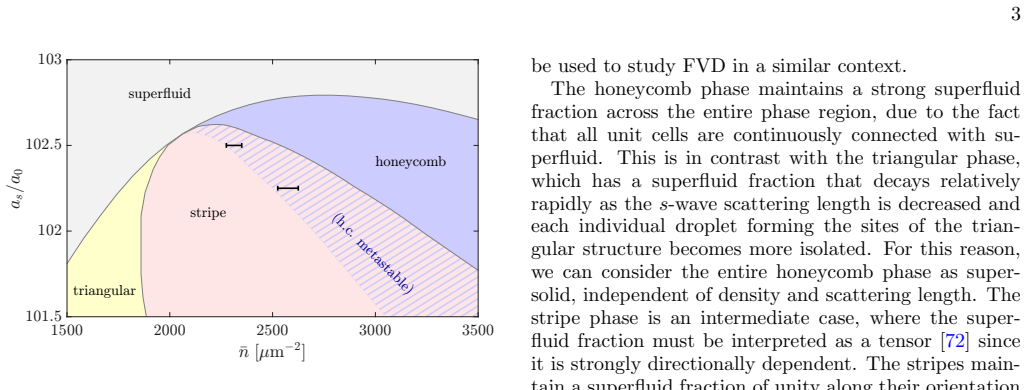
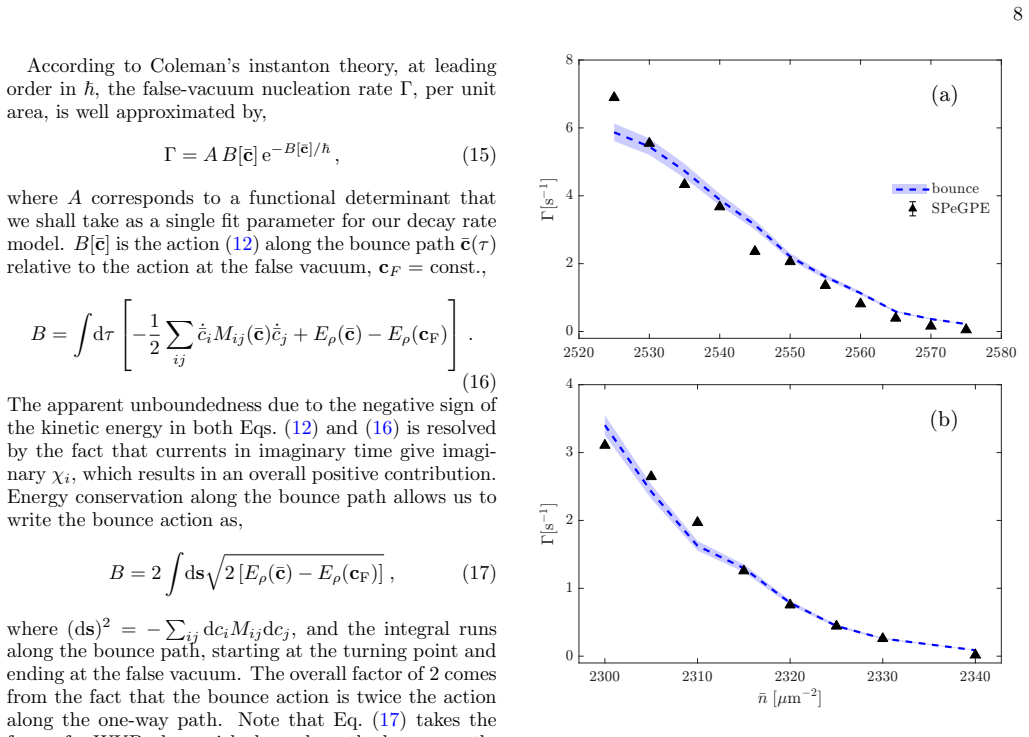
False-vacuum decay between two morphologically distinct supersolid phases via bubble nucleation is studied in a uniform dipolar gas confined to the plane. Starting from a metastable honeycomb state, the formation of stripe phase domains is simulated numerically by means of a stochastic projected extended Gross-Pitaevskii equation. The speed of bubble growth is analyzed in relation to the multiple speeds of sound of the supersolid, and is found to be set by the slowest of these sounds. The vacuum decay rate is numerically extracted and compared against a minimal effective model for the Coleman bounce solution connecting the two supersolid orders.
What carries the argument
The stochastic projected extended Gross-Pitaevskii equation simulating real-time dynamics of supersolid phases together with the Coleman bounce solution for the decay rate between morphological orders.
If this is right
- Bubble growth speed equals the slowest sound speed among the multiple sound modes of the supersolid.
- Numerically extracted decay rates agree with the minimal effective model based on the Coleman bounce solution.
- Bubble formation occurs directly in real-space density and can be probed with in situ imaging.
- The system supplies a rich structure of metastable states and collective excitations that participate in the decay.
Where Pith is reading between the lines
- Laboratory realizations with dipolar gases could enable direct experimental tests of false-vacuum decay in a controllable quantum many-body system.
- The limiting role of the slowest sound speed on bubble dynamics may appear in other phase transitions involving supersolids.
- Morphological false-vacuum processes could be explored in supersolids under different confinement geometries or dipolar interaction strengths.
Load-bearing premise
The stochastic projected extended Gross-Pitaevskii equation faithfully captures the real-time dynamics and fluctuation spectrum of the two supersolid phases without requiring corrections from beyond-mean-field effects or experimental imperfections.
What would settle it
An experiment measuring bubble expansion speed that differs from the slowest sound speed in the supersolid, or a decay rate that deviates from the Coleman bounce model prediction.
Figures




read the original abstract
False-vacuum decay between two morphologically distinct supersolid phases via bubble nucleation is studied in a uniform dipolar gas confined to the plane. Starting from a metastable honeycomb state, the formation of stripe phase domains is simulated numerically by means of a stochastic projected extended Gross-Pitaevskii equation. The speed of bubble growth is analyzed in relation to the multiple speeds of sound of the supersolid, and is found to be set by the slowest of these sounds. The vacuum decay rate is numerically extracted and compared against a minimal effective model for the Coleman bounce solution connecting the two supersolid orders. Our results establish dipolar supersolids as a novel and versatile platform for studying false-vacuum decay. This setting offers a rich structure of metastable states and collective excitations that come into play in the decay. Furthermore, here, in contrast to previous studies, bubble formation occurs directly in the real-space density and can be probed with \textit{in situ} imaging.
Editorial analysis
A structured set of objections, weighed in public.
Referee Report
Summary. The paper claims that false-vacuum decay occurs between a metastable honeycomb supersolid phase and the stable stripe phase in a uniform two-dimensional dipolar Bose gas, realized via bubble nucleation. Stochastic projected extended Gross-Pitaevskii equation (SPGPE) simulations starting from the honeycomb state show domain formation, with bubble expansion speed limited by the slowest sound speed of the supersolid; the extracted decay rate is compared to a minimal effective model based on the Coleman bounce solution connecting the two orders. The work positions dipolar supersolids as a platform for studying false-vacuum decay with real-space density observables accessible to in situ imaging.
Significance. If the central numerical results hold after validation, the manuscript would establish a controllable quantum-gas platform for morphological false-vacuum decay that features multiple sound speeds, collective excitations, and directly imageable real-space bubbles. This adds a new experimental setting distinct from prior scalar BEC or relativistic-field studies, with the SPGPE-to-Coleman comparison providing a concrete link between microscopic dynamics and effective tunneling theory.
major comments (2)
- [§3 and §4] §3 (Numerical Method) and §4 (Results): The SPGPE simulations are presented as faithfully capturing the real-time decay dynamics and fluctuation spectrum, yet the manuscript contains no discussion of convergence with respect to grid size, stochastic trajectory number, or SPGPE cutoff, nor any error bars on the extracted decay rates. These omissions are load-bearing because the quantitative comparison to the Coleman-bounce effective model and the claim of slowest-sound-limited growth rest directly on the reliability of the reported rates.
- [§2.2 and §5] §2.2 and §5 (Effective Model): The minimal effective model for the Coleman bounce is introduced as an independent post-simulation check, but the manuscript does not specify how its parameters (e.g., potential barrier height or surface tension) are determined without reference to the SPGPE data. This leaves open whether the reported agreement is a genuine test or partly by construction, directly affecting the strength of the platform claim.
minor comments (3)
- [Abstract] Abstract: the statement that 'bubble formation occurs directly in the real-space density' would benefit from a single-sentence contrast with prior false-vacuum studies in which order-parameter bubbles are not directly imaged.
- [Figure captions] Figure captions (e.g., Fig. 2): axis labels for sound-speed comparisons should explicitly annotate the multiple sound speeds of the supersolid on the same plot for immediate visual assessment.
- [Notation] Notation: the definition of the 'slowest sound' in the supersolid should be cross-referenced to the dispersion relation derived earlier in the text to avoid ambiguity when comparing to bubble velocity.
Simulated Author's Rebuttal
We thank the referee for the careful reading and constructive comments. We address each major point below and will revise the manuscript to strengthen the presentation of numerical reliability and model independence.
read point-by-point responses
-
Referee: [§3 and §4] §3 (Numerical Method) and §4 (Results): The SPGPE simulations are presented as faithfully capturing the real-time decay dynamics and fluctuation spectrum, yet the manuscript contains no discussion of convergence with respect to grid size, stochastic trajectory number, or SPGPE cutoff, nor any error bars on the extracted decay rates. These omissions are load-bearing because the quantitative comparison to the Coleman-bounce effective model and the claim of slowest-sound-limited growth rest directly on the reliability of the reported rates.
Authors: We agree that explicit convergence tests and error estimates are necessary to support the quantitative claims. In the revised manuscript we will add a new subsection to §3 that reports convergence with respect to grid spacing, number of stochastic trajectories, and SPGPE cutoff energy. We will also attach statistical error bars to the extracted decay rates, obtained from the ensemble variance across independent trajectories. These additions will directly substantiate the reported bubble growth speeds and the comparison to the effective model. revision: yes
-
Referee: [§2.2 and §5] §2.2 and §5 (Effective Model): The minimal effective model for the Coleman bounce is introduced as an independent post-simulation check, but the manuscript does not specify how its parameters (e.g., potential barrier height or surface tension) are determined without reference to the SPGPE data. This leaves open whether the reported agreement is a genuine test or partly by construction, directly affecting the strength of the platform claim.
Authors: The parameters of the effective model are obtained entirely from the microscopic energy functional of the dipolar Bose gas and the equilibrium properties of the two supersolid phases, without any input from the SPGPE trajectories. The barrier height follows from the energy difference and saddle-point configuration between honeycomb and stripe states; the surface tension is computed from the excess interfacial energy in a separate, deterministic calculation. We will revise §2.2 to state this procedure explicitly and to emphasize that the Coleman-bounce comparison is therefore an independent test. revision: partial
Circularity Check
No significant circularity; numerical simulation and post-hoc comparison are independent
full rationale
The paper derives its results from direct numerical evolution under the stochastic projected extended Gross-Pitaevskii equation, which generates the real-time dynamics and bubble nucleation independently of the effective model. The decay rate is extracted from these simulations and compared afterward to a minimal Coleman-bounce effective model rather than being fitted to or defined by it. Bubble-growth speed is observed relative to the supersolid sound speeds as a post-simulation analysis. No load-bearing step reduces by construction to a self-citation, ansatz, or fitted input; the derivation remains self-contained against the external benchmark of the effective-model comparison.
Axiom & Free-Parameter Ledger
axioms (2)
- domain assumption The stochastic projected extended Gross-Pitaevskii equation accurately describes the real-time dynamics and fluctuation spectrum of the supersolid phases.
- domain assumption The two supersolid orders can be treated as distinct vacua connected by a Coleman bounce solution in an effective model.
Reference graph
Works this paper leans on
-
[1]
Ex- tending our ansatz further implies loosening this assump- tion, or going farther by taking into account higher har- monics with similar symmetry
are the same. Ex- tending our ansatz further implies loosening this assump- tion, or going farther by taking into account higher har- monics with similar symmetry. The integral of the density over the unit cell area, Auc = Z uc dx= Z √ 3Luc/2 0 Z y/ √ 3+Luc y/ √ 3 dx ! dy = √ 3L2 uc/2,(D3) gives Nuc ≡ Z uc dx|ψ| 2 ,(D4) and sinceN uc = ¯nAuc, choosing the...
-
[2]
In simpler terms, these points correspond to k=0and the two surrounding hexagons are constructed via the lattice vectorsb i
andb 2 = (4π/Luc)(0,1/ √ 3), and subject to max(|n|,|m|,|m + n|)≤2. In simpler terms, these points correspond to k=0and the two surrounding hexagons are constructed via the lattice vectorsb i. The dipole-dipole energy thus results as ED = ˜gdd 2 X i |Ki(c1, c2)|2 ˜U2D(ki).(D12) The coefficients can each be exactly calculated and are shown in Table I. 14 k...
-
[3]
Coleman, Fate of the false vacuum: Semiclassical the- ory, Phys
S. Coleman, Fate of the false vacuum: Semiclassical the- ory, Phys. Rev. D15, 2929 (1977)
1977
-
[4]
C. G. Callan and S. Coleman, Fate of the false vacuum. ii. first quantum corrections, Phys. Rev. D16, 1762 (1977)
1977
-
[5]
Altland and B
A. Altland and B. D. Simons,Condensed Matter Field Theory(Cambridge University Press, 2010)
2010
-
[6]
Farhi, A
E. Farhi, A. H. Guth, and J. Guven, Is it possible to cre- ate a universe in the laboratory by quantum tunneling?, Nuclear Physics B339, 417 (1990)
1990
-
[7]
Fialko, B
O. Fialko, B. Opanchuk, A. I. Sidorov, P. D. Drummond, and J. Brand, Fate of the false vacuum: Towards realiza- tion with ultra-cold atoms, EPL (Europhysics Letters) 110, 56001 (2015)
2015
-
[8]
Fialko, B
O. Fialko, B. Opanchuk, A. I. Sidorov, P. D. Drum- mond, and J. Brand, The universe on a table top: engi- neering quantum decay of a relativistic scalar field from a metastable vacuum, Journal of Physics B: Atomic, Molecular and Optical Physics50, 024003 (2017)
2017
-
[9]
Opanchuk, R
B. Opanchuk, R. Polkinghorne, O. Fialko, J. Brand, and P. D. Drummond, Quantum simulations of the early uni- verse, Annalen der Physik525, 866–876 (2013)
2013
-
[10]
Braden, M
J. Braden, M. C. Johnson, H. V. Peiris, and S. Weinfurt- ner, Towards the cold atom analog false vacuum, Journal of High Energy Physics2018(2018)
2018
-
[11]
Braden, M
J. Braden, M. C. Johnson, H. V. Peiris, A. Pontzen, and S. Weinfurtner, Nonlinear dynamics of the cold atom ana- log false vacuum, Journal of High Energy Physics2019 (2019)
2019
-
[12]
Braden, M
J. Braden, M. C. Johnson, H. V. Peiris, A. Pontzen, and S. Weinfurtner, New semiclassical picture of vacuum de- cay, Phys. Rev. Lett.123, 031601 (2019)
2019
-
[13]
Braden, M
J. Braden, M. C. Johnson, H. V. Peiris, A. Pontzen, and S. Weinfurtner, Erratum: New semiclassical picture of vacuum decay [phys. rev. lett. 123, 031601 (2019)], Phys. Rev. Lett.129, 059901 (2022)
2019
-
[14]
T. P. Billam, R. Gregory, F. Michel, and I. G. Moss, Simulating seeded vacuum decay in a cold atom system, Phys. Rev. D100, 065016 (2019)
2019
-
[15]
T. P. Billam, K. Brown, and I. G. Moss, Simulating cos- mological supercooling with a cold-atom system, Phys. Rev. A102, 043324 (2020)
2020
-
[16]
K. L. Ng, B. Opanchuk, M. Thenabadu, M. Reid, and P. D. Drummond, Fate of the false vacuum: Finite tem- perature, entropy, and topological phase in quantum sim- ulations of the early universe, PRX Quantum2, 010350 (2021)
2021
-
[17]
T. P. Billam, K. Brown, A. J. Groszek, and I. G. Moss, Simulating cosmological supercooling with a cold atom system. II. thermal damping and parametric instability, Phys. Rev. A104, 053309 (2021)
2021
-
[18]
T. P. Billam, K. Brown, and I. G. Moss, False-vacuum decay in an ultracold spin-1 bose gas, Phys. Rev. A105, L041301 (2022)
2022
-
[19]
T. P. Billam, K. Brown, and I. G. Moss, Bubble nucle- ation in a cold spin 1 gas, New Journal of Physics25, 043028 (2023)
2023
-
[20]
Braden, M
J. Braden, M. C. Johnson, H. V. Peiris, A. Pontzen, and S. Weinfurtner, Mass renormalization in lattice simula- tions of false vacuum decay, Phys. Rev. D107, 083509 (2023)
2023
-
[21]
A. C. Jenkins, J. Braden, H. V. Peiris, A. Pontzen, M. C. Johnson, and S. Weinfurtner, Analog vacuum decay from vacuum initial conditions, Phys. Rev. D109, 023506 (2024)
2024
-
[22]
A. C. Jenkins, I. G. Moss, T. P. Billam, Z. Hadzibabic, H. V. Peiris, and A. Pontzen, Generalized cold-atom sim- ulators for vacuum decay, Phys. Rev. A110, L031301 (2024)
2024
-
[23]
A. C. Jenkins, H. V. Peiris, and A. Pontzen, Bubbles in a box: Eliminating edge nucleation in cold-atom simulators of vacuum decay, Phys. Rev. A112, 023318 (2025)
2025
- [24]
- [25]
-
[26]
Lagnese, F
G. Lagnese, F. M. Surace, M. Kormos, and P. Calabrese, False vacuum decay in quantum spin chains, Phys. Rev. B104, L201106 (2021)
2021
-
[27]
S. B. Rutkevich, Decay of the metastable phase ind= 1 andd= 2 Ising models, Phys. Rev. B60, 14525 (1999)
1999
-
[28]
Sinha, T
A. Sinha, T. Chanda, and J. Dziarmaga, Nonadiabatic dynamics across a first-order quantum phase transition: Quantized bubble nucleation, Phys. Rev. B103, L220302 (2021)
2021
-
[29]
Pomponio, M
O. Pomponio, M. A. Werner, G. Zar´ and, and G. Takacs, Bloch oscillations and the lack of the decay of the false vacuum in a one-dimensional quantum spin chain, Sci- Post Physics12, 061 (2022)
2022
-
[30]
Milsted, J
A. Milsted, J. Liu, J. Preskill, and G. Vidal, Collisions of false-vacuum bubble walls in a quantum spin chain, PRX Quantum3, 020316 (2022)
2022
-
[31]
Lencs´ es, G
M. Lencs´ es, G. Mussardo, and G. Tak´ acs, Variations on vacuum decay: The scaling Ising and tricritical Ising field theories, Phys. Rev. D106, 105003 (2022)
2022
-
[32]
J. A. Maki, A. Berti, I. Carusotto, and A. Biella, Monte carlo matrix-product-state approach to the false vacuum decay in the monitored quantum Ising chain, SciPost Physics15, 152 (2023)
2023
-
[33]
Darbha, M
S. Darbha, M. Kornjaˇ ca, F. Liu, J. Balewski, M. R. Hirs- brunner, P. L. S. Lopes, S.-T. Wang, R. Van Beeumen, D. Camps, and K. Klymko, False vacuum decay and nu- cleation dynamics in neutral atom systems, Phys. Rev. B110, 155103 (2024)
2024
-
[34]
Lagnese, F
G. Lagnese, F. M. Surace, S. Morampudi, and F. Wilczek, Detecting a long-lived false vacuum with quantum quenches, Phys. Rev. Lett.133, 240402 (2024)
2024
-
[35]
Pomponio, A
O. Pomponio, A. Krasznai, and G. Tak´ acs, Confinement and false vacuum decay on the potts quantum spin chain, SciPost Physics18, 082 (2025)
2025
-
[36]
C. Yin, F. M. Surace, and A. Lucas, Theory of metastable states in many-body quantum systems, Phys. Rev. X15, 011064 (2025)
2025
-
[37]
Abel and M
S. Abel and M. Spannowsky, Quantum-field-theoretic simulation platform for observing the fate of the false vacuum, PRX Quantum2, 010349 (2021)
2021
-
[38]
Vodeb, J.-Y
J. Vodeb, J.-Y. Desaules, A. Hallam, A. Rava, G. Hu- mar, D. Willsch, F. Jin, M. Willsch, K. Michielsen, and Z. Papi´ c, Stirring the false vacuum via interacting quan- tized bubbles on a 5,564-qubit quantum annealer, Nature Physics21, 386–392 (2025). 16
2025
- [39]
- [40]
-
[41]
Zenesini, A
A. Zenesini, A. Berti, R. Cominotti, C. Rogora, I. G. Moss, T. P. Billam, I. Carusotto, G. Lamporesi, A. Re- cati, and G. Ferrari, False vacuum decay via bubble for- mation in ferromagnetic superfluids, Nature Physics20, 558–563 (2024)
2024
-
[42]
Penrose and L
O. Penrose and L. Onsager, Bose-Einstein condensation and liquid helium, Phys. Rev.104, 576 (1956)
1956
-
[43]
E. P. Gross, Unified theory of interacting bosons, Phys. Rev.106, 161 (1957)
1957
-
[44]
Gross, Classical theory of boson wave fields, Annals of Physics4, 57 (1958)
E. Gross, Classical theory of boson wave fields, Annals of Physics4, 57 (1958)
1958
-
[45]
Andreev and I
A. Andreev and I. Lifshitz, Quantum theory of defects in crystals, J. Exp. Theo. Phys.56, 2057 (1969)
2057
-
[46]
A. J. Leggett, Can a solid be ”superfluid”?, Phys. Rev. Lett.25, 1543 (1970)
1970
-
[47]
Boninsegni and N
M. Boninsegni and N. V. Prokof’ev, Colloquium: Super- solids: What and where are they?, Rev. Mod. Phys.84, 759 (2012)
2012
-
[48]
S.-C. Ji, L. Zhang, X.-T. Xu, Z. Wu, Y. Deng, S. Chen, and J.-W. Pan, Softening of roton and phonon modes in a Bose-Einstein condensate with spin-orbit coupling, Phys. Rev. Lett.114, 105301 (2015)
2015
-
[49]
J.-R. Li, J. Lee, W. Huang, S. Burchesky, B. Shteynas, F. C ¸ . Top, A. O. Jamison, and W. Ketterle, A stripe phase with supersolid properties in spin–orbit-coupled Bose–Einstein condensates, Nature543, 91 (2017)
2017
-
[50]
T. M. Bersano, J. Hou, S. Mossman, V. Gokhroo, X.-W. Luo, K. Sun, C. Zhang, and P. Engels, Experimental re- alization of a long-lived striped Bose-Einstein condensate induced by momentum-space hopping, Phys. Rev. A99, 051602 (2019)
2019
-
[51]
Tanzi, E
L. Tanzi, E. Lucioni, F. Fam` a, J. Catani, A. Fioretti, C. Gabbanini, R. N. Bisset, L. Santos, and G. Modugno, Observation of a dipolar quantum gas with metastable supersolid properties, Phys. Rev. Lett.122, 130405 (2019)
2019
-
[52]
B¨ ottcher, J.-N
F. B¨ ottcher, J.-N. Schmidt, M. Wenzel, J. Hertkorn, M. Guo, T. Langen, and T. Pfau, Transient supersolid properties in an array of dipolar quantum droplets, Phys. Rev. X9, 011051 (2019)
2019
-
[53]
Chomaz, D
L. Chomaz, D. Petter, P. Ilzh¨ ofer, G. Natale, A. Traut- mann, C. Politi, G. Durastante, R. M. W. van Bijnen, A. Patscheider, M. Sohmen, M. J. Mark, and F. Ferlaino, Long-lived and transient supersolid behaviors in dipolar quantum gases, Phys. Rev. X9, 021012 (2019)
2019
-
[54]
Chomaz, I
L. Chomaz, I. Ferrier-Barbut, F. Ferlaino, B. Laburthe- Tolra, B. L. Lev, and T. Pfau, Dipolar physics: a review of experiments with magnetic quantum gases, Reports on Progress in Physics86, 026401 (2022)
2022
-
[55]
M. A. Norcia, C. Politi, L. Klaus, E. Poli, M. Sohmen, M. J. Mark, R. N. Bisset, L. Santos, and F. Ferlaino, Two-dimensional supersolidity in a dipolar quantum gas, Nature596, 357 (2021)
2021
-
[56]
Bland, E
T. Bland, E. Poli, C. Politi, L. Klaus, M. A. Norcia, F. Ferlaino, L. Santos, and R. N. Bisset, Two-dimensional supersolid formation in dipolar condensates, Phys. Rev. Lett.128, 195302 (2022)
2022
- [57]
-
[58]
Sohmen, C
M. Sohmen, C. Politi, L. Klaus, L. Chomaz, M. J. Mark, M. A. Norcia, and F. Ferlaino, Birth, life, and death of a dipolar supersolid, Phys. Rev. Lett.126, 233401 (2021)
2021
-
[59]
Zhang, F
Y.-C. Zhang, F. Maucher, and T. Pohl, Supersolidity around a critical point in dipolar Bose-Einstein conden- sates, Phys. Rev. Lett.123, 015301 (2019)
2019
-
[60]
Schmidt, L
M. Schmidt, L. Lassabli` ere, G. Qu´ em´ ener, and T. Lan- gen, Self-bound dipolar droplets and supersolids in molecular bose-einstein condensates, Phys. Rev. Res.4, 013235 (2022)
2022
-
[61]
B. T. E. Ripley, D. Baillie, and P. B. Blakie, Two- dimensional supersolidity in a planar dipolar Bose gas, Phys. Rev. A108, 053321 (2023)
2023
-
[62]
D. Lima, M. Grossklags, V. Zampronio, F. Cinti, and A. Mendoza-Coto, Supersolid dipolar phases in planar geometry: Effects of tilted polarization, Phys. Rev. A 111, 063311 (2025)
2025
-
[63]
A.-C. Lee, D. Baillie, and P. B. Blakie, Stability of a flattened dipolar binary condensate: Emergence of the spin roton, Phys. Rev. Res.4, 033153 (2022)
2022
-
[64]
U. R. Fischer, Stability of quasi-two-dimensional Bose- Einstein condensates with dominant dipole-dipole inter- actions, Phys. Rev. A73, 031602 (2006)
2006
-
[65]
Ticknor, R
C. Ticknor, R. M. Wilson, and J. L. Bohn, Anisotropic superfluidity in a dipolar Bose gas, Phys. Rev. Lett.106, 065301 (2011)
2011
-
[66]
Baillie and P
D. Baillie and P. B. Blakie, A general theory of flattened dipolar condensates, New Journal of Physics17, 033028 (2015)
2015
-
[67]
Sch¨ utzhold, M
R. Sch¨ utzhold, M. Uhlmann, Y. Xu, and U. R. Fischer, Mean-field expansion in Bose–Einstein condensates with finite-range interactions, International Journal of Modern Physics B20, 3555–3565 (2006)
2006
-
[68]
A. R. P. Lima and A. Pelster, Quantum fluctuations in dipolar Bose gases, Phys. Rev. A84, 041604 (2011)
2011
-
[69]
L. Chomaz, Quantum-stabilized states in magnetic dipo- lar quantum gases, Annual Review of Condensed Mat- ter Physics 10.1146/annurev-conmatphys-061125-032048 (2025)
-
[70]
W¨ achtler and L
F. W¨ achtler and L. Santos, Quantum filaments in dipo- lar Bose-Einstein condensates, Phys. Rev. A93, 061603 (2016)
2016
-
[71]
W¨ achtler and L
F. W¨ achtler and L. Santos, Ground-state properties and elementary excitations of quantum droplets in dipolar Bose-Einstein condensates, Phys. Rev. A94, 043618 (2016)
2016
-
[72]
Zhang, T
Y.-C. Zhang, T. Pohl, and F. Maucher, Metastable pat- terns in one- and two-component dipolar Bose-Einstein condensates, Phys. Rev. Res.6, 023023 (2024)
2024
-
[73]
P. B. Blakie, Dirac points and shear instability induced crystal transitions in honeycomb supersolids, Phys. Rev. Lett.134, 013401 (2025)
2025
-
[74]
P. B. Blakie, Superfluid fraction tensor of a two- dimensional supersolid, Journal of Physics B: Atomic, Molecular and Optical Physics57, 115301 (2024)
2024
-
[75]
S. J. Rooney, P. B. Blakie, and A. S. Bradley, Stochastic projected Gross-Pitaevskii equation, Phys. Rev. A86, 17 053634 (2012)
2012
-
[76]
S. J. Rooney, P. B. Blakie, and A. S. Bradley, Numeri- cal method for the stochastic projected Gross-Pitaevskii equation, Phys. Rev. E89, 013302 (2014)
2014
-
[77]
E. B. Linscott and P. B. Blakie, Thermally activated local collapse of a flattened dipolar condensate, Phys. Rev. A 90, 053605 (2014)
2014
-
[78]
S. J. Rooney, T. W. Neely, B. P. Anderson, and A. S. Bradley, Persistent-current formation in a high- temperature Bose-Einstein condensate: An experimental test for classical-field theory, Phys. Rev. A88, 063620 (2013)
2013
-
[79]
R. G. McDonald, P. S. Barnett, F. Atayee, and A. Bradley, Dynamics of hot Bose-Einstein condensates: stochastic Ehrenfest relations for number and energy damping, SciPost Physics8, 029 (2020)
2020
-
[80]
C. W. Gardiner and M. J. Davis, The stochastic Gross–Pitaevskii equation: II, Journal of Physics B: Atomic, Molecular and Optical Physics36, 4731–4753 (2003)
2003
discussion (0)
Sign in with ORCID, Apple, or X to comment. Anyone can read and Pith papers without signing in.