REVIEW 2 major objections 3 references
CArtBench: Evaluating Vision-Language Models on Chinese Art Understanding, Interpretation, and Authenticity
T0 review · 2 major / 0 minor · reviewed 2026-07-12 · grok-4.5
Pith's one-line read Vision-language models still fail at connoisseur-level Chinese art: high short-form scores hide weak style-to-period inference, expert appreciation, and authenticity discrimination.
desk verdict Solid museum-grounded Chinese-art VLM suite: the large-task gaps are real and useful; the authenticity/reinterpret pieces are diagnostic only. read the letter →
The pith
A machine-rendered reading of the paper's core claim, the machinery that carries it, and where it could break.
The reading
What carries the argument
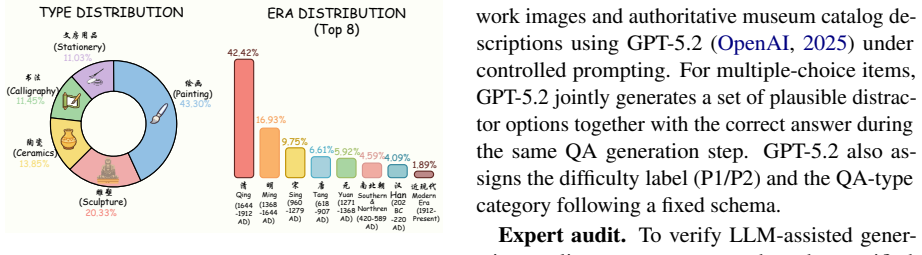
CArtBench: a four-task, museum-grounded suite (CuratorQA, CatalogCaption, Reinterpret, ConnoisseurPairs) built by aligning Palace Museum image objects from Wikidata with authoritative catalog pages, then applying expert-guided filtering and controlled task instantiation so short-form recognition, structured appreciation, defensible reinterpretation, and authenticity diagnostics can be evaluated together.
What would settle it
Expand CuratorQA with a large set of fully human-authored questions and multi-museum sources, re-run the same models, and check whether the style-to-period and P2 accuracy drops disappear; or enlarge ConnoisseurPairs with many more expert-vetted pairs and test whether authenticity accuracy rises well above chance with the same systems.
Extended reading notes
Core claim
High aggregate accuracy on museum-grounded Chinese-art questions can coexist with large degradations on hard evidence linking and style-to-period inference; structured long-form appreciation remains far from expert references; and authenticity discrimination under visually similar confounds stays near chance. Across nine VLMs, these patterns show that connoisseur-level Chinese-art reasoning—evidence-faithful interpretation and confound-aware discrimination—is still largely unsolved.
Load-bearing premise
The load-bearing premise is that LLM-written questions cleaned by filters and a limited expert audit, drawn from one museum's catalog style, are clean enough that measured gaps on knowledge-heavy and authenticity tasks reflect real curator competence rather than generation artifacts or institutional framing.
Editorial analysis
A structured set of objections, weighed in public.
Referee Report
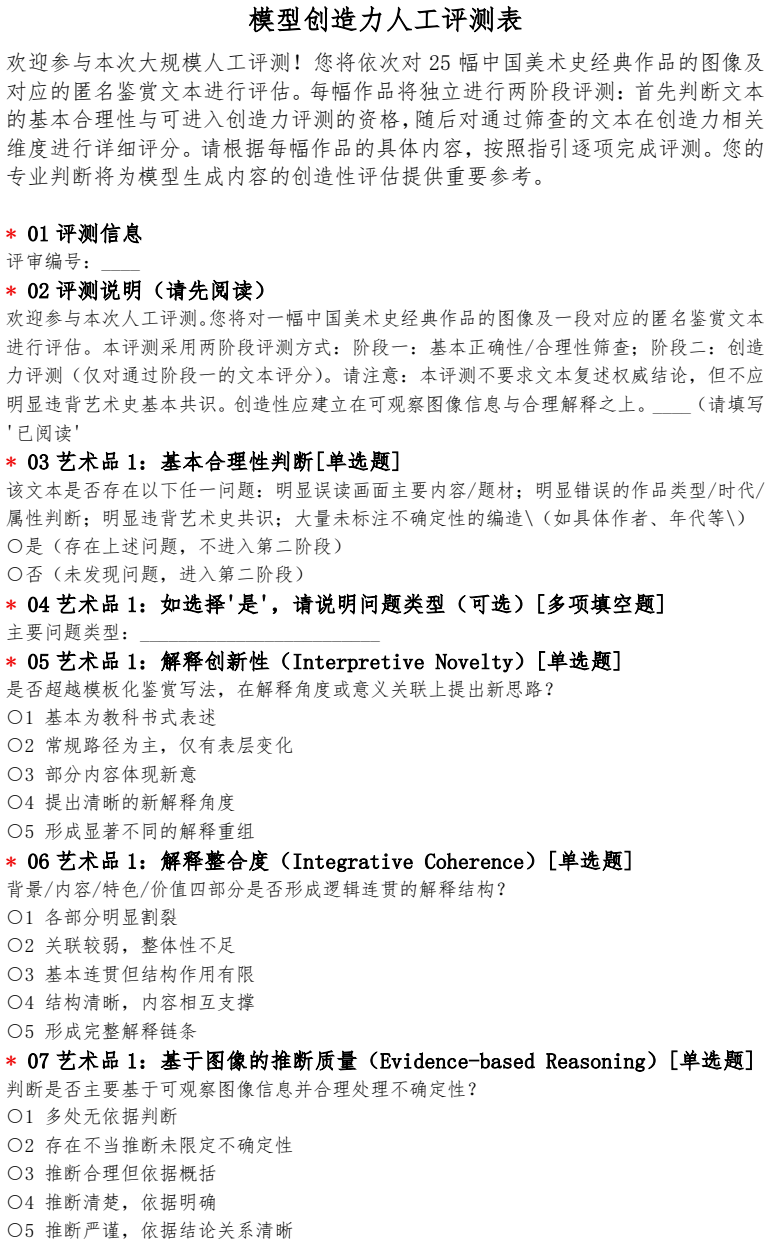
Summary. The paper introduces CArtBench, a museum-grounded VLM benchmark for Chinese art built by aligning Palace Museum Wikidata objects with catalog pages. It defines four tasks: CuratorQA (14,421 evidence-grounded MC/verification questions over 1,589 works), CatalogCaption (structured four-section appreciation on 86 works), Reinterpret (expert-rated creative reinterpretation on 25 canonical works), and ConnoisseurPairs (authenticity discrimination on 10 authentic–imitation pairs). Across nine VLMs, the main empirical claim is that high aggregate CuratorQA accuracy coexists with sharp drops on style-to-period inference (QA5) and knowledge-involved P2 items; CatalogCaption remains far below expert references (best model KPI ≈0.26 vs human ≈0.70); and authenticity discrimination stays near chance. Evaluation combines exact-match accuracy, character-level overlap metrics, embedding similarity, KPI weight sensitivity, and multi-rater human rubrics with IAA reporting.
Significance. If the results hold, CArtBench fills a clear gap: culturally grounded, museum-facing evaluation of Chinese art that goes beyond short-form recognition/QA into evidence linkage, structured appreciation, interpretive defensibility, and confound-aware authenticity. Strengths include a large audited CuratorQA set, expert-rewritten CatalogCaption references, explicit diagnostic framing for the small Reinterpret/ConnoisseurPairs tasks, KPI ranking stability under weight perturbations, bilingual-vs-API gap tests with McNemar and artwork-clustered bootstrap, and planned release of IDs, annotations, and evaluation code. The paper’s failure-mode analysis (QA5/P2 drops; near-chance authenticity) is actionable for culturally grounded multimodal systems and museum-facing applications.
major comments (2)
- §3.3 and Limitations: CuratorQA gold labels and distractors are LLM-assisted (GPT-5.2). The stratified expert audit of 1,000 questions (1 error; ≈0.47% upper-bound error rate) is a strong mitigation, but it does not fully address whether recurring templates or distractor patterns systematically inflate aggregate accuracy while concentrating residual artifacts on P2/QA5—the subsets that carry the central “high overall accuracy masks hard failures” claim (Table 1). A load-bearing addition would be a small human-authored or adversarially rewritten contrast set (or explicit shortcut analysis) showing that the QA5/P2 gaps persist under non-LLM construction.
- §6.4, Table 6 and Limitations: ConnoisseurPairs (n=10) is correctly labeled diagnostic, yet the abstract and conclusion still treat near-chance authenticity as a co-equal pillar of the main finding. With accuracy estimates of 0.4–0.6 on 10 pairs, variance is high and model ranking is not supported. Either enlarge the pair set (or report bootstrap CIs / chance-level tests) or demote authenticity language in the abstract/conclusion so the central claim rests primarily on CuratorQA and CatalogCaption, where n and protocols are stronger.
Circularity Check
No circularity: empirical VLM benchmark with held-out gold labels, expert references, and fixed a-priori metrics; findings are measurements, not constructions.
full rationale
CArtBench is an empirical evaluation paper, not a first-principles derivation. Its central claims (CuratorQA aggregate accuracy masking QA5/P2 drops; CatalogCaption KPI far below human; ConnoisseurPairs near chance) are measured against externally curated targets: LLM-assisted then expert-audited gold answers (1 error / 1000; §3.3), expert-rewritten four-section references, two-stage human rubrics, and specialist-curated authentic–imitation pairs. KPI weights are fixed a priori (λ = {0.45, 0.25, 0.20, 0.10}) and stress-tested under uniform/Dirichlet/Gaussian perturbations with stable rankings (Table 3; App. B.1)—not fitted to force a preferred model order. No equation equates a fitted parameter to a claimed prediction; no uniqueness theorem or ansatz is imported via self-citation as a load-bearing premise; no known empirical pattern is merely renamed. LLM-assisted question generation and single-museum sourcing are acknowledged limitations, not circular reductions of the reported results. The derivation chain is therefore self-contained against its stated evaluation protocols.
Assumptions & free parameters
free parameters (2)
- CatalogCaption KPI weights (λ_BERT, λ_CIDEr, λ_ROUGE, λ_BLEU) =
{0.45, 0.25, 0.20, 0.10}
- Expert Likert anchors and Stage-1 plausibility gate criteria for Reinterpret
assumptions (5)
- domain assumption Palace Museum catalog descriptions aligned via Wikidata titles, after expert filtering, constitute authoritative museum-grounded references for Chinese art evaluation.
- domain assumption P1 questions are answerable from visible evidence alone and P2 require visual cues plus art knowledge; QA5 legitimately probes style-to-period inference.
- domain assumption Character-level ROUGE/BLEU/CIDEr-like, Chinese BERTScore, and embedding cosine are useful scalable proxies for alignment to expert-rewritten four-section appreciations.
- ad hoc to paper A stratified expert audit of 1,000 LLM-generated questions with one corrected error implies residual gold-label error is negligible for reported accuracies.
- standard math Exact-match accuracy under constrained decoding is the right primary metric for CuratorQA.
invented entities (2)
-
CArtBench four-task suite (CuratorQA, CatalogCaption, Reinterpret, ConnoisseurPairs)
-
ConnoisseurPairs authentic–imitation diagnostic set (10 pairs)
Cite this review
Pith. "Pith review of CArtBench: Evaluating Vision-Language Models on Chinese Art Understanding, Interpretation, and Authenticity." pith.science (2026). https://pith.science/paper/AFWRNCUW
@misc{pith2026260411632,
  author       = {Pith},
  title        = {Pith review of: CArtBench: Evaluating Vision-Language Models on Chinese Art Understanding, Interpretation, and Authenticity},
  year         = {2026},
  howpublished = {\url{https://pith.science/paper/AFWRNCUW}},
  note         = {Machine review of arXiv:2604.11632}
}
read the original abstract
We introduce CARTBENCH, a museum-grounded benchmark for evaluating vision-language models (VLMs) on Chinese artworks beyond short-form recognition and QA. CARTBENCH comprises four subtasks: CURATORQA for evidence-grounded recognition and reasoning, CATALOGCAPTION for structured four-section expert-style appreciation, REINTERPRET for defensible reinterpretation with expert ratings, and CONNOISSEURPAIRS for diagnostic authenticity discrimination under visually similar confounds. CARTBENCH is built by aligning image-bearing Palace Museum objects from Wikidata with authoritative catalog pages, spanning five art categories across multiple dynasties. Across nine representative VLMs, we find that high overall CURATORQA accuracy can mask sharp drops on hard evidence linking and style-to-period inference; long-form appreciation remains far from expert references; and authenticity-oriented diagnostic discrimination stays near chance, underscoring the difficulty of connoisseur-level reasoning for current models.
Figures

Figures from the paper (4 more)


Reference graph
Works this paper leans on
-
[1]
Artemis: Affective language for visual art. In Proceedings of the IEEE/CVF Conference on Com- puter Vision and Pattern Recognition (CVPR), pages 11569–11579. Aishwarya Agrawal, Dhruv Batra, Devi Parikh, and Aniruddha Kembhavi. 2018. Don’t just assume; look and answer: Overcoming priors for visual question answering. InProceedings of the IEEE/CVF Con- fere...
arXiv 2018
-
[2]
Cmmu: A benchmark for chinese multi-modal multi-type question understanding and reasoning. Preprint, arXiv:2401.14011. Feng Jin, Qingling Chang, and Zehua Xu. 2023. Muse- umqa: A fine-grained question answering dataset for museums and artifacts. InProceedings of the 2023 6th International Conference on Machine Learning and Natural Language Processing (MLN...
arXiv 2023
-
[3]
标题/作者/年代/著录/历 史事 件细节 /释文
For each sampled w, we compute KPIw =P i wi mi where mi denotes the corresponding metric value, then obtain a model ranking induced by KPIw. We compare each ranking to the default- weight ranking using Spearman’sρ and Kendall’sτ. We also compute (i)Top-1 same rate, the fraction of scenarios in which the best-performingmodel (excluding human baselines) is ...
2025
Reviewed July 12, 2026 · model on record in the stance chip above.
Discussion (0). Continue with ORCID to comment.