Recognition: unknown
Implementation and commissioning of an experimental system towards sub-eV axion-like particle searches with 0.1 PW laser at ELI-NP
Pith reviewed 2026-05-10 15:36 UTC · model grok-4.3
The pith
An integrated experimental system at ELI-NP has been commissioned and validated for background studies in sub-eV axion-like particle searches with four-wave mixing of 0.1 PW laser pulses.
A machine-rendered reading of the paper's core claim, the machinery that carries it, and where it could break.
Core claim
The authors have integrated vacuum, beam-overlap, and trigger subsystems into the 0.1 PW experimental area at ELI-NP and commissioned the full system for four-wave-mixing searches for axion-like particles. Performance was validated through measurements of laser characteristics, stability, and four-wave-mixing signal detections at 20 mJ pulse energy and 1.3 times 10^{-7} mbar vacuum pressure, demonstrating that the apparatus is fully functional as designed and ready for stepwise scale-up to the maximum 2.5 J energy.
What carries the argument
Four-wave mixing of two coaxially combined laser beams inside a controlled vacuum focal region, enabled by integrated subsystems that regulate vacuum pressure, spatiotemporal beam overlap, and event-trigger patterns to identify and subtract backgrounds from residual atoms and optical elements.
If this is right
- Residual backgrounds from gas and optics can be systematically identified and quantified at the 20 mJ level.
- Laser stability and four-wave-mixing signal detection have been confirmed under the required vacuum and overlap conditions.
- The platform supports controlled increases in pulse energy from 20 mJ to 2.5 J without redesign of the core subsystems.
- The same apparatus can be used for dedicated background runs prior to any ALP search campaign.
Where Pith is reading between the lines
- If background control holds at full power, the setup could be used to set new experimental limits on ALP-photon coupling in the sub-eV mass window.
- The stepwise energy ramp provides a practical template for risk reduction at other high-intensity laser facilities pursuing similar rare-event searches.
- The validated vacuum and overlap controls may also benefit non-ALP applications such as precision nonlinear optics or vacuum birefringence tests.
Load-bearing premise
Background signals produced by residual gas atoms and optical elements can be sufficiently suppressed or subtracted when the laser pulse energy is raised from 20 mJ to the full 2.5 J level.
What would settle it
A measurement performed at the full 2.5 J pulse energy in which the observed four-wave-mixing rate after background subtraction either scales with the product of the two laser intensities or remains below the projected sensitivity for sub-eV axion-like particles.
Figures









read the original abstract
We have developed and commissioned an experimental system at ELI-NP towards searches for axion-like particles (ALPs) in the worldwide 10~PW-class laser facility. The search principle is based on the Four-Wave Mixing (FWM) process at a focal region of coaxially combined two laser beams. The subsystems to control vacuum pressure, area size, spatiotemporal overlap and trigger-event pattern, are integrated into the experimental area for 0.1 PW laser output at ELI-NP. The integrated system is dedicated to identifying the possible background sources originated from the residual atoms and the optical elements. The performance and functionality of the subsystems were validated through the evaluations of laser characteristics, their stability and the FWM signal detections. Furthermore commissioning results for the background studies were demonstrated with 20 mJ-level laser pulses at the vacuum pressure of $1.3 \times 10^{-7}$ mbar. In conclusion, the integrated experimental system is fully functional as designed and provides a suitable platform for the background studies towards the ALP searches, enabling a stepwise scale-up of the laser pulse energies from 20 mJ to the maximum energy of 2.5 J in the 0.1 PW experimental area.
Editorial analysis
A structured set of objections, weighed in public.
Referee Report
Summary. The manuscript describes the implementation and commissioning of an integrated experimental system at ELI-NP for sub-eV axion-like particle searches based on four-wave mixing of two coaxially combined laser beams in a 0.1 PW facility. Subsystems controlling vacuum, focal overlap, and event triggering are integrated and validated via laser stability, FWM signal detection, and background measurements performed exclusively with 20 mJ pulses at 1.3×10^{-7} mbar; the authors conclude that the setup is fully functional and provides a platform enabling stepwise energy scaling from 20 mJ to the full 2.5 J.
Significance. If the reported low-power performance extends to higher energies, the work supplies a concrete, commissioned platform inside a 10 PW-class laser facility for ALP searches, with explicit metrics on pulse energy, vacuum level, and FWM detection that can serve as a baseline for future background-subtraction studies. The concrete subsystem validations constitute a strength for an experimental commissioning paper.
major comments (1)
- [Abstract (concluding statement) and commissioning results] All reported commissioning data, laser characterizations, FWM detections, and background studies are obtained at 20 mJ pulse energy. The central claim that the system 'is fully functional as designed and provides a suitable platform ... enabling a stepwise scale-up ... to the maximum energy of 2.5 J' (Abstract, final sentence) therefore rests on an untested extrapolation across a factor of 125 in energy. No scaling analysis, simulation of intensity-dependent effects (optical damage, self-focusing, plasma formation), or intermediate-power test is provided to show that residual-gas or optical-element backgrounds remain subtractable. This directly affects the load-bearing assertion of suitability for the full ALP program.
Simulated Author's Rebuttal
We thank the referee for the constructive review and for recognizing the value of the concrete subsystem validations in our commissioning paper. We address the single major comment below with a targeted revision to the abstract.
read point-by-point responses
-
Referee: [Abstract (concluding statement) and commissioning results] All reported commissioning data, laser characterizations, FWM detections, and background studies are obtained at 20 mJ pulse energy. The central claim that the system 'is fully functional as designed and provides a suitable platform ... enabling a stepwise scale-up ... to the maximum energy of 2.5 J' (Abstract, final sentence) therefore rests on an untested extrapolation across a factor of 125 in energy. No scaling analysis, simulation of intensity-dependent effects (optical damage, self-focusing, plasma formation), or intermediate-power test is provided to show that residual-gas or optical-element backgrounds remain subtractable. This directly affects the load-bearing assertion of suitability for the full ALP program.
Authors: We agree that the commissioning data are limited to 20 mJ and that the manuscript contains no scaling simulations or intermediate-power tests. The abstract statement was intended to convey that the integrated subsystems (vacuum control, beam overlap, and triggering) have been validated at the initial energy level and are engineered to support incremental energy increases up to 2.5 J within the 0.1 PW area. However, the phrasing can be read as implying readiness for the full program without further qualification. We will revise the abstract's concluding sentence to state explicitly that the present work establishes a validated low-energy platform for background studies, with stepwise energy scaling planned as future work. A short paragraph will also be added in the discussion section outlining the intended scaling sequence and the principal intensity-dependent effects that will be monitored at each step. This revision clarifies the scope without altering the reported results. revision: yes
Circularity Check
No circularity: experimental commissioning report with no derivations, equations, or predictions
full rationale
The paper is a pure experimental report describing the integration and testing of subsystems for vacuum control, laser overlap, and background identification at ELI-NP. Commissioning data (laser stability, FWM detection, residual-gas backgrounds) are presented exclusively from 20 mJ shots at 1.3e-7 mbar. No equations, fitted parameters, theoretical derivations, or quantitative predictions appear anywhere in the text. The concluding claim that the system 'is fully functional as designed and provides a suitable platform... enabling a stepwise scale-up' is an engineering assertion based on demonstrated low-power performance, not a mathematical reduction to inputs or self-citation. No load-bearing steps reduce by construction to prior results or fits.
Axiom & Free-Parameter Ledger
Reference graph
Works this paper leans on
-
[1]
The beam cross-section of the two lasers is illustrated with their spatial overlap before and after focusing in Fig
The area-size scan is designed to change spatial over- lap by controlling the beam diameter of Ti:Sa laser. The beam cross-section of the two lasers is illustrated with their spatial overlap before and after focusing in Fig. 4. The red circles represent the edge of Nd:YAG laser beam profile before focusing (a) and at the focal spot (b). The green dotted l...
-
[2]
The CPA system employs multiple amplification stages with Ti:Sapphire crystal for sub-ns- stretched broadband laser pulse to reach 250 J laser en- ergy
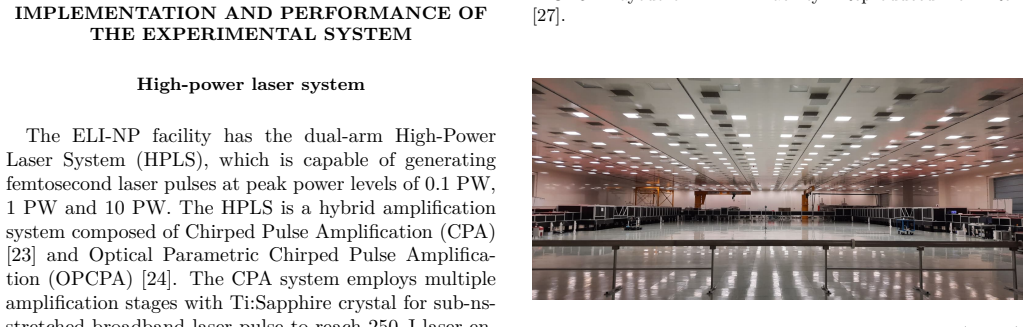
and Optical Parametric Chirped Pulse Amplifica- tion (OPCPA) [ 24]. The CPA system employs multiple amplification stages with Ti:Sapphire crystal for sub-ns- stretched broadband laser pulse to reach 250 J laser en- ergy. The OPCPA system utilizes a parametric ampli- fication for broadband gain and the suppression of the amplified spontaneous emission (ASE...
2000
-
[3]
G. R. Blumenthal, S. M. Faber, J. R. Primack and M. J. Rees, Nature 311, 517-525 (1984). doi: 10.1038/311517a0
-
[4]
S. Weinberg, Phys. Rev. Lett. 40 223 (1978). doi: 10.1103/PhysRevLett.40.223
-
[5]
F. Wilczek, Phys. Rev. Lett. 40 279 (1978). doi: 10.1103/PhysRevLett.40.279
-
[6]
R. D. Peccei and H. R. Quinn, Phys. Rev. Lett. 38 1440 (1977). doi: 10.1103/PhysRevLett.38.1440
-
[7]
K. Homma, D. Habs, and T. Tajima, Appl. Phys. B 106, 229–240 (2012). doi: 10.1007/s00340-011-4567-3
-
[8]
K. Homma, Prog. Theor. Exp. Phys. 2012, 04D004 (2012). doi: 10.1093/ptep/pts073
-
[9]
Y. Fujii and K. Homma, Prog. Theor. Phys 126 531 (2011); doi: 10.1143/PTP.126.531 Prog. Theor. Exp. Phys. 2014, 089203 (2014). [erratum] doi: 10.1093/ptep/ptu099
-
[10]
K. Homma and Y. Kirita, J. High Energy Phys 09, 095 (2020). doi: 10.1007/JHEP09(2020)095
-
[11]
C. N. Danson, C. Haefner, J. Bromage, T. Butcher, J.-C. F. Chanteloup, E. A. Chowdhury, A. Galvanauskas, L. A. Gizzi, J. Hein, D. I. Hillier, et al., High Power Laser Sci. Eng. 7 e54 (2019). doi: 10.1017/hpl.2019.36
-
[12]
Z. Li, Y. Leng, and R. Li, Laser Photonics Rev. 17 2100705 (2023). doi: 10.1002/lpor.202100705
-
[13]
K. Homma, O. Tesileanu, Y. Nakamiya, Y. Kirita, C. Chiochiu, M. Cuciuc, G. Giubega, T. Hasada, M. Hashida, F. Ishibashi, et al., Eur. Phys. J. A 59 109 (2023). doi: 10.1140/epja/s10050-023-01001-y
-
[14]
E. Arik et al. (CAST Collaboration), J. Cosmol. As- tropart. Phys. 02 008 (2009). doi: 10.1088/1475- 7516/2009/02/008
-
[16]
M. Arik et al. (CAST Collaboration), Phys. Rev. Lett. 112 091302 (2014). doi: 10.1103/Phys- RevLett.112.091302
-
[17]
V. Anastassopoulos et al. (CAST Collaboration), Nature Phys. 13 584 (2017). doi: 10.1038/nphys4109
-
[18]
K. Ehret et al. Phys. Lett. B 689 149-155 (2010). doi: 10.1016/j.physletb.2010.04.066
-
[19]
R. Ballou et al. (OSQAR Collaboration), Phys. Rev. D 92 092002 (2015). doi: 10.1103/PhysRevD.92.092002
-
[20]
T. Hasebe, K. Homma, Y. Nakamiya, K. Matsuura, K. Otani, M. Hashida, S. Inoue, and S. Sakabe, Prog. Theor. Exp. Phys. 2015 073C01 (2015). doi: 10.1093/ptep/ptv101
-
[21]
K. Homma et al. (SAPPHIRES Collabora- tion), J. High Energy Phys. 12 108 (2021). doi: 10.1007/JHEP12(2021)108
-
[22]
Y. Kirita et al. (SAPPHIRES Collaboration), J. High Energy Phys. 10 176 (2022). doi: 10.1007/JHEP10(2022)176
-
[23]
Y. Kirita et al. (SAPPHIRES Collaboration), J. High Energy Phys. 06 138 (2025). doi: 10.1007/JHEP06(2025)138
-
[24]
A. Zoubir, M. Richardson, L. Canioni, A. Brocas, and L. Sarger, J. Opt. Soc. Am. B 22 2138-2143 (2005). doi: 10.1364/JOSAB.22.002138
-
[25]
D. Strickland and G. Mourou, Optics Communications 56 219-221 (1985). doi: 10.1016/0030-4018(85)90120-8
-
[26]
A. Dubietis, G. Jonušauskas and A. Piskarskas, Optics Communications 88 437-440 (1992). doi: 10.1016/0030- 4018(92)90070-8
-
[27]
Radier et al., High Power Laser Sci
C. Radier et al., High Power Laser Sci. Eng. 10 e21 (2022). doi: 10.1017/hpl.2022.11
-
[28]
Chalus et al., High Power Laser Sci
O. Chalus et al., High Power Laser Sci. Eng. 12 e90 (2024). doi: 10.1017/hpl.2024.78
-
[29]
K. A. Tanaka et al., Matter Radiat. Extremes 5 024402 (2020). doi: 10.1063/1.5093535
-
[30]
C. Iaconis and I. A. Walmsley, Opt. Lett. 23 792-794 (1998). doi: 10.1364/OL.23.000792
-
[31]
C. Iaconis and I. A. Walmsley, IEEE J. Quantum Elec- tron. 35 501-509 (1999). doi: 10.1109/3.753654
-
[32]
M. E. Anderson, A. Monmayrant, S.-P. Gorza, P. Wasyl- czyk, and I. A. Walmsley, Laser Phys. Lett. 5 259 (2008). doi: 10.1002/lapl.200710129
discussion (0)
Sign in with ORCID, Apple, or X to comment. Anyone can read and Pith papers without signing in.