Recognition: unknown
Geometry-controlled magnon-polariton excitations in a bilayer planar cavity
Pith reviewed 2026-05-10 14:58 UTC · model grok-4.3
The pith
Placing two magnetic films inside one planar cavity lets their positions in the standing wave tune the strength of the collective magnon-photon interaction.
A machine-rendered reading of the paper's core claim, the machinery that carries it, and where it could break.
Core claim
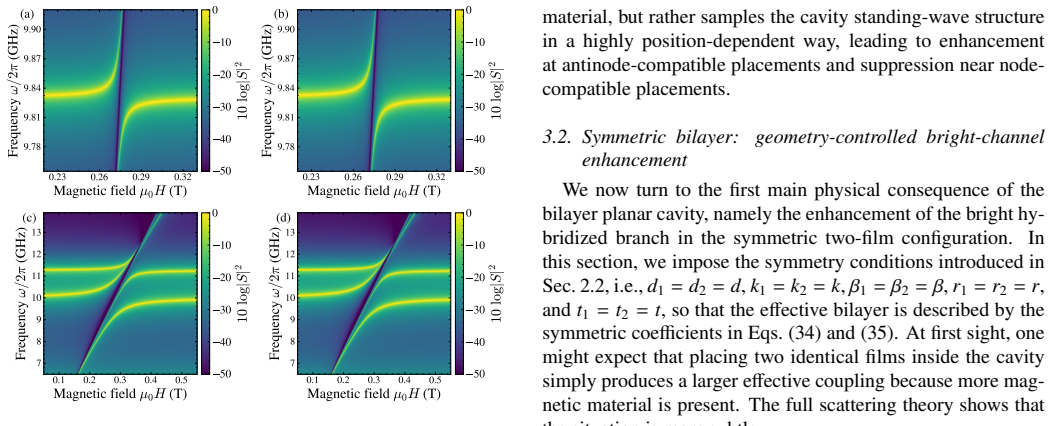
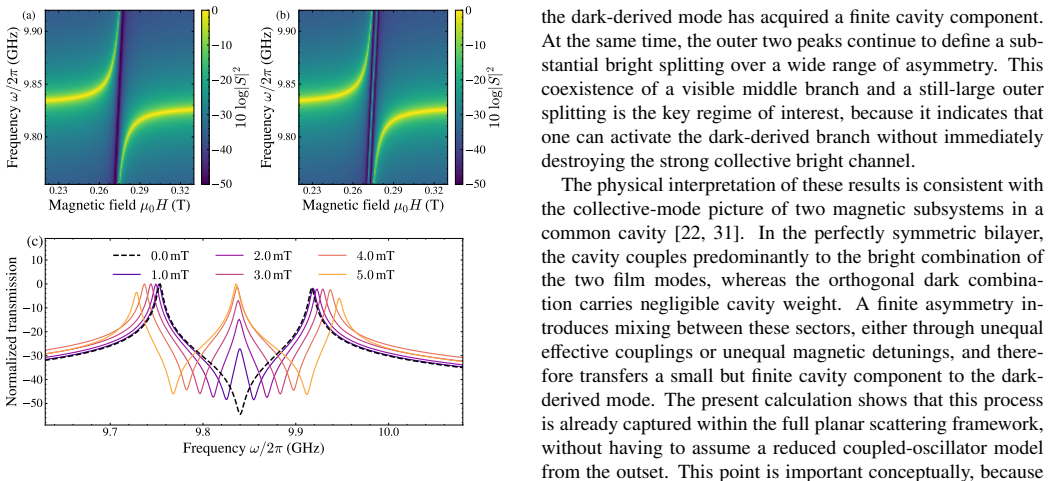
In the two-film scattering theory the bilayer does not simply strengthen the magnon-photon interaction by adding magnetic material; instead the positions of the films within the cavity standing-wave pattern select a collective bright channel whose coupling strength is enhanced at antinodes and suppressed at nodes. Weak symmetry breaking between the films transfers finite cavity weight to an otherwise dark mode, producing an extra spectroscopic branch. In the multimode extension with nonzero exchange, odd standing-spin-wave families reorganize into family-resolved bright and dark bilayer channels.
What carries the argument
The collective bright magnon channel whose visibility to the cavity photon is set by how the two films align with the standing-wave antinodes versus nodes.
If this is right
- Antinode-compatible placements increase the effective magnon-photon coupling constant.
- Node-compatible placements reduce or eliminate the main avoided crossing.
- Small symmetry breaking between the films activates an additional observable mode without destroying the primary splitting.
- In the multimode regime, exchange interaction sorts standing-spin-wave families into distinct bright and dark bilayer channels.
Where Pith is reading between the lines
- The same positional control could be used to suppress or enhance specific magnon modes in device designs without altering material properties.
- The bright-dark channel picture offers a way to think about mode selection in other multi-layer cavity systems beyond the macrospin limit.
- If the assumption of negligible direct interlayer coupling holds, the geometry-only tuning remains valid even when films are made from different materials.
Load-bearing premise
The two films interact only through the shared cavity field and their relative placement in its standing-wave pattern, with no significant direct dipolar or exchange coupling between the layers themselves.
What would settle it
Measure the size of the avoided crossing for identical films placed at an antinode versus at a node and check whether the gap changes with position while total film thickness is held fixed.
Figures




read the original abstract
Planar cavity magnonics has been developed predominantly for a single magnetic film, leaving the role of multiple magnetic layers in a cavity-scattering framework with spatial resolution largely unexplored. In this study, we introduce a bilayer planar cavity in which two magnetic films are embedded inside the same microwave cavity and interact through the cavity field and their relative placement within the standing-wave pattern. First, we derive a full two-film scattering theory in the macrospin limit and recover the exact zero-gap half-thickness limit to benchmark it against the known one-film planar result. This formulation reveals that the bilayer does not simply strengthen the magnon-photon interaction by adding magnetic material but instead enables position-dependent control of the collective bright channel. Antinode-compatible placements enhance effective coupling, whereas node-compatible placements suppress it. We then show that weak symmetry breaking between the two films transfers the finite cavity weight to a mode that is dark in the symmetric limit, producing an additional spectroscopic branch without immediately destroying the main avoided crossing. To extend the analysis beyond the macrospin regime, we formulate a reduced multimode bilayer theory for $J\neq 0$, where odd standing-spin-wave families reorganize into family-resolved bright and dark bilayer channels. Our results show that bilayer planar cavities are a minimal but versatile setting for controlling the collective magnon-polariton structure through geometry, symmetry, and exchange-driven mode hierarchy.
Editorial analysis
A structured set of objections, weighed in public.
Referee Report
Summary. The manuscript develops a two-film scattering theory for magnon-polariton excitations in a planar cavity, treating the magnetic films as interacting exclusively through the shared cavity field according to their positions in the standing-wave pattern. In the macrospin limit it recovers the known single-film result in the zero-gap half-thickness case and shows that bilayer geometry permits position-dependent tuning of the collective bright channel (enhanced at antinodes, suppressed at nodes) rather than simply increasing the total magnetic volume. The analysis is extended to weak symmetry breaking, which activates a previously dark mode, and to a reduced multimode theory (J ≠ 0) in which odd standing-spin-wave families reorganize into family-resolved bright and dark bilayer channels.
Significance. If the central results hold, the work demonstrates that bilayer placement inside a planar cavity supplies an additional geometric handle on magnon-photon hybridization and mode character that is not available in single-film devices. The analytical recovery of the established one-film limit and the parameter-free character of the macrospin derivation are clear strengths; the symmetry-breaking and multimode extensions further illustrate how geometry and exchange can be used to reorganize the polariton spectrum.
major comments (1)
- [Macrospin scattering theory] Macrospin scattering theory (abstract and the two-film derivation): the model explicitly states that the films 'interact through the cavity field and their relative placement within the standing-wave pattern' and therefore omits direct magnetostatic dipolar coupling. When the interlayer gap d becomes comparable to the film thickness, the interlayer dipolar field scales as ~1/d^3 and can hybridize the macrospins independently of the cavity phase, mixing bright/dark character and shifting the avoided-crossing gap. Although the zero-gap limit is recovered correctly, this does not guarantee that the position-dependent control of the bright channel remains purely geometric for finite but small d; an order-of-magnitude estimate of direct versus cavity-mediated coupling (or explicit inclusion of the dipolar term) is needed to substantiate the central claim.
minor comments (2)
- [Abstract] The abstract asserts recovery of the 'exact zero-gap half-thickness limit' but supplies no explicit equations or numerical checks; placing the key matching equation or a brief comparison table in the main text would improve readability.
- [Multimode extension] The multimode extension for J ≠ 0 reorganizes odd standing-spin-wave families but, like the macrospin part, does not discuss inter-film dipolar terms; a short paragraph justifying the regime of validity would clarify the scope.
Simulated Author's Rebuttal
We thank the referee for the careful reading of our manuscript and the constructive comment on the macrospin scattering theory. We address the point below.
read point-by-point responses
-
Referee: [Macrospin scattering theory] Macrospin scattering theory (abstract and the two-film derivation): the model explicitly states that the films 'interact through the cavity field and their relative placement within the standing-wave pattern' and therefore omits direct magnetostatic dipolar coupling. When the interlayer gap d becomes comparable to the film thickness, the interlayer dipolar field scales as ~1/d^3 and can hybridize the macrospins independently of the cavity phase, mixing bright/dark character and shifting the avoided-crossing gap. Although the zero-gap limit is recovered correctly, this does not guarantee that the position-dependent control of the bright channel remains purely geometric for finite but small d; an order-of-magnitude estimate of direct versus cavity-mediated coupling (or explicit inclusion of the dipolar term) is needed to substantiate the central claim.
Authors: We agree that the model omits direct magnetostatic dipolar coupling between the films, as it is formulated to isolate the cavity-mediated interaction and the geometric control arising from placement within the standing-wave pattern. This is an intentional simplification to focus on the bilayer-specific effects. To address the concern and substantiate the central claim, the revised manuscript will include an order-of-magnitude estimate of the direct dipolar coupling strength relative to the cavity-mediated interaction, using the film thicknesses, saturation magnetizations, and cavity parameters already employed in the paper. This estimate will identify the range of interlayer gaps d for which the geometric (position-dependent) control of the bright channel remains dominant, and we will explicitly state the validity conditions of the approximation. revision: yes
Circularity Check
Derivation self-contained; benchmarked against independent one-film result
full rationale
The paper derives the two-film macrospin scattering theory from cavity field interactions and relative placement in the standing-wave pattern, then explicitly recovers the known one-film planar result in the zero-gap half-thickness limit as a benchmark. This validation uses an external known result rather than a self-fit or self-citation chain. The position-dependent control of the collective bright channel follows directly from the derived equations without reducing to inputs by construction. The multimode extension for J≠0 is formulated separately as a reduced theory. No fitted parameters are renamed as predictions, no self-definitional loops, and any self-citations are not load-bearing for the central geometric claim. The derivation remains self-contained against external benchmarks.
Axiom & Free-Parameter Ledger
axioms (2)
- domain assumption Macrospin limit for each magnetic film
- domain assumption Films interact exclusively through the shared cavity field
Reference graph
Works this paper leans on
-
[1]
S. O. Demokritov, V . E. Demidov, O. Dzyapko, G. A. Melkov, A. A. Serga, B. Hillebrands, A. N. Slavin, Bose-Einstein condensation of quasi- equilibrium magnons at room temperature under pumping, Nature 443 (2006) 430–433.doi:10.1038/nature05117
-
[2]
T. Schneider, A. A. Serga, B. Leven, B. Hillebrands, R. L. Stamps, M. P. Kostylev, Realization of spin-wave logic gates, Appl. Phys. Lett. 92 (2008) 022505.doi:10.1063/1.2834714
-
[4]
A. A. Serga, A. V . Chumak, B. Hillebrands, YIG magnonics, J. Phys. D: Appl. Phys. 43 (2010) 264002.doi:10.1088/0022-3727/43/26/ 264002
-
[5]
B. Lenk, H. Ulrichs, F. Garbs, M. M ¨unzenberg, The building blocks of magnonics, Phys. Rep. 507 (2011) 107–136.doi:10.1016/j. physrep.2011.06.003
work page doi:10.1016/j 2011
-
[6]
Kajiwara, K
Y . Kajiwara, K. Harii, S. Takahashi, J. Ohe, K. Uchida, M. Mizuguchi, H. Umezawa, H. Kawai, K. Ando, K. Takanashi, S. Maekawa, E. Saitoh, Transmission of electrical signals by spin-wave interconversion in a magnetic insulator, Nature 464 (2010) 262–266.doi:10.1038/ nature08876
2010
-
[7]
A. V . Chumak, A. A. Serga, T. Schneider, B. Hillebrands, M. P. Kostylev, R. L. Stamps, A. Khitun, A magnon transistor for all-magnon data pro- cessing, Nat. Commun. 5 (2014) 4700.doi:10.1038/ncomms5700
-
[8]
A. V . Chumak, V . I. Vasyuchka, A. A. Serga, B. Hillebrands, Magnon spintronics, Nat. Phys. 11 (2015) 453–461.doi:10.1038/nphys3347
-
[9]
L. J. Cornelissen, J. Liu, R. A. Duine, J. Ben Youssef, B. J. van Wees, Long-distance transport of magnon spin information in a magnetic in- sulator at room temperature, Nat. Phys. 11 (2015) 1022–1026.doi: 10.1038/nphys3465
-
[10]
A. V . Chumak, A. A. Serga, B. Hillebrands, Magnonic crystals for data processing, J. Phys. D: Appl. Phys. 50 (2017) 244001.doi:10.1088/ 1361-6463/aa6a65
2017
-
[11]
M. Krawczyk, D. Grundler, Review and prospects of magnonic crystals and devices with reprogrammable band structure, J. Phys.: Condens. Mat- ter 26 (2014) 123202.doi:10.1088/0953-8984/26/12/123202
-
[12]
A. Barman, G. Gubbiotti, S. Ladak, A. O. Adeyeye, M. Krawczyk, P. Gr ¨unberg, B. Hillebrands, et al., The 2021 magnonics roadmap, J. Phys.: Condens. Matter 33 (2021) 413001.doi:10.1088/1361-648X/ abec1a
-
[13]
B. Flebus, D. Grundler, B. Rana, Y . Otani, I. Barsukov, A. Barman, G. Gubbiotti, et al., The 2024 magnonics roadmap, J. Phys.: Condens. Matter 36 (2024) 363501.doi:10.1088/1361-648X/ad399c
-
[14]
¨O. O. Soykal, M. E. Flatt ´e, Strong field interactions between a nano- magnet and a photonic cavity, Phys. Rev. Lett. 104 (2010) 077202. doi:10.1103/PhysRevLett.104.077202
-
[15]
H. Huebl, C. W. Zollitsch, J. Lotze, F. Hocke, M. Greifenstein, A. Marx, R. Gross, S. T. B. Goennenwein, High cooperativity in coupled mi- crowave resonator ferrimagnetic insulator hybrids, Phys. Rev. Lett. 111 (2013) 127003.doi:10.1103/PhysRevLett.111.127003
-
[16]
Tabuchi, S
Y . Tabuchi, S. Ishino, T. Ishikawa, R. Yamazaki, K. Usami, Y . Naka- mura, Hybridizing ferromagnetic magnons and microwave photons in the quantum limit, Phys. Rev. Lett. 113 (2014) 083603.doi:10.1103/ PhysRevLett.113.083603
2014
-
[17]
X. Zhang, C.-L. Zou, L. Jiang, H. X. Tang, Strongly coupled magnons and cavity microwave photons, Phys. Rev. Lett. 113 (2014) 156401.doi: 10.1103/PhysRevLett.113.156401
-
[18]
Goryachev, W
M. Goryachev, W. G. Farr, D. L. Creedon, Y . Fan, M. Kostylev, M. E. Tobar, High-cooperativity cavity QED with magnons at mi- crowave frequencies, Phys. Rev. Appl. 2 (2014) 054002.doi:10.1103/ PhysRevApplied.2.054002
2014
-
[19]
L. Bai, M. Harder, Y . P. Chen, X. Fan, J. Q. Xiao, C.-M. Hu, Spin pump- ing in electrodynamically coupled magnon-photon systems, Phys. Rev. Lett. 114 (2015) 227201.doi:10.1103/PhysRevLett.114.227201
-
[20]
Tabuchi, T
Y . Tabuchi, T. Ishikawa, T. Ishikawa, R. Yamazaki, K. Usami, Y . Naka- mura, Coherent coupling between a ferromagnetic magnon and a su- perconducting qubit, Science 349 (2015) 405–408.doi:10.1126/ science.aaa3693
2015
-
[21]
D. Lachance-Quirion, Y . Tabuchi, A. Gloppe, K. Usami, Y . Nakamura, 14 Hybrid quantum systems based on magnonics, Appl. Phys. Express 12 (2019) 070101.doi:10.7567/1882-0786/ab2103
-
[22]
B. Zare Rameshti, S. Viola Kusminskiy, J. A. Haigh, K. Usami, D. Lachance-Quirion, Y . Nakamura, C.-M. Hu, H. X. Tang, G. E. W. Bauer, Y . M. Blanter, Cavity magnonics, Phys. Rep. 979 (2022) 1–61. doi:10.1016/j.physrep.2022.06.001
-
[23]
H. Y . Yuan, Y . Cao, A. Kamra, R. A. Duine, P. Yan, Quantum magnonics: when magnon spintronics meets quantum information science, Phys. Rep. 965 (2022) 1–74.doi:10.1016/j.physrep.2022.03.002
-
[24]
D. D. Awschalom, C. R. Du, R. He, F. J. Heremans, A. Hoffmann, J. Hou, H. Kurebayashi, Y . Li, L. Liu, V . Novosad, J. Sklenar, S. E. Sullivan, D. Sun, H. Tang, V . Tyberkevych, C. Trevillian, A. W. Tsen, L. R. Weiss, W. Zhang, X. Zhang, L. Zhao, C. W. Zollitsch, Quantum engineering with hybrid magnonic systems and materials, IEEE Trans. Quantum Eng. 2 (2...
-
[25]
Harder, Y
M. Harder, Y . Yang, B. M. Yao, C. H. Yu, J. W. Rao, Y . S. Gui, R. L. Stamps, C.-M. Hu, Level attraction due to dissipative magnon- photon coupling, Phys. Rev. Lett. 121 (2018) 137203.doi:10.1103/ PhysRevLett.121.137203
2018
-
[26]
Y .-P. Wang, J. W. Rao, Y . Yang, P.-C. Xu, Y . S. Gui, B. M. Yao, J. Q. You, C.-M. Hu, Nonreciprocity and unidirectional invisibility in cav- ity magnonics, Phys. Rev. Lett. 123 (2019) 127202.doi:10.1103/ PhysRevLett.123.127202
2019
-
[27]
J. W. Rao, P. C. Xu, Y . S. Gui, Y . P. Wang, Y . Yang, B. M. Yao, J. Dietrich, G. E. Bridges, X. L. Fan, D. S. Xue, C.-M. Hu, Interferometric control of magnon-induced nearly perfect absorption in cavity magnonics, Nat. Commun. 12 (2021) 1933.doi:10.1038/s41467-021-22171-7
-
[28]
J. M. Lee, M.-J. Hwang, H.-W. Lee, Topological magnon-photon in- teraction for cavity magnonics, Commun. Phys. 6 (2023) 194.doi: 10.1038/s42005-023-01316-8
-
[29]
S. Mart ´ınez-Losa del Rinc ´on, I. Gimeno, J. P ´erez-Bail´on, V . Rollano, F. Luis, D. Zueco, M. J. Mart ´ınez-P´erez, Measuring the magnon-photon coupling in shaped ferromagnets: tuning of the resonance frequency, Phys. Rev. Appl. 19 (2023) 014002.doi:10.1103/PhysRevApplied. 19.014002
-
[30]
Y . Cao, P. Yan, H. Huebl, S. T. B. Goennenwein, G. E. W. Bauer, Ex- change magnon-polaritons in microwave cavities, Phys. Rev. B 91 (2015) 094423.doi:10.1103/PhysRevB.91.094423
-
[31]
X. Zhang, C.-L. Zou, N. Zhu, F. Marquardt, L. Jiang, H. X. Tang, Magnon dark modes and gradient memory, Nat. Commun. 6 (2015) 8914.doi: 10.1038/ncomms9914
-
[32]
V . L. Grigoryan, K. Xia, Cavity-mediated dissipative spin-spin cou- pling, Phys. Rev. B 100 (2019) 014415.doi:10.1103/PhysRevB.100. 014415
-
[33]
H. Pan, J. Qian, Z. Rao, C.-M. Hu, Z. H. An, Spin pumping of magnons coherently coupled to a cavity dark mode, Phys. Rev. Appl. 19 (2023) 014075.doi:10.1103/PhysRevApplied.19.014075
-
[34]
X. Zhan, Y . Zhang, X. Yan, Y . Xiao, Bright and dark modes of exchange- coupled ferromagnetic bilayers in a microwave cavity, J. Appl. Phys. 130 (2021) 123901.doi:10.1063/5.0063510
-
[35]
M. A. Smith, A. L. Lafferty, A. Joseph, M. R. McMaster, J. N. Scott, W. R. Hendren, R. M. Bowman, M. P. Weides, R. Mac ˆedo, Observation of room temperature exchange cavity magnon-polaritons in metallic thin films, Adv. Quantum Technol. 7 (2024) 2300420.doi:10.1002/qute. 202300420
-
[36]
Hoshi, Y
K. Hoshi, Y . Nozaki, T. Hidano, H. Adachi, S. Maekawa, E. Saitoh, Electric voltage generation by standing spin waves in a cavity magnon- polariton system, Phys. Rev. Appl. 21 (2024) 064057.doi:10.1103/ PhysRevApplied.21.064057
2024
-
[37]
Zhuang, X
S. Zhuang, X. Zhang, Y . Zhu, N. X. Sun, C.-B. Eom, P. G. Evans, J.- M. Hu, Hybrid magnon-phonon cavity for large-amplitude terahertz spin- wave excitation, Phys. Rev. Appl. 21 (2024) 044009.doi:10.1103/ PhysRevApplied.21.044009
2024
-
[38]
S. A. Nulli, M. S. Ukhtary, R. Saito, Significant enhancement of light absorption in undoped graphene using dielectric multilayer system, Appl. Phys. Lett. 112 (2018) 073101.doi:10.1063/1.5012604
-
[39]
F. Kengo, S. Solihin, M. S. Ukhtary, J. Suwardy, M. A. Majidi, A. R. T. Nugraha, Tunable optical absorption in undoped graphene sandwiched between multilayer dielectric stacks with mirror symmetry, Phys. Scr. 99 (2024) 035513.doi:10.1088/1402-4896/ad23b1
-
[40]
D. F. Walls, G. J. Milburn, Quantum Optics, Springer, 2008.doi:10. 1007/978-3-540-28574-8
2008
-
[41]
Lorentz Invariance and the Kinematic Structure of V ertex Functions
M. Tavis, F. W. Cummings, Exact solution for an N-molecule—radiation- field hamiltonian, Phys. Rev. 170 (1968) 379.doi:10.1103/PhysRev. 170.379
-
[42]
M. Harder, C.-M. Hu, Cavity spintronics: An early review of recent progress in the study of magnon–photon level repulsion, Solid State Phys. 69 (2018) 47–121.doi:10.1016/bs.ssp.2018.08.001
-
[43]
K. Sadhana, R. Shinde, S. Murthy, Synthesis of nanocrystalline YIG using microwave-hydrothermal method, Int. J. Mod. Phys. B 23 (2009) 3637– 3642.doi:10.1142/S0217979209063109
-
[44]
S. A. Manuilov, S. Khartsev, A. M. Grishin, Pulsed laser deposited Y3Fe5O12 films: Nature of magnetic anisotropy I, J. Appl. Phys. 106 (2009) 123917.doi:10.1063/1.3272731. 15
discussion (0)
Sign in with ORCID, Apple, or X to comment. Anyone can read and Pith papers without signing in.