Recognition: unknown
Data-driven oscillator model for multi-frequency turbulent flows
Pith reviewed 2026-05-10 16:07 UTC · model grok-4.3
The pith
Data-driven oscillators extracted from flow data forecast multi-frequency turbulent cavity behavior over long periods.
A machine-rendered reading of the paper's core claim, the machinery that carries it, and where it could break.
Core claim
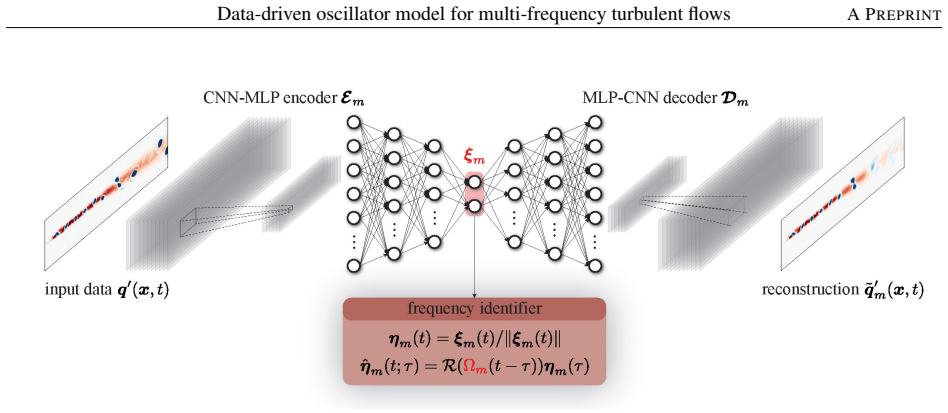
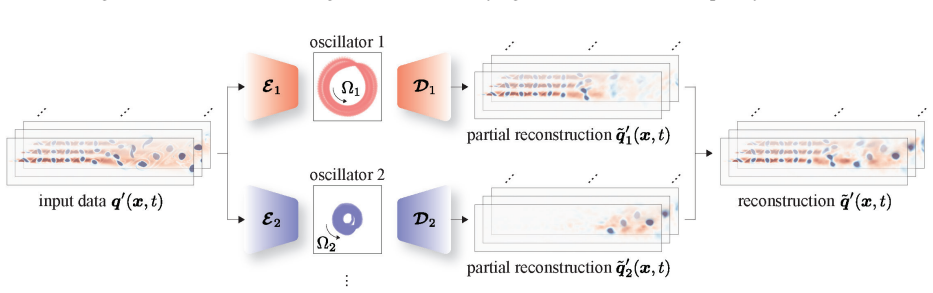
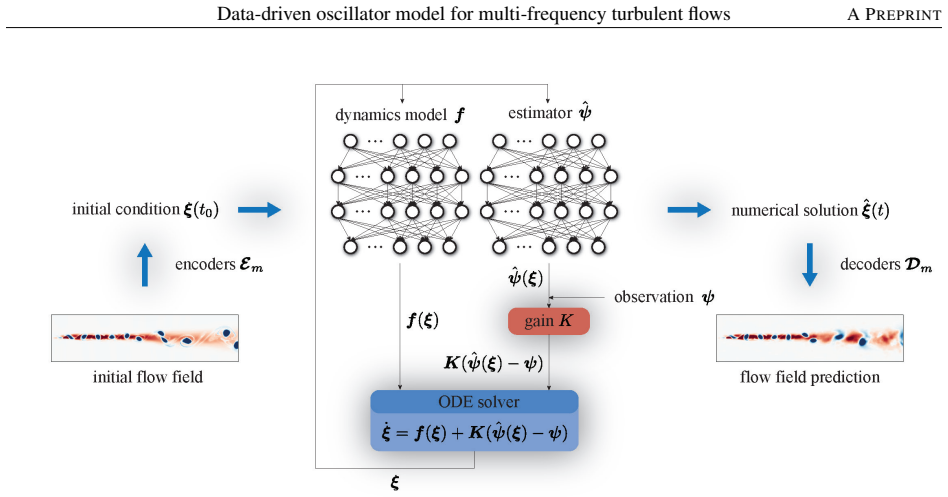
The authors train autoencoders on flow-field snapshots from the supersonic turbulent cavity flow to obtain a set of representative oscillators that reflect dominant large-scale features and physical characteristics. They then train neural networks to model the coupled dynamics of these oscillators, producing a data-driven reduced-order model that accurately forecasts the multi-frequency oscillatory behavior for long times without rapid divergence.
What carries the argument
Specially designed autoencoders that extract a set of representative oscillators from flow-field data, combined with neural networks that learn the oscillators' coupled dynamics.
If this is right
- The extracted oscillators represent the dominant large-scale flow features and physical characteristics of the turbulent cavity flow.
- The oscillator model accurately forecasts the multi-frequency oscillatory behavior for long periods.
- The framework enables deeper investigations of perturbation dynamics in multi-frequency turbulent flows.
- The method supports reduced-order modeling and potential control design for turbulent flows.
Where Pith is reading between the lines
- The oscillator basis could allow direct application of phase-reduction techniques to quantify how external forcing affects individual frequency components.
- The same extraction procedure might transfer to other multi-frequency flows, such as those arising in aeroacoustics or wake dynamics, without requiring new analytic reductions.
- Stable long-term forecasts suggest the model could serve as a lightweight surrogate for exploring statistical properties of the flow that are expensive to compute from full simulations.
Load-bearing premise
Specially designed autoencoders can extract oscillators that capture the dominant multi-frequency dynamics and physical characteristics of the turbulent flow, while the neural-network model produces accurate long-term forecasts without rapid error growth or loss of stability.
What would settle it
A comparison in which the model's long-term forecasts diverge from the actual cavity-flow data within a few oscillation periods or in which the extracted oscillators fail to align with known large-scale flow structures would falsify the claim.
Figures


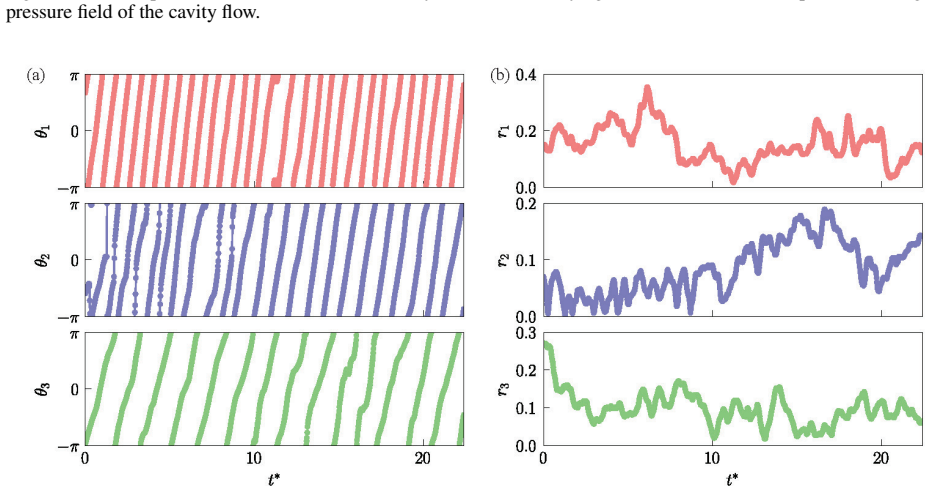


read the original abstract
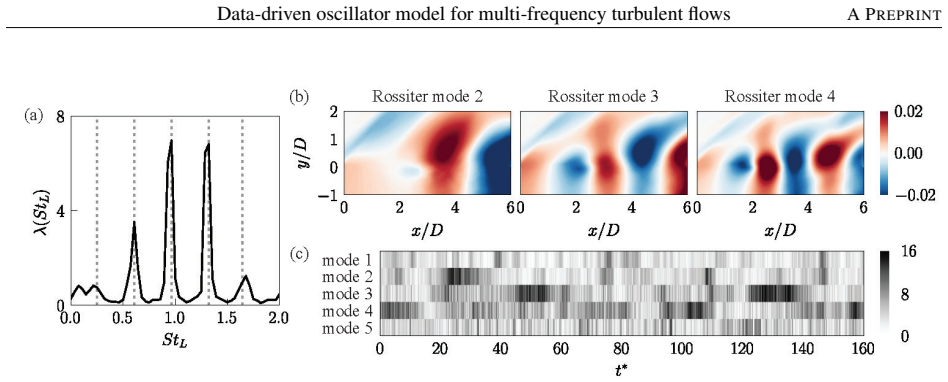
The complex dynamics of high-dimensional oscillatory flows can be simplified using phase-reduction analysis, providing a deeper understanding of the flow response to external perturbations. Although phase-based modeling and analysis have been utilized in recent studies on oscillatory fluid flows, their usages are still limited to single-frequency flows due to difficulties in addressing chaotic characteristics induced by multiple frequencies of turbulent flows. In order to overcome this limitation, we propose a data-driven framework that models the dynamics of multi-frequency turbulent flows based on a set of oscillators. The representative oscillators are extracted from the flow field data by training specially designed autoencoders. The oscillator dynamics are modeled through a machine-learning technique using neural networks to accurately predict the multi-frequency oscillatory behavior of turbulent flows. We verify the oscillator-based model of the multi-frequency turbulent flow by applying the proposed data-driven method to the three-dimensional supersonic turbulent flow over a cavity. We show that the extracted oscillators represent the dominant large-scale flow features and reflect the physical characteristics of the turbulent cavity flow. The data-driven oscillator dynamics model accurately forecasts the oscillatory behavior of the turbulent cavity flow for a long period. The proposed data-driven method for reduced-order modeling of turbulent flows with oscillators will enable deeper investigations of perturbation dynamics and control of turbulent flows.
Editorial analysis
A structured set of objections, weighed in public.
Referee Report
Summary. The paper proposes a data-driven framework to model multi-frequency turbulent flows by extracting a set of representative oscillators from flow-field data using specially designed autoencoders and then learning their dynamics with neural networks. Applied to three-dimensional supersonic turbulent cavity flow, it claims that the extracted oscillators capture the dominant large-scale flow features and physical characteristics, while the NN-based dynamics model accurately forecasts the oscillatory behavior for a long period, thereby extending phase-reduction ideas beyond single-frequency cases.
Significance. If the long-term forecast accuracy and physical fidelity of the oscillators can be demonstrated with quantitative validation, the approach would offer a reduced-order representation useful for perturbation analysis and control of chaotic multi-frequency turbulent flows. The combination of autoencoders for oscillator extraction with NN dynamics modeling is a concrete step toward data-driven phase models in fluid dynamics.
major comments (3)
- [Abstract and Results] Abstract and Results section: the central claims that the model 'accurately forecasts the oscillatory behavior ... for a long period' and that the oscillators 'represent the dominant large-scale flow features and reflect the physical characteristics' are stated without any quantitative metrics (e.g., prediction error norms, RMSE over forecast horizon, baseline comparisons to POD or DMD, or Lyapunov-spectrum checks). In a chaotic turbulent flow this absence makes it impossible to assess whether the NN vector field remains stable or reproduces the attractor.
- [Method (NN dynamics)] Method section on neural-network dynamics: no description is given of any constraint, loss term, or post-training check (e.g., energy conservation, Lyapunov exponent matching, or long-horizon rollout regularization) that would prevent exponential divergence of trajectories in a system known to possess positive Lyapunov exponents. Without such safeguards, long-term accuracy cannot be guaranteed beyond the training window.
- [Method (autoencoder)] Autoencoder design and oscillator count: the number of oscillators and the autoencoder architecture are listed as free hyperparameters, yet the paper presents the extracted oscillators as uniquely 'representative' without an ablation study or information criterion showing that the chosen count is necessary and sufficient to capture the multi-frequency content.
minor comments (2)
- [Method] Notation for the oscillator phases and amplitudes is introduced without a clear table or equation block that distinguishes them from the original flow variables.
- [Figures] Figure captions for the cavity-flow visualizations should explicitly state the time horizon used for the forecast comparison and the quantitative error measure plotted (if any).
Simulated Author's Rebuttal
We thank the referee for the constructive comments that identify opportunities to strengthen the quantitative support and methodological transparency of the work. We address each major comment below and will incorporate revisions accordingly.
read point-by-point responses
-
Referee: [Abstract and Results] Abstract and Results section: the central claims that the model 'accurately forecasts the oscillatory behavior ... for a long period' and that the oscillators 'represent the dominant large-scale flow features and reflect the physical characteristics' are stated without any quantitative metrics (e.g., prediction error norms, RMSE over forecast horizon, baseline comparisons to POD or DMD, or Lyapunov-spectrum checks). In a chaotic turbulent flow this absence makes it impossible to assess whether the NN vector field remains stable or reproduces the attractor.
Authors: We agree that the absence of explicit quantitative metrics limits the ability to rigorously evaluate long-term stability and attractor reproduction in this chaotic system. The manuscript currently supports the claims through visual comparisons of flow features and time series in the results. In the revision we will add RMSE and other error norms over extended forecast horizons, direct comparisons to POD and DMD baselines, and attractor diagnostics where computationally feasible, allowing a clearer assessment of the NN vector field. revision: yes
-
Referee: [Method (NN dynamics)] Method section on neural-network dynamics: no description is given of any constraint, loss term, or post-training check (e.g., energy conservation, Lyapunov exponent matching, or long-horizon rollout regularization) that would prevent exponential divergence of trajectories in a system known to possess positive Lyapunov exponents. Without such safeguards, long-term accuracy cannot be guaranteed beyond the training window.
Authors: The concern about potential divergence in the presence of positive Lyapunov exponents is valid. Our current training uses a short-term prediction loss that empirically produces stable rollouts within the reported horizons. We will revise the method section to provide a fuller description of the training procedure, add explicit long-horizon rollout evaluations, and include post-training checks on trajectory stability. These additions will be presented without claiming new constraints that were not originally implemented. revision: yes
-
Referee: [Method (autoencoder)] Autoencoder design and oscillator count: the number of oscillators and the autoencoder architecture are listed as free hyperparameters, yet the paper presents the extracted oscillators as uniquely 'representative' without an ablation study or information criterion showing that the chosen count is necessary and sufficient to capture the multi-frequency content.
Authors: The number of oscillators was selected to align with the dominant frequencies identified in the spectral content of the cavity flow. We acknowledge that presenting this choice without supporting ablation leaves the claim of representativeness less substantiated. The revised manuscript will include an ablation study over a range of oscillator counts, reporting reconstruction and forecasting metrics to demonstrate that the selected number is both necessary and sufficient for capturing the multi-frequency dynamics. revision: yes
Circularity Check
No circularity: empirical data-driven fitting with external validation
full rationale
The paper trains autoencoders on cavity DNS data to extract oscillators and neural networks to learn their dynamics, then reports that the resulting model reproduces dominant flow features and produces long-term forecasts when rolled out. These steps are standard supervised learning on held-out or continued simulation trajectories; the claimed accuracy is measured against the original external DNS fields rather than being true by algebraic identity or self-definition. No load-bearing step reduces to a fitted parameter renamed as prediction, a self-citation chain, or an ansatz smuggled from prior author work. The derivation chain therefore remains self-contained and falsifiable against the independent flow data.
Axiom & Free-Parameter Ledger
free parameters (2)
- Number of oscillators
- Autoencoder and neural-network architecture hyperparameters
axioms (1)
- domain assumption Multi-frequency turbulent flows can be faithfully reduced to the dynamics of a finite set of coupled oscillators extracted from the velocity field.
invented entities (1)
-
Representative oscillators
no independent evidence
Reference graph
Works this paper leans on
-
[1]
V . Godavarthi, Y . Kawamura, L. S. Ukeiley, L. N. Cattafesta III, and K. Taira. Phase-based analysis and control of supersonic turbulent cavity flows.arXiv:2502.05753,
-
[2]
H. Mousavi, A. Jones, and J. Eldredge. Sequential estimation of disturbed aerodynamic flows from sparse measurements via a reduced latent space.arXiv:2509.03795,
-
[3]
J. L. Ba, J. R. Kiros, and G. E. Hinton. Layer normalization.arXiv:1607.06450,
work page internal anchor Pith review Pith/arXiv arXiv
discussion (0)
Sign in with ORCID, Apple, or X to comment. Anyone can read and Pith papers without signing in.