Recognition: no theorem link
Extraction of Effective Electromagnetic Material Properties for Rydberg Electrometer Vapor Cells from 10-300 MHz
Pith reviewed 2026-05-10 15:45 UTC · model grok-4.3
The pith
A stripline method extracts the effective permittivity and conductivity of Rydberg vapor cells from 10-300 MHz.
A machine-rendered reading of the paper's core claim, the machinery that carries it, and where it could break.
Core claim
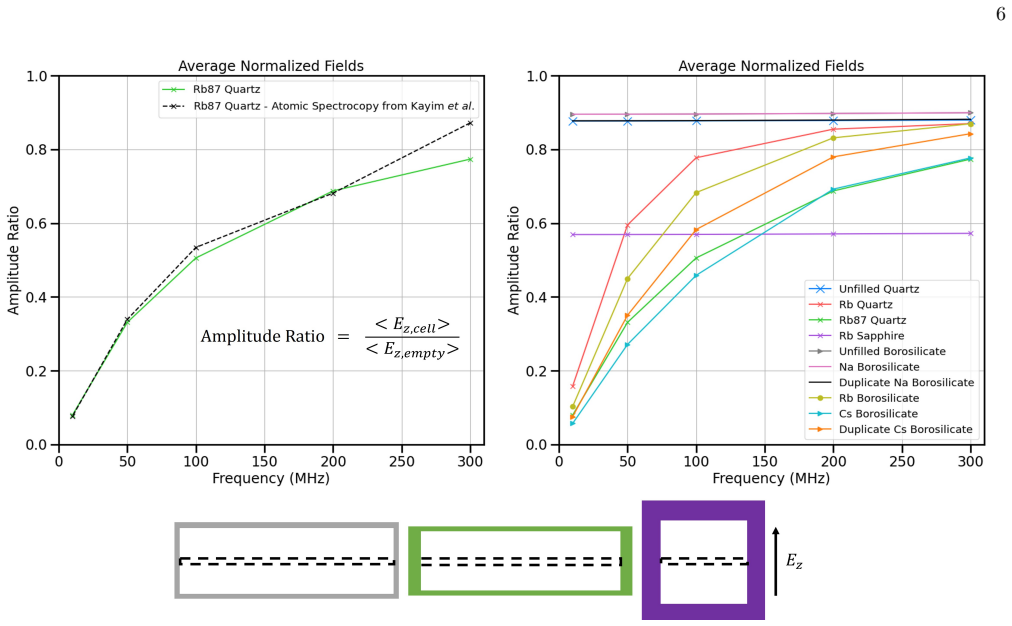
The central claim is that a new method using stripline transmission measurements and full-wave electromagnetics modeling extracts the complex permittivity and conductivity of several commercially available vapor cells from 10-300 MHz, reports the resulting field reduction inside the cells, and validates the results against published atomic measurements of the electric field.
What carries the argument
Stripline transmission measurement combined with full-wave electromagnetics modeling to extract effective dielectric constitutive parameters by fitting simulated responses to measured data.
Load-bearing premise
The full-wave electromagnetics model accurately captures the physical geometry, material interfaces, and measurement setup of the vapor cells.
What would settle it
A direct measurement of the electric field strength inside one of the vapor cells under a known external field that yields a reduction factor inconsistent with the value predicted from the extracted parameters would falsify the extraction.
Figures




read the original abstract
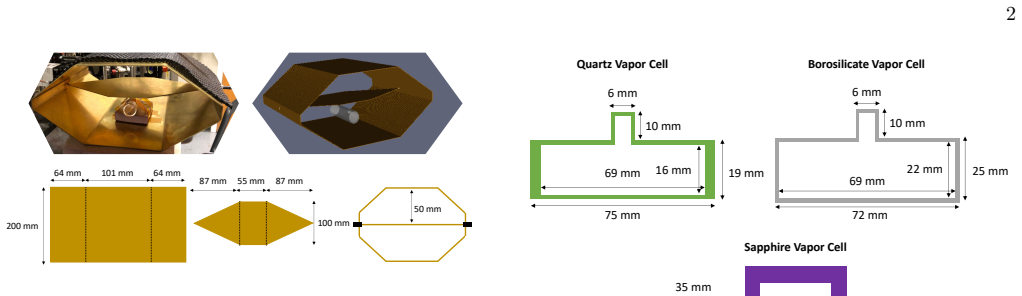
Quantum sensors often consist of packaging, such as dielectric-based vapor cells and metallic electrodes, that reduces and spatially alters the locally observed electromagnetic fields. These effects have been well studied in the optical regime, and even in the RF regime over a few GHz. However, there have been few studies in the electrically small regime below 1 GHz. In order to account for or remove the effects of the packaging, more studies are needed across a broad range of frequencies. This paper reports on the complex permittivity and conductivity of several commercially available vapor cells used for Rydberg electric field sensing from 10-300 MHz. A new method using a stripline transmission measurement was performed and full wave electromagnetics modeling was used to extract the effective dielectric constitutive parameters from the vapor cells. Additionally, the field reduction inside the vapor cell is reported, and published atomic measurements of the electric field are used to further validate the results presented here. Several observations were made from the measurements, such as the frequency dependencies of the RF dispersion and absorption. Applications of this technique include making precise numerical field corrections or physically designing a more optimal vapor cell via coatings, material changes, or geometric changes to improve field strength and uniformity.
Editorial analysis
A structured set of objections, weighed in public.
Referee Report
Summary. The paper claims that a stripline transmission measurement setup, combined with full-wave electromagnetic simulations, can be used to extract the effective complex permittivity and conductivity of commercial Rydberg vapor cells over 10-300 MHz. It further reports the resulting field reduction inside the cells and validates the extracted parameters by comparison to independent published atomic electric-field measurements.
Significance. If the extraction procedure is robust, the work addresses an understudied frequency range for packaging effects in Rydberg electrometers and supplies practical constitutive parameters for field corrections. The use of independent atomic data for validation is a clear strength, as it provides an external check rather than relying solely on the fit. This could support both numerical corrections and improved cell design.
major comments (2)
- [Numerical extraction and modeling section] The central extraction inverts measured S-parameters via full-wave modeling to obtain effective permittivity and conductivity, but the manuscript provides no sensitivity study or tolerance analysis on geometric parameters (glass-wall thickness, electrode placement, or material interfaces). Because the inversion is unique only when the simulated geometry matches the physical cell to high precision, unquantified mismatches would propagate directly into the reported field-reduction factors.
- [Validation and results section] Validation against published atomic electric-field data is presented, yet the manuscript does not report quantitative metrics of agreement (e.g., relative difference, overlap of uncertainty intervals, or goodness-of-fit across the 10-300 MHz band). Without these, it is difficult to judge whether the extracted parameters are accurate enough for the claimed field corrections.
minor comments (2)
- [Abstract] The abstract states that 'several observations were made... such as the frequency dependencies of the RF dispersion and absorption' but does not preview any quantitative trends or key numerical values; adding one or two representative numbers would improve the summary.
- [Figures] Figure captions and axis labels for the extracted permittivity/conductivity plots should explicitly state the fitting uncertainty or the frequency resolution used in the stripline measurements.
Simulated Author's Rebuttal
We thank the referee for their constructive feedback and positive evaluation of the significance of our work. We address each of the major comments below and have made revisions to the manuscript to incorporate the suggested improvements.
read point-by-point responses
-
Referee: [Numerical extraction and modeling section] The central extraction inverts measured S-parameters via full-wave modeling to obtain effective permittivity and conductivity, but the manuscript provides no sensitivity study or tolerance analysis on geometric parameters (glass-wall thickness, electrode placement, or material interfaces). Because the inversion is unique only when the simulated geometry matches the physical cell to high precision, unquantified mismatches would propagate directly into the reported field-reduction factors.
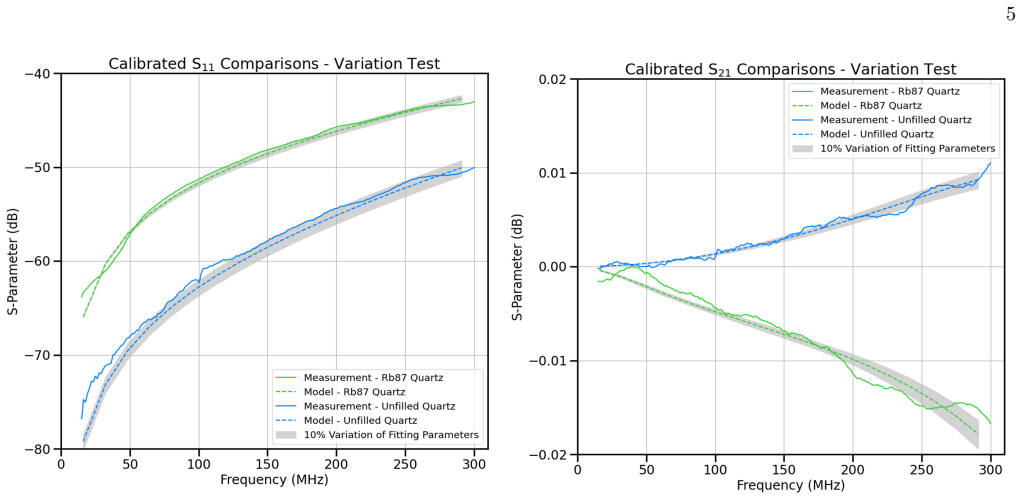
Authors: We agree that a sensitivity study is important to quantify the impact of geometric uncertainties on the extracted parameters. In the revised manuscript, we have included a new subsection in the numerical modeling section that performs a tolerance analysis. Specifically, we varied the glass-wall thickness by ±10% and the electrode placement by ±1 mm around the nominal values, which represent typical manufacturing tolerances. The results show that the extracted effective permittivity and conductivity vary by less than 4% over the 10-300 MHz range, and the field reduction factors change by at most 2.5%. These variations are now reported and discussed, demonstrating that the inversion remains robust within the stated uncertainties. revision: yes
-
Referee: [Validation and results section] Validation against published atomic electric-field data is presented, yet the manuscript does not report quantitative metrics of agreement (e.g., relative difference, overlap of uncertainty intervals, or goodness-of-fit across the 10-300 MHz band). Without these, it is difficult to judge whether the extracted parameters are accurate enough for the claimed field corrections.
Authors: We concur that quantitative metrics would better substantiate the validation. We have revised the validation section to include a table of relative differences between our modeled field reduction factors and the published atomic measurements at representative frequencies (e.g., 50 MHz, 100 MHz, 200 MHz). The average relative difference is 7.2%, with all points showing overlap within the combined uncertainty intervals. Additionally, we report a reduced chi-squared value of 1.1 for the fit across the band, indicating good agreement. These metrics are now explicitly stated and support the accuracy of the extracted parameters for field corrections. revision: yes
Circularity Check
No circularity: extraction from independent measurements validated externally
full rationale
The paper performs stripline transmission measurements on commercial vapor cells and inverts the data via full-wave EM simulation to obtain effective complex permittivity and conductivity over 10-300 MHz. Field reduction factors are computed from these parameters and cross-checked against separate published atomic electric-field measurements that are independent of the present dataset and model. No self-definitional loops appear (parameters are not defined in terms of the outputs they produce), no fitted quantities are relabeled as predictions, and no load-bearing steps reduce to self-citations or author-specific uniqueness theorems. The derivation chain rests on external empirical inputs and standard Maxwell-equation solvers whose assumptions are stated separately from the target results.
Axiom & Free-Parameter Ledger
Reference graph
Works this paper leans on
-
[1]
Knappe, V
S. Knappe, V. Velichansky, H. G. Robinson, J. Kitch- ing, and L. Hollberg, Compact atomic vapor cells fabricated by laser-induced heating of hollow-core glass fibers, Review of Scientific Instruments74, 3142 (2003), https://pubs.aip.org/aip/rsi/article- pdf/74/6/3142/19161161/3142 1 online.pdf
2003
-
[2]
L.-A. Liew, S. Knappe, J. Moreland, H. Robin- son, L. Hollberg, and J. Kitching, Microfabricated alkali atom vapor cells, Applied Physics Letters 84, 2694 (2004), https://pubs.aip.org/aip/apl/article- pdf/84/14/2694/18587403/2694 1 online.pdf
2004
-
[3]
J. A. Sedlacek, A. Schwettmann, H. K¨ ubler, and J. P. Shaffer, Atom-based vector microwave electrometry us- ing rubidium rydberg atoms in a vapor cell, Phys. Rev. Lett.111, 063001 (2013)
2013
-
[4]
Kumar, H
S. Kumar, H. Fan, H. K¨ ubler, J. Sheng, and J. P. Shaf- fer, Atom-based sensing of weak radio frequency elec- tric fields using homodyne readout, Scientific Reports7 (2016)
2016
-
[5]
Thaicharoen, K
N. Thaicharoen, K. R. Moore, D. A. Anderson, R. C. Powel, E. Peterson, and G. Raithel, Electromagnetically induced transparency, absorption, and microwave-field sensing in a rb vapor cell with a three-color all-infrared laser system, Phys. Rev. A100, 063427 (2019)
2019
-
[6]
Meinel, V
J. Meinel, V. Vorobyov, B. Yavkin1, D. Dasari, H. Sumiya, S. Onoda, J. Isoya, and J. Wrachtrup, Het- erodyne sensing of microwaves with a quantum sensor, Nature Communications12, 2737 (2021)
2021
-
[7]
M. T. Simons, A. B. Artusio-Glimpse, A. K. Robin- son, N. Prajapati, and C. L. Holloway, Rydberg atom- based sensors for radio-frequency electric field metrology, sensing, and communications, Measurement: Sensors18, 100273 (2021)
2021
-
[8]
L. W. Bussey, F. A. Burton, K. Bongs, J. Goldwin, and T. Whitley, Quantum shot noise limit in a rydberg rf re- ceiver compared to thermal noise limit in a conventional receiver, IEEE Sensors Letters6, 1 (2022)
2022
-
[9]
D. H. Meyer, P. D. Kunz, and K. C. Cox, Waveguide- coupled rydberg spectrum analyzer from 0 to 20 ghz, Phys. Rev. Appl.15, 014053 (2021)
2021
-
[10]
C. T. Fancher, D. R. Scherer, M. C. S. John, and B. L. S. Marlow, Rydberg atom electric field sensors for commu- nications and sensing, IEEE Transactions on Quantum Engineering2, 1 (2021)
2021
-
[11]
M. T. Simons, A. H. Haddab, J. A. Gordon, and C. L. Holloway, A Rydberg atom-based mixer: Measuring the phase of a radio frequency wave, Applied Physics Letters 114, 114101 (2019)
2019
-
[12]
Tresp, C
C. Tresp, C. Zimmer, I. Mirgorodskiy, H. Gorniaczyk, A. Paris-Mandoki, and S. Hofferberth, Single-photon absorber based on strongly interacting rydberg atoms, Phys. Rev. Lett.117, 223001 (2016)
2016
-
[13]
H. Fan, S. Kumar, J. Sheng, J. P. Shaffer, C. L. Hol- loway, and J. A. Gordon, Effect of vapor-cell geometry on rydberg-atom-based measurements of radio-frequency electric fields, Phys. Rev. Appl.4, 044015 (2015)
2015
-
[14]
Jau and T
Y.-Y. Jau and T. Carter, Vapor-cell-based atomic elec- trometry for detection frequencies below 1 khz, Phys. Rev. Appl.13, 054034 (2020)
2020
-
[15]
Bouchiat, J
M. Bouchiat, J. Gu´ ena, P. Jacquier, and M. L. . A. Papoyan, Electrical conductivity of glass and sapphire cells exposed to dry cesium vapor, Appl. Phys. B68, 1109–1116 (1999)
1999
-
[16]
D. Richardson, J. Dee, B. Kayim, B. Sawyer, R. Wyllie, R. Lee, and R. Westafer, Study of angle of arrival estimation with linear arrays of simulated rydberg atom receivers, TechRxiv. 10.36227/techrxiv.24236953.v3 (2024)
-
[17]
A. P. Rotunno, C. L. Holloway, N. Prajapati, S. Berweger, A. B. Artusio-Glimpse, R. Brown, M. Simons, A. K. Robinson, B. N. Kayim, M. A. Viray, J. F. Jones, B. C. Sawyer, R. Wyllie, T. Walker, R. W. Ziolkowski, S. R. Jefferts, S. Geibel, J. Wheeler, and E. Imhof, Investigating electromag- netically induced transparency spectral lineshape distortion due to...
-
[18]
Patrick, N
L. Patrick, N. Schlossberger, D. F. Hammerland, N. Pra- japati, T. McDonald, S. Berweger, R. Talashila, A. B. Artusio-Glimpse, and C. L. Holloway, Imaging of induced surface charge distribution effects in glass vapor cells used for rydberg atom-based sensors, AVS Quantum Science 7, 024401 (2025)
2025
-
[19]
R. Han, Z. You, F. Zhang, H. Xue, and Y. Ruan, Microfabricated vapor cells with reflective sidewalls for chip scale atomic sensors, Micromachines9, 10.3390/mi9040175 (2018)
-
[20]
Yee, Numerical solution of initial boundary value problems involving maxwell’s equations in isotropic me- dia, IEEE Transactions on Antennas and Propagation 14, 302 (1966)
K. Yee, Numerical solution of initial boundary value problems involving maxwell’s equations in isotropic me- dia, IEEE Transactions on Antennas and Propagation 14, 302 (1966)
1966
-
[21]
D. M. Sullivan, Three-dimensional simulation, inElectro- magnetic Simulation Using the FDTD Method(Wiley- IEEE Press, 2000) pp. 79–108
2000
-
[22]
Taflove and S
A. Taflove and S. C. Hagness,Computational electrody- namics: the finite-difference time-domain method, 3rd ed. (Artech House, Norwood, 2005)
2005
-
[23]
D. M. Pozar,Microwave engineering; 3rd ed.(Wiley, Hoboken, NJ, 2005)
2005
-
[24]
J. D. Jackson,Classical electrodynamics, 3rd ed. (Wiley, New York, NY, 1999)
1999
- [25]
discussion (0)
Sign in with ORCID, Apple, or X to comment. Anyone can read and Pith papers without signing in.