Recognition: unknown
Inverse Design of Inorganic Compounds with Generative AI
Pith reviewed 2026-05-10 15:30 UTC · model grok-4.3
The pith
Generative AI pipelines address the full complexity of inorganic compounds to enable inverse design.
A machine-rendered reading of the paper's core claim, the machinery that carries it, and where it could break.
Core claim
The paper establishes that generative AI methods have evolved towards data-representation-model pipelines that address the full complexity of inorganic compounds, including their chemical composition, geometry, symmetry, and electronic structure, for systems ranging from molecules to crystals including transition metal complexes and microporous materials.
What carries the argument
Data-representation-model pipelines, which integrate representations of chemical composition, geometry, symmetry, and electronic structure to generate inorganic compounds with specified properties.
If this is right
- Inverse design is now feasible for diverse inorganic systems including transition metal complexes and microporous materials.
- Benchmark standardization will help evaluate and compare generative methods across studies.
- Synthesizability metrics are essential for translating AI-generated compounds into experimentally viable targets.
Where Pith is reading between the lines
- These pipelines may be extended to incorporate more detailed quantum mechanical properties during generation.
- Success in inorganic applications could inspire similar comprehensive approaches in related fields like organic materials design.
- Generated structures could be validated against existing chemical databases to assess novelty and feasibility.
Load-bearing premise
That the reviewed methods and literature capture the current capabilities sufficiently and that incremental evolution of pipelines will overcome inorganic challenges without requiring fundamental new ideas.
What would settle it
A study that identifies inorganic compounds with symmetry or electronic features that no current generative AI pipeline can accurately model or generate would challenge the central claim of sufficient progress.
Figures



read the original abstract
Machine learning is revolutionizing chemistry. Beyond the value of predictive models accelerating virtual screening, generative AI aims at enabling inverse design, reversing the compound-to-property prediction paradigm into property-to-compound generation. Chemists now have access to a rich AI toolbox for organic chemistry, including drug discovery. However, the application of these methods to inorganic compounds remains limited by the challenges posed by their intrinsic nature. This Review analyzes how these challenges have been addressed, considering widely diverse systems ranging from molecules to crystals, including transition metal complexes and microporous materials. The analysis focuses on how generative AI methods have evolved towards data-representation-model pipelines that address the full complexity of inorganic compounds, including their chemical composition, geometry, symmetry, and electronic structure. Future directions, like benchmark standardization and the development of synthesizability metrics, are also discussed.
Editorial analysis
A structured set of objections, weighed in public.
Referee Report
Summary. The manuscript is a review surveying the application of generative AI to inverse design of inorganic compounds. It covers diverse systems including molecules, crystals, transition metal complexes, and microporous materials. The central descriptive claim is that generative methods have evolved from basic models into integrated data-representation-model pipelines that jointly address the full complexity of inorganic systems: chemical composition, geometry, symmetry, and electronic structure. The review discusses challenges specific to inorganics versus organics, reviews existing approaches, and outlines future directions such as benchmark standardization and synthesizability metrics.
Significance. If the literature survey is comprehensive and balanced, the review would provide a useful synthesis for researchers working at the intersection of AI and inorganic chemistry/materials science. It explicitly credits the shift toward holistic pipelines that tackle multiple structural and electronic aspects simultaneously, which is a key strength given the greater intrinsic challenges of inorganic systems (e.g., variable oxidation states, long-range order). The forward-looking sections on benchmarks and synthesizability metrics are particularly valuable as they identify actionable gaps that could accelerate reproducible progress in the field.
major comments (2)
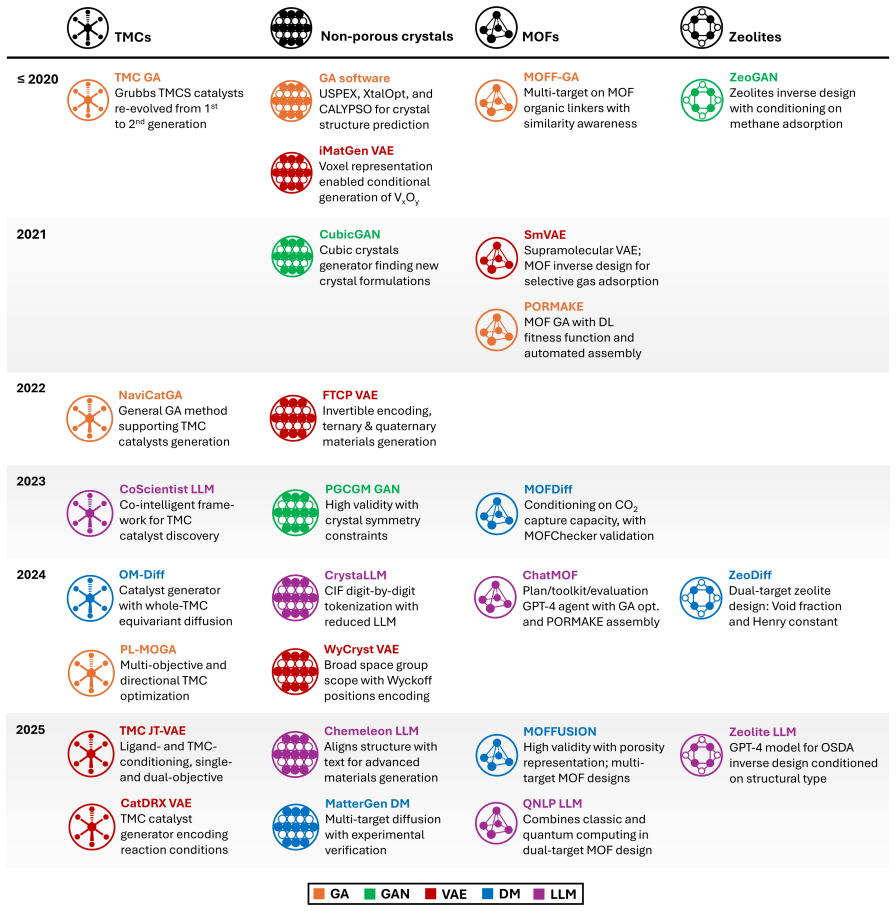
- [Method evolution discussion (near abstract claim)] The central claim that methods have evolved toward pipelines addressing composition, geometry, symmetry, and electronic structure simultaneously is load-bearing for the review's thesis. However, the manuscript would be strengthened by adding an explicit timeline or comparative table (e.g., in the section discussing method evolution) that maps specific cited works to the four complexity axes, rather than relying solely on narrative description; without this, the 'evolution' narrative risks appearing qualitative rather than evidence-based.
- [Literature selection and crystal systems section] The weakest assumption noted in the review—that the selected literature sufficiently represents the state of the field—requires more justification. In the coverage of crystal generation, for example, the manuscript should explicitly state the search strategy or inclusion criteria used to select papers, to allow readers to assess potential omissions of counterexamples or alternative architectures.
minor comments (3)
- [Throughout, especially data-representation subsections] Notation for data representations (e.g., graph vs. voxel vs. string encodings) is introduced inconsistently across sections; a dedicated glossary or consistent abbreviation table would improve clarity.
- [Figures in the pipeline evolution sections] Several figures illustrating pipeline architectures would benefit from explicit labels indicating which complexity axes (composition/geometry/symmetry/electronic structure) each component addresses.
- [Future directions] The future-directions paragraph on synthesizability metrics cites the need for new metrics but does not reference any existing proxy metrics from the inorganic literature (e.g., those used in crystal structure prediction); adding 2–3 concrete citations would make the recommendation more actionable.
Simulated Author's Rebuttal
We thank the referee for the positive assessment of our review and the recommendation for minor revision. The comments provide valuable guidance on strengthening the evidence base for our central thesis and improving transparency in literature selection. We address each point below and will incorporate the suggested revisions.
read point-by-point responses
-
Referee: [Method evolution discussion (near abstract claim)] The central claim that methods have evolved toward pipelines addressing composition, geometry, symmetry, and electronic structure simultaneously is load-bearing for the review's thesis. However, the manuscript would be strengthened by adding an explicit timeline or comparative table (e.g., in the section discussing method evolution) that maps specific cited works to the four complexity axes, rather than relying solely on narrative description; without this, the 'evolution' narrative risks appearing qualitative rather than evidence-based.
Authors: We agree that an explicit mapping would render the evolution narrative more rigorous and evidence-based. In the revised manuscript, we will insert a comparative table in the method evolution section. The table will list representative cited works chronologically and indicate (via checkmarks or similar) which of the four complexity axes—chemical composition, geometry, symmetry, and electronic structure—each work addresses. This addition will directly support the central claim without altering the narrative flow. revision: yes
-
Referee: [Literature selection and crystal systems section] The weakest assumption noted in the review—that the selected literature sufficiently represents the state of the field—requires more justification. In the coverage of crystal generation, for example, the manuscript should explicitly state the search strategy or inclusion criteria used to select papers, to allow readers to assess potential omissions of counterexamples or alternative architectures.
Authors: We acknowledge that explicit documentation of the literature selection process is necessary for a balanced review. In the revised version, we will add a short dedicated paragraph (likely at the start of the crystal generation subsection or in a methods-oriented note) that details the search strategy. This will include the databases and repositories queried, the primary keywords and Boolean combinations employed, the time window covered, and the inclusion/exclusion criteria applied (e.g., focus on generative models for periodic crystals, exclusion of purely predictive rather than generative studies). Such transparency will enable readers to evaluate coverage and potential gaps. revision: yes
Circularity Check
No circularity: review paper with no derivations or predictions
full rationale
This is a survey paper that reviews existing literature on generative AI for inverse design of inorganic compounds. It makes no new mathematical claims, derivations, fitted predictions, or empirical results. The central narrative is descriptive, summarizing how data-representation-model pipelines have evolved to address composition, geometry, symmetry, and electronic structure across cited works. No load-bearing steps reduce to self-definition, self-citation chains, or renamed inputs; the argument rests entirely on the existence and behavior of the externally cited literature.
Axiom & Free-Parameter Ledger
Reference graph
Works this paper leans on
-
[1]
Beitrag zur konstitution anorganischer verbindungen.Zeitschrift für anorganische Chemie3, 267–330 (1893)
Werner, A. Beitrag zur konstitution anorganischer verbindungen.Zeitschrift für anorganische Chemie3, 267–330 (1893)
-
[2]
Knowles, W. S. & Sabacky, M. J. Catalytic asymmetric hydrogenation employing a soluble, optically active, rhodium complex.Chem. Commun. (London)1445–1446 (1968)
1968
-
[3]
Miyashita, A.et al.Synthesis of 2,2’-bis(diphenylphosphino)-1,1’-binaphthyl (binap), an atropisomeric chiral bis(triaryl)phosphine, and its use in the rhodium(i)-catalyzed asymmetric hydrogenation ofα-(acylamino)acrylic acids.J. Am. Chem. Soc.102, 7932–7934 (1980)
1980
-
[4]
& Suzuki, A
Miyaura, N., Yamada, K. & Suzuki, A. A new stereospecific cross-coupling by the palladium- catalyzed reaction of 1-alkenylboranes with 1-alkenyl or 1-alkynyl halides.Tetrahedron Lett. 20, 3437–3440 (1979)
1979
-
[5]
Negishi, E., King, A. O. & Okukado, N. Selective carbon-carbon bond formation via transition metal catalysis. 3. a highly selective synthesis of unsymmetrical biaryls and diarylmethanes by the nickel- or palladium-catalyzed reaction of aryl- and benzylzinc derivatives with aryl halides.J. Org. Chem.42, 1821–1823 (1977)
1977
-
[6]
Heck, R. F. & Nolley Jr, J. Palladium-catalyzed vinylic hydrogen substitution reactions with aryl, benzyl, and styryl halides.J. Org. Chem.37, 2320–2322 (1972)
1972
-
[7]
H.et al.Transition-metal-catalyzed c–h bond activation for the formation of c–c bonds in complex molecules.Chem
Docherty, J. H.et al.Transition-metal-catalyzed c–h bond activation for the formation of c–c bonds in complex molecules.Chem. Rev.123, 7692–7760 (2023)
2023
-
[8]
M., Joe, C
Ganley, J. M., Joe, C. L. & Simmons, E. M. Development of robust, efficient and scalable transition metal catalyzed transformations: Translation of reactions from micromole to multi-kilogram scale processes.ACS Catal.15, 8317–8336 (2025)
2025
-
[9]
Rosenberg, B., VanCamp, L., Trosko, J. E. & Mansour, V. H. Platinum compounds: a new class of potent antitumour agents.Nature222, 385–386 (1969)
1969
-
[10]
& Costas, M
Milan, M., Bietti, M. & Costas, M. Enantioselective aliphatic c–h bond oxidation catalyzed by bioinspired complexes.Chem. Commun.54, 9559–9570 (2018)
2018
-
[11]
F.et al.Coupling dinitrogen and hydrocarbons through aryl migration.Nature 584, 221–226 (2020)
McWilliams, S. F.et al.Coupling dinitrogen and hydrocarbons through aryl migration.Nature 584, 221–226 (2020)
2020
-
[12]
& Beller, M
Liang, H.-Q., Beweries, T., Francke, R. & Beller, M. Molecular catalysts for the reductive homocoupling of co2 towards c2+ compounds.Angew. Chem. Int. Ed.61, e202200723 (2022)
2022
-
[13]
& de Bruin, B
Goswami, M., Chirila, A., Rebreyend, C. & de Bruin, B. Epr spectroscopy as a tool in homogeneous catalysis research.Top. Catal.58, 719–750 (2015)
2015
-
[14]
R., Bursch, M., Grimme, S
Maurer, L. R., Bursch, M., Grimme, S. & Hansen, A. Assessing density functional theory for chemically relevant open-shell transition metal reactions.J. Chem. Theory Comput.17, 6134–6151 (2021)
2021
-
[15]
K., Rankic, D
Prier, C. K., Rankic, D. A. & MacMillan, D. W. C. Visible light photoredox catalysis with transition metal complexes: Applications in organic synthesis.Chem. Rev.113, 5322–5363 (2013). 16.Zuo, Z.et al.Merging photoredox with nickel catalysis: Coupling ofα-carboxyl sp 3-carbons with aryl halides.Science345, 437–440 (2014). 27/42
2013
-
[16]
Y.et al.Metallaphotoredox: The merger of photoredox and transition metal catalysis.Chem
Chan, A. Y.et al.Metallaphotoredox: The merger of photoredox and transition metal catalysis.Chem. Rev.122, 1485–1542 (2022)
2022
-
[17]
J., Pérez-Jiménez, M
Navarro, M., Moreno, J. J., Pérez-Jiménez, M. & Campos, J. Small molecule activation with bimetallic systems: a landscape of cooperative reactivity.Chem. Commun.58, 11220–11235 (2022)
2022
-
[18]
D.et al.Computational approach to molecular catalysis by 3d transition metals: Challenges and opportunities.Chem
Vogiatzis, K. D.et al.Computational approach to molecular catalysis by 3d transition metals: Challenges and opportunities.Chem. Rev.119, 2453–2523 (2019)
2019
-
[19]
Wheelhouse, K. M. P., Webster, R. L. & Beutner, G. L. Advances and applications in catalysis with earth-abundant metals.Org. Process Res. Dev.27, 1157–1159 (2023)
2023
-
[20]
K.et al.Recent advances in metallodrug: Coordination-induced synergy between clinically approved drugs and metal ions.Mater
Kim, W. K.et al.Recent advances in metallodrug: Coordination-induced synergy between clinically approved drugs and metal ions.Mater. Today Adv.25, 100569 (2025)
2025
-
[21]
& Gagliardi, L
Sauza-de la Vega, A., Darù, A., Nofz, S. & Gagliardi, L. Designing molecular qubits: computational insights into first-row and group 6 transition metal complexes.Chem. Sci.16, 12896–12905 (2025)
2025
-
[22]
M.et al.Reticular synthesis and the design of new materials.Nature423, 705–714 (2003)
Yaghi, O. M.et al.Reticular synthesis and the design of new materials.Nature423, 705–714 (2003)
2003
-
[23]
Hoskins, B. F. & Robson, R. Design and construction of a new class of scaffolding- like materials comprising infinite polymeric frameworks of 3d-linked molecular rods. a reappraisal of the zinc cyanide and cadmium cyanide structures and the synthesis and structure of the diamond-related frameworks [n(ch3)4][cuiznii(cn)4] and cui[4,4’,4”,4”’- tetracyanotet...
1990
-
[24]
& Seki, K
Kondo, M., Yoshitomi, T., Matsuzaka, H., Kitagawa, S. & Seki, K. Three-dimensional framework with channeling cavities for small molecules: [M2(4, 4′-bpy)3(NO3)4]·xH2On (m = co, ni, zn).Angew. Chem. Int. Ed. Engl.36, 1725–1727 (1997)
1997
-
[25]
Eddaoudi, M.et al.Systematic design of pore size and functionality in isoreticular mofs and their application in methane storage.Science295, 469–472 (2002)
2002
-
[26]
Nature635, 96–101 (2024)
Zhou, Z.et al.Carbon dioxide capture from open air using covalent organic frameworks. Nature635, 96–101 (2024)
2024
-
[27]
Lin, J.-B.et al.A scalable metal-organic framework as a durable physisorbent for carbon dioxide capture.Science374, 1464–1469 (2021)
2021
-
[28]
C., Aksu, G
Daglar, H., Gulbalkan, H. C., Aksu, G. O. & Keskin, S. Computational simulations of metal–organic frameworks to enhance adsorption applications.Adv. Mater.37, 2405532 (2024). 30.Fathieh, F.et al.Practical water production from desert air.Sci. Adv.4, eaat3198 (2018)
2024
-
[29]
E., O’Keeffe, M
Furukawa, H., Cordova, K. E., O’Keeffe, M. & Yaghi, O. M. The chemistry and applications of metal-organic frameworks.Science341, 1230444 (2013)
2013
-
[30]
Alezi, D.et al.Mof crystal chemistry paving the way to gas storage needs: Aluminum-based soc-mof for ch4, o2, and co2 storage.J. Am. Chem. Soc.137, 13308–13318 (2015)
2015
-
[31]
O., Idrees, K
Chen, Z., Kirlikovali, K. O., Idrees, K. B., Wasson, M. C. & Farha, O. K. Porous materials for hydrogen storage.Chem8, 693–716 (2022). 28/42
2022
-
[32]
Chen, Z.et al.Balancing volumetric and gravimetric uptake in highly porous materials for clean energy.Science368, 297–303 (2020)
2020
-
[33]
& Meyer, D
Sini, K., Bourgeois, D., Idouhar, M., Carboni, M. & Meyer, D. Metal-organic frameworks cavity size effect on the extraction of organic pollutants.Mater. Lett.250, 92–95 (2019)
2019
-
[34]
Asgari, M.et al.The structuring of porous reticular materials for energy applications at industrial scales.Chem. Soc. Rev.54, 4701–4744 (2025)
2025
-
[35]
Férey, G.et al.A chromium terephthalate-based solid with unusually large pore volumes and surface area.Science309, 2040–2042 (2005)
2040
-
[36]
H.et al.A new zirconium inorganic building brick forming metal organic frameworks with exceptional stability.J
Cavka, J. H.et al.A new zirconium inorganic building brick forming metal organic frameworks with exceptional stability.J. Am. Chem. Soc.130, 13850–13851 (2008)
2008
-
[37]
& Pang, H
Xu, Y., Li, Q., Xue, H. & Pang, H. Metal-organic frameworks for direct electrochemical applications.Coord. Chem. Rev.376, 292–318 (2018)
2018
-
[38]
V.et al.Mof-derived cobalt nanoparticles catalyze a general synthesis of amines
Jagadeesh, R. V.et al.Mof-derived cobalt nanoparticles catalyze a general synthesis of amines. Science358, 326–332 (2017)
2017
-
[39]
& Gates, B
Yang, D. & Gates, B. C. Catalysis by metal organic frameworks: Perspective and suggestions for future research.ACS Catal.9, 1779–1798 (2019). 42.Barrer, R. M. 435. syntheses and reactions of mordenite.J. Chem. Soc.2158–2163 (1948)
2019
-
[40]
Inorganic solid acids and their use in acid-catalyzed hydrocarbon reactions.Chem
Corma, A. Inorganic solid acids and their use in acid-catalyzed hydrocarbon reactions.Chem. Rev.95, 559–614 (1995)
1995
-
[41]
& Pirngruber, G
Chizallet, C., Bouchy, C., Larmier, K. & Pirngruber, G. Molecular views on mechanisms of brønsted acid-catalyzed reactions in zeolites.Chem. Rev.123, 6107–6196 (2023)
2023
-
[42]
Li, Y. & Yu, J. Emerging applications of zeolites in catalysis, separation and host–guest assembly.Nat. Rev. Mater.6, 1156–1174 (2021)
2021
-
[43]
& Rey, F
Pérez-Botella, E., Valencia, S. & Rey, F. Zeolites in adsorption processes: State of the art and future prospects.Chem. Rev.122, 17647–17695 (2022)
2022
-
[44]
d., Martínez, C
Campo, P. d., Martínez, C. & Corma, A. Activation and conversion of alkanes in the confined space of zeolite-type materials.Chem. Soc. Rev.50, 8511–8595 (2021)
2021
-
[45]
Jiao, F.et al.Disentangling the activity-selectivity trade-off in catalytic conversion of syngas to light olefins.Science380, 727–730 (2023)
2023
-
[46]
Matito-Martos, I.et al.Zeolite screening for the separation of gas mixtures containing SO2, CO2 and CO.Phys. Chem. Chem. Phys.16, 19884–19893 (2014)
2014
-
[47]
Deng, L.et al.Atom-economic synthesis of zeolites.J. Am. Chem. Soc.146, 29115–29122 (2024)
2024
-
[48]
F., Abdelhamid, H
Abdel-Magied, A. F., Abdelhamid, H. N., Ashour, R. M., Zou, X. & Forsberg, K. Hierarchical porous zeolitic imidazolate frameworks nanoparticles for efficient adsorption of rare-earth elements.Micropor. Mesopor. Mat.278, 175–184 (2019)
2019
-
[49]
Zhang, Q., Gao, S. & Yu, J. Metal sites in zeolites: Synthesis, characterization, and catalysis. Chem. Rev.123, 6039–6106 (2023). 53.Zhao, M.et al.Low-temperature hydroformylation of ethylene by phosphorous stabilized rh sites in a one-pot synthesized rh-(o)-p-mfi zeolite.Nat. Commun.14, 7174 (2023). 29/42
2023
-
[50]
Nature636, 368–373 (2024)
Lu, P.et al.A stable zeolite with atomically ordered and interconnected mesopore channel. Nature636, 368–373 (2024)
2024
-
[51]
V.et al.Advances in theory and their application within the field of zeolite chemistry.Chem
Speybroeck, V. V.et al.Advances in theory and their application within the field of zeolite chemistry.Chem. Soc. Rev.44, 7044–7111 (2015)
2015
-
[52]
Yan, W., Li, Y., Xiao, F.-S., Liu, Z. & Yu, J. The future of zeolites.Chem. Mater.36, 7103–7105 (2024)
2024
-
[53]
& Yeh, J.-W
Hsu, W.-L., Tsai, C.-W., Yeh, A.-C. & Yeh, J.-W. Clarifying the four core effects of high- entropy materials.Nat. Rev. Chem.8, 471–485 (2024)
2024
-
[54]
Electronic and optical properties of nanostructured MoS2 materials: influence of reduced spatial dimensions and edge effects.Phys
Mlinar, V. Electronic and optical properties of nanostructured MoS2 materials: influence of reduced spatial dimensions and edge effects.Phys. Chem. Chem. Phys.19, 15891–15902 (2017)
2017
-
[55]
& Miyasaka, T
Kojima, A., Teshima, K., Shirai, Y. & Miyasaka, T. Organometal halide perovskites as visible-light sensitizers for photovoltaic cells.J. Am. Chem. Soc.131, 6050–6051 (2009)
2009
-
[56]
C., Ehrler, B
Polman, A., Knight, M., Garnett, E. C., Ehrler, B. & Sinke, W. C. Photovoltaic materials: Present efficiencies and future challenges.Science352, aad4424 (2016)
2016
-
[57]
Snaith, H. J. Present status and future prospects of perovskite photovoltaics.Nature Mater. 17, 372–376 (2018)
2018
-
[58]
& Park, N.-G
Im, J.-H., Lee, C.-R., Lee, J.-W., Park, S.-W. & Park, N.-G. 6.5% efficient perovskite quantum-dot-sensitized solar cell.Nanoscale3, 4088–4093 (2011)
2011
-
[59]
Chiba, T.et al.Anion-exchange red perovskite quantum dots with ammonium iodine salts for highly efficient light-emitting devices.Nature Photon12, 681–687 (2018)
2018
-
[60]
Synth4, 1056–1067 (2025)
Song, M.et al.Synthesis of single-unit-cell-thick perovskites by liquid-phase confined assembly for high-performance ultrastable x-ray detectors.Nat. Synth4, 1056–1067 (2025). 65.Hwang, J.et al.Perovskites in catalysis and electrocatalysis.Science358, 751–756 (2017)
2025
-
[61]
Al-Ashouri, A.et al.Monolithic perovskite/silicon tandem solar cell with >29% efficiency by enhanced hole extraction.Science370, 1300–1309 (2020)
2020
-
[62]
M., Teuscher, J., Miyasaka, T., Murakami, T
Lee, M. M., Teuscher, J., Miyasaka, T., Murakami, T. N. & Snaith, H. J. Efficient hybrid solar cells based on meso-superstructured organometal halide perovskites.Science338, 643–647 (2012)
2012
-
[63]
I., Yang, Y
Lee, J.-W., Tan, S., Seok, S. I., Yang, Y. & Park, N.-G. Rethinking the a cation in halide perovskites.Science375, eabj1186 (2022)
2022
-
[64]
Correa-Baena, J.-P.et al.Promises and challenges of perovskite solar cells.Science358, 739–744 (2017)
2017
-
[65]
& Park, N.-G
Zhang, C. & Park, N.-G. Materials and methods for cost-effective fabrication of perovskite photovoltaic devices.Commun. Mater.5, 194 (2024)
2024
-
[66]
& Liao, L.-S
Chen, C.-H., Cheng, S.-N., Cheng, L., Wang, Z.-K. & Liao, L.-S. Toxicity, leakage, and recycling of lead in perovskite photovoltaics.Adv. Energy Mater.13, 2204144 (2023)
2023
-
[67]
L., Nova, A
Morán-González, L., Burnage, A. L., Nova, A. & Balcells, D. Ai approaches to homogeneous catalysis with transition metal complexes.ACS Catal.15, 9089–9105 (2025). 30/42
2025
-
[68]
Xin, H.et al.Roadmap for transforming heterogeneous catalysis with artificial intelligence. Nat. Catal.9, 102–111 (2026)
2026
-
[69]
Wang, C.et al.Metal-based approaches for the fight against antimicrobial resistance: Mecha- nisms, opportunities, and challenges.J. Am. Chem. Soc.147, 12361–12380 (2025)
2025
-
[70]
M.et al.Porous materials: The next frontier in energy technologies.Science390, eadn9391 (2025)
Farber, E. M.et al.Porous materials: The next frontier in energy technologies.Science390, eadn9391 (2025)
2025
-
[71]
Yao, Y.et al.Roadmap for next-generation electrochemical energy storage technologies: Secondary batteries and supercapacitors.ACS Nano19, 30568–30687 (2025)
2025
-
[72]
Anstine, D. M. & Isayev, O. Generative models as an emerging paradigm in the chemical sciences.J. Am. Chem. Soc.145, 8736–8750 (2023)
2023
-
[73]
H., Kim, S
Noh, J., Gu, G. H., Kim, S. & Jung, Y. Machine-enabled inverse design of inorganic solid materials: promises and challenges.Chem. Sci.11, 4871–4881 (2020)
2020
-
[74]
Chen, M., Mei, S., Fan, J. & Wang, M. An overview of diffusion models: Applications, guided generation, statistical rates and optimization.arXivpreprint, 2404.07771 (2024)
- [75]
- [76]
-
[77]
Chemical space: limits, evolution and modelling of an object bigger than our universal library.Digital Discovery1, 568–585 (2022)
Restrepo, G. Chemical space: limits, evolution and modelling of an object bigger than our universal library.Digital Discovery1, 568–585 (2022). 85.Simon, D. Evolutionary optimization algorithms.First EditionBook, Wiley (2013)
2022
-
[78]
R., Bruno, I
Groom, C. R., Bruno, I. J., Lightfoot, M. P. & Ward, S. C. The cambridge structural database. Acta Crystallogr. B72, 171–179 (2016)
2016
-
[79]
Gražulis, S.et al.Crystallography open database (cod): an open-access collection of crystal structures and platform for world-wide collaboration.Nucleic Acids Res.40, D420–D427 (2011)
2011
-
[80]
& Rehme, S
Zagorac, D., Müller, H., Ruehl, S., Zagorac, J. & Rehme, S. Recent developments in the inorganic crystal structure database: theoretical crystal structure data and related features. J. Appl. Cryst.52, 918–925 (2019)
2019
discussion (0)
Sign in with ORCID, Apple, or X to comment. Anyone can read and Pith papers without signing in.