Q-LINK: Quantum Layerwise Information Residual Network via a Messenger Qubit for Barren Plateaus Mitigation
Pith reviewed 2026-05-10 15:35 UTC · model grok-4.3
The pith
A single messenger qubit added to variational quantum circuits mitigates barren plateaus while preserving expressibility.
A machine-rendered reading of the paper's core claim, the machinery that carries it, and where it could break.
Core claim
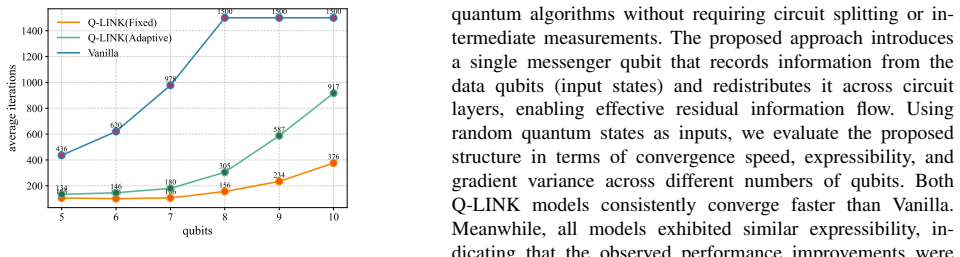
The Q-LINK architecture uses a single messenger qubit in a layerwise residual manner to sustain higher gradient variance in variational quantum circuits. This yields 4-6 times faster convergence and up to two orders of magnitude larger gradients than vanilla models. Expressibility remains largely the same, so the circuit continues to explore the full Hilbert space.
What carries the argument
The messenger qubit in the Q-LINK residual architecture, which links circuit layers to propagate information and counteract exponential gradient decay.
Where Pith is reading between the lines
- The residual link idea could extend to other quantum circuit families that suffer from vanishing gradients during training.
- On hardware, the single-qubit overhead might allow deeper circuits before plateaus dominate, enabling new variational applications.
- The approach could be combined with existing mitigation methods for compounded gains in optimization efficiency.
Load-bearing premise
Numerical simulations on random quantum states accurately predict behavior on structured optimization tasks and real NISQ hardware without the messenger qubit introducing offsetting noise or connectivity penalties.
What would settle it
Direct experiments on NISQ hardware for a concrete task such as VQE or QAOA where gradient variance stays low and convergence speed does not improve would falsify the mitigation claim.
Figures



read the original abstract
In hybrid classical-quantum computing, variational quantum algorithms (VQAs) have emerged as a promising approach in the Noisy Intermediate-Scale Quantum (NISQ) era; however, their performance is often hindered by barren plateaus, where gradients vanish exponentially, rendering optimization ineffective. In this work, we introduce a residual-inspired quantum circuit architecture that incorporates a single messenger qubit, referred to as Q-LINK. By conducting numerical simulations on random quantum states, we observe that Q-LINK significantly enhances optimization behavior by sustaining larger gradient variance and accelerating convergence. Additionally, Q-LINK improves convergence efficiency by 4-6 times and increases gradient variance by up to two orders of magnitude compared with the Vanilla model. To further characterize the impact of the proposed structure, we analyze the expressibility of the circuits before and after introducing Q-LINK and find that the overall expressibility value remains largely unchanged, indicating that the original representational capacity of the circuit is preserved. In addition, we visualize the loss landscapes of different architectures to provide insights into how the proposed design reshapes the cost function landscape. These results demonstrate that introducing only a single messenger qubit can effectively mitigate barren plateau effects while maintaining the ability to explore the Hilbert space of variational quantum circuits.
Editorial analysis
A structured set of objections, weighed in public.
Referee Report
Summary. The manuscript introduces Q-LINK, a residual-inspired variational quantum circuit architecture that adds a single messenger qubit to mitigate barren plateaus. Numerical simulations on random quantum states show that Q-LINK yields 4-6 times faster convergence and up to two orders of magnitude larger gradient variance than a vanilla baseline, while expressibility remains largely unchanged and loss landscapes appear more navigable.
Significance. If the empirical gains hold under structured Hamiltonians and hardware noise, the single-qubit overhead would constitute a lightweight, practical addition to VQA design that preserves Hilbert-space exploration. The direct comparison to a vanilla model and the expressibility check are straightforward strengths; however, the absence of analytic bounds or scaling arguments limits the result to an empirical observation rather than a general mitigation strategy.
major comments (2)
- [Abstract] Abstract and simulation results: the reported factors of 4-6× convergence improvement and up to 100× gradient-variance increase are presented without any mention of trial counts, circuit depths, number of random instances, statistical tests, or error bars. This omission prevents assessment of whether the gains are robust or sensitive to post-hoc choices in the random-state ensemble.
- [Numerical Simulations] Simulation methodology: all gradient-variance and convergence claims rest on sampling random quantum states rather than a fixed, task-specific cost function C(θ) = ⟨ψ(θ)|H|ψ(θ)⟩ with locality or correlation structure (e.g., molecular or Ising Hamiltonians). No analytic bound or scaling argument is supplied showing that Var(∂C/∂θ_i) remains polynomially bounded once the messenger qubit is introduced under such structured costs.
minor comments (2)
- [Loss Landscape Analysis] The loss-landscape visualizations would benefit from quantitative metrics (e.g., smoothness or barrier-height statistics) in addition to qualitative plots to support the claim that the landscape is reshaped favorably.
- [Methods] Notation for the messenger-qubit coupling and residual link should be defined explicitly in an equation or diagram early in the methods section to avoid ambiguity when comparing to the vanilla circuit.
Simulated Author's Rebuttal
We thank the referee for the constructive and detailed comments. We address each major comment point by point below, indicating where revisions will be made to strengthen the manuscript.
read point-by-point responses
-
Referee: [Abstract] Abstract and simulation results: the reported factors of 4-6× convergence improvement and up to 100× gradient-variance increase are presented without any mention of trial counts, circuit depths, number of random instances, statistical tests, or error bars. This omission prevents assessment of whether the gains are robust or sensitive to post-hoc choices in the random-state ensemble.
Authors: We agree that the abstract should provide more context on the simulation parameters for proper evaluation. In the revised manuscript we will update the abstract to state that the reported factors are averages over 1000 independent random instances, using circuit depths of 4–12 layers, with results shown as means accompanied by one-standard-deviation error bars. We will also note that statistical significance was assessed via paired t-tests (p < 0.01). The full experimental protocol, including random-state generation and trial counts, is already described in Section III; we will add a cross-reference in the abstract and ensure every figure caption explicitly mentions the error bars. revision: yes
-
Referee: [Numerical Simulations] Simulation methodology: all gradient-variance and convergence claims rest on sampling random quantum states rather than a fixed, task-specific cost function C(θ) = ⟨ψ(θ)|H|ψ(θ)⟩ with locality or correlation structure (e.g., molecular or Ising Hamiltonians). No analytic bound or scaling argument is supplied showing that Var(∂C/∂θ_i) remains polynomially bounded once the messenger qubit is introduced under such structured costs.
Authors: Random quantum states constitute a standard, problem-agnostic benchmark for isolating barren-plateau behavior, as used in the foundational literature. Nevertheless, we accept that demonstration on structured Hamiltonians would increase practical relevance. In the revision we will add a new subsection presenting results for the transverse-field Ising model (with local and non-local interaction terms), confirming that the gradient-variance increase and 4–6× convergence speedup persist. With respect to analytic bounds, the present work is empirical; deriving a general scaling argument that guarantees polynomial boundedness of Var(∂C/∂θ_i) for arbitrary structured Hamiltonians lies beyond the scope of this numerical study and would require substantial additional theoretical development. revision: partial
- Absence of an analytic bound or scaling argument guaranteeing that gradient variance remains polynomially bounded for general structured Hamiltonians.
Circularity Check
No circularity; results are direct empirical comparisons to baseline
full rationale
The paper reports numerical simulations on random quantum states that directly compare gradient variance, convergence speed, expressibility, and loss landscapes of the Q-LINK architecture against a vanilla baseline. No algebraic derivation, parameter fitting, or first-principles reduction is claimed; the improvements (4-6x convergence, up to 100x gradient variance) are presented as observed outcomes of the simulations rather than predictions derived from the inputs by construction. Expressibility analysis and landscape visualization are independent computations on the same circuits. No self-citations, uniqueness theorems, or ansatzes are invoked as load-bearing steps. The chain is therefore self-contained empirical evidence.
Axiom & Free-Parameter Ledger
axioms (2)
- standard math Standard unitary evolution, measurement, and gradient computation in variational quantum circuits
- domain assumption Barren plateaus arise in deep random circuits as established in prior literature
invented entities (1)
-
Messenger qubit
no independent evidence
Reference graph
Works this paper leans on
-
[1]
Variational quantum algorithms for chemical simulation and drug discovery,
H. Mustafa, S. N. Morapakula, P. Jain, and S. Ganguly, “Variational quantum algorithms for chemical simulation and drug discovery,” in Proc. 2022 Int. Conf. Trends Quantum Comput. Emerging Bus. Technol. (TQCEBT), 2022, pp. 1–8
work page 2022
-
[2]
Towards large-scale quantum optimiza- tion solvers with few qubits,
M. Sciorilli, L. Borges, T. L. Patti, D. Garc ´ıa-Mart´ın, G. Camilo, A. Anandkumar, and L. Aolita, “Towards large-scale quantum optimiza- tion solvers with few qubits,”Nat. Commun., vol. 16, no. 1, p. 476, 2025
work page 2025
-
[3]
Qfnn-ffd: Quantum federated neural network for financial fraud detection,
N. Innan, A. Marchisio, M. Bennai, and M. Shafique, “Qfnn-ffd: Quantum federated neural network for financial fraud detection,” in Proc. 2025 IEEE Int. Conf. Quantum Softw. (QSW), 2025, pp. 41–47
work page 2025
-
[4]
The theory of variational hybrid quantum–classical algorithms,
J. R. McClean, J. Romero, R. Babbush, and A. Aspuru-Guzik, “The theory of variational hybrid quantum–classical algorithms,”New J. Phys., vol. 18, no. 2, p. 023023, 2016
work page 2016
-
[5]
Variational quantum algorithms,
M. Cerezo, A. Arrasmith, R. Babbush, S. C. Benjamin, S. Endo, K. Fujii, J. R. McClean, K. Mitarai, X. Yuan, L. Cincio, and P. J. Coles, “Variational quantum algorithms,”Nat. Rev. Phys., vol. 3, no. 9, pp. 625–644, 2021
work page 2021
-
[6]
Resource- efficient quantum algorithm for protein folding,
A. Robert, P. K. Barkoutsos, S. Woerner, and I. Tavernelli, “Resource- efficient quantum algorithm for protein folding,”npj Quantum Inf., vol. 7, no. 1, p. 38, 2021
work page 2021
-
[7]
A novel hybrid quantum architecture for path planning in quantum-enabled autonomous mobile robots,
M. Sarkar, J. Pradhan, A. K. Singh, and H. Nenavath, “A novel hybrid quantum architecture for path planning in quantum-enabled autonomous mobile robots,”IEEE Trans. Consum. Electron., vol. 70, no. 3, pp. 5597– 5606, 2024
work page 2024
-
[8]
Barren plateaus in variational quantum computing,
M. Larocca, S. Thanasilp, S. Wang, K. Sharma, J. Biamonte, P. J. Coles, L. Cincio, J. R. McClean, Z. Holmes, and M. Cerezo, “Barren plateaus in variational quantum computing,”Nat. Rev. Phys., pp. 1–16, 2025
work page 2025
-
[9]
Avoiding barren plateaus with classical deep neural networks,
L. Friedrich and J. Maziero, “Avoiding barren plateaus with classical deep neural networks,”Phys. Rev. A, vol. 106, 2022
work page 2022
-
[10]
Z. Yi, Y . Liang, and H. Situ, “Enhancing variational quantum circuit training: An improved neural network approach for barren plateau mitigation,”Phys. Scr ., vol. 100, no. 8, p. 086004, 2025
work page 2025
-
[11]
Z. Yi and R. Bhadani, “Neural-network generated quantum state can alleviate the barren plateau in variational quantum circuits,” inFrontiers in Optics, 2025, pp. FW6D–3
work page 2025
-
[12]
Entanglement devised barren plateau mitigation,
T. L. Patti, K. Najafi, X. Gao, and S. F. Yelin, “Entanglement devised barren plateau mitigation,”Phys. Rev. Res., vol. 3, no. 3, p. 033090, 2021. /uni00000015 /uni00000013 /uni00000015/uni00000047/uni0000004c/uni00000055/uni00000048/uni00000046/uni00000057/uni0000004c/uni00000052/uni00000051/uni00000003/uni00000014 /uni00000015 /uni00000013 /uni00000015 ...
work page 2021
-
[13]
Mitigating barren plateaus of variational quantum eigensolvers,
X. Liu, G. Liu, H. K. Zhang, J. Huang, and X. Wang, “Mitigating barren plateaus of variational quantum eigensolvers,”IEEE Trans. Quantum Eng., vol. 5, pp. 1–19, 2024
work page 2024
-
[14]
Z. Yi and R. Bhadani, “The PID controller strikes back: Classical controller helps mitigate barren plateaus in noisy variational quantum circuits,” in8th Annual Learning for Dynamics & Control Conference. PMLR, 2026, arXiv:2511.14820. [Online]. Available: https://arxiv.org/ abs/2511.14820
-
[15]
Resqnets: A residual approach for mitigating barren plateaus in quantum neural networks,
M. Kashif and S. Al-Kuwari, “Resqnets: A residual approach for mitigating barren plateaus in quantum neural networks,”EPJ Quantum Technol., vol. 11, no. 1, pp. 1–28, 2024
work page 2024
-
[16]
M. A. Nielsen and I. L. Chuang,Quantum Computation and Quantum Information. Cambridge, U.K.: Cambridge Univ. Press, 2010
work page 2010
-
[17]
S. Sim, P. D. Johnson, and A. Aspuru-Guzik, “Expressibility and entan- gling capability of parameterized quantum circuits for hybrid quantum- classical algorithms,”Adv. Quantum Technol., vol. 2, no. 12, p. 1900070, 2019
work page 2019
-
[18]
Deep residual learning for image recognition,
K. He, X. Zhang, S. Ren, and J. Sun, “Deep residual learning for image recognition,” inProc. IEEE Conf. Comput. Vis. Pattern Recognit. (CVPR), pp. 770–778
-
[19]
Visualizing the loss landscape of neural nets,
H. Li, Z. Xu, G. Taylor, C. Studer, and T. Goldstein, “Visualizing the loss landscape of neural nets,” inAdvances in Neural Information Processing Systems (NeurIPS), vol. 31, 2018
work page 2018
-
[20]
Tensorcircuit: A quantum software framework for the nisq era,
S. X. Zhang, J. Allcock, Z. Q. Wan, S. Liu, J. Sun, H. Yu, X. H. Yang, J. Qiu, Z. Ye, Y . Q. Chen, and C. K. Lee, “Tensorcircuit: A quantum software framework for the nisq era,”Quantum, vol. 7, p. 912, 2023
work page 2023
-
[21]
Pytorch: An imperative style, high-performance deep learning library,
A. Paszke, S. Gross, F. Massa, A. Lerer, J. Bradbury, G. Chanan, T. Killeen, Z. Lin, N. Gimelshein, L. Antiga, and A. Desmaison, “Pytorch: An imperative style, high-performance deep learning library,” inAdv. Neural Inf. Process. Syst. (NeurIPS), vol. 32, 2019
work page 2019
discussion (0)
Sign in with ORCID, Apple, or X to comment. Anyone can read and Pith papers without signing in.