Recognition: 2 theorem links
· Lean TheoremBlind Catalytic Quantum Error Correction: Target-State Estimation and Fidelity Recovery Without A Priori Knowledge
Pith reviewed 2026-05-11 02:03 UTC · model grok-4.3
The pith
Blind catalytic quantum error correction recovers the target state by estimating it directly from the noisy output without any prior knowledge of the ideal state.
A machine-rendered reading of the paper's core claim, the machinery that carries it, and where it could break.
Core claim
Target-state estimation from the noisy output alone suffices for catalytic quantum error correction, because the recovery fidelity satisfies the Lipschitz bound F_rec greater than or equal to 1 minus 2 times the one-norm distance between the estimated and true target states; this bound accounts for the observed linear correlation between estimation accuracy and recovery success, with a crossover dimension near 25 to 40 separating estimation regimes and a hybrid estimator bridging them.
What carries the argument
The two-stage blind CQEC protocol, in which a classical estimator extracts a proxy target state from the noisy quantum output and feeds it into the catalytic recovery module, with the Lipschitz continuity of fidelity with respect to trace distance supplying the performance guarantee.
If this is right
- Estimation and recovery fidelities remain linearly correlated with r greater than 0.99 for dimensions from 4 to 256 and across multiple noise models.
- A crossover dimension d star approximately 25 to 40 marks the transition between optimal estimation strategies, with a tunable hybrid bridging the regimes.
- Noisy VQE simulations for H2 show a 3.4 times reduction in energy error after blind recovery.
- The protocol returns the corrected quantum state itself rather than only expectation values, at single-copy measurement cost.
- The central bottleneck reduces to a classical estimation task once the coherent modes survive in the noisy output.
Where Pith is reading between the lines
- Improving classical state-estimation algorithms would directly translate into better quantum recovery performance without additional quantum hardware.
- Iterative algorithms such as VQE could run with autonomous correction modules that adapt as the variational parameters evolve.
- The method may extend to other variational or adaptive quantum algorithms where the output state cannot be known in advance.
- Under strong decoherence that destroys all coherent modes, performance would collapse to that of a classical estimator with no quantum advantage.
Load-bearing premise
Target coherent modes must remain detectable in the noisy state so that estimation from the noisy output alone can produce a sufficiently accurate proxy.
What would settle it
Measure whether the linear correlation between estimation fidelity and recovery fidelity disappears for highly mixed target states or under decoherence strong enough to erase coherent modes before estimation occurs.
Figures





read the original abstract
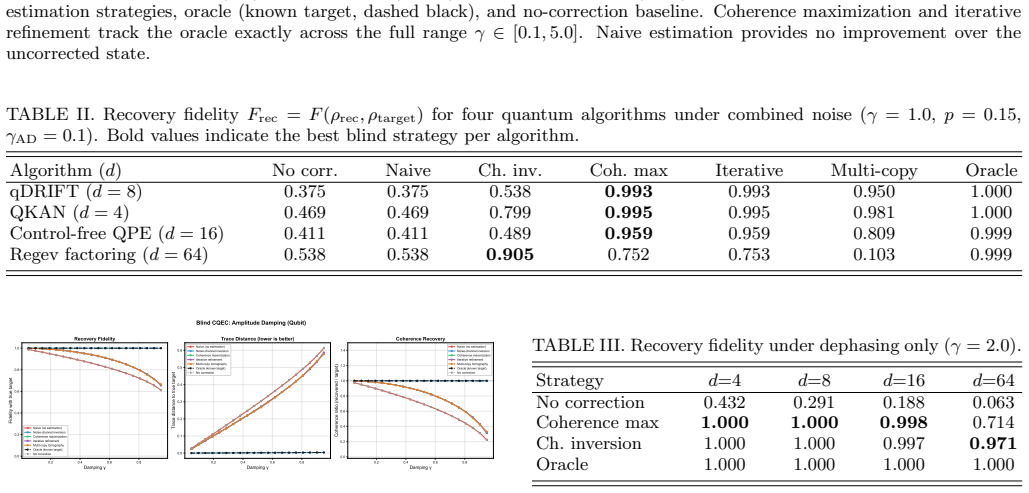
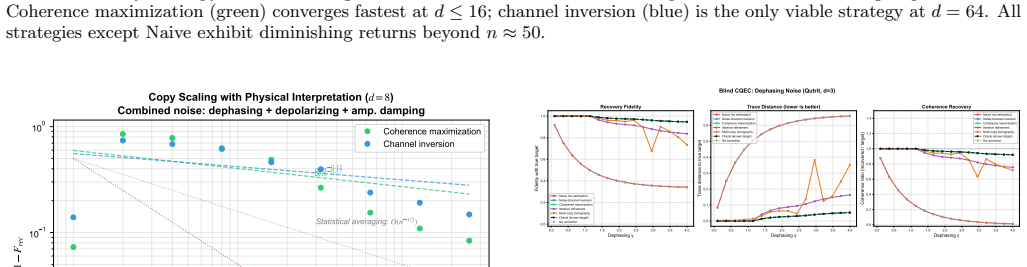
Near-term quantum computers must protect fragile coherence against decoherence to deliver useful results. Catalytic quantum error correction (CQEC) addresses this challenge by amplifying residual coherence with a reusable catalyst, achieving threshold-free recovery whenever the target coherent modes survive in the noisy state. However, the original protocol requires complete knowledge of the ideal target -- an assumption that fails for variational and iterative algorithms whose output is unknown to the correction module. Here we show that this requirement can be removed by estimating the target from the noisy output alone, in a two-stage protocol we call \emph{blind CQEC}. We benchmark five estimation strategies across three noise channels, four quantum algorithms ($d = 4$--$64$), Haar-random states up to $d = 256$, and mixed targets, and find that estimation and recovery fidelities are linearly correlated ($r > 0.99$); we prove an analytical Lipschitz bound $F_\mathrm{rec} \geq 1 - 2\|\hat{\rho}_\mathrm{est} - \rho_\mathrm{target}\|_1$ that explains the correlation, derive a crossover dimension $d^* \approx 25$--$40$, and show that a tunable hybrid bridges the two regimes. Unlike error-mitigation methods (zero-noise extrapolation, probabilistic error cancellation, virtual distillation), blind CQEC returns the state itself rather than corrected expectation values, with single-copy overhead. A noisy-VQE demonstration for H$_2$ yields $3.4\times$ energy-error reduction, and a \texttt{qiskit-aer} circuit-level check confirms transfer to small circuits. These results identify the bottleneck of blind error correction as a classical estimation problem, opening a route to autonomous, threshold-free recovery in algorithms where pre-encoding is unavailable.
Editorial analysis
A structured set of objections, weighed in public.
Referee Report
Summary. The paper introduces blind catalytic quantum error correction (blind CQEC), a two-stage protocol that estimates the unknown target state directly from the noisy output to remove the a priori knowledge requirement of standard CQEC. It proves the analytical Lipschitz bound F_rec ≥ 1 - 2‖ρ̂_est - ρ_target‖_1, reports a linear correlation (r > 0.99) between estimation and recovery fidelities across five estimation strategies, three noise channels, algorithms with d = 4–64, Haar-random states up to d = 256, and mixed targets, derives a crossover dimension d* ≈ 25–40 with a tunable hybrid, and demonstrates a noisy-VQE application for H2 yielding 3.4× energy-error reduction plus qiskit-aer circuit verification.
Significance. If the results hold, this provides a practical route to autonomous, threshold-free state recovery on near-term devices for variational algorithms where targets are not known in advance. The parameter-free analytical Lipschitz bound and the breadth of benchmarks (multiple channels, dimensions, algorithms, random and mixed states) give direct support to the correlation claim and distinguish blind CQEC from expectation-value-only methods by returning the corrected state with single-copy overhead. The framing of estimation as the classical bottleneck is a useful conceptual advance.
major comments (1)
- [Abstract and protocol description] Abstract and protocol description: the central claim that blind CQEC achieves threshold-free recovery with the observed r > 0.99 correlation and the Lipschitz bound F_rec ≥ 1 - 2‖ρ̂_est - ρ_target‖_1 relies on the five estimation strategies successfully extracting the target from the noisy output alone. This requires that coherent modes survive sufficiently in the noisy state, a condition stated for non-blind CQEC but not explicitly shown to hold for blind estimation under strong decoherence or highly mixed targets; the benchmarks include mixed targets but do not isolate regimes where the survival assumption fails, leaving the robustness of the bound and correlation unverified in those cases.
minor comments (2)
- The derivation of the crossover dimension d* ≈ 25–40 and the hybrid strategy should include an explicit equation or procedure for determining d* from the data.
- The reported correlation r > 0.99 would be strengthened by stating whether error bars, statistical tests, or data-exclusion criteria were applied to the benchmark results.
Simulated Author's Rebuttal
We thank the referee for their careful reading and constructive feedback. We address the major comment below and indicate the revisions planned for the manuscript.
read point-by-point responses
-
Referee: [Abstract and protocol description] Abstract and protocol description: the central claim that blind CQEC achieves threshold-free recovery with the observed r > 0.99 correlation and the Lipschitz bound F_rec ≥ 1 - 2‖ρ̂_est - ρ_target‖_1 relies on the five estimation strategies successfully extracting the target from the noisy output alone. This requires that coherent modes survive sufficiently in the noisy state, a condition stated for non-blind CQEC but not explicitly shown to hold for blind estimation under strong decoherence or highly mixed targets; the benchmarks include mixed targets but do not isolate regimes where the survival assumption fails, leaving the robustness of the bound and correlation unverified in those cases.
Authors: The survival of coherent modes is a prerequisite for threshold-free CQEC recovery in general and is independent of whether the target is known a priori or estimated blindly; it concerns only the presence of residual coherence in the noisy state. The Lipschitz bound F_rec ≥ 1 - 2‖ρ̂_est - ρ_target‖_1 is proven analytically from the definitions of fidelity and trace distance and therefore holds for any estimation method, including the five blind strategies, without additional assumptions on noise strength. The reported linear correlation (r > 0.99) is observed empirically across all benchmarks, which already include mixed targets of varying purity and multiple noise channels. We agree that the manuscript does not explicitly isolate the boundary regimes where survival fails for the blind protocol. In the revised version we will (i) clarify in the protocol section that the survival condition is identical to standard CQEC and (ii) add a dedicated paragraph analyzing strong-decoherence and low-purity limits, confirming where the correlation and bound remain valid and where recovery ceases to be threshold-free. These additions address the robustness concern directly. revision: yes
Circularity Check
No significant circularity; Lipschitz bound is independent analytical derivation
full rationale
The central result is the parameter-free analytical proof of the Lipschitz inequality F_rec ≥ 1 - 2‖ρ̂_est - ρ_target‖_1, which is derived from standard properties of fidelity and trace distance rather than from any fitted data or self-referential definition. The reported linear correlation (r > 0.99) is an empirical observation across independent benchmark suites (noise channels, algorithms, dimensions, mixed states) and is explained by the bound rather than forced by it. No derivation step reduces to a fitted input renamed as prediction, a self-citation chain, or an ansatz smuggled via prior work. The survival assumption for coherent modes is an explicit modeling premise, not a hidden tautology. The paper is therefore self-contained against external benchmarks.
Axiom & Free-Parameter Ledger
free parameters (1)
- crossover dimension d* =
25-40
axioms (2)
- domain assumption Target coherent modes survive in the noisy state
- standard math Standard quantum mechanics, density operators, and noise channels (depolarizing, dephasing, amplitude damping)
Lean theorems connected to this paper
-
IndisputableMonolith/Foundation/AbsoluteFloorClosure.leanabsolute_floor_iff_bare_distinguishability unclear?
unclearRelation between the paper passage and the cited Recognition theorem.
Theorem 1 (Shiraishi–Takagi). A catalytic covariant transformation ρ⊗c ↦ τ … exists if and only if C(ρ′)⊆C(ρ) and ρ is full rank.
-
IndisputableMonolith/Cost/FunctionalEquation.leanwashburn_uniqueness_aczel unclear?
unclearRelation between the paper passage and the cited Recognition theorem.
coherence maximization … (ρ̂_est)_ij = √(ρ_noisy_ii ρ_noisy_jj) e^{iφ_ij}
What do these tags mean?
- matches
- The paper's claim is directly supported by a theorem in the formal canon.
- supports
- The theorem supports part of the paper's argument, but the paper may add assumptions or extra steps.
- extends
- The paper goes beyond the formal theorem; the theorem is a base layer rather than the whole result.
- uses
- The paper appears to rely on the theorem as machinery.
- contradicts
- The paper's claim conflicts with a theorem or certificate in the canon.
- unclear
- Pith found a possible connection, but the passage is too broad, indirect, or ambiguous to say the theorem truly supports the claim.
Reference graph
Works this paper leans on
-
[1]
Set ˆρ(0) est from Eq. (4)
-
[2]
Fork= 1, . . . , K: run CQEC with target ˆρ (k−1) est to obtainρ (k) rec; update ˆρ(k) est =α ρ (k) rec + (1−α) ˆρ(k−1) est with damping parameterα= 0.5. The damping parameterα= 0.5 was selected empiri- cally to balance convergence speed against oscillation; valuesα∈[0.3,0.7] yield similar results in our bench- marks. We do not have an analytical converge...
-
[3]
H. Wakaura, Catalytic quantum error correction: The- ory, efficient catalyst preparation, and numerical bench- marks, In preparation (2026)
work page 2026
-
[4]
N. Shiraishi and R. Takagi, Arbitrary amplification of quantum coherence in asymptotic and catalytic transfor- mation, Phys. Rev. Lett.132, 180202 (2024)
work page 2024
-
[5]
P. W. Shor, Scheme for reducing decoherence in quantum computer memory, Phys. Rev. A52, R2493 (1995)
work page 1995
-
[6]
Gottesman, Stabilizer codes and quantum error cor- rection, Ph.D
D. Gottesman, Stabilizer codes and quantum error cor- rection, Ph.D. thesis, Caltech (1997)
work page 1997
-
[7]
Knill, Quantum computing with realistically noisy de- vices, Nature434, 39 (2005)
E. Knill, Quantum computing with realistically noisy de- vices, Nature434, 39 (2005)
work page 2005
-
[8]
H. Wakaura, Resource-efficient catalyst preparation for catalytic quantum state recovery via dynamical decou- pling, twirling, and purification, In preparation (2026)
work page 2026
-
[9]
A. Peruzzo, J. McClean, P. Shadbolt, M.-H. Yung, X.-Q. Zhou, P. J. Love, A. Aspuru-Guzik, and J. L. O’Brien, A variational eigenvalue solver on a photonic quantum processor, Nat. Commun.5, 4213 (2014)
work page 2014
- [10]
-
[11]
We use “blind” in the operational sense that the target state is unknown to the correction protocol, distinct from blind quantum computing, which concerns hiding com- putation from an untrusted server
-
[12]
Hradil, Quantum-state estimation, Phys
Z. Hradil, Quantum-state estimation, Phys. Rev. A55, R1561 (1997)
work page 1997
-
[13]
D. Gross, Y.-K. Liu, S. T. Flammia, S. Becker, and J. Eis- ert, Quantum state tomography via compressed sensing, Phys. Rev. Lett.105, 150401 (2010)
work page 2010
-
[14]
J. Haah, A. W. Harrow, Z. Ji, X. Wu, and N. Yu, Sample- optimal tomography of quantum states, IEEE Trans. Inf. Theory63, 5628 (2017)
work page 2017
-
[15]
C.-F. Chen, H.-Y. Huang, R. Kueng, and J. A. Tropp, Concentration for random product formulas, PRX Quan- tum2, 040305 (2021)
work page 2021
-
[16]
P. Ivashkov, P.-W. Huang, K. Koor, L. Pira, and P. Rebentrost, QKAN: Quantum Kolmogorov–Arnold networks, arXiv preprint arXiv:2410.04435 (2024)
work page internal anchor Pith review arXiv 2024
-
[17]
L. Clinton, T. S. Cubitt, R. Garcia-Patron, A. Monta- naro, S. Stanisic, and M. Stroeks, Quantum phase esti- mation without controlled unitaries, PRX Quantum7, 010345 (2026)
work page 2026
-
[18]
Regev, An efficient quantum factoring algorithm, arXiv (2024), 2308.06572v3
O. Regev, An efficient quantum factoring algorithm, arXiv preprint arXiv:2308.06572v3 (2024)
-
[19]
C. A. Fuchs and J. van de Graaf, Cryptographic dis- tinguishability measures for quantum-mechanical states, IEEE Trans. Inf. Theory45, 1216 (1999)
work page 1999
-
[20]
M. A. Nielsen and I. L. Chuang,Quantum Computation and Quantum Information, 10th ed. (Cambridge Univer- sity Press, 2010)
work page 2010
-
[21]
T. Baumgratz, M. Cramer, and M. B. Plenio, Quantify- ing coherence, Phys. Rev. Lett.113, 140401 (2014)
work page 2014
-
[22]
A. Streltsov, G. Adesso, and M. B. Plenio, Colloquium: Quantum coherence as a resource, Rev. Mod. Phys.89, 041003 (2017). 14
work page 2017
-
[23]
J. Emerson, R. Alicki, and K. ˙Zyczkowski, Scalable noise estimation with random unitary operators, J. Opt. B7, S347 (2005)
work page 2005
-
[24]
R. Raghoonanan and T. Byrnes, Purification quantum error correction, In preparation (2026)
work page 2026
discussion (0)
Sign in with ORCID, Apple, or X to comment. Anyone can read and Pith papers without signing in.