Recognition: unknown
Time-Delocalized Local Measurements in an Indefinite Causal Order
Pith reviewed 2026-05-10 16:04 UTC · model grok-4.3
The pith
Local measurements realized inside quantum switch preserving indefinite causal order via time-delocalized ancilla
A machine-rendered reading of the paper's core claim, the machinery that carries it, and where it could break.
Core claim
We experimentally realize a local measurement scheme for the quantum switch by coupling the photon to a time-delocalized ancilla system. Our method ensures that the measurement apparatus interacts with the system at two distinct times and yet yields a single outcome. We use a quantum eraser measurement to preserve the ICO, which we certify by measuring a causal witness and finding a negative value of C_W ≈ -0.305(1). This also provides a general method for path-coherence-preserving measurements with broad applications beyond ICO.
What carries the argument
The time-delocalized ancilla system that couples to the photon in the quantum switch at two times, enabling a single local readout while preserving the superposition of causal orders.
Load-bearing premise
The post-selected linear optical gates and the engineered time-delocalized ancilla coupling preserve the required coherences without introducing uncontrolled decoherence or bias.
What would settle it
Observing a positive causal witness value C_W or absence of interference in the quantum eraser would show that the indefinite causal order was not preserved.
Figures

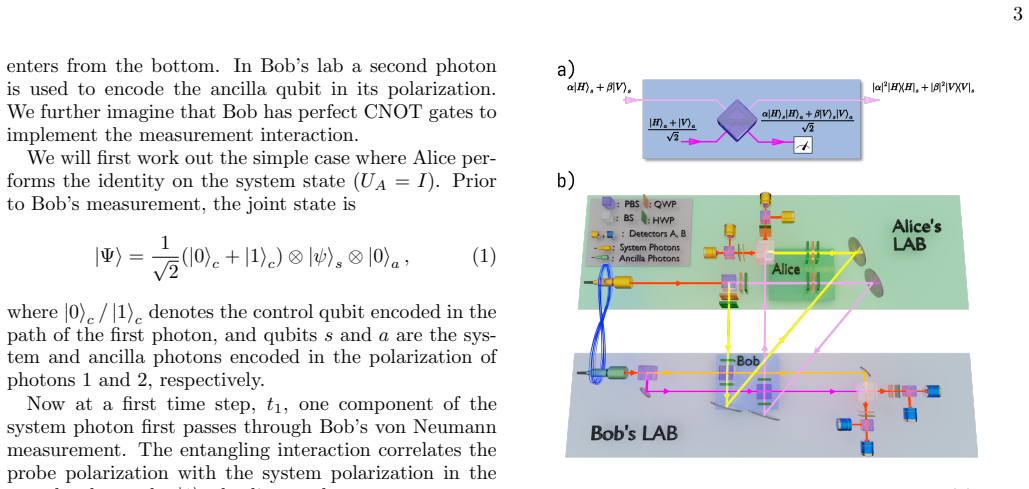


read the original abstract
Processes with indefinite causal order (ICO), such as the quantum switch, are an emerging resource for quantum tasks and a fundamental test bed for studies of temporal correlations in quantum mechanics. A limitation of past photonic implementations of the quantum switch, however, is their inability to perform measurements inside the switch without either destroying the superposition of causal orders or delaying readout until the after the quantum switch. Measurements where the results are read out locally are needed for several applications of ICO, but also for a loophole-free verification of ICO. Here, we overcome past limitations by introducing a $\mathit{local}$ measurement scheme and coupling the photon in the switch to a $\mathit{time-delocalized}$ ancilla system. We experimentally realize this protocol using a photonic quantum switch with post-selected linear optical logic gates. Our method ensures that the measurement apparatus interacts with the system at two distinct times and yet yields a single outcome. We use a quantum eraser measurement to preserve the ICO, which we certify by measuring a causal witness and finding a negative value of $\mathcal{C}_W \approx -0.305 (1)$. Furthermore, by explicitly realizing a time-delocalized ancilla system, our protocol not only enables a new class of quantum switch protocols requiring local readout, but also provides a general method for path-coherence-preserving measurements with broad applications beyond ICO.
Editorial analysis
A structured set of objections, weighed in public.
Referee Report
Summary. The manuscript introduces a protocol for local measurements in indefinite causal order (ICO) processes via coupling to a time-delocalized ancilla system, ensuring interaction at distinct times with a single readout outcome. It experimentally implements this in a photonic quantum switch using post-selected linear optical logic gates and a quantum eraser, certifying ICO by measuring a causal witness with value C_W ≈ -0.305(1).
Significance. If the post-selection is shown to be unbiased, the work enables a new class of ICO protocols with local readout, addressing a key limitation of prior photonic implementations and supporting applications in quantum information as well as loophole-free ICO verification. The explicit realization of the time-delocalized ancilla provides a general coherence-preserving measurement technique.
major comments (2)
- [§4] §4 (Experimental Implementation): The post-selection efficiency, full data selection criteria, heralding conditions for the linear optical gates, and complete error budget (including potential phase errors or amplitude biases from the quantum eraser) are not provided. This is load-bearing for the central claim, as the reported C_W ≈ -0.305(1) could be affected by selective discarding of events that artificially enhances negativity without preserving the causal superposition coherences.
- [§3] §3 (Theoretical Protocol): The coupling of the time-delocalized ancilla to the system is described at a high level, but lacks explicit verification that the single-outcome measurement does not introduce post-selection-dependent collapse of the causal order superposition; a concrete calculation or bound on any introduced decoherence would be needed to support the witness measurement.
minor comments (2)
- [Abstract and §2] Notation for the causal witness (C_W vs. mathcal{C}_W) is used inconsistently between abstract and main text; standardize throughout.
- [Figures] Figure captions for the experimental setup should explicitly label the post-selection step and its relation to the witness operator to improve clarity.
Simulated Author's Rebuttal
We thank the referee for their careful reading of our manuscript and their constructive comments. We address each of the major comments below and have made revisions to incorporate the suggested improvements.
read point-by-point responses
-
Referee: [§4] §4 (Experimental Implementation): The post-selection efficiency, full data selection criteria, heralding conditions for the linear optical gates, and complete error budget (including potential phase errors or amplitude biases from the quantum eraser) are not provided. This is load-bearing for the central claim, as the reported C_W ≈ -0.305(1) could be affected by selective discarding of events that artificially enhances negativity without preserving the causal superposition coherences.
Authors: We agree that these details are essential to substantiate the central claim. In the revised manuscript we have expanded §4 (and added a supplementary note) with the post-selection efficiency, the complete data selection criteria, the heralding conditions for the linear optical gates, and a full error budget. The budget includes explicit bounds on phase errors and amplitude biases arising from the quantum eraser; we show that the post-selection remains unbiased with respect to the causal-order superposition and does not artificially inflate the negativity of the witness. revision: yes
-
Referee: [§3] §3 (Theoretical Protocol): The coupling of the time-delocalized ancilla to the system is described at a high level, but lacks explicit verification that the single-outcome measurement does not introduce post-selection-dependent collapse of the causal order superposition; a concrete calculation or bound on any introduced decoherence would be needed to support the witness measurement.
Authors: We appreciate this observation. Although the protocol is outlined in §3, we have added an explicit calculation in the revised version demonstrating that the single-outcome measurement performed by the time-delocalized ancilla does not induce post-selection-dependent collapse of the causal-order superposition. The calculation supplies a quantitative upper bound on any residual decoherence, confirming that the measured witness remains valid. revision: yes
Circularity Check
No circularity: experimental measurement of causal witness
full rationale
The paper reports an experimental photonic realization of time-delocalized local measurements inside a quantum switch, using post-selected gates and a quantum eraser to obtain a single-outcome readout while preserving ICO. The central result is the measured value of the causal witness C_W ≈ -0.305(1), which is an empirical datum obtained from the apparatus rather than a theoretical prediction derived from fitted parameters or self-referential definitions. No load-bearing derivation step reduces to its own inputs by construction; the work is self-contained as a physical demonstration whose validity rests on the experimental controls and the independently defined witness operator, not on any tautological renaming or self-citation chain.
Axiom & Free-Parameter Ledger
axioms (2)
- domain assumption Linear optical elements can implement the quantum switch in superposition of causal orders when post-selected
- domain assumption The quantum eraser can erase which-path information without destroying the indefinite causal order
invented entities (1)
-
time-delocalized ancilla system
no independent evidence
Reference graph
Works this paper leans on
-
[1]
Chiribella, G
G. Chiribella, G. M. D’Ariano, P. Perinotti, and B. Val- iron, Quantum computations without definite causal structure, Physical Review A—Atomic, Molecular, and Optical Physics88, 022318 (2013)
2013
-
[2]
O. Oreshkov, F. Costa, and ˇC. Brukner, Quantum corre- lations with no causal order, Nature Communications3, 1092 (2012), arXiv:1105.4464 [quant-ph]
-
[3]
Experimental aspects of indefinite causal order in quan- tum mechanics, Nature Reviews Physics , 483 (2024)
2024
-
[4]
Baumeler, A
¨A. Baumeler, A. Feix, and S. Wolf, Maximal incompati- bility of locally classical behavior and global causal order in multiparty scenarios, Physical Review A90, 042106 (2014)
2014
-
[5]
Baumeler and S
¨A. Baumeler and S. Wolf, The space of logically consis- tent classical processes without causal order, New Jour- nal of Physics18, 013036 (2016)
2016
-
[6]
Wechs, H
J. Wechs, H. Dourdent, A. A. Abbott, and C. Branciard, Quantum circuits with classical versus quantum control of causal order, PRX Quantum2, 030335 (2021)
2021
-
[7]
J. Bavaresco, M. Murao, and M. T. Quintino, Unitary channel discrimination beyond group structures: Ad- vantages of sequential and indefinite-causal-order strate- gies, Journal of Mathematical Physics63, 042203 (2022), arXiv:2105.13369 [quant-ph]
-
[8]
Ara´ ujo, A
M. Ara´ ujo, A. Feix, F. Costa, andˇC. Brukner, Quantum circuits cannot control unknown operations, New J. Phys. 16, 093026
-
[9]
M. M. Taddei, J. Cari˜ ne, D. Mart´ ınez, T. Garc´ ıa, N. Guerrero, A. A. Abbott, M. Ara´ ujo, C. Branciard, E. S. G´ omez, S. P. Walborn, L. Aolita, and G. Lima, Computational advantage from the quantum superposi- tion of multiple temporal orders of photonic gates, PRX Quantum2, 010320 (2021), arXiv:2002.07817 [quant-ph]
- [10]
-
[11]
¨A. . Baumeler and S. Wolf, Perfect signaling among three parties violating predefined causal order, inInformation Theory (ISIT), 2014 IEEE International Symposium on (2014) pp. 526–530, arXiv:1312.5916 [quant-ph]
-
[12]
A. Feix, M. Ara´ ujo, andˇC. Brukner, Quantum superposi- tion of the order of parties as a communication resource, Phys. Rev. A92, 052326 (2015)
2015
-
[13]
P. A. Gu´ erin, A. Feix, M. Ara´ ujo, andˇC. Brukner, Expo- nential communication complexity advantage from quan- tum superposition of the direction of communication, Phys. Rev. Lett.117, 100502
-
[14]
Refrigeration with Indefinite Causal Orders on a Cloud Quantum Computer
D. Felce, V. Vedral, and F. Tennie, Refrigeration with Indefinite Causal Orders on a Cloud Quantum Computer, arXiv e-prints , arXiv:2107.12413 (2021), arXiv:2107.12413 [quant-ph]
- [15]
-
[16]
Simonov, G
K. Simonov, G. Francica, G. Guarnieri, and M. Pater- nostro, Work extraction from coherently activated maps via quantum switch, Phys. Rev. A105, 032217 (2022)
2022
-
[17]
Frey, Indefinite causal order aids quantum depolar- izing channel identification, Quantum Information Pro- cessing18, 96 (2019)
M. Frey, Indefinite causal order aids quantum depolar- izing channel identification, Quantum Information Pro- cessing18, 96 (2019)
2019
-
[18]
Chapeau-Blondeau, Indefinite causal order for quan- tum metrology with quantum thermal noise, Physics Let- ters A447, 128300
F. Chapeau-Blondeau, Indefinite causal order for quan- tum metrology with quantum thermal noise, Physics Let- ters A447, 128300
-
[19]
X. Zhao, Y. Yang, and G. Chiribella, Quantum metrol- ogy with indefinite causal order, Phys. Rev. Lett.124, 190503
-
[20]
Spencer-Wood, Indefinite causal key distribution, Journal of Physics A: Mathematical and Theoretical (2025)
H. Spencer-Wood, Indefinite causal key distribution, Journal of Physics A: Mathematical and Theoretical (2025)
2025
-
[21]
N. Gao, D. Li, A. Mishra, J. Yan, K. Simonov, and G. Chiribella, Measuring incompatibility and clustering quantum observables with a quantum switch, Phys. Rev. Lett.130, 170201 (2023)
2023
- [22]
- [23]
-
[24]
G. Rubino, L. A. Rozema, D. Ebler, H. Kristj´ ansson, S. Salek, P. Allard Gu´ erin, A. A. Abbott, C. Branciard, ˇC. Brukner, G. Chiribella, and P. Walther, Experimental quantum communication enhancement by superposing 8 trajectories, Physical Review Research3, 013093 (2021), arXiv:2007.05005 [quant-ph]
- [25]
- [26]
- [27]
- [28]
-
[29]
G. Zhu, Y. Chen, Y. Hasegawa, and P. Xue, Charging quantum batteries via indefinite causal order: Theory and experiment, Phys. Rev. Lett.131, 240401 (2023)
2023
-
[30]
M. An, S. Ru, Y. Wang, Y. Yang, F. Wang, P. Zhang, and F. Li, Noisy quantum parameter estimation with in- definite causal order, Phys. Rev. A109, 012603 (2024)
2024
-
[31]
K. Wei, N. Tischler, S.-R. Zhao, Y.-H. Li, J. M. Arrazola, Y. Liu, W. Zhang, H. Li, L. You, Z. Wang, Y.-A. Chen, B. C. Sanders, Q. Zhang, G. J. Pryde, F. Xu, and J.- W. Pan, Experimental Quantum Switching for Exponen- tially Superior Quantum Communication Complexity, Phys. Rev. Lett.122, 120504 (2019), arXiv:1810.10238 [quant-ph]
-
[32]
Goswami, C
K. Goswami, C. Giarmatzi, M. Kewming, F. Costa, C. Branciard, J. Romero, and A. G. White, Indefinite causal order in a quantum switch, Phys. Rev. Lett.121, 090503 (2018)
2018
-
[33]
Goswami, Y
K. Goswami, Y. Cao, G. A. Paz-Silva, J. Romero, and A. G. White, Increasing communication capacity via superposition of order, Phys. Rev. Research2, 033292 (2020)
2020
-
[34]
P. Yin, X. Zhao, Y. Yang, Y. Guo, W.-H. Zhang, G.-C. Li, Y.-J. Han, B.-H. Liu, J.-S. Xu, G. Chiribella,et al., Experimental super-heisenberg quantum metrology with indefinite gate order, Nature Physics19, 1122 (2023)
2023
-
[35]
Antesberger, M
M. Antesberger, M. T. Quintino, P. Walther, and L. A. Rozema, Higher-order process matrix tomography of a passively-stable quantum switch, PRX Quantum5, 010325 (2024)
2024
-
[36]
Toward an Experimental Device-Independent Verification of Indefinite Causal Order
C. Richter, M. Antesberger, H. Cao, P. Walther, and L. A. Rozema, Towards an experimental device- independent verification of indefinite causal order, arXiv preprint arXiv:2506.16949 (2025)
work page internal anchor Pith review Pith/arXiv arXiv 2025
-
[37]
Ara´ ujo, C
M. Ara´ ujo, C. Branciard, F. Costa, A. Feix, C. Giar- matzi, and ˇC. Brukner, Witnessing causal nonseparabil- ity, New Journal of Physics17, 102001 (2015)
2015
-
[38]
T. Purves and A. J. Short, Quantum Theory Cannot Vi- olate a Causal Inequality, Phys. Rev. Lett.127, 110402 (2021), arXiv:2101.09107 [quant-ph]
-
[39]
Van Der Lugt, J
T. Van Der Lugt, J. Barrett, and G. Chiribella, Device- independent certification of indefinite causal order in the quantum switch, Nature Communications14, 5811 (2023)
2023
-
[40]
J. Bavaresco, M. Ara´ ujo, ˇC. Brukner, and M. T. Quintino, Semi-device-independent certification of indefinite causal order, Quantum3, 176 (2019), arXiv:1903.10526 [quant-ph]
-
[41]
M. Le´ sniak, R. Kukulski, P. Lewandowska, G. Rajchel- Mieldzio´ c, and M. Wro´ nski, A bipartite quantum key dis- tribution protocol based on indefinite causal order, arXiv preprint arXiv:2603.08204 (2026)
-
[42]
Englert, Fringe visibility and which-way informa- tion: An inequality, Physical review letters77, 2154 (1996)
B.-G. Englert, Fringe visibility and which-way informa- tion: An inequality, Physical review letters77, 2154 (1996)
1996
- [43]
-
[44]
Knill, R
E. Knill, R. Laflamme, and G. J. Milburn, A scheme for efficient quantum computation with linear optics, Nature (London)409, 46 (2001)
2001
-
[45]
T. C. Ralph, N. K. Langford, T. Bell, and A. White, Lin- ear optical controlled-not gate in the coincidence basis, Physical Review A65, 062324 (2002)
2002
- [46]
-
[47]
Pryde, J
G. Pryde, J. O’Brien, A. White, T. Ralph, and H. Wise- man, Measurement of quantum weak values of photon polarization, Physical review letters94, 220405 (2005)
2005
-
[48]
Pittman, B
T. Pittman, B. Jacobs, and J. Franson, Probabilistic quantum logic operations using polarizing beam splitters, Physical Review A64, 062311 (2001)
2001
-
[49]
S. Barz, I. Kassal, M. Ringbauer, Y. O. Lipp, B. Daki´ c, A. Aspuru-Guzik, and P. Walther, A two-qubit photonic quantum processor and its application to solving systems of linear equations, Scientific reports4, 6115 (2014)
2014
- [50]
-
[51]
Y. Valibouse, M. Cladera-Rossell´ o, M. Antesberger, P. Walther, and L. A. Rozema, Time-delocalized local measurements in an indefinite causal order, 10.5281/zen- odo.19334935 (2026). 9 Appendix A: Measurement inside the Quantum Switch To perform a measurement of the system polarization, we use an ancilla photon inspired by the von Neumann measurement mod...
discussion (0)
Sign in with ORCID, Apple, or X to comment. Anyone can read and Pith papers without signing in.