Light-Matter-Coupling formalism for magnons: probing quantum geometry with light
Pith reviewed 2026-05-10 14:53 UTC · model grok-4.3
The pith
A light-matter coupling expansion of the effective magnon Hamiltonian directly yields the Fleury-Loudon Raman vertex and links Raman circular dichroism to magnon Berry curvature.
A machine-rendered reading of the paper's core claim, the machinery that carries it, and where it could break.
Core claim
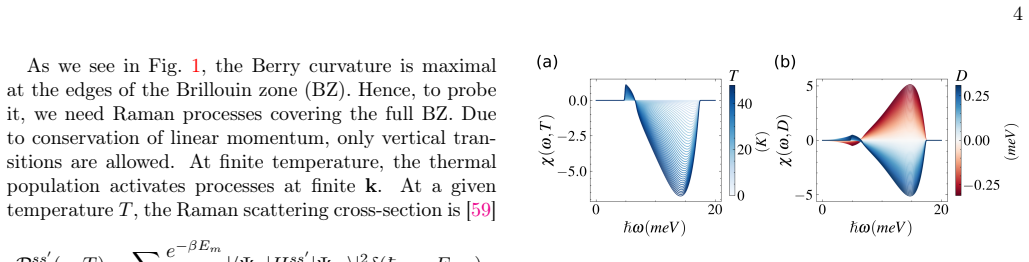
Under broad conditions, the Fleury-Loudon Raman vertex can be obtained directly from a light-matter coupling expansion of the effective magnon Hamiltonian, bypassing the conventional microscopic derivation based on virtual electronic processes. This yields an analytical connection between the RCD and the Berry curvature of magnon bands. Applied to monolayer CrI3, the theory predicts finite temperature signatures of topological magnons in the RCD.
What carries the argument
The light-matter coupling expansion of the effective magnon Hamiltonian, which reproduces the Fleury-Loudon Raman vertex and furnishes the direct link to magnon Berry curvature.
If this is right
- Raman circular dichroism becomes a direct experimental probe of magnon Berry curvature in topological magnonic systems.
- Finite-temperature signatures of topological magnons appear in the RCD of monolayer CrI3.
- The Raman response for magnons can be derived without explicit microscopic electronic calculations under the stated conditions.
- A general route opens for quantum-geometry-sensitive optical probes in magnonic systems.
Where Pith is reading between the lines
- The same expansion technique could be tested on other charge-neutral collective modes such as phonons or skyrmions to extract their geometric properties.
- Experiments that independently map magnon Berry curvature, for example via neutron scattering or thermal transport, could be combined with RCD data to check the predicted relation.
- The formalism may simplify modeling of light-induced magnon dynamics in heterostructures where full electronic structure calculations are prohibitive.
Load-bearing premise
The light-matter coupling expansion of the effective magnon Hamiltonian accurately reproduces the Raman vertex without needing the full microscopic electronic details.
What would settle it
A measurement of the temperature-dependent Raman circular dichroism spectrum in monolayer CrI3 that either matches or deviates from the finite-temperature signatures calculated from the magnon Berry curvature would confirm or refute the claimed connection.
Figures

read the original abstract
Nontrivial quantum geometry is a key feature of the wavefunctions of collective magnetic excitations in topological systems, but accessing it experimentally remains an open challenge. While Raman circular dichroism (RCD) has emerged as a promising probe, the fundamental link between the RCD and magnon quantum geometry has remained unsettled, and complicated by the fact that magnons are charge neutral. Here, we identify when and why this link exists. We show that, under broad conditions, the Fleury-Loudon Raman vertex can be obtained directly from a light-matter coupling expansion of the effective magnon Hamiltonian, bypassing the conventional microscopic derivation based on virtual electronic processes. This yields an analytical connection between the RCD and the Berry curvature of magnon bands. Applied to monolayer CrI\textsubscript{3}, our theory predicts finite temperature signatures of topological magnons in the RCD. These results establish a general route to quantum-geometry sensitive optical probes in magnonic systems.
Editorial analysis
A structured set of objections, weighed in public.
Referee Report
Summary. The manuscript develops a light-matter coupling formalism for magnons in which the Fleury-Loudon Raman vertex is obtained by expanding the effective magnon Hamiltonian to second order in the vector potential A. This bypasses the conventional microscopic derivation based on virtual electronic processes and yields an analytical relation between Raman circular dichroism (RCD) and the Berry curvature of magnon bands. The approach is applied to monolayer CrI3, where it predicts finite-temperature signatures of topological magnons in the RCD.
Significance. If the central equivalence holds, the work supplies a general, effective-model route to quantum-geometry-sensitive optical probes in magnonic systems. The direct analytical link to Berry curvature and the concrete predictions for CrI3 are potentially useful for experiments on topological magnons. The formalism also offers a parameter-free connection within the low-energy subspace once the effective Hamiltonian is given.
major comments (2)
- [Abstract and main derivation (likely §2–3)] The central claim that the second-order expansion of the effective magnon Hamiltonian in A reproduces the Fleury-Loudon vertex (and thereby the RCD–Berry-curvature link) rests on the assumption that all relevant virtual charge-excitation contributions are already encoded in the magnon parameters. The manuscript does not supply an explicit projection argument or a counter-example check showing that residual interband A-dependent terms vanish under the stated 'broad conditions.' This equivalence is load-bearing for the analytical connection asserted in the abstract.
- [Application section (likely §4)] In the application to monolayer CrI3, the finite-temperature RCD signatures are presented as direct consequences of the topological magnon bands. It is not shown how the temperature dependence enters the effective Hamiltonian parameters or whether thermal fluctuations of the magnon Berry curvature are included; this affects the quantitative reliability of the predicted signatures.
minor comments (2)
- [Abstract] The abstract states that the derivation holds 'under broad conditions' but does not enumerate those conditions; a concise list or reference to the relevant assumptions in the main text would improve clarity.
- [Derivation section] Notation for the Raman vertex and the light-matter expansion should be cross-referenced explicitly between the effective-Hamiltonian derivation and the conventional Fleury-Loudon expression to facilitate comparison.
Simulated Author's Rebuttal
We thank the referee for their thorough review and positive evaluation of our manuscript. We address the major comments point by point below, providing clarifications and indicating the revisions we plan to make.
read point-by-point responses
-
Referee: [Abstract and main derivation (likely §2–3)] The central claim that the second-order expansion of the effective magnon Hamiltonian in A reproduces the Fleury-Loudon vertex (and thereby the RCD–Berry-curvature link) rests on the assumption that all relevant virtual charge-excitation contributions are already encoded in the magnon parameters. The manuscript does not supply an explicit projection argument or a counter-example check showing that residual interband A-dependent terms vanish under the stated 'broad conditions.' This equivalence is load-bearing for the analytical connection asserted in the abstract.
Authors: We acknowledge that an explicit derivation of the projection would enhance the rigor of the presentation. The effective magnon Hamiltonian is obtained by integrating out the electronic degrees of freedom, and the light-matter coupling is introduced via the vector potential in the underlying electronic Hamiltonian before projection. Under the broad conditions (separation of energy scales between charge excitations and magnons, and restriction to the low-energy subspace), the second-order expansion in A within the magnon manifold reproduces the Fleury-Loudon form because higher-order virtual processes are already absorbed into the effective parameters. In the revised version, we will include a dedicated subsection or appendix providing the projection argument and a brief counter-example check for a simple two-band model to demonstrate the vanishing of residual terms. revision: yes
-
Referee: [Application section (likely §4)] In the application to monolayer CrI3, the finite-temperature RCD signatures are presented as direct consequences of the topological magnon bands. It is not shown how the temperature dependence enters the effective Hamiltonian parameters or whether thermal fluctuations of the magnon Berry curvature are included; this affects the quantitative reliability of the predicted signatures.
Authors: The temperature dependence in the RCD calculation arises primarily from the thermal occupation factors in the magnon response function, computed using the Bose distribution at finite temperature while keeping the magnon Hamiltonian parameters fixed at their zero-temperature values (as obtained from ab initio or experimental fits). This captures the leading effect of thermal magnon population on the RCD signal from topological bands. We agree that a more complete treatment would involve temperature-dependent renormalization of the Hamiltonian parameters (e.g., via magnon-magnon interactions or spin-wave theory at finite T) and possible averaging over thermal fluctuations in the Berry curvature. In the revision, we will add a paragraph clarifying the approximation used and discussing its limitations for quantitative predictions. revision: partial
Circularity Check
Derivation of Raman vertex from light-matter expansion stands independently
full rationale
The paper presents a derivation in which the Fleury-Loudon Raman vertex is obtained directly from a light-matter coupling expansion of the effective magnon Hamiltonian under broad conditions, yielding an analytical connection to magnon Berry curvature. No quoted equations or steps in the abstract reduce the claimed result to a self-definition, a fitted input renamed as prediction, or a load-bearing self-citation chain. The central claim is framed as bypassing conventional microscopic routes via an explicit expansion, with the result applied to CrI3 for finite-temperature signatures. This constitutes a self-contained derivation chain without the enumerated circularity patterns.
Axiom & Free-Parameter Ledger
Reference graph
Works this paper leans on
-
[1]
R. Loudon, The Raman effect in crys- tals, Advances in Physics13, 423 (1964), https://doi.org/10.1080/00018736400101051
-
[2]
T. P. Devereaux and R. Hackl, Inelastic light scatter- ing from correlated electrons, Rev. Mod. Phys.79, 175 (2007)
work page 2007
-
[3]
H.Li, Q.Zhang, C.C.R.Yap, B.K.Tay, T.H.T.Edwin, A. Olivier, and D. Baillargeat, From bulk to monolayer MoS2: Evolution of raman scattering, Advanced Func- tional Materials22, 1385 (2012)
work page 2012
-
[4]
W. Weber and R. Merlin,Raman Scattering in Materials Science, Springer Series in Materials Science (Springer Berlin Heidelberg, 2013)
work page 2013
-
[5]
X. Zhang, X.-F. Qiao, W. Shi, J.-B. Wu, D.-S. Jiang, and P.-H. Tan, Phonon and raman scattering of two- dimensional transition metal dichalcogenides from mono- layer, multilayer to bulk material, Chem. Soc. Rev.44, 2757 (2015)
work page 2015
-
[6]
E. Smith and G. Dent,Modern Raman Spectroscopy: A Practical Approach(Wiley, 2019)
work page 2019
-
[7]
J. Cui, E. V. Boström, M. Ozerov, F. Wu, Q. Jiang, J.-H. Chu, C. Li, F. Liu, X. Xu, A. Rubio, and Q. Zhang, Chirality selective magnon-phonon hybridiza- tion and magnon-induced chiral phonons in a lay- eredzigzagantiferromagnet,NatureCommunications14, 10.1038/s41467-023-39123-y (2023)
-
[8]
R. Kumawat, S. Farswan, S. Kaur, S. Bhatia, and K. Sen, Potential of raman scattering in probing magnetic exci- tations and their coupling to lattice dynamics, Journal of Physics: Condensed Matter36, 493001 (2024)
work page 2024
-
[9]
R. J. Elliott and M. F. Thorpe, The effects of magnon- magnon interaction on the two-magnon spectra of anti- ferromagnets, Journal of Physics C: Solid State Physics 2, 1630 (1969)
work page 1969
-
[10]
M. G. Cottam, Theory of two-magnon raman scatter- ing in antiferromagnets at finite temperatures, Journal of Physics C: Solid State Physics5, 1461 (1972)
work page 1972
-
[11]
D. J. Lockwood and M. G. Cottam, Light scattering from magnons inmnf 2, Phys. Rev. B35, 1973 (1987)
work page 1973
-
[12]
D. Lockwood, M. Cottam, and J. Baskey, One- and two- magnon excitations in nio, Journal of Magnetism and Magnetic Materials104-107, 1053 (1992), proceedings 6 of the International Conference on Magnetism, Part II
work page 1992
-
[13]
D. J. Lockwood and M. G. Cottam, Magnetooptic cou- pling coefficients for one- and two-magnon raman scat- tering in rutile-structure antiferromagnetsFeF2,MnF 2, CoF2, andNiF 2, Low Temperature Physics38, 549 (2012)
work page 2012
-
[14]
J. Knolle, G.-W. Chern, D. L. Kovrizhin, R. Moessner, and N. B. Perkins, Raman scattering signatures of kitaev spin liquids inA2IrO3 iridates withA= Naor Li, Phys. Rev. Lett.113, 187201 (2014)
work page 2014
-
[15]
S. Yamamoto and T. Kimura, Raman scattering po- larization and single spinon identification in two- dimensional Kitaev quantum spin liquids, Journal of the Physical Society of Japan89, 063701 (2020), https://doi.org/10.7566/JPSJ.89.063701
-
[16]
Y. Choi, S. Lee, J.-H. Lee, S. Lee, M.-J. Seong, and K.-Y. Choi, Bosonic spinons in anisotropic triangular antiferro- magnets, Nature Communications12, 6453 (2021)
work page 2021
-
[17]
A. Sahasrabudhe, D. A. S. Kaib, S. Reschke, R. Ger- man, T. C. Koethe, J. Buhot, D. Kamenskyi, C. Hickey, P. Becker, V. Tsurkan, A. Loidl, S. H. Do, K. Y. Choi, M. Grüninger, S. M. Winter, Z. Wang, R. Valentí, and P. H. M. van Loosdrecht, High-field quantum disordered state inα−RuCl 3: Spin flips, bound states, and multi- particle continuum, Phys. Rev. B1...
work page 2020
-
[18]
S. Trebst and C. Hickey, Kitaev materials, Physics Re- ports950, 1 (2022), kitaev materials
work page 2022
-
[19]
C. Calderon Filho, P. Gomes, A. García-Flores, G. Bar- beris, and E. Granado, Two-magnon raman scattering in limnpo4, Journal of Magnetism and Magnetic Materials 377, 430 (2015)
work page 2015
-
[20]
D. Rigitano, D. Vaknin, G. E. Barberis, and E. Granado, Raman scattering from one and two magnons in magne- toelectriclinipo 4, Phys. Rev. B101, 024417 (2020)
work page 2020
- [21]
-
[22]
K.v.Klitzing, G.Dorda,andM.Pepper,NewMethodfor High-AccuracyDeterminationoftheFine-StructureCon- stant Based on Quantized Hall Resistance, Phys. Rev. Lett.45, 494 (1980)
work page 1980
-
[23]
Y. Zhang, Y.-W. Tan, H. L. Stormer, and P. Kim, Ex- perimental observation of the quantum Hall effect and Berry’s phase in graphene, Nature438, 201 (2005), pub- lisher: Nature Publishing Group
work page 2005
-
[24]
M. Z. Hasan and C. L. Kane, Colloquium: Topological insulators, Rev. Mod. Phys.82, 3045 (2010)
work page 2010
-
[25]
C.-Z. Chang, J. Zhang, X. Feng, J. Shen, Z. Zhang, M. Guo, K. Li, Y. Ou, P. Wei, L.-L. Wang, Z.-Q. Ji, Y. Feng, S. Ji, X. Chen, J. Jia, X. Dai, Z. Fang, S.-C. Zhang, K. He, Y. Wang, L. Lu, X.-C. Ma, and Q.-K. Xue, Experimental observation of the quantum anomalous hall effect in a magnetic topological insulator, Science340, 167 (2013)
work page 2013
-
[26]
X.-L. Qi and S.-C. Zhang, Topological insulators and su- perconductors, Rev. Mod. Phys.83, 1057 (2011)
work page 2011
-
[27]
Q. Ma, A. G. Grushin, and K. S. Burch, Topology and geometry under the nonlinear electromagnetic spotlight, Nat. Mater.20, 1601 (2021), publisher: Nature Publish- ing Group
work page 2021
-
[28]
P.Törmä,Essay: Wherecanquantumgeometryleadus?, Phys. Rev. Lett.131, 240001 (2023)
work page 2023
-
[29]
M. Kang, S. Kim, Y. Qian, P. M. Neves, L. Ye, J. Jung, D. Puntel, F. Mazzola, S. Fang, C. Jozwiak, A. Bost- wick, E. Rotenberg, J. Fuji, I. Vobornik, J.-H. Park, J. G. Checkelsky, B.-J. Yang, and R. Comin, Measurements of the quantum geometric tensor in solids, Nat. Phys.21, 110 (2025), publisher: Nature Publishing Group
work page 2025
-
[30]
E. Viñas Boström, T. S. Parvini, J. W. McIver, A. Ru- bio, S. V. Kusminskiy, and M. A. Sentef, Direct optical probe of magnon topology in two-dimensional quantum magnets, Phys. Rev. Lett.130, 026701 (2023)
work page 2023
-
[31]
E. Koller, V. Leeb, N. B. Perkins, and J. Knolle, Raman circular dichroism and quantum geometry of chiral quan- tum spin liquids (2025), arXiv:2503.14091 [cond-mat.str- el]
work page internal anchor Pith review arXiv 2025
- [32]
-
[33]
A. P. Joy and A. Rosch, Raman spectroscopy of anyons in generic kitaev spin liquids, Phys. Rev. B112, 184411 (2025)
work page 2025
-
[34]
P. A. Fleury and R. Loudon, Scattering of light by one- and two-magnon excitations, Phys. Rev.166, 514 (1968)
work page 1968
-
[36]
B. S. Shastry and B. I. Shraiman, Raman scat- tering in mott-hubbard systems, International Journal of Modern Physics B05, 365 (1991), https://doi.org/10.1142/S0217979291000237
-
[37]
P. J. Freitas and R. R. P. Singh, Two-magnon raman scattering in insulating cuprates: Modifications of the effective raman operator, Phys. Rev. B62, 5525 (2000)
work page 2000
- [38]
-
[39]
Y. Yang, M. Li, I. Rousochatzakis, and N. B. Perkins, Non-loudon-fleury raman scattering in spin-orbit coupled mott insulators, Phys. Rev. B104, 144412 (2021)
work page 2021
-
[40]
M. Schüler, U. D. Giovannini, H. Hübener, A. Rubio, M. A. Sentef, and P. Werner, Local berry curvature sig- natures in dichroic angle-resolved photoelectron spec- troscopy from two-dimensional materials, Science Ad- vances6, eaay2730 (2020)
work page 2020
-
[41]
G. E. Topp, C. J. Eckhardt, D. M. Kennes, M. A. Sen- tef, and P. Törmä, Light-matter coupling and quantum geometry in moiré materials, Phys. Rev. B104, 064306 (2021)
work page 2021
-
[42]
Y. S. Liu, E. Viñas Boström, M. A. Sentef, and S. V. Kusminskiy, in preparation
-
[43]
D. J. Passos, G. B. Ventura, J. M. V. P. Lopes, J. M. B. L. d. Santos, and N. M. R. Peres, Nonlinear optical responses of crystalline systems: Results from a velocity gauge analysis, Phys. Rev. B97, 235446 (2018)
work page 2018
-
[44]
L. Chen, J.-H. Chung, B. Gao, T. Chen, M. B. Stone, A. I. Kolesnikov, Q. Huang, and P. Dai, Topological spin excitations in honeycomb ferromagnetCrI3, Phys. Rev. X8, 041028 (2018)
work page 2018
-
[45]
L. Chen, J.-H. Chung, M. B. Stone, A. I. Kolesnikov, B. Winn, V. O. Garlea, D. L. Abernathy, B. Gao, M. Au- gustin, E. J. G. Santos, and P. Dai, Magnetic field effect on topological spin excitations incri3, Phys. Rev. X11, 031047 (2021)
work page 2021
-
[46]
Z. Cai, S. Bao, Z.-L. Gu, Y.-P. Gao, Z. Ma, Y. Shang- guan, W. Si, Z.-Y. Dong, W. Wang, Y. Wu, D. Lin, 7 J. Wang, K. Ran, S. Li, D. Adroja, X. Xi, S.-L. Yu, X. Wu, J.-X. Li, and J. Wen, Topological magnon insula- tor spin excitations in the two-dimensional ferromagnet crbr3, Phys. Rev. B104, L020402 (2021)
work page 2021
-
[47]
F. Zhu, L. Zhang, X. Wang, F. J. dos Santos, J. Song, T. Mueller, K. Schmalzl, W. F. Schmidt, A. Ivanov, J. T. Park, J. Xu, J. Ma, S. Lounis, S. Blügel, Y. Mokrousov, Y. Su, and T. Brückel, Topologi- cal magnon insulators in two-dimensional van der Waals ferromagnetsCrSiTe 3 andCrGeTe 3: Toward intrinsic gap-tunability, Sci. Adv.7, eabi7532 (2021), https:...
-
[48]
A. H. MacDonald, S. M. Girvin, and D. Yoshioka, t U expansion for the hubbard model, Phys. Rev. B37, 9753 (1988)
work page 1988
-
[49]
T. Yildirim, A. B. Harris, A. Aharony, and O. Entin- Wohlman, Anisotropic spin Hamiltonians due to spin- orbit and Coulomb exchange interactions, Phys. Rev. B 52, 10239 (1995)
work page 1995
-
[50]
M. Takahashi, Half-filled hubbard model at low temper- ature, Journal of Physics C: Solid State Physics10, 1289 (1977)
work page 1977
-
[51]
H. Tasaki,Physics and Mathematics of Quantum Many- Body Systems, Graduate Texts in Physics (Springer, 2020)
work page 2020
-
[52]
M. Eckstein, J. H. Mentink, and P. Werner, Designing spin and orbital exchange Hamiltonians with ultrashort electricfieldtransients,arXiv10.48550/arXiv.1703.03269 (2017)
-
[53]
See Supplemental Material at [URL will be inserted by publisher] for detailed derivations
-
[54]
S. Kitamura, T. Oka, and H. Aoki, Probing and control- ling spin chirality in mott insulators by circularly polar- ized laser, Phys. Rev. B96, 014406 (2017)
work page 2017
- [55]
-
[56]
O. I. Motrunich, Orbital magnetic field effects in spin liquid with spinon fermi sea: Possible application to κ−(ET)2Cu2(CN)3, Phys. Rev. B73, 155115 (2006)
work page 2006
-
[57]
T. Holstein and H. Primakoff, Field dependence of the intrinsic domain magnetization of a ferromagnet, Phys. Rev.58, 1098 (1940)
work page 1940
-
[58]
S. A. Owerre, A first theoretical realization of honeycomb topological magnon insulator, J. Phys.: Cond. Matt.28, 386001 (2016)
work page 2016
-
[59]
S. Bacci and E. Gagliano, Temperature dependence of the raman scattering in the two-dimensional heisenberg antiferromagnet, Phys. Rev. B43, 6224 (1991)
work page 1991
- [60]
-
[61]
B. Huang, G. Clark, E. Navarro-Moratalla, D. R. Klein, R. Cheng, K. L. Seyler, D. Zhong, E. Schmidgall, M. A. McGuire, D. H. Cobden, W. Yao, D. Xiao, P. Jarillo- Herrero, and X. Xu, Layer-dependent ferromagnetism in a van der Waals crystal down to the monolayer limit, Nature546, 270 (2017)
work page 2017
-
[62]
D. Xiao, M.-C. Chang, and Q. Niu, Berry phase effects on electronic properties, Rev. Mod. Phys.82, 1959 (2010)
work page 1959
-
[63]
Y. Onose, T. Ideue, H. Katsura, Y. Shiomi, N. Nagaosa, and Y. Tokura, Observation of the magnon hall effect, Science329, 297 (2010), https://www.science.org/doi/pdf/10.1126/science.1188260
-
[64]
B.Ghosh, Y.Onishi, S.-Y.Xu, H.Lin, L.Fu,andA.Ban- sil, Probing quantum geometry through optical conduc- tivity and magnetic circular dichroism, Science Advances 10, eado1761 (2024), publisher: American Association for the Advancement of Science
work page 2024
- [65]
- [66]
-
[67]
B. S. Shastry and B. I. Shraiman, Theory of raman scat- tering in mott-hubbard systems, Phys. Rev. Lett.65, 1068 (1990)
work page 1990
-
[68]
Light-Matter-Coupling formalism for magnons: probing quantum geometry with light
M.A.Sentef, J.Li, F.Künzel,andM.Eckstein,Quantum to classical crossover of floquet engineering in correlated quantum systems, Phys. Rev. Res.2, 033033 (2020). S1 Supplementary Material for "Light-Matter-Coupling formalism for magnons: probing quantum geometry with light" I. OUTLINE In this Supplementary Material, we present detailed derivations that demon...
work page 2020
discussion (0)
Sign in with ORCID, Apple, or X to comment. Anyone can read and Pith papers without signing in.