Recognition: unknown
Agentic LLM Reasoning in a Self-Driving Laboratory for Air-Sensitive Lithium Halide Spinel Conductors
Pith reviewed 2026-05-10 14:50 UTC · model grok-4.3
The pith
Agentic AI in a glovebox self-driving lab increases the success rate for discovering lithium halide spinel ionic conductors from 1.33% to 5.33% over 352 samples.
A machine-rendered reading of the paper's core claim, the machinery that carries it, and where it could break.
Core claim
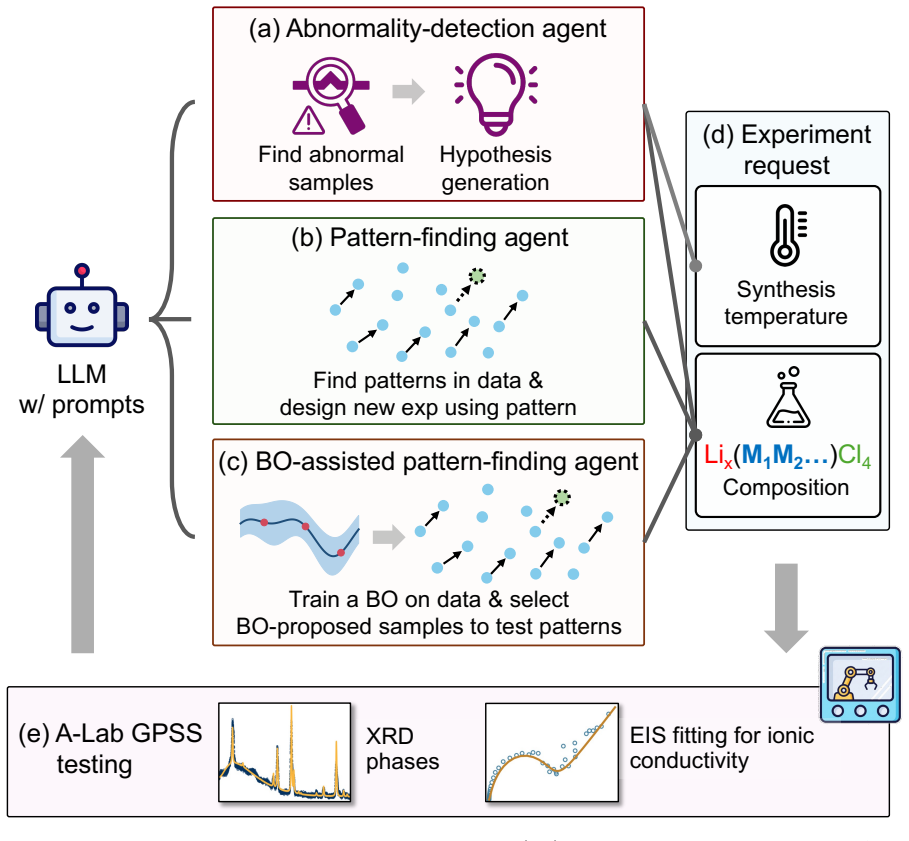
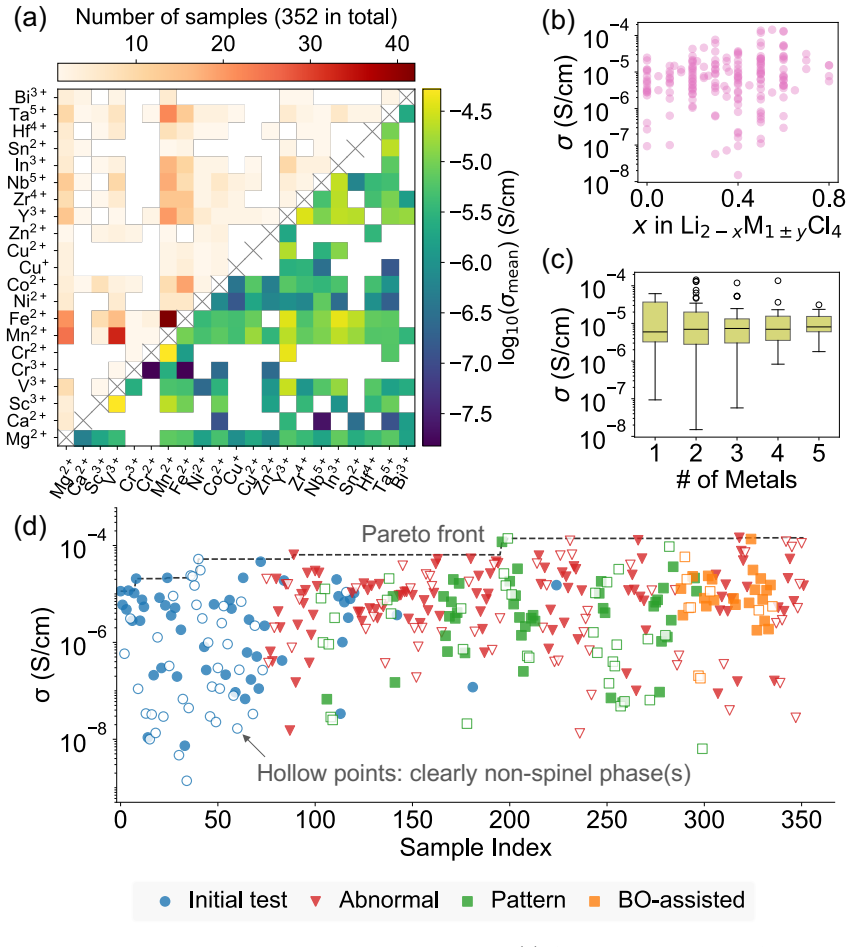
The paper claims that structuring autonomous experimental design with abductive and inductive reasoning in an agentic AI framework, when deployed on the A-Lab GPSS platform, enables broad exploration of the compositional space of lithium halide spinel solid-state ionic conductors, resulting in the experimental realization of 72% of the 171 possible pairwise combinations among 19 metals and an increase in the fraction of compositions with both good ionic conductivity (> 0.05 mS/cm) and high halide spinel phase purity from 1.33% to 5.33% over the course of the 352-sample campaign.
What carries the argument
The agentic AI framework that uses abductive reasoning to interrogate abnormal observations in explored regions and inductive reasoning to expand into unvisited chemical space.
If this is right
- The platform provides a scalable method for autonomous discovery of other air-sensitive solid-state materials.
- Abductive and inductive reasoning serve complementary roles in local refinement and global exploration of chemical space.
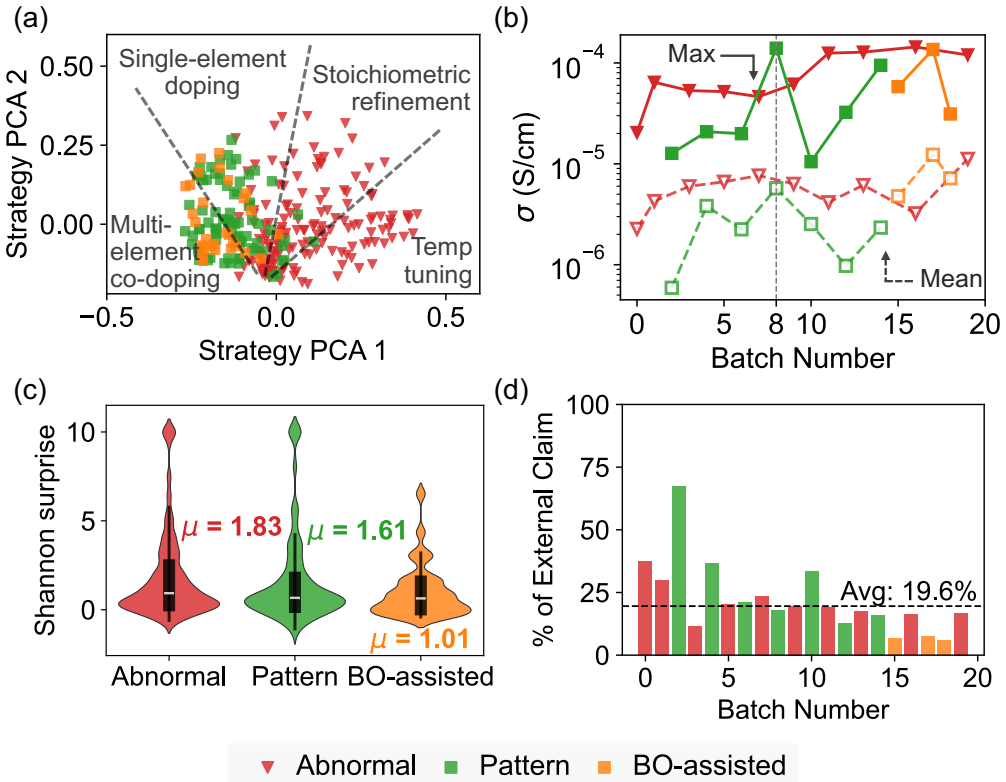
- Inspecting the AI's reasoning processes reveals distinct discovery strategies that contribute to the observed improvement in success rate.
- 72% coverage of pairwise combinations indicates effective navigation of a high-dimensional compositional space.
Where Pith is reading between the lines
- Testing the system against a baseline of random proposals would confirm whether the reasoning strategies are responsible for the success rate increase.
- The approach could be extended to other classes of air-sensitive materials, such as those used in batteries or catalysts, to accelerate discovery in those domains.
- Similar agentic frameworks might improve efficiency in other experimental sciences involving iterative hypothesis generation and testing.
Load-bearing premise
The increase in the fraction of successful compositions is due to the agentic AI's abductive and inductive reasoning strategies and not due to random sampling, uncontrolled variations in synthesis conditions, or post-campaign data selection.
What would settle it
A control campaign in which compositions are proposed randomly without the AI reasoning framework, yielding a comparable or larger increase in the success fraction, would show that the agent's strategies are not necessary for the improvement.
Figures

read the original abstract
Self-driving laboratories promise to accelerate materials discovery. Yet current automated solid-state synthesis platforms are limited to ambient conditions, thereby precluding their use for air-sensitive materials. Here, we present A-Lab for Glovebox Powder Solid-state Synthesis (A-Lab GPSS), a robotic platform capable of synthesizing and characterizing air-sensitive inorganic materials under strict air-free conditions. By integrating an agentic AI framework into the A-Lab GPSS platform, we structure autonomous experimental design through abductive and inductive reasoning. We deploy this platform to explore the vast compositional space of lithium halide spinel solid-state ionic conductors. Across a synthesis campaign comprising 352 samples with diverse compositions, the system explores a broad chemical space, experimentally realizing 72% of the 171 possible pairwise combinations among the 19 metals considered in this study. Over the course of the campaign, the fraction of compositions exhibiting both good ionic conductivity (> 0.05 mS/cm) and high halide spinel phase purity increases from 1.33% in the first 75 agent-proposed samples to 5.33% in the final 75. Furthermore, by inspecting the AI's reasoning processes, we reveal distinct yet complementary discovery strategies: abductive reasoning interrogates abnormal observations within already explored regions, whereas inductive reasoning expands the search into broader, previously unvisited chemical space. This work establishes a scalable platform for the autonomous discovery of complex, air-sensitive solid-state materials.
Editorial analysis
A structured set of objections, weighed in public.
Referee Report
Summary. The paper introduces A-Lab GPSS, a robotic platform for automated powder solid-state synthesis of air-sensitive inorganic materials under inert conditions, integrated with an agentic LLM framework that employs abductive and inductive reasoning for experimental design. Deployed on lithium halide spinel solid electrolytes, the work reports a 352-sample campaign across 19 metals that experimentally realizes 72% of the 171 possible pairwise combinations and shows the joint success rate (ionic conductivity >0.05 mS/cm and high spinel phase purity) rising from 1.33% in the first 75 agent-proposed samples to 5.33% in the final 75, with the improvement ascribed to the AI's complementary reasoning strategies.
Significance. If the reported increase in success rate can be shown to result from the agentic reasoning rather than uncontrolled variables, the work would constitute a notable advance by extending self-driving laboratories to air-sensitive materials and by providing concrete examples of how abductive versus inductive LLM strategies operate in a physical discovery loop.
major comments (3)
- [Results (synthesis campaign statistics)] Results section describing the 352-sample campaign: the headline claim that the joint success rate rose from 1.33% (first 75 samples) to 5.33% (final 75 samples) is presented without any control arm using random composition selection, fixed heuristics, or a non-reasoning baseline under identical A-Lab GPSS conditions, so the improvement cannot be attributed specifically to the agentic AI.
- [Results (coverage of pairwise combinations)] Results section on chemical-space coverage: the statement that 72% of the 171 pairwise metal combinations were realized lacks a null model or binomial calculation of the coverage fraction expected from uniform random sampling after 352 trials, leaving open whether the observed exploration efficiency exceeds random.
- [Methods and Results] Methods and results sections: no raw data tables, error bars on the success-rate fractions, or statistical tests (e.g., two-proportion z-test or permutation test) are supplied to evaluate whether the observed 1.33% to 5.33% increase is significant or could arise from operator learning, glovebox drift, or post-hoc binning of the 352 outcomes.
minor comments (2)
- The manuscript would benefit from an explicit data-availability statement and deposition of the full composition list, measured conductivities, and phase-purity metrics so that independent re-analysis of the trend is possible.
- Figure captions and text should clarify how 'high halide spinel phase purity' was quantitatively defined (e.g., Rietveld weight fraction threshold) to allow reproducibility.
Simulated Author's Rebuttal
We thank the referee for the constructive and detailed comments, which highlight important aspects of experimental design and statistical rigor. We address each major comment point by point below, indicating where revisions will be made to the manuscript. We agree that additional controls and statistical analyses would strengthen the attribution of improvements to the agentic framework.
read point-by-point responses
-
Referee: Results section describing the 352-sample campaign: the headline claim that the joint success rate rose from 1.33% (first 75 samples) to 5.33% (final 75 samples) is presented without any control arm using random composition selection, fixed heuristics, or a non-reasoning baseline under identical A-Lab GPSS conditions, so the improvement cannot be attributed specifically to the agentic AI.
Authors: We acknowledge that the absence of a parallel control arm (random, heuristic, or non-reasoning baseline) under identical conditions prevents definitive causal attribution of the success-rate increase to the agentic LLM reasoning alone. The manuscript instead relies on qualitative inspection of the AI's abductive and inductive reasoning traces to link specific strategies to improved outcomes. In revision we will add an explicit limitations subsection discussing potential confounding factors (operator learning, glovebox condition drift, post-hoc binning) and will include a post-hoc simulation comparing the observed success trajectory against a random-sampling null model derived from the empirical composition distribution. A full randomized control campaign is not feasible within the current revision timeline but is planned for follow-up work. revision: partial
-
Referee: Results section on chemical-space coverage: the statement that 72% of the 171 pairwise metal combinations were realized lacks a null model or binomial calculation of the coverage fraction expected from uniform random sampling after 352 trials, leaving open whether the observed exploration efficiency exceeds random.
Authors: We agree that a quantitative null model is needed. In the revised manuscript we will add a binomial-probability calculation (and Monte-Carlo simulation) of the expected coverage fraction under uniform random sampling of 352 compositions from the 171 possible pairwise combinations. This will allow direct comparison with the observed 72% coverage and will be presented alongside the existing coverage figure. revision: yes
-
Referee: Methods and results sections: no raw data tables, error bars on the success-rate fractions, or statistical tests (e.g., two-proportion z-test or permutation test) are supplied to evaluate whether the observed 1.33% to 5.33% increase is significant or could arise from operator learning, glovebox drift, or post-hoc binning of the 352 outcomes.
Authors: We will supply the full raw dataset (composition, synthesis parameters, phase purity, conductivity) as a supplementary table. Error bars will be added to the success-rate plot using binomial (Clopper-Pearson) confidence intervals. We will also report a two-proportion z-test (and, if appropriate, a permutation test) for the 1.33% versus 5.33% comparison, together with a brief discussion of possible confounding effects and the rationale for the chosen temporal bins. These additions will appear in both the Results and Methods sections. revision: yes
- A full randomized control arm under identical A-Lab GPSS conditions cannot be performed retroactively and would require new experimental runs beyond the scope of the current revision.
Circularity Check
No circularity: purely experimental reporting with no derivations or fitted predictions
full rationale
The manuscript describes a robotic synthesis platform and an agentic AI workflow that proposed 352 compositions for air-sensitive lithium halide spinels. All reported quantities (72 % coverage of pairwise metal combinations, rise in joint success rate from 1.33 % to 5.33 %, phase purity and conductivity measurements) are direct experimental outcomes obtained from physical synthesis, XRD, and EIS characterization. No equations, parameter fits, uniqueness theorems, or predictive models are introduced whose outputs are then re-used as inputs; the success-rate trend is presented as an observed time-series statistic rather than a derived claim. Consequently the paper contains no load-bearing step that reduces to its own inputs by construction.
Axiom & Free-Parameter Ledger
Reference graph
Works this paper leans on
-
[1]
Himanen, L., Geurts, A., Foster, A.S., and Rinke, P. (2019). Data-driven materials science: status, challenges, and perspectives. Advanced Science6, 1900808
2019
-
[2]
Otyepka, M., Pykal, M., and Otyepka, M. (2025). Advancing materials discovery through artificial intelligence. Applied Materials Today47, 102981
2025
-
[3]
Jain, A., Ong, S.P., Hautier, G., Chen, W., Richards, W.D., Dacek, S., Cholia, S., Gunter, D., Skinner, D., Ceder, G. et al. (2013). Commentary: The materials project: A materials genome approach to accelerating materials innovation. APL materials1
2013
-
[4]
Horton, M.K., Huck, P., Yang, R.X., Munro, J.M., Dwaraknath, S., Ganose, A.M., Kingsbury, R.S., Wen, M., Shen, J.X., Mathis, T.S. et al. (2025). Accelerated data-driven materials science with the materials project. Nature Materials pp. 1–11
2025
-
[5]
Cheng, M., Fu, C.L., Okabe, R., Chotrattanapituk, A., Boonkird, A., Hung, N.T., and Li, M. (2026). Artificial intelligence-driven approaches for materials design and discovery. Nature Materials pp. 1–17
2026
-
[6]
Saal, J.E., Kirklin, S., Aykol, M., Meredig, B., and Wolverton, C. (2013). Materials design and discovery with high-throughput density functional theory: the open quantum materials database (oqmd). Jom65, 1501–1509
2013
-
[7]
Merchant, A., Batzner, S., Schoenholz, S.S., Aykol, M., Cheon, G., and Cubuk, E.D. (2023). Scaling deep learning for materials discovery. Nature624, 80–85. 21
2023
-
[8]
Szymanski, N.J., Rendy, B., Fei, Y., Kumar, R.E., He, T., Milsted, D., McDermott, M.J., Gallant, M., Cubuk, E.D., Merchant, A. et al. (2023). An autonomous laboratory for the accelerated synthesis of novel materials. Nature624, 86–91
2023
-
[9]
Chen, J., Cross, S.R., Miara, L.J., Cho, J.J., Wang, Y., and Sun, W. (2024). Navigating phase diagram complexity to guide robotic inorganic materials synthesis. Nature Synthesis3, 606–614
2024
-
[10]
Bateni, F., Sadeghi, S., Orouji, N., Bennett, J.A., Punati, V.S., Stark, C., Wang, J., Rosko, M.C., Chen, O., Castellano, F.N. et al. (2024). Smart dope: a self-driving fluidic lab for accelerated development of doped perovskite quantum dots. Advanced Energy Materials14, 2302303
2024
-
[11]
Zaki, M., Prinz, C., and Ruehle, B. (2025). A self-driving lab for nano-and advanced materials synthesis. ACS nano19, 9029–9041
2025
-
[12]
Wang, C., Kim, Y.J., Vriza, A., Batra, R., Baskaran, A., Shan, N., Li, N., Darancet, P., Ward, L., Liu, Y. et al. (2025). Autonomous platform for solution processing of electronic polymers. Nature communications16, 1498
2025
-
[13]
Yik, J.T., Hvarfner, C., Sj¨ olund, J., Berg, E.J., and Zhang, L. (2025). Accelerating aqueous electrolyte design with automated full-cell battery experimentation and bayesian optimization. Cell Reports Physical Science6
2025
-
[14]
Zhang, T., Lin, H., Chen, Y., and Viswanathan, V. (2025). Salsa: A low-cost self-driving lab for salt solubility assessment for battery electrolytes. ChemRxiv
2025
-
[15]
Burger, B., Maffettone, P.M., Gusev, V.V., Aitchison, C.M., Bai, Y., Wang, X., Li, X., Alston, B.M., Li, B., Clowes, R. et al. (2020). A mobile robotic chemist. Nature583, 237–241
2020
-
[16]
Tinajero, C., Zanatta, M., S´ anchez-Velandia, J.E., Garc´ ıa-Verdugo, E., and Sans, V. (2025). Reac-discovery: an artificial intelligence–driven platform for continuous-flow catalytic reactor discovery and optimization. Nature Communications16, 9062
2025
-
[17]
Zhang, Z., Ren, Z., Hsu, C.W., Chen, W., Hong, Z.W., Lee, C.F., Penn, A., Xu, H., Zheng, D.J., Miao, S. et al. (2025). A multimodal robotic platform for multi-element electrocatalyst discovery. Nature647, 390–396
2025
-
[18]
MacLeod, B.P., Parlane, F.G., Morrissey, T.D., H¨ ase, F., Roch, L.M., Dettelbach, K.E., Mor- eira, R., Yunker, L.P., Rooney, M.B., Deeth, J.R. et al. (2020). Self-driving laboratory for accelerated discovery of thin-film materials. Science Advances6, eaaz8867
2020
-
[19]
MacLeod, B.P., Parlane, F.G., Rupnow, C.C., Dettelbach, K.E., Elliott, M.S., Morrissey, T.D., Haley, T.H., Proskurin, O., Rooney, M.B., Taherimakhsousi, N. et al. (2022). A self-driving laboratory advances the pareto front for material properties. Nature communications13, 995. 22
2022
-
[20]
Cakan, D.N., Kumar, R.E., Oberholtz, E., Kodur, M., Palmer, J.R., Gupta, A., Kaushal, K., Vossler, H.M., and Fenning, D.P. (2024). Pascal: the perovskite automated spin coat assembly line accelerates composition screening in triple-halide perovskite alloys. Digital Discovery3, 1236–1246
2024
-
[21]
Ament, S., Amsler, M., Sutherland, D.R., Chang, M.C., Guevarra, D., Connolly, A.B., Gre- goire, J.M., Thompson, M.O., Gomes, C.P., and Van Dover, R.B. (2021). Autonomous ma- terials synthesis via hierarchical active learning of nonequilibrium phase diagrams. Science Advances7, eabg4930
2021
-
[22]
Steiner, S., Wolf, J., Glatzel, S., Andreou, A., Granda, J.M., Keenan, G., Hinkley, T., Aragon- Camarasa, G., Kitson, P.J., Angelone, D. et al. (2019). Organic synthesis in a modular robotic system driven by a chemical programming language. Science363, eaav2211
2019
-
[23]
Ruan, Y., Lu, C., Xu, N., He, Y., Chen, Y., Zhang, J., Xuan, J., Pan, J., Fang, Q., Gao, H. et al. (2024). An automatic end-to-end chemical synthesis development platform powered by large language models. Nature communications15, 10160
2024
-
[24]
Ghafarollahi, A., and Buehler, M.J. (2025). Automating alloy design and discovery with physics-aware multimodal multiagent ai. Proceedings of the National Academy of Sciences 122, e2414074122
2025
-
[25]
Giro, R., Hsu, H., Kishimoto, A., Hama, T., Neumann, R.F., Luan, B., Takeda, S., Hamada, L., and Steiner, M.B. (2023). Ai powered, automated discovery of polymer membranes for carbon capture. npj Computational Materials9, 133
2023
-
[26]
Tom, G., Schmid, S.P., Baird, S.G., Cao, Y., Darvish, K., Hao, H., Lo, S., Pablo-Garc´ ıa, S., Rajaonson, E.M., Skreta, M. et al. (2024). Self-driving laboratories for chemistry and materials science. Chemical Reviews124, 9633–9732
2024
-
[27]
frugal twin
Lo, S., Baird, S.G., Schrier, J., Blaiszik, B., Carson, N., Foster, I., Aguilar-Granda, A., Kalinin, S.V., Maruyama, B., Politi, M. et al. (2024). Review of low-cost self-driving laboratories in chemistry and materials science: the “frugal twin” concept. Digital Discovery3, 842–868
2024
-
[28]
McCalla, E. (2023). Semiautomated experiments to accelerate the design of advanced battery materials: combining speed, low cost, and adaptability. ACS Engineering Au3, 391–402
2023
-
[29]
Wang, S., Xu, X., Cui, C., Zeng, C., Liang, J., Fu, J., Zhang, R., Zhai, T., and Li, H. (2022). Air sensitivity and degradation evolution of halide solid state electrolytes upon exposure. Advanced Functional Materials32, 2108805
2022
-
[30]
Ren, T., Chen, X., Zhang, H., Zhang, H., and Xia, W. (2025). Humidity stability of halide solid-state electrolytes. Journal of Materials Chemistry A. 23
2025
-
[31]
Zimmermann, Y., Bazgir, A., Al-Feghali, A., Ansari, M., Bocarsly, J., Brinson, L.C., Chiang, Y., Circi, D., Chiu, M.H., Daelman, N. et al. (2025). 32 examples of llm applications in mate- rials science and chemistry: towards automation, assistants, agents, and accelerated scientific discovery. Machine Learning: Science and Technology6, 030701
2025
-
[32]
Boiko, D.A., MacKnight, R., Kline, B., and Gomes, G. (2023). Autonomous chemical research with large language models. Nature624, 570–578
2023
-
[33]
Zhou, D., Yang, R., Jia, Z., Cai, Y., Zhao, L., Guo, L., Ye, G., Wang, S., Chen, L., Liu, D. et al. (2026). A practical inverse design approach for high-entropy catalysts using generative ai. Nature Synthesis pp. 1–10
2026
- [34]
- [35]
-
[36]
Cao, S., Zhang, Z., Alghadeer, M., Fasciati, S.D., Piscitelli, M., Bakr, M., Leek, P., and Aspuru-Guzik, A. (2025). Automating quantum computing laboratory experiments with an agent-based ai framework. Patterns6
2025
- [37]
-
[38]
Bran, A., Cox, S., Schilter, O., Baldassari, C., White, A.D., and Schwaller, P
M. Bran, A., Cox, S., Schilter, O., Baldassari, C., White, A.D., and Schwaller, P. (2024). Augmenting large language models with chemistry tools. Nature Machine Intelligence6, 525– 535
2024
-
[39]
Smith, N. (2022). 5.4 types of inferences. In Introduction to Philosophy pp. 150– 158.. Houston, Texas: OpenStax pp. 150–158. URL:https://openstax.org/books/ introduction-philosophy/pages/5-4-types-of-inferences
2022
- [40]
-
[41]
Merkle, R., and Maier, J. (2005). On the tammann–rule. Zeitschrift f¨ ur anorganische und allgemeine Chemie631, 1163–1166
2005
-
[42]
Li, X., Liang, J., Yang, X., Adair, K.R., Wang, C., Zhao, F., and Sun, X. (2020). Progress and perspectives on halide lithium conductors for all-solid-state lithium batteries. Energy & Environmental Science13, 1429–1461. 24
2020
-
[43]
Tang, X., Xie, F., Lu, Y., Rong, X., Chen, L., and Hu, Y.S. (2025). Halide-based solid elec- trolytes: opportunities and challenges in the synergistic development of all-solid-state li/na batteries. EES Batteries
2025
-
[44]
Liu, Z., Zhang, G., Pepas, J., Ma, Y., and Chen, H. (2024). Li2fecl4 as a cost-effective and durable cathode for solid-state li-ion batteries. ACS Energy Letters9, 5464–5470
2024
-
[45]
Yang, X., Chen, Y., Wei, G., Diallo, M.S., Avdeev, M., Hau, H.M., Qiu, H., Ji, H., and Ceder, G. (2025). Harnessing cation disorder for enhancing ionic conductivity in lithium inverse spinel halides. ACS Energy Letters10, 1338–1346
2025
-
[46]
Wang, Y., Holekevi Chandrappa, M.L., Otani, I., Fortes, A.D., Howard, C.M., Cui, M., Rad- hakrishnan, B., Qian, L., and Nazar, L.F. (2025). Cation-ordering-driven design of superionic lithium halospinels. Journal of the American Chemical Society
2025
-
[47]
Fu, J., Wang, C., Wang, S., Reid, J.W., Liang, J., Luo, J., Kim, J.T., Zhao, Y., Yang, X., Zhao, F. et al. (2025). A cost-effective all-in-one halide material for all-solid-state batteries. Nature pp. 1–8
2025
-
[48]
Rom, C.L., Yox, P., Cardoza, A.M., Smaha, R.W., Phan, M.Q., Martin, T.R., and Maughan, A.E. (2024). Expanding the phase space for halide-based solid electrolytes: Li–mg–zr–cl spinels. Chemistry of Materials36, 7283–7291
2024
-
[49]
Jeon, T., and Jung, S.C. (2024). Enhancing lithium conductivity using high-valence cations in cubic spinel halide solid electrolytes. ACS Applied Materials & Interfaces16, 47443–47453
2024
-
[50]
Zhou, L., and Nazar, L.F. (2025). Vacancy driven fast ion conduction in lithium deficient magnesium chloride spinel. ACS Materials Letters7, 2482–2488
2025
-
[51]
Zeng, Y., Ouyang, B., Liu, J., Byeon, Y.W., Cai, Z., Miara, L.J., Wang, Y., and Ceder, G. (2022). High-entropy mechanism to boost ionic conductivity. Science378, 1320–1324
2022
-
[52]
Schlem, R., Banik, A., Ohno, S., Suard, E., and Zeier, W.G. (2021). Insights into the lithium sub-structure of superionic conductors li3ycl6 and li3ybr6. Chemistry of Materials33, 327–337
2021
-
[53]
Li, X., Liang, J., Chen, N., Luo, J., Adair, K.R., Wang, C., Banis, M.N., Sham, T.K., Zhang, L., Zhao, S. et al. (2019). Back cover: Water-mediated synthesis of a superionic halide solid electrolyte (angew. chem. int. ed. 46/2019). Angewandte Chemie International Edition58, 16698–16698
2019
-
[54]
Kanno, R., Takeda, Y., Takada, K., and Yamamoto, O. (1984). Ionic conductivity and phase transition of the spinel system li2- 2x m 1+ xcl4 (m= mg, mn, cd). Journal of The Electro- chemical Society131, 469
1984
-
[55]
Tao, L., Gao, Z., Sun, F., Yang, Y., Wang, Y., and Chen, H. (2026). Spinel-type li2mncl4 solid electrolyte for all-solid-state batteries. ACS Applied Energy Materials. 25
2026
-
[56]
Hauke, J., and Kossowski, T. (2011). Comparison of values of pearson’s and spearman’s corre- lation coefficients on the same sets of data. Quaestiones geographicae30, 87–93
2011
-
[57]
Fei, Y., Rendy, B., Kumar, R., Dartsi, O., Sahasrabuddhe, H.P., McDermott, M.J., Wang, Z., Szymanski, N.J., Walters, L.N., Milsted, D. et al. (2024). Alabos: a python-based recon- figurable workflow management framework for autonomous laboratories. Digital Discovery3, 2275–2288
2024
-
[58]
Fei, Y., McDermott, M.J., Rom, C.L., Wang, S., and Ceder, G. (2026). Dara: Automated multiple-hypothesis phase identification and refinement from powder x-ray diffraction. Chem- istry of Materials38, 1364–1376. doi:10.1021/acs.chemmater.5c02820
-
[59]
Murbach, M., Gerwe, B., Dawson-Elli, N., and Tsui, L.k. (2020). impedance.py: A Python package for electrochemical impedance analysis. Journal of Open Source Software5. URL: https://doi.org/10.21105/joss.02349. doi:10.21105/joss.02349
-
[60]
Virtanen, P., Gommers, R., Oliphant, T.E., Haberland, M., Reddy, T., Cournapeau, D., Burovski, E., Peterson, P., Weckesser, W., Bright, J., van der Walt, S.J., Brett, M., Wil- son, J., Millman, K.J., Mayorov, N., Nelson, A.R.J., Jones, E., Kern, R., Larson, E., Carey, C.J., Polat, ˙I., Feng, Y., Moore, E.W., VanderPlas, J., Laxalde, D., Perktold, J., Cimr...
-
[61]
0.0203; it shows an extra low-angle peak (15.82 ◦) and several missing peaks relative to the spinel model, andσRT = 9.48e-05 S/cm (highest among the listed samples). (2) Com- parison set: Spinel-only or spinel-dominant Y-containing references at 500 ◦C show lower σRT: Li1.8Fe0.8Y0.2Cl4 (Fd-3m 1.0) 3.82e-05; Li1.78Fe0.78Y0.22Cl4 (Fd-3m 0.9717 + LiCl 0.0283...
-
[62]
Olson, M., Santorella, E., Tiao, L.C., Cakmak, S., Garrard, M., Daulton, S., Lin, Z.J., Ament, S., Beckerman, B., Onofrey, E., Igusti, P., Lara, C., Letham, B., Cardoso, C., Shen, S.S., Lin, A.C., Grange, M., Kashtelyan, E., Eriksson, D., Balandat, M., and Bakshy, E. (2025). Ax: A platform for adaptive experimentation. In L. Akoglu, C. Doerr, van J.N. Rij...
2025
-
[63]
Ward, L., Dunn, A., Faghaninia, A., Zimmermann, N.E., Bajaj, S., Wang, Q., Montoya, J., Chen, J., Bystrom, K., Dylla, M. et al. (2018). Matminer: An open source toolkit for materials data mining. Computational Materials Science152, 60–69
2018
-
[64]
Baumg¨ artner, J.F., Isler, D., Nguyen, Q.H., Klimpel, M., ˇSivavec, J., ˇCerne, C., Chernyshov, D., Beek, W.v., Rettenwander, D., Kravchyk, K.V., and Kovalenko, M.V. (2025). A Highly Conductive Halospinel Cathode for All-Solid-State Batteries. ChemRxiv. URL:https: //chemrxiv.org/engage/chemrxiv/article-details/685d2ee3c1cb1ecda065c01f. doi:10. 26434/chem...
2025
-
[65]
Balandat, M., Karrer, B., Jiang, D., Daulton, S., Letham, B., Wilson, A.G., and Bakshy, E. (2020). Botorch: A framework for efficient monte-carlo bayesian optimization. Advances in neural information processing systems33, 21524–21538
2020
-
[66]
Tshitoyan, V., Dagdelen, J., Weston, L., Dunn, A., Rong, Z., Kononova, O., Persson, K.A., Ceder, G., and Jain, A. (2019). Unsupervised word embeddings capture latent knowledge from materials science literature. Nature571, 95–98
2019
-
[67]
Grosse, J., Fischer, R., Garnett, R., and Hennig, P. (2024). A greedy approximation for k- determinantal point processes. In International Conference on Artificial Intelligence and Statis- tics. PMLR pp. 3052–3060. S-30
2024
discussion (0)
Sign in with ORCID, Apple, or X to comment. Anyone can read and Pith papers without signing in.