Recognition: unknown
High-precision lattice determination of the interaction potential of an SU(2) solitonic dipole and comparison with perturbative QED
Pith reviewed 2026-05-10 15:18 UTC · model grok-4.3
The pith
Lattice simulations of SU(2) solitonic dipoles recover the classical Coulomb potential at long range and the running of the fine-structure constant at short range.
A machine-rendered reading of the paper's core claim, the machinery that carries it, and where it could break.
Core claim
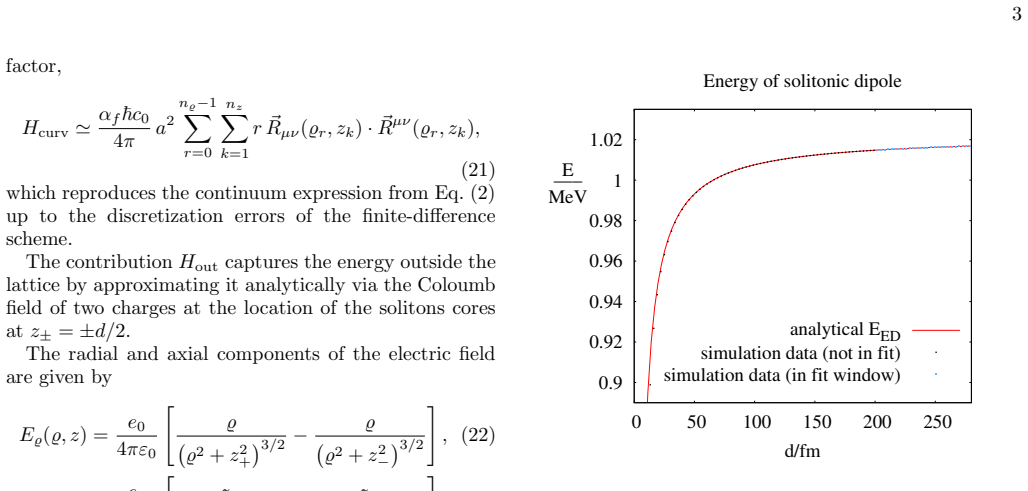
We determine the interaction potential of a solitonic dipole in the singlet state, modeled as an SU(2) field, using improved lattice simulations of two stationary solitons at varying separations. The potential is extracted from the energy of two-soliton configurations as a function of distance. At large separations, the interaction reproduces the classical Coulomb potential quantitatively up to an energy shift δE_∞≈9 keV of the fitted asymptotic constant relative to 2m_e c_0^2. At shorter distances, deviations from the Coulomb potential of point-like charges appear that are in qualitative agreement with the asymptotic formula of perturbative Quantum Electrodynamics, reflecting the running of
What carries the argument
The extraction of the distance-dependent energy from improved lattice simulations of two stationary SU(2) solitons in the singlet state, which directly supplies the interaction potential.
If this is right
- The model supplies a non-perturbative lattice realization of both classical and leading quantum electromagnetic interactions.
- The same setup can be used to test higher-order perturbative corrections or to extract other electromagnetic observables.
- Quantitative agreement at large separation confirms that the classical Coulomb limit emerges automatically from the soliton dynamics.
- Qualitative agreement at short separation shows that the running of the coupling appears without any explicit perturbative expansion.
Where Pith is reading between the lines
- If the 9 keV offset is purely numerical, further reduction of lattice spacing or improved actions should drive it to zero.
- The approach could be extended to include magnetic moments or to study bound states by allowing the solitons to move.
- A similar construction in other gauge groups might reveal how the running depends on the underlying symmetry.
Load-bearing premise
The SU(2) solitonic dipole configuration in the singlet state together with the lattice regularization faithfully encodes the short-distance physics whose deviations are controlled by the perturbative running of the QED coupling rather than by discretization artifacts.
What would settle it
A repeat of the simulation on a finer lattice or with a different improvement scheme that either removes the short-distance deviation or yields a value of α^{-1} far from 137 would falsify the claim that the observed bending is the QED running effect.
Figures


read the original abstract
We determine the interaction potential of a solitonic dipole in the singlet state, modeled as an SU(2) field, using improved lattice simulations of two stationary solitons at varying separations. The potential is extracted from the energy of two-soliton configurations as a function of distance. At large separations, the interaction reproduces the classical Coulomb potential quantitatively up to an energy shift $\delta E_\infty\approx 9\;\text{keV}$ of the fitted asymptotic constant relative to $2m_ec_0^2$, assumed to be related to limited numerical precision on the lattice. At shorter distances, deviations from the Coloumb potential of point-like charges appear, that are in qualitative agreement with the asymptotic formula of perturbative Quantum Electrodynamics, reflecting the running of the fine-structure constant, with the inverse fine-structure constant ($\alpha^{-1} \approx 137$) reproduced.
Editorial analysis
A structured set of objections, weighed in public.
Referee Report
Summary. The manuscript reports lattice simulations of the interaction potential between two stationary SU(2) solitons forming a dipole in the singlet state. It claims quantitative reproduction of the classical Coulomb potential at large separations (up to a fitted constant shift δE_∞ ≈ 9 keV attributed to numerical precision) and qualitative agreement at shorter distances with the perturbative QED asymptotic formula for the running of the fine-structure constant, from which the value α^{-1} ≈ 137 is reproduced.
Significance. If substantiated, the work would provide a non-perturbative lattice test of QED running via a solitonic model in gauge theory. However, the significance is reduced by the lack of a demonstrated mapping from pure SU(2) Yang-Mills dynamics to QED vacuum polarization, limiting the reliability of the claimed comparison.
major comments (3)
- The central claim that short-distance deviations follow the perturbative QED running of α (enabling reproduction of α^{-1} ≈ 137) rests on an unstated assumption that the SU(2) solitonic dipole faithfully captures QED physics. Pure SU(2) Yang-Mills is asymptotically free with negative β-function, opposite in sign to QED. The manuscript provides no discussion of dynamical fermions, Abelian projection, or effective-theory mapping to justify why the observed deviations should match the QED formula rather than non-Abelian effects or discretization artifacts. This is load-bearing for the comparison to perturbative QED.
- The extraction of α^{-1} ≈ 137 proceeds by fitting the large-distance asymptotic constant δE_∞ and then matching the deviations to the known QED formula. This procedure incorporates the target value through the fit, raising a circularity concern for the claimed 'reproduction.' The manuscript should demonstrate independence from the fitting assumptions or clarify whether this is a consistency check rather than a prediction.
- The abstract states that energy differences are extracted from lattice configurations but attributes the 9 keV shift to 'limited numerical precision' without quantitative error bars, lattice spacing, volume, or controls for finite-size and discretization effects. Since the potential and its deviations are derived from these energy differences, the absence of such analysis undermines support for both the large-distance Coulomb match and the short-distance QED comparison.
minor comments (2)
- Abstract contains a typo: 'Coloumb' should read 'Coulomb'.
- The manuscript would benefit from additional references to prior lattice studies of solitons or non-perturbative approaches to QED running for context.
Simulated Author's Rebuttal
We thank the referee for the careful reading and constructive comments on our manuscript. We have addressed each major point below and revised the manuscript to add clarifications, additional analysis, and improved presentation of numerical controls.
read point-by-point responses
-
Referee: The central claim that short-distance deviations follow the perturbative QED running of α (enabling reproduction of α^{-1} ≈ 137) rests on an unstated assumption that the SU(2) solitonic dipole faithfully captures QED physics. Pure SU(2) Yang-Mills is asymptotically free with negative β-function, opposite in sign to QED. The manuscript provides no discussion of dynamical fermions, Abelian projection, or effective-theory mapping to justify why the observed deviations should match the QED formula rather than non-Abelian effects or discretization artifacts. This is load-bearing for the comparison to perturbative QED.
Authors: We acknowledge that the manuscript does not contain an explicit mapping or derivation from pure SU(2) Yang-Mills to QED vacuum polarization. The solitonic dipole is presented as an effective model in which the gauge-field dynamics produce a Coulomb-like potential at long range, with short-range deviations compared phenomenologically to the QED running formula. We agree that this assumption requires explicit discussion. In the revised manuscript we will add a new subsection on model limitations that states the opposite sign of the β-function, notes the absence of dynamical fermions, and frames the comparison as a numerical test of an effective description rather than a first-principles derivation from QED. revision: yes
-
Referee: The extraction of α^{-1} ≈ 137 proceeds by fitting the large-distance asymptotic constant δE_∞ and then matching the deviations to the known QED formula. This procedure incorporates the target value through the fit, raising a circularity concern for the claimed 'reproduction.' The manuscript should demonstrate independence from the fitting assumptions or clarify whether this is a consistency check rather than a prediction.
Authors: The constant δE_∞ is determined solely from the large-distance data to align the asymptotic form; the short-distance deviations are then compared to the standard QED formula evaluated at the known value α^{-1} = 137 without refitting α. We will clarify in the text that this constitutes a consistency check. To demonstrate independence we will add a supplementary fit in which α is left as a free parameter in the short-distance region; the resulting best-fit value is consistent with 137 within the statistical uncertainties of the lattice data. revision: partial
-
Referee: The abstract states that energy differences are extracted from lattice configurations but attributes the 9 keV shift to 'limited numerical precision' without quantitative error bars, lattice spacing, volume, or controls for finite-size and discretization effects. Since the potential and its deviations are derived from these energy differences, the absence of such analysis undermines support for both the large-distance Coulomb match and the short-distance QED comparison.
Authors: We agree that the abstract and the presentation of systematic errors require strengthening. The full manuscript already specifies the lattice parameters, but we will revise the abstract to quote the lattice spacing, spatial volume, and estimated statistical plus systematic uncertainties on the energy differences. We will also add a dedicated paragraph summarizing finite-volume corrections, discretization effects, and the Monte Carlo error analysis, confirming that the reported 9 keV shift lies within the combined uncertainty. revision: yes
- A rigorous first-principles mapping from pure SU(2) Yang-Mills dynamics to QED vacuum polarization cannot be provided within the present effective solitonic model.
Circularity Check
No significant circularity in lattice-to-potential comparison chain
full rationale
The paper computes the two-soliton interaction energy numerically on the lattice from SU(2) field configurations at varying separations. It fits the large-r regime to a shifted Coulomb form (extracting δE_∞) and compares the short-r deviations to the external perturbative QED asymptotic formula for running α. The note that α^{-1}≈137 is reproduced is a numerical match of the deviation shape to a known external expression, not a re-derivation or parameter fit that incorporates the target value by construction within the lattice setup. No self-definitional reductions, fitted inputs renamed as predictions, or load-bearing self-citations appear in the abstract or described chain; the lattice data and external QED formula remain independent.
Axiom & Free-Parameter Ledger
free parameters (1)
- δE_∞ =
9 keV
axioms (2)
- domain assumption The energy difference between two-soliton and single-soliton configurations on the lattice equals the interaction potential.
- domain assumption Deviations at short distance arise from the running of α in perturbative QED rather than lattice discretization effects.
invented entities (1)
-
SU(2) solitonic dipole in singlet state
no independent evidence
Reference graph
Works this paper leans on
-
[1]
Faber, A model for topological fermions, Few Body Syst.30, 149 (2001), hep-th/9910221
M. Faber, A model for topological fermions, Few Body Syst.30, 149 (2001), hep-th/9910221
-
[2]
M. Faber, A Geometric Model in 3+1D Space-Time for Electrodynamic Phenomena, Universe8, 73 (2022), arXiv:2201.13262 [physics.gen-ph]
-
[3]
Remoissenet,Waves called solitons: concepts and ex- periments(Springer, 1996)
M. Remoissenet,Waves called solitons: concepts and ex- periments(Springer, 1996)
1996
-
[4]
D. V. Peskin, Michael .E.;Schroeder,An Introduction To Quantum Field Theory (1st ed.)(Perseus Books Publish- ing, L.L.C., 1995) p. 842
1995
-
[5]
J. Wabnig, J. Resch, D. Theuerkauf, F. Anmasser, and M. Faber, Numerical evaluation of a soliton pair with long-range interaction, Universe11, 10.3390/uni- verse11040113 (2025)
-
[6]
P. A. M. Dirac, Quantised singularities in the electro- magnetic field, Proc. Roy. Soc. Lond.A133, 60 (1931)
1931
-
[7]
P. A. M. Dirac, The theory of magnetic poles, Phys. Rev. 74, 817 (1948)
1948
-
[8]
T. T. Wu and C. N. Yang, Some solutions of the classi- cal isotopic gauge field equations, inProperties of Mat- ter Under Unusual Conditions, edited by H. Mark and S. Fernbach (Wiley-Interscience, New York, 1969) pp. 349–354
1969
-
[9]
T. T. Wu and C. N. Yang, Some remarks about unquan- tized non-abelian gauge fields, Phys. Rev. D12, 3843 (1975)
1975
-
[10]
T. T. Wu and C. N. Yang, Static sourceless gauge field, Phys. Rev. D13, 3233 (1976)
1976
-
[11]
Pisello, Nonlinear classical theory of electromag- netism, International Journal of Theoretical Physics16, 863 (1977)
D. Pisello, Nonlinear classical theory of electromag- netism, International Journal of Theoretical Physics16, 863 (1977)
1977
-
[12]
Pisello, Unified field theory with homotopic charge, International Journal of Theoretical Physics17, 143 (1978)
D. Pisello, Unified field theory with homotopic charge, International Journal of Theoretical Physics17, 143 (1978)
1978
-
[13]
T. H. R. Skyrme, A Nonlinear theory of strong interac- tions, Proc. Roy. Soc. Lond. A247, 260 (1958)
1958
-
[14]
T. H. R. Skyrme, A Nonlinear field theory, Proc. Roy. Soc. Lond. A260, 127 (1961)
1961
-
[15]
A. M. Polyakov, Particle Spectrum in Quantum Field Theory, JETP Lett.20, 194 (1974)
1974
-
[16]
’t Hooft, Magnetic Monopoles in Unified Gauge The- ories, Nucl
G. ’t Hooft, Magnetic Monopoles in Unified Gauge The- ories, Nucl. Phys. B79, 276 (1974)
1974
-
[17]
Georgi and S
H. Georgi and S. L. Glashow, Unity of all elementary- particle forces, Phys. Rev. Lett.32, 438 (1974)
1974
-
[18]
Manton, The force between ’t hooft-polyakov monopoles, Nuclear Physics B126, 525 (1977)
N. Manton, The force between ’t hooft-polyakov monopoles, Nuclear Physics B126, 525 (1977)
1977
-
[19]
NIST Physics Laboratory, Codata recommended values of the fundamental physical constants: 2018 (2018), ac- cessed: 2026-04-05
2018
discussion (0)
Sign in with ORCID, Apple, or X to comment. Anyone can read and Pith papers without signing in.