Recognition: unknown
Limits of Statistical Models of Ultracold Complex Lifetimes
Pith reviewed 2026-05-10 15:07 UTC · model grok-4.3
The pith
Statistical models indicate that close-coupling calculations may be insufficient to explain long lifetimes in ultracold molecular collisions.
A machine-rendered reading of the paper's core claim, the machinery that carries it, and where it could break.
Core claim
We propose a statistical model designed to simulate the result of full close-coupling calculations by numerically sampling resonances using random matrix theory and utilizing results from quantum defect theory to calculate scattering properties and lifetimes. We find that in the limit of dense resonances, our theory agrees well with the Rice-Ramsperger-Kassel-Markus prediction, whereas in the limit of sparse resonances, the physics is governed by threshold behavior rather than resonant effects. By comparing these predictions to experimental results in two limits, we argue that close-coupling calculations alone may be insufficient to resolve the issue of long lifetimes.
What carries the argument
The statistical model that samples resonances from random matrix theory and computes lifetimes using quantum defect theory as a stand-in for full close-coupling calculations.
If this is right
- In the dense resonance limit, predicted lifetimes match those from the RRKM statistical theory.
- In the sparse resonance limit, lifetimes are determined by threshold laws rather than individual resonances.
- Experimental data in both limits cannot be fully reproduced by close-coupling calculations alone.
- Additional factors beyond current quantum scattering methods may be required to explain sticky collisions.
Where Pith is reading between the lines
- The model provides a way to estimate when statistical approximations become reliable without running full calculations.
- Hybrid approaches combining statistical sampling with selective close-coupling might be needed for intermediate regimes.
- Experiments targeting the crossover between dense and sparse resonance regimes could test the model's validity.
Load-bearing premise
The statistical model using random matrix theory for resonances and quantum defect theory for scattering accurately represents the results that full close-coupling calculations would produce in the relevant density regimes.
What would settle it
A measurement of lifetimes in an ultracold system with dense resonances that matches close-coupling calculations but deviates from both the statistical model and the RRKM prediction would falsify the central argument.
Figures



read the original abstract
The puzzle of "sticky collisions," in which molecular collision complexes exhibit unexpectedly long lifetimes, remains an unresolved mystery. A central challenge to solving this mystery is that traditional close-coupling calculations remain limited by the vast computational cost needed to take into account all the degrees of freedom involved in the collision. In this work, we propose a statistical model designed to simulate the result of full close-coupling calculations, with the goal of collecting statistics about reasonable lifetimes of collision complexes. To do so, we numerically sample resonances using random matrix theory and utilize results from quantum defect theory to calculate scattering properties and lifetimes. We find that in the limit of dense resonances, our theory agrees well with the Rice-Ramsperger-Kassel-Markus (RRKM) prediction, whereas in the limit of sparse resonances, the physics is governed by threshold behavior rather than resonant effects. By comparing these predictions to experimental results in two limits, we argue that close-coupling calculations alone may be insufficient to resolve the issue of long lifetimes.
Editorial analysis
A structured set of objections, weighed in public.
Referee Report
Summary. The manuscript develops a statistical model that samples resonances via random matrix theory and computes scattering properties and lifetimes using quantum defect theory, with the explicit aim of approximating the outcomes of full close-coupling calculations for ultracold molecular collision complexes. In the dense-resonance limit the model recovers the RRKM lifetime prediction; in the sparse-resonance limit threshold laws dominate. Direct comparison of these limiting behaviors with existing experimental data on sticky collisions leads the authors to conclude that close-coupling calculations alone are unlikely to resolve the observed long lifetimes.
Significance. If the RMT+QDT construction can be shown to reproduce the lifetime statistics of exact close-coupling calculations, the work supplies a computationally tractable route to lifetime distributions in regimes that remain inaccessible to direct CC. The clean recovery of RRKM in one limit and threshold dominance in the other supplies useful analytic benchmarks, while the experimental comparisons sharpen the theoretical challenge posed by sticky collisions.
major comments (3)
- [Model description and validation] The central claim that close-coupling calculations are insufficient rests on the assertion that the RMT-sampled resonances plus QDT scattering faithfully reproduce the lifetime statistics that would be obtained from full close-coupling. No benchmark comparison against exact CC results is presented in any computable regime (few-channel or low-dimensional model systems), leaving the proxy unvalidated. This assumption is load-bearing for the argument in the abstract and conclusion.
- [Sparse-resonance results] In the sparse-resonance regime the manuscript states that lifetimes are governed by threshold behavior rather than resonant effects, yet the quantitative extraction of lifetimes from the QDT S-matrix elements and the statistical sampling procedure are not accompanied by error estimates or convergence tests with respect to the number of sampled resonances. Without these, the claimed dominance of threshold laws cannot be assessed against experimental uncertainties.
- [Comparison with experiment] The experimental comparisons invoked to support the conclusion are described only qualitatively in the abstract; the manuscript does not report quantitative measures of agreement (e.g., overlap of lifetime distributions, reduced chi-squared values) or the precise experimental datasets and error bars used. This weakens the inference that the statistical model (and hence CC) fails to explain the data.
minor comments (2)
- [Notation] Notation for the resonance width distribution and the definition of the dense/sparse boundary should be introduced once and used consistently; at present the transition criterion appears only in the text without an equation label.
- [Figures] Figure captions should explicitly state the number of RMT realizations averaged and the range of total angular momentum or partial waves included, to allow readers to judge statistical convergence.
Simulated Author's Rebuttal
We thank the referee for the careful reading and constructive comments on our manuscript. We address each major comment below, indicating planned revisions where appropriate.
read point-by-point responses
-
Referee: [Model description and validation] The central claim that close-coupling calculations are insufficient rests on the assertion that the RMT-sampled resonances plus QDT scattering faithfully reproduce the lifetime statistics that would be obtained from full close-coupling. No benchmark comparison against exact CC results is presented in any computable regime (few-channel or low-dimensional model systems), leaving the proxy unvalidated. This assumption is load-bearing for the argument in the abstract and conclusion.
Authors: We agree that direct numerical benchmarks against close-coupling calculations in simplified regimes would provide valuable validation. However, even few-channel CC calculations for molecular systems with the relevant degrees of freedom remain computationally prohibitive, which is the core motivation for developing the RMT+QDT statistical proxy. Our validation instead relies on exact recovery of the RRKM limit for dense resonances and threshold-law dominance for sparse resonances, both of which are analytically known. In the revised manuscript we will expand the discussion of these limits as analytic benchmarks and add a brief outline of why direct CC validation is currently infeasible for the systems of interest. revision: partial
-
Referee: [Sparse-resonance results] In the sparse-resonance regime the manuscript states that lifetimes are governed by threshold behavior rather than resonant effects, yet the quantitative extraction of lifetimes from the QDT S-matrix elements and the statistical sampling procedure are not accompanied by error estimates or convergence tests with respect to the number of sampled resonances. Without these, the claimed dominance of threshold laws cannot be assessed against experimental uncertainties.
Authors: We thank the referee for highlighting this omission. In the revised manuscript we will include statistical error estimates on the extracted lifetimes and present convergence tests with respect to the number of sampled resonances in the sparse regime. These additions will allow quantitative assessment of the threshold-law dominance and direct comparison with experimental uncertainties. revision: yes
-
Referee: [Comparison with experiment] The experimental comparisons invoked to support the conclusion are described only qualitatively in the abstract; the manuscript does not report quantitative measures of agreement (e.g., overlap of lifetime distributions, reduced chi-squared values) or the precise experimental datasets and error bars used. This weakens the inference that the statistical model (and hence CC) fails to explain the data.
Authors: We acknowledge that the current experimental comparisons are primarily qualitative. In the revision we will specify the exact experimental datasets used (including references and error bars), report quantitative measures of agreement such as distribution overlap or statistical goodness-of-fit metrics, and clarify how these support the conclusion that close-coupling calculations alone are unlikely to resolve the observed lifetimes. revision: yes
Circularity Check
No circularity: standard RMT+QDT statistical proxy applied independently
full rationale
The derivation samples resonances via random matrix theory and computes scattering/lifetimes via quantum defect theory to generate statistics intended as a proxy for close-coupling. These are applied to derive RRKM agreement in the dense-resonance limit and threshold dominance in the sparse limit, followed by comparison to experiment. No step reduces by construction to its own inputs, no parameter is fitted to a subset and renamed as prediction, and no load-bearing premise rests on a self-citation chain or imported uniqueness theorem. The model is an external approximation whose validity is assumed rather than tautologically enforced by the paper's own equations.
Axiom & Free-Parameter Ledger
axioms (2)
- domain assumption Random matrix theory applies to the statistics of resonances in ultracold molecular collisions
- domain assumption Quantum defect theory suffices to calculate scattering properties and lifetimes from the sampled resonances
Reference graph
Works this paper leans on
-
[1]
(12), we calculate the ther- mally averaged time delay⟨Q⟩for 1000 random spectra, in order to collect statistics on the possible lifetimes of the collision complex
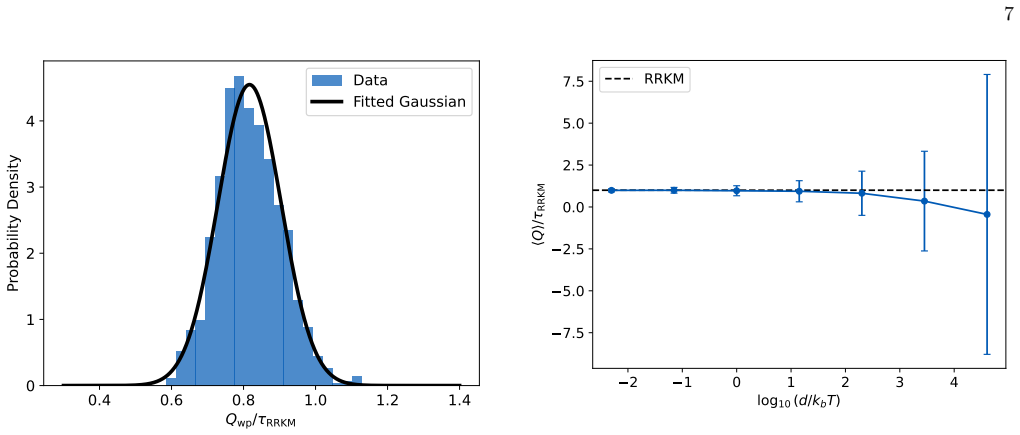
Distribution of Time Delays Using our definition in Eq. (12), we calculate the ther- mally averaged time delay⟨Q⟩for 1000 random spectra, in order to collect statistics on the possible lifetimes of the collision complex. Fig. 2 plots the histogram of values for ⟨Q⟩, in units ofτ RRKM for easy comparison. As seen from the figure, the distribution is well c...
-
[2]
Qualitatively, we can make a prediction of the width of the⟨Q⟩distribution by using counting statis- tics
Distribution Width The ability to run simulations with many different sample spectra yields information about possible dis- tributions of time delays, not merely single estimated values. Qualitatively, we can make a prediction of the width of the⟨Q⟩distribution by using counting statis- tics. Each resonance contributes a time delay⟨Q µ⟩, whereµ= 1, . . . ...
-
[3]
center of mass
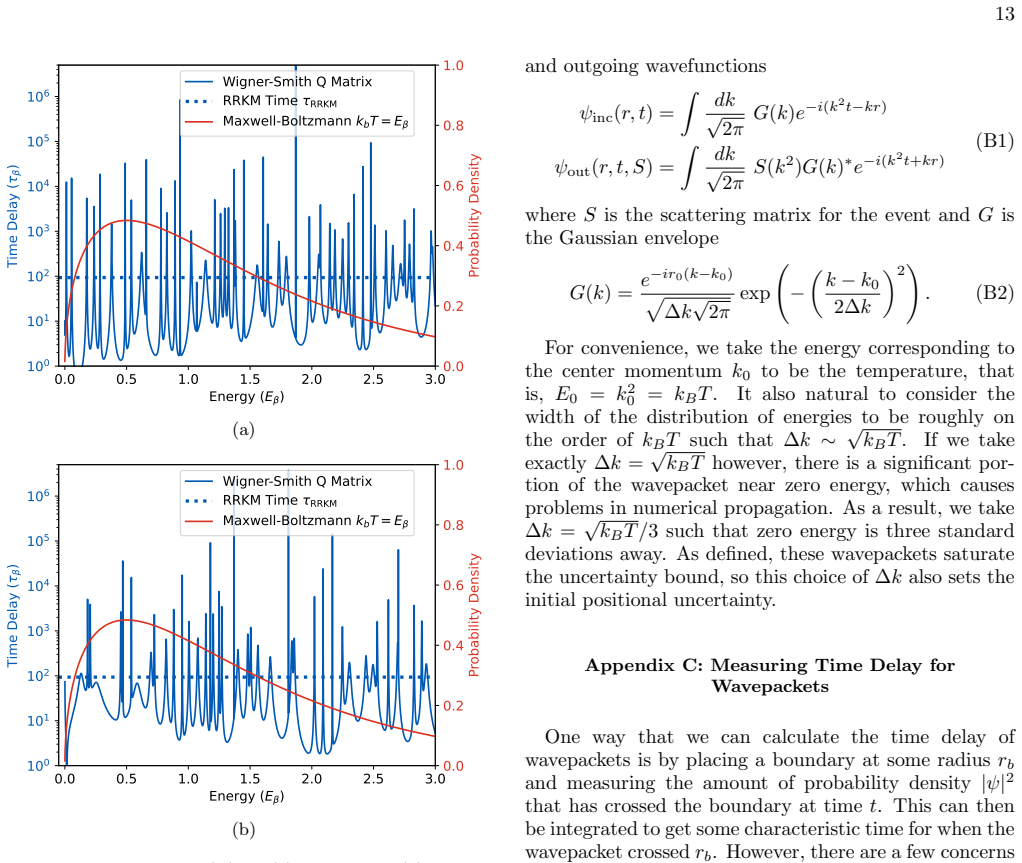
Wavepackets The time delayQ(E) is evaluated in the energy do- main, but it can also be instructive to note how the res- onant spectrum explicitly influences the propagation of wave packets in the time domain. Returning to the ini- tial parameters in Eq. (13), we use the resonant spec- trum corresponding with Fig. 1 to propagate a Gaussian wavepacket throu...
-
[4]
Using Eq
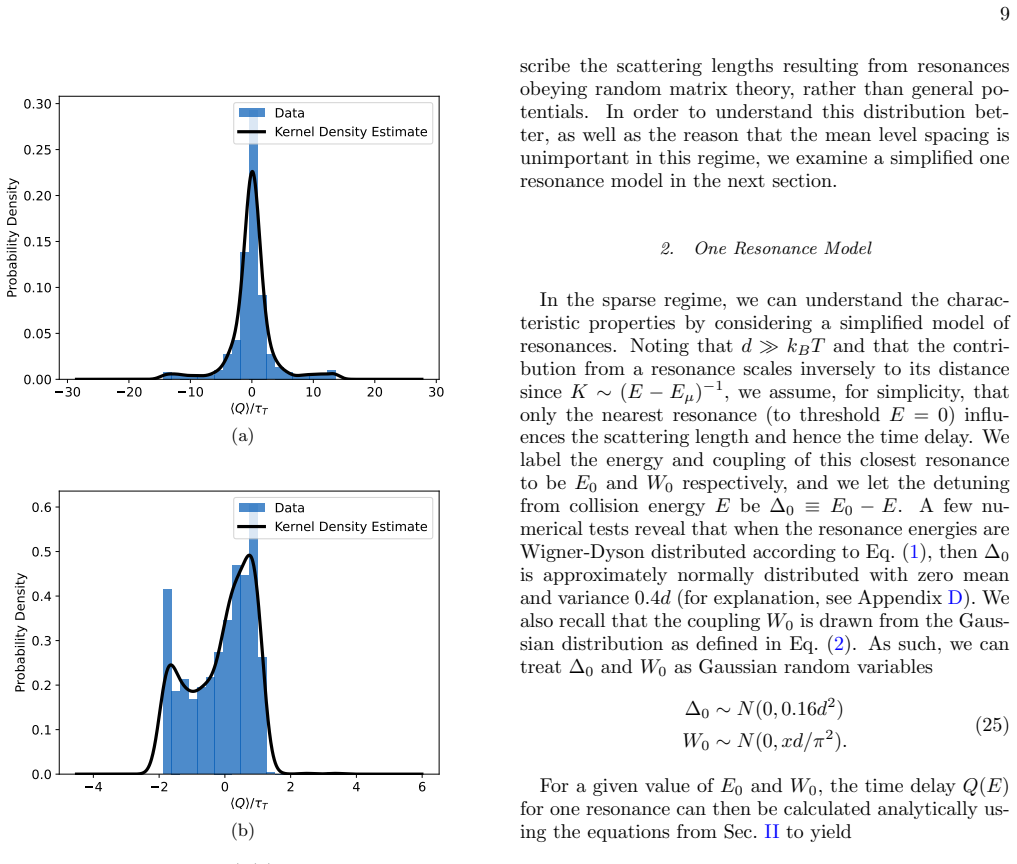
Distribution of Time Delays Nonetheless, the model admits an ensemble of time delays to be evaluated. Using Eq. (23), we see that the thermally averaged time delay is given by ⟨Q⟩= Z ∞ 0 dE P(E) −as √2µ√ E =−2a s r 2µ πkBT (24) As we mentioned, this quantity may vary widely with the different scattering lengthsa s in each realization of the spectrum. Howe...
-
[5]
One Resonance Model In the sparse regime, we can understand the charac- teristic properties by considering a simplified model of resonances. Noting thatd≫k BTand that the contri- bution from a resonance scales inversely to its distance sinceK∼(E−E µ)−1, we assume, for simplicity, that only the nearest resonance (to thresholdE= 0) influ- ences the scatteri...
-
[6]
Wavepackets We briefly remark on how the sparse regime translates to wavepacket evolution. Unlike the dense case, there are no resonances, soQ(E) varies relatively slowly, which causes an overall delay in the entire wavepacket, rather than creating many sharp features like in Fig. 5. As a result, there is a uniform notion of time delay for any collision. ...
-
[7]
Christianen, M
A. Christianen, M. W. Zwierlein, G. C. Groenenboom, and T. Karman, Photoinduced two-body loss of ultracold molecules, Phys. Rev. Lett.123, 123402 (2019)
2019
-
[8]
Gersema, K
P. Gersema, K. K. Voges, M. Meyer zum Alten Borgloh, L. Koch, T. Hartmann, A. Zenesini, S. Ospelkaus, J. Lin, J. He, and D. Wang, Probing photoinduced two-body loss of ultracold nonreactive bosonic 23Na87Rb and 23Na39K molecules, Phys. Rev. Lett.127, 163401 (2021)
2021
-
[9]
Liu, M.-G
Y. Liu, M.-G. Hu, M. A. Nichols, D. D. Grimes, T. Kar- man, H. Guo, and K.-K. Ni, Photo-excitation of long- lived transient intermediates in ultracold reactions, Na- ture Physics16, 1132–1136 (2020)
2020
-
[10]
Bigagli, W
N. Bigagli, W. Yuan, S. Zhang, B. Bulatovic, T. Karman, I. Stevenson, and S. Will, Observation of bose–einstein condensation of dipolar molecules, Nature631, 289–293 (2024)
2024
-
[11]
M. A. Nichols, Y.-X. Liu, L. Zhu, M.-G. Hu, Y. Liu, and K.-K. Ni, Detection of long-lived complexes in ultra- cold atom-molecule collisions, Phys. Rev. X12, 011049 (2022)
2022
-
[12]
Bause, A
R. Bause, A. Schindewolf, R. Tao, M. Duda, X.-Y. Chen, G. Qu´ em´ ener, T. Karman, A. Christianen, I. Bloch, and X.-Y. Luo, Collisions of ultracold molecules in bright and dark optical dipole traps, Phys. Rev. Res.3, 033013 (2021)
2021
-
[13]
M. B. Soley and E. J. Heller, Classical approach to col- lision complexes in ultracold chemical reactions, Phys. Rev. A98, 052702 (2018)
2018
-
[14]
J. F. E. Croft and J. L. Bohn, Long-lived complexes and chaos in ultracold molecular collisions, Phys. Rev. A89, 012714 (2014). 12
2014
-
[15]
M. B. Soley and E. J. Heller, Ultracold molecular col- lisions: Quasiclassical, semiclassical, and classical ap- proaches in the quantum regime, Chemical Reviews125, 6609 (2025), pMID: 40558080
2025
-
[16]
Lide,Classical Simulations of Ultracold Chemical Re- actions, Bachelor’s thesis, Trinity University (2021)
M. Lide,Classical Simulations of Ultracold Chemical Re- actions, Bachelor’s thesis, Trinity University (2021)
2021
-
[17]
M. P. Man, G. C. Groenenboom, and T. Karman, Sym- metry breaking in sticky collisions between ultracold molecules, Phys. Rev. Lett.129, 243401 (2022)
2022
- [18]
-
[19]
J. F. E. Croft, C. Makrides, M. Li, A. Petrov, B. K. Kendrick, N. Balakrishnan, and S. Kotochigova, Univer- sality and chaoticity in ultracold k+krb chemical reac- tions, Nature Communications8, 15897 (2017)
2017
-
[20]
H. J. da Silva, B. K. Kendrick, H. Li, S. Kotochigova, and N. Balakrishnan, Nonadiabatically driven quantum inter- ference effects in the ultracold k + krb→rb + k2 chem- ical reaction, The Journal of Physical Chemistry Letters 16, 6171 (2025), pMID: 40498682
2025
-
[21]
Y.-X. Liu, L. Zhu, J. Luke, M. C. Babin, M. Gronowski, H. Ladjimi, M. Tomza, J. L. Bohn, T. V. Tscherbul, and K.-K. Ni, Hyperfine-to-rotational energy transfer in ultracold atom–molecule collisions of rb and krb, Nature Chemistry17, 688–694 (2025)
2025
-
[22]
Mayle, B
M. Mayle, B. P. Ruzic, and J. L. Bohn, Statistical aspects of ultracold resonant scattering, Phys. Rev. A85, 062712 (2012)
2012
-
[23]
V. V. Flambaum, G. F. Gribakin, and C. Harabati, Ana- lytical calculation of cold-atom scattering, Phys. Rev. A 59, 1998 (1999)
1998
-
[24]
J. L. Bohn and R. R. Wang, Probability distributions of atomic scattering lengths, Canadian Journal of Physics 103, 81 (2025)
2025
-
[25]
G. E. Mitchell, A. Richter, and H. A. Weidenm¨ uller, Ran- dom matrices and chaos in nuclear physics: Nuclear reac- tions, Reviews of Modern Physics82, 2845–2901 (2010)
2010
-
[27]
R. A. Marcus, Unimolecular dissociations and free rad- ical recombination reactions, The Journal of Chemical Physics20, 359 (1952)
1952
-
[28]
O. K. Rice and H. C. Ramsperger, Theories of unimolec- ular gas reactions at low pressures, Journal of the Amer- ican Chemical Society49, 1617 (1927)
1927
-
[29]
J. F. E. Croft, N. Balakrishnan, and B. K. Kendrick, Long-lived complexes and signatures of chaos in ultracold k2+rb collisions, Phys. Rev. A96, 062707 (2017)
2017
-
[30]
J. F. E. Croft, J. L. Bohn, and G. Qu´ em´ ener, Anomalous lifetimes of ultracold complexes decaying into a single channel, Phys. Rev. A107, 023304 (2023)
2023
-
[31]
Idziaszek and P
Z. Idziaszek and P. S. Julienne, Universal rate constants for reactive collisions of ultracold molecules, Phys. Rev. Lett.104, 113202 (2010)
2010
-
[32]
P. D. Gregory, J. A. Blackmore, S. L. Bromley, and S. L. Cornish, Loss of ultracold 87Rb133Cs molecules via opti- cal excitation of long-lived two-body collision complexes, Phys. Rev. Lett.124, 163402 (2020)
2020
-
[33]
B. P. Ruzic, C. H. Greene, and J. L. Bohn, Quantum de- fect theory for high-partial-wave cold collisions, Physical Review A87, 10.1103/physreva.87.032706 (2013)
-
[34]
E. P. Wigner, Lower limit for the energy derivative of the scattering phase shift, Phys. Rev.98, 145 (1955)
1955
-
[35]
Eisenbud,The Formal Properties of Nuclear Colli- sions, Ph.D
L. Eisenbud,The Formal Properties of Nuclear Colli- sions, Ph.D. thesis, Princeton University (1948)
1948
-
[36]
F. T. Smith, Lifetime matrix in collision theory, Phys. Rev.118, 349 (1960)
1960
-
[37]
M. D. Frye and J. M. Hutson, Time delays in ultra- cold atomic and molecular collisions, Phys. Rev. Res.1, 033023 (2019)
2019
-
[38]
Christianen, T
A. Christianen, T. Karman, and G. C. Groenenboom, Quasiclassical method for calculating the density of states of ultracold collision complexes, Phys. Rev. A100, 032708 (2019)
2019
-
[39]
Mitra, V
R. Mitra, V. S. Prasannaa, and B. K. Sahoo, Compar- ative analysis of nonrelativistic and relativistic calcula- tions of electric dipole moments and polarizabilities of heteronuclear alkali-metal dimers, Phys. Rev. A101, 012511 (2020)
2020
-
[40]
Desouter-Lecomte and X
M. Desouter-Lecomte and X. Chapuisat, Quantum- mechanical statistical theories for chemical reactivity: overlapping resonances, Physical Chemistry Chemical Physics1, 2635 (1999)
1999
- [41]
-
[42]
K.-K. Ni, R. Shaham, J. Luke, and R. Wang, Private communication (2025)
2025
-
[43]
B. K. Kendrick, H. Li, J. K los, and S. Kotochigova, Non- adiabatic quantum interference and complex formation in ultracold collisions of rb with krb, Phys. Chem. Chem. Phys. , (2026)
2026
-
[44]
Kaplan, Scar and antiscar quantum effects in open chaotic systems, Phys
L. Kaplan, Scar and antiscar quantum effects in open chaotic systems, Phys. Rev. E59, 5325 (1999)
1999
-
[45]
Heller, Private communication (2025)
R. Heller, Private communication (2025). Appendix A: V arying the Coupling Strength We examine the effects of varying the bound-free cou- pling parameterx. We plot in Fig. 9(a) and (b) the time delayQfor an example spectrum whenx= 0.1 and x= 10 respectively. The predominant effect of shifting xfrom 1 is that resonances become sharper. For both x= 0.1 andx...
2025
-
[46]
As a result, the distribution forw=W 2 0 is given by P(w≥0) = 1 xd √ 2πw exp − w 2x2d2 (E1) To find the distribution ofα 0, we must then take the ratio distribution ofz=W 2 0 /∆0. This can be done by taking the integral P(z) = Z ∞ −∞ dy|y| 1√ 2πα2d2 exp − y2 2α2d2 × 1 xd√2πzy exp − zy 2x2d2 = 1 b Z ∞ −∞ dy |y|√zy exp − x2y2 +α 2zy 2α2x2d2 , (E2) whereb= 2...
discussion (0)
Sign in with ORCID, Apple, or X to comment. Anyone can read and Pith papers without signing in.