Recognition: unknown
Scalable Qumode-Qubit State Transfer and Fast-forward Quantum Fourier Transform using Oscillators
Pith reviewed 2026-05-10 15:02 UTC · model grok-4.3
The pith
Transferring n-qubit states to m qumodes reduces state transfer time from O(2^n) to O(2^{n/m}).
A machine-rendered reading of the paper's core claim, the machinery that carries it, and where it could break.
Core claim
Transferring an n-qubit state to m qumodes can be done in O(2^{n/m}) time by distributing the state coefficients across the modes. This multi-qumode state transfer acts as a subroutine to approximately realize the n-qubit quantum Fourier transform on m qumodes with the stated improved runtime scaling.
What carries the argument
The multi-qumode state transfer protocol that encodes qubit state coefficients into multiple continuous-variable oscillator states to achieve exponential runtime reduction.
If this is right
- The quantum Fourier transform can be accelerated on hybrid qubit-qumode hardware.
- State conversion between arbitrary numbers of qubits and qumodes becomes scalable.
- Runtime for quantum signal processing tasks improves exponentially with added qumodes.
- Mixed analog-digital approaches to quantum computing gain a practical building block.
Where Pith is reading between the lines
- This technique could be extended to other quantum algorithms that rely on Fourier transforms or state encoding.
- Hybrid systems might combine qubit logic with qumode-based fast operations for sensing or communication.
- Practical implementations would need to account for real-world coupling efficiencies in oscillator systems.
Load-bearing premise
The protocol assumes ideal lossless coupling between qubits and qumodes with perfect control and no decoherence.
What would settle it
Measuring the runtime for transferring a specific n-qubit state to varying numbers of m qumodes and verifying whether it follows the O(2^{n/m}) scaling under controlled conditions.
Figures



read the original abstract
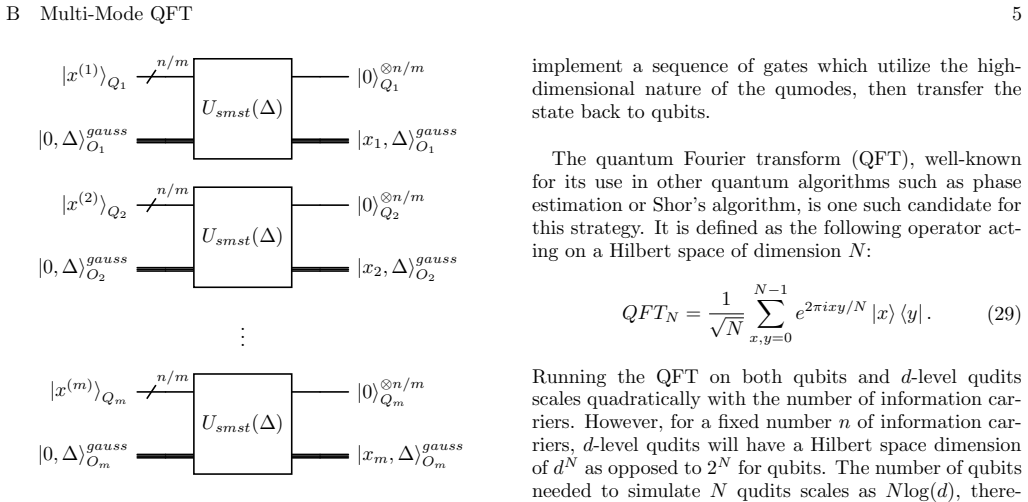
Transferring the information stored in the expansion coefficients of a multi-qubit state to the coefficients of a continuous-variable state is an important protocol for communicating quantum information. It was shown in previous work how to transfer an $n$-qubit state to a single qumode in $\mathcal{O}(2^n)$ time. We show that by transferring this state to $m$ qumodes, the runtime can be improved to $\mathcal{O}(2^{n/m})$. Furthermore, we demonstrate how multi-qumode state transfer can be used as a subroutine for approximately realizing the $n$-qubits quantum Fourier transform on $m$-qumode with runtime scaling $\mathcal{O}(m2^{n/m}/\epsilon+m^2)$, accelerating qubit quantum Fourier transform using qumodes. This work presents a scalable approach to convert discrete and continuous quantum information between an arbitrary number of qubits and qumodes. It represents a crucial step forward in mixed analog-digital quantum signal processing for computing, sensing, and communication.
Editorial analysis
A structured set of objections, weighed in public.
Referee Report
Summary. The manuscript proposes a protocol for transferring an n-qubit state to m qumodes in O(2^{n/m}) time, improving on the O(2^n) scaling for a single qumode shown in prior work. It further uses this multi-qumode transfer as a subroutine to approximately implement the n-qubit quantum Fourier transform on m qumodes, with runtime scaling O(m 2^{n/m}/ε + m²). The work focuses on scalable conversion between discrete and continuous-variable quantum information under ideal coupling assumptions.
Significance. If the stated scalings hold, the result provides a concrete route to exponential improvement in qubit-qumode state transfer via parallelization across m oscillators and demonstrates a hybrid approach to accelerating the QFT. This could be relevant for mixed analog-digital quantum signal processing in computing and sensing, particularly if the protocol can be realized in platforms with controllable oscillators. The paper supplies a falsifiable runtime prediction that can be tested against circuit implementations.
minor comments (3)
- The abstract states the runtime claims but does not include a high-level derivation sketch or circuit diagram; adding a one-paragraph outline of the parallelization step in the introduction would improve accessibility without lengthening the manuscript.
- The error analysis for the approximate QFT subroutine (runtime term m 2^{n/m}/ε) should explicitly state the norm in which the approximation is measured (e.g., diamond norm or trace distance) and confirm that the m² overhead remains sub-dominant for the target regime of m ≪ n.
- Notation for the qumode operators and the coupling Hamiltonian is introduced without a dedicated preliminary section; a short table summarizing the symbols and their commutation relations would aid readers unfamiliar with continuous-variable encodings.
Simulated Author's Rebuttal
We thank the referee for their positive summary of our manuscript on scalable qumode-qubit state transfer and the fast-forward QFT using oscillators, as well as for recommending minor revision. No specific major comments were included in the report, so we have no detailed points to address at this time. We will incorporate any minor revisions as appropriate in the updated version of the manuscript.
Circularity Check
No significant circularity detected
full rationale
The paper introduces a new multi-qumode state transfer protocol that parallelizes the single-qumode O(2^n) transfer (cited from prior work) across m qumodes to achieve O(2^{n/m}) scaling, then uses this as a subroutine for an approximate n-qubit QFT on m qumodes with the stated error-dependent runtime. These scalings are derived directly from the protocol construction and ideal assumptions without any self-definitional loops, fitted parameters renamed as predictions, or load-bearing self-citations that reduce the central claims to their inputs. The derivation chain remains self-contained and independent of the target results.
Axiom & Free-Parameter Ledger
Reference graph
Works this paper leans on
-
[1]
state transfer-like
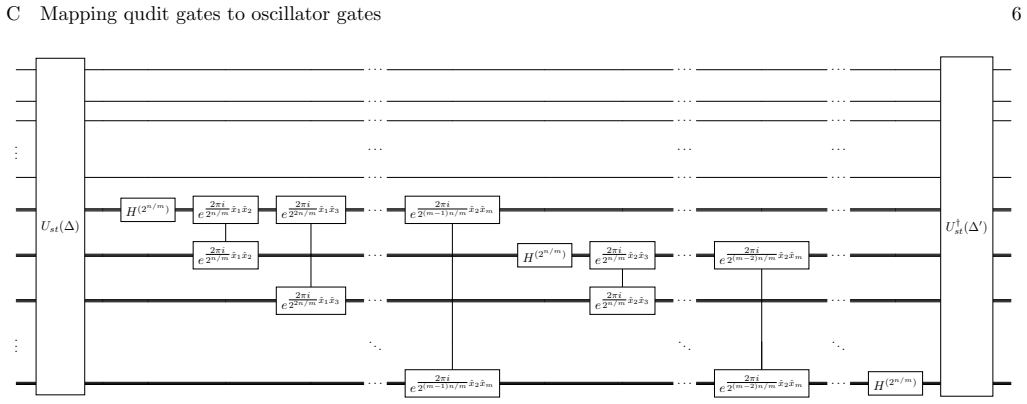
Hadamard gate We first note that the action of the qudit Hadamard in Eq.(30) is the same as the quantum Fourier trans- form on log 2(d) qubits. Implementing the qubit quan- tum Fourier transform on qubits using a single qumode as an ancilla has already been worked out in Ref. [41] We can take inspiration from this protocol to construct the qudit Hadamard ...
-
[2]
Apply a “padding” gateU (j) p (∆) between ana- qubit ancilla register and thejth qumode
-
[3]
Apply a displacement gateD j(− 2n/m+a 2 ∆) to the jth qumode
-
[4]
Apply the free evolution gateF j to thej-th qumode
-
[5]
The purpose of the first step is to make the wave- function periodic with respect tox (j) so that the non- periodic qumode behaves logically like a qudit
Apply an ”anti-padding” gateU (j) ap (∆′) between the jth qumode anda ′ anti-padding qubits. The purpose of the first step is to make the wave- function periodic with respect tox (j) so that the non- periodic qumode behaves logically like a qudit. That is, Ref. [41] found that the free evolution gates gives rise to the Fourier phases with errorO(1/2 a) wh...
-
[6]
Preparea ′ + 1 ancilla qubits as|0⟩ a′+1, wherea ′ = O(log2( ∆ σ ))
-
[7]
Encode information about the sign of the position of the oscillatorxasf(x) = 1 2(1−sgn(x)) into the (a′ + 1)th qubit, where sgn(x) is the sign function
-
[8]
Encode information about| ˜k(j)|into thea ′ anti- padding qubits
-
[9]
Disentangle the qumode from thea ′+1 qubits using a sequence of double-controlled displacement gates. The final state after applying the anti-padding gate is shown in Appendix A 1 to be of the form: 1√ 2n/m 2n/m−1X y(j)=0 e2πiy(j) x(j) /2n/m |y(j),∆ ′⟩ gauss Oj ⊗ | ˜ψfinal⟩Q (35) where| ˜ψf inal⟩is ana ′ + 1-qubit state that can be discarded or re...
-
[10]
back-of-the-envelope
Controlled rotation gate The other qudit gate that we must map onto oscilla- tor gates is the controlled rotation gateR (d) k , whose action on a 2-qudit basis state|x⟩ |y⟩is given by: R(d) k |x⟩ |y⟩=e 2πixy/d k |x⟩ |y⟩.(36) Note that in the qumode case, qudit basis states are encoded into sharply-peaked Gaussian wavepack- ets centered about integer multi...
-
[11]
The runtime of qubit primitive gates is much higher than that of primitive qubit-oscillator hybrid gates (on average)
-
[12]
As a quick illustrative example, we can consider the hypothetical case whereϵ QSP ≈10 −3, in which case ∆ + log2(1/ϵQSP )≈11 when ∆ = 1
The qudit leveldis much smaller than the inverse error 1 ϵ . As a quick illustrative example, we can consider the hypothetical case whereϵ QSP ≈10 −3, in which case ∆ + log2(1/ϵQSP )≈11 when ∆ = 1. Plotting the RHS of Eq. (55) as a function of (d, ϵ) gives us a contour map where the level curves tell us what ratio Tgate,q Tgate,o would be necessary to rea...
2000
-
[13]
Recall from the single-qumode QFT that the free evolution gate only produced the needed action when the qumode state was periodic
F ull derivation of Hadamard gate We begin by noting the similarity of Eq (30) with the qubit QFT operation that was implemented using a free evolution gate for the single-qumode case. Recall from the single-qumode QFT that the free evolution gate only produced the needed action when the qumode state was periodic. A similar statement is true for our curre...
-
[14]
Fidelity bounds on Hadamard gate A single application of the Hadamard gate involves the following steps which each (except the displacement gate step) introduce approximation errors that can be quan- tified:
-
[15]
The application of the padding gate usinga padding qubits which incurs an error ofO(aϵ) for apadding qubits and a QSP error ofϵ
-
[16]
The error-free application of a displacement gate D(2n/m+a−1∆)
-
[17]
The application of the free evolution gate, which incurs an approximation error ofO( 1 2a )
-
[18]
A10 which incurs errorO( σ ∆)
The Gaussian envelope approximation in Eq. A10 which incurs errorO( σ ∆)
-
[19]
Below we show that this incurs an error ofO(erfc( ∆ σ 2a′ )) fora ′ anti-padding qubits
The approximation that Eq A10 can be approxi- mated as a finite sum over ˜k(j). Below we show that this incurs an error ofO(erfc( ∆ σ 2a′ )) fora ′ anti-padding qubits. In order for this error to be on the order of machine epsilon, a good rule of thumb is to choosea ′ =⌈log 2( ∆ σ ) + 1⌉
-
[20]
The errors for the first four of these is given in [41], thus we will start by deriving the error bound of the fifth item
The anti-padding disentangling step which uses an approximate QSP circuit. The errors for the first four of these is given in [41], thus we will start by deriving the error bound of the fifth item. Eq A10 describes the action of this sequence of gates on a single basis state|x (j),∆⟩ gauss Oj . Consider now the action of this gate on a superposition of su...
-
[21]
Smith, Eleanor Crane, John M
Yuan Liu, Shraddha Singh, Kevin C. Smith, Eleanor Crane, John M. Martyn, Alec Eickbusch, Alexander Schuckert, Richard D. Li, Jasmine Sinanan-Singh, Miche- line B. Soley, Takahiro Tsunoda, Isaac L. Chuang, Nathan Wiebe, and Steven M. Girvin. Hybrid oscillator- qubit quantum processors: Instruction set architectures, abstract machine models, and application...
-
[22]
Hybrid continuous-discrete-variable quantum computing: a guide to utility,
AF Kemper, Antonios Alvertis, Muhammad Asaduz- zaman, Bojko N Bakalov, Dror Baron, Joel Bierman, Blake Burgstahler, Srikar Chundury, Elin Ranjan Das, Jim Furches, et al. Hybrid continuous-discrete-variable quantum computing: a guide to utility.arXiv preprint arXiv:2511.13882, 2025
-
[23]
Using bosons to improve resource efficiency of quantum simulation of vibronic molecular dynamics
Henry L Nourse, Vanessa C Olaya-Agudelo, and Ivan Kassal. Using bosons to improve resource efficiency of quantum simulation of vibronic molecular dynamics. arXiv preprint arXiv:2512.20828, 2025
-
[24]
Braunstein and Peter van Loock
Samuel L. Braunstein and Peter van Loock. Quantum in- formation with continuous variables.Reviews of Modern Physics, 77(2):513–577, June 2005. Publisher: American Physical Society
2005
-
[25]
MacDonell, Christophe H
Tomas Navickas, Ryan J. MacDonell, Christophe H. Valahu, Vanessa C. Olaya-Agudelo, Frank Scuccimarra, Maverick J. Millican, Vassili G. Matsos, Henry L. Nourse, Arjun D. Rao, Michael J. Biercuk, Cornelius Hempel, Ivan Kassal, and Ting Rei Tan. Experimental Quantum Simulation of Chemical Dynamics.Journal of the Amer- ican Chemical Society, 147(27):23566–235...
2025
-
[26]
MacDonell
Jong-Kwon Ha and Ryan J. MacDonell. Analog quan- tum simulation of coupled electron-nuclear dynamics in molecules.Chemical Science, 16(41):19423–19435, Octo- ber 2025. Publisher: The Royal Society of Chemistry. 22
2025
-
[27]
Fault-tolerant quantum computation with high threshold in two dimen- sions
Robert Raussendorf and Jim Harrington. Fault-tolerant quantum computation with high threshold in two dimen- sions. 98(19):190504. Publisher: American Physical So- ciety
-
[28]
Fowler, Ashley M
Austin G. Fowler, Ashley M. Stephens, and Peter Groszkowski. High-threshold universal quantum com- putation on the surface code. 80(5):052312. Publisher: American Physical Society
-
[29]
Fowler, Matteo Mariantoni, John M
Austin G. Fowler, Matteo Mariantoni, John M. Martinis, and Andrew N. Cleland. Surface codes: Towards practi- cal large-scale quantum computation. 86(3):032324. Pub- lisher: American Physical Society
-
[30]
Steven M. Girvin. Introduction to quantum error correc- tion and fault tolerance. page 70
-
[31]
Fowler, Simon Devitt, and Rodney Van Meter
Clare Horsman, Austin G. Fowler, Simon Devitt, and Rodney Van Meter. Surface code quantum computing by lattice surgery. 14(12):123011. Publisher: IOP Pub- lishing
-
[32]
Cross, Jay M
Sergey Bravyi, Andrew W. Cross, Jay M. Gambetta, Dmitri Maslov, Patrick Rall, and Theodore J. Yoder. High-threshold and low-overhead fault-tolerant quantum memory. 627(8005):778–782. Publisher: Nature Publish- ing Group
-
[33]
A game of surface codes: Large-scale quantum computing with lattice surgery
Daniel Litinski. A game of surface codes: Large-scale quantum computing with lattice surgery. 3:128. Pub- lisher: Verein zur F¨ orderung des Open Access Pub- lizierens in den Quantenwissenschaften
-
[34]
En- coding a qubit in an oscillator
Daniel Gottesman, Alexei Kitaev, and John Preskill. En- coding a qubit in an oscillator. 64(1):012310. Publisher: American Physical Society
-
[35]
Closest lattice point decoding for multimode gottesman- kitaev-preskill codes
Mao Lin, Christopher Chamberland, and Kyungjoo Noh. Closest lattice point decoding for multimode gottesman- kitaev-preskill codes. 4(4):040334. Publisher: American Physical Society
-
[36]
Analysis of loss correction with the gottesman-kitaev-preskill code
Jacob Hastrup and Ulrik Lund Andersen. Analysis of loss correction with the gottesman-kitaev-preskill code. 108(5):052413. Publisher: American Physical Society
-
[37]
Grimsmo and Shruti Puri
Arne L. Grimsmo and Shruti Puri. Quantum er- ror correction with the gottesman-kitaev-preskill code. 2(2):020101. Publisher: American Physical Society
-
[38]
Brady, Alec Eickbusch, Shraddha Singh, Jing Wu, and Quntao Zhuang
Anthony J. Brady, Alec Eickbusch, Shraddha Singh, Jing Wu, and Quntao Zhuang. Advances in bosonic quantum error correction with gottesman-kitaev-preskill codes: Theory, engineering and applications. 93:100496
-
[39]
Pair-cat codes: autonomous error-correction with low-order nonlinearity
Victor V Albert, Shantanu O Mundhada, Alexander Grimm, Steven Touzard, Michel H Devoret, and Liang Jiang. Pair-cat codes: autonomous error-correction with low-order nonlinearity. 4(3):035007. Publisher: IOP Pub- lishing
-
[40]
P. T. Cochrane, G. J. Milburn, and W. J. Munro. Macroscopically distinct quantum-superposition states as a bosonic code for amplitude damping. 59(4):2631–2634. Publisher: American Physical Society
-
[41]
Fault-tolerant quantum computation by hy- brid qubits with bosonic cat code and single photons
Jaehak Lee. Fault-tolerant quantum computation by hy- brid qubits with bosonic cat code and single photons. 5(3)
-
[42]
Victor V. Albert. Bosonic coding: introduction and use cases
-
[43]
V. V. Sivak, A. Eickbusch, B. Royer, S. Singh, I. Tsiout- sios, S. Ganjam, A. Miano, B. L. Brock, A. Z. Ding, L. Frunzio, S. M. Girvin, R. J. Schoelkopf, and M. H. De- voret. Real-time quantum error correction beyond break- even. 616(7955):50–55. Publisher: Nature Publishing Group
-
[44]
Brock, Shraddha Singh, Alec Eickbusch, Volodymyr V
Benjamin L. Brock, Shraddha Singh, Alec Eickbusch, Volodymyr V. Sivak, Andy Z. Ding, Luigi Frunzio, Steven M. Girvin, and Michel H. Devoret. Quantum error correction of qudits beyond break-even. 641(8063):612–
-
[46]
Nielsen and Isaac L
Michael A. Nielsen and Isaac L. Chuang.Quantum Com- putation and Quantum Information: 10th Anniversary Edition. Cambridge University Press, 2010
2010
-
[47]
Approxi- mate quantum fourier transform with o(n log(n)) t gates
Yunseong Nam, Yuan Su, and Dmitri Maslov. Approxi- mate quantum fourier transform with o(n log(n)) t gates. 6(1):1–6. Publisher: Nature Publishing Group
-
[48]
Gregory D Kahanamoku-Meyer, John Blue, Thiago Bergamaschi, Craig Gidney, and Isaac L Chuang. A log-depth in-place quantum fourier transform that rarely needs ancillas.arXiv preprint arXiv:2505.00701, 2025
-
[49]
Don Coppersmith. An approximate fourier transform useful in quantum factoring.arXiv preprint quant- ph/0201067, 2002
-
[50]
Quantum- Fourier-transform-based quantum arithmetic with qu- dits.Physical Review A, 103(3):032417, March 2021
Archimedes Pavlidis and Emmanuel Floratos. Quantum- Fourier-transform-based quantum arithmetic with qu- dits.Physical Review A, 103(3):032417, March 2021
2021
-
[51]
O’Brien, Akira Furusawa, and Jelena Vuˇ ckovi´ c
Jeremy L. O’Brien, Akira Furusawa, and Jelena Vuˇ ckovi´ c. Photonic quantum technologies. 3(12):687–
-
[52]
Publisher: Nature Publishing Group
-
[53]
Recent progress in quantum photonic chips for quantum communication and internet
Wei Luo, Lin Cao, Yuzhi Shi, Lingxiao Wan, Hui Zhang, Shuyi Li, Guanyu Chen, Yuan Li, Sijin Li, Yunxiang Wang, Shihai Sun, Muhammad Faeyz Karim, Hong Cai, Leong Chuan Kwek, and Ai Qun Liu. Recent progress in quantum photonic chips for quantum communication and internet. 12(1):175. Publisher: Nature Publishing Group
-
[54]
Ralph, Jelmer J
Hui Wang, Timothy C. Ralph, Jelmer J. Renema, Chao- Yang Lu, and Jian-Wei Pan. Scalable photonic quantum technologies. 24(12):1883–1897. Publisher: Nature Pub- lishing Group
-
[55]
Continuous-variable quantum repeaters based on bosonic error-correction and teleportation: architecture and ap- plications
Bo-Han Wu, Zheshen Zhang, and Quntao Zhuang. Continuous-variable quantum repeaters based on bosonic error-correction and teleportation: architecture and ap- plications. 7(2):025018. Publisher: IOP Publishing
-
[56]
Arquin: Architectures for multinode super- conducting quantum computers.ACM Transactions on Quantum Computing, 5(3), September 2024
James Ang, Gabriella Carini, Yanzhu Chen, Isaac Chuang, Michael Demarco, Sophia Economou, Alec Eickbusch, Andrei Faraon, Kai-Mei Fu, Steven Girvin, Michael Hatridge, Andrew Houck, Paul Hilaire, Kevin Krsulich, Ang Li, Chenxu Liu, Yuan Liu, Margaret Martonosi, David McKay, Jim Misewich, Mark Ritter, Robert Schoelkopf, Samuel Stein, Sara Sussman, Hong Tang,...
2024
-
[57]
Akhtar, F
M. Akhtar, F. Bonus, F. R. Lebrun-Gallagher, N. I. John- son, M. Siegele-Brown, S. Hong, S. J. Hile, S. A. Kul- miya, S. Weidt, and W. K. Hensinger. A high-fidelity quantum matter-link between ion-trap microchip mod- ules. 14(1):531. Publisher: Nature Publishing Group
-
[58]
Stute, B
A. Stute, B. Casabone, B. Brandst¨ atter, K. Friebe, T. E. Northup, and R. Blatt. Quantum-state transfer from an ion to a photon. 7(3):219–222. Publisher: Nature Pub- lishing Group
-
[59]
D. Main, P. Drmota, D. P. Nadlinger, E. M. Ainley, A. Agrawal, B. C. Nichol, R. Srinivas, G. Araneda, and D. M. Lucas. Distributed quantum computing across an optical network link. 638(8050):383–388. Publisher: Na- 23 ture Publishing Group
-
[60]
Eisert, K
J. Eisert, K. Jacobs, P. Papadopoulos, and M. B. Ple- nio. Optimal local implementation of nonlocal quantum gates.Phys. Rev. A, 62:052317, Oct 2000
2000
-
[61]
Transversal Fault Tolerant Distributed Quantum Computing Operations
John Stack, Ming Wang, and Frank Mueller. Assess- ing teleportation of logical qubits in a distributed quan- tum architecture under error correction.arXiv preprint arXiv:2504.05611, 2025
work page internal anchor Pith review Pith/arXiv arXiv 2025
-
[62]
Pablo Bonilla Ataides, Hengyun Zhou, Qian Xu, Gefen Baranes, Bikun Li, Mikhail D
J. Pablo Bonilla Ataides, Hengyun Zhou, Qian Xu, Gefen Baranes, Bikun Li, Mikhail D. Lukin, and Liang Jiang. Constant-overhead fault-tolerant bell-pair distillation us- ing high-rate codes.Phys. Rev. Lett., 135:130804, Sep 2025
2025
-
[63]
Martyn, Jasmine Sinanan-Singh, Kevin C
Yuan Liu, John M. Martyn, Jasmine Sinanan-Singh, Kevin C. Smith, Steven M. Girvin, and Isaac L. Chuang. Toward mixed analog-digital quantum signal processing: Quantum AD/DA conversion and the fourier transform. pages 1–15
-
[64]
Grand unification of quantum algo- rithms.PRX Quantum, 2(4):040203, 2021
John M Martyn, Zane M Rossi, Andrew K Tan, and Isaac L Chuang. Grand unification of quantum algo- rithms.PRX Quantum, 2(4):040203, 2021
2021
-
[65]
Rossi and Isaac L
Zane M. Rossi and Isaac L. Chuang. Multivariable quantum signal processing (m-QSP): prophecies of the two-headed oracle. 6:811. Publisher: Verein zur F¨ orderung des Open Access Publizierens in den Quan- tenwissenschaften
-
[66]
Martyn, Yuan Liu, Zachary E
John M. Martyn, Yuan Liu, Zachary E. Chin, and Isaac L. Chuang. Efficient fully-coherent quantum signal processing algorithms for real-time dynamics simulation. 158(2):024106
-
[67]
Guang Hao Low and Isaac L. Chuang. Optimal hamiltonian simulation by quantum signal processing. 118(1):010501. Publisher: American Physical Society
-
[68]
Joven, Elin Ranjan Das, Joel Bierman, Aish- warya Majumdar, Masoud Hakimi Heris, and Yuan Liu
Kevin J. Joven, Elin Ranjan Das, Joel Bierman, Aish- warya Majumdar, Masoud Hakimi Heris, and Yuan Liu. Scalable quantum computational science: A perspective from block-encodings and polynomial transformations. 2(1):010901
-
[69]
Lin Lin. Mathematical and numerical analysis of quan- tum signal processing.arXiv preprint arXiv:2510.00443, 2025
-
[70]
Quantum singular value transformation and be- yond: exponential improvements for quantum matrix arithmetics
Andr´ as Gily´ en, Yuan Su, Guang Hao Low, and Nathan Wiebe. Quantum singular value transformation and be- yond: exponential improvements for quantum matrix arithmetics. InProceedings of the 51st Annual ACM SIGACT Symposium on Theory of Computing, STOC 2019, pages 193–204. Association for Computing Machin- ery
2019
-
[71]
Optimal polynomial based quan- tum eigenstate filtering with application to solving quan- tum linear systems
Lin Lin and Yu Tong. Optimal polynomial based quan- tum eigenstate filtering with application to solving quan- tum linear systems. 4:361. Publisher: Verein zur F¨ orderung des Open Access Publizierens in den Quan- tenwissenschaften
-
[72]
Universal unitary trans- fer of continuous-variable quantum states into a few qubits.Phys
Jacob Hastrup, Kimin Park, Jonatan Bohr Brask, Radim Filip, and Ulrik Lund Andersen. Universal unitary trans- fer of continuous-variable quantum states into a few qubits.Phys. Rev. Lett., 128:110503, Mar 2022
2022
-
[73]
Neill Lambert, Eric Gigu‘ere, Paul Menczel, Boxi Li, Patrick Hopf, Gerardo Su’arez, Marc Gali, Jake Lish- man, Rushiraj Gadhvi, Rochisha Agarwal, Asier Galicia, Nathan Shammah, Paul Nation, J. R. Johansson, Shah- nawaz Ahmed, Simon Cross, Alexander Pitchford, and Franco Nori. Qutip 5: The quantum toolbox in Python. Physics Reports, 1153:1–62, 2026
2026
-
[74]
Bennett, Gilles Brassard, Sandu Popescu, Benjamin Schumacher, John A
Charles H. Bennett, Gilles Brassard, Sandu Popescu, Benjamin Schumacher, John A. Smolin, and William K. Wootters. Purification of noisy entanglement and faith- ful teleportation via noisy channels.Phys. Rev. Lett., 76:722–725, Jan 1996
1996
-
[75]
Stafford and Nicolas C
Matthew P. Stafford and Nicolas C. Menicucci. Biased gottesman-kitaev-preskill repetition code. 108(5):052428
discussion (0)
Sign in with ORCID, Apple, or X to comment. Anyone can read and Pith papers without signing in.