Dynamical signatures of conventional and asymptotic quantum many-body scars on a trapped ion simulator
Pith reviewed 2026-05-10 15:22 UTC · model grok-4.3
The pith
Asymptotic quantum many-body scars thermalize more slowly as system size increases in ion-trap experiments.
A machine-rendered reading of the paper's core claim, the machinery that carries it, and where it could break.
Core claim
In the chosen 2-local model that hosts both conventional and asymptotic scars, the asymptotic quantum many-body scars are gapless excitations of a localization transition. These states are prepared efficiently on the processor and, under Floquet driving, exhibit thermalization timescales that increase with qubit number up to N = 20.
What carries the argument
Asymptotic quantum many-body scars realized as gapless excitations of a ground-state localization transition, prepared via their structure in logarithmic-depth circuits on an all-to-all connected processor.
If this is right
- Thermalization times for asymptotic scars grow with system size, allowing longer-lived nonthermal states in larger simulators.
- Conventional and asymptotic scars can be told apart by whether their thermalization rate slows or stays constant with added particles.
- Logarithmic-depth preparation makes these states accessible for scalable quantum simulation on all-to-all processors.
- Model parameters can be tuned to favor asymptotic over conventional scar behavior.
Where Pith is reading between the lines
- If the size-dependent slowdown persists, asymptotic scars could provide a route to scalable long-lived states for quantum memory or simulation.
- The connection to localization transitions implies similar scar behavior may exist in other models that host ground-state phase transitions.
- Repeating the protocol on different hardware or with varied interaction ranges would test whether the observed trend is platform-independent.
Load-bearing premise
The prepared states accurately realize the theoretical asymptotic scars and the measured slowdown in thermalization is produced by the scar mechanism rather than noise or finite-size artifacts.
What would settle it
An experiment on the same model that finds thermalization time stopping its increase or beginning to decrease once qubit number exceeds 20 would falsify the asymptotic-scar interpretation.
Figures




read the original abstract
One of the promising applications of digital quantum processors is the simulation of many-body quantum systems. They have been already used to investigate several ergodicity violating mechanisms, which were initially discovered in synthetic quantum matter, such as many-body localisation, Hilbert space fragmentation and quantum many-body scars (QMBS). In addition to conventional QMBS, a recently discovered mechanism for ergodicity violation are the so-called asymptotic quantum many-body scars (AQMBS). These become more stable as system size is increased, leading to progressively longer thermalisation timescales. In this work, we show a connection between gapless excitations and AQMBS in certain qudit-based models. We then consider a 2-local model, hosting both conventional and asymptotic scars, in which the AQMBS states are gapless excitations of a ground state localisation transition. By exploiting the structure of the found AQMBS states and the all-to-all connectivity of the Quantinuum H1-1 quantum processor, we prepare these states in logarithmic circuit depth, and probe their thermalisation behaviour under Floquet dynamics. Performing simulations on up to N = 20 qubits and up to 418 entangling ZZ gates, we find slower thermalisation times as the system size is increased, providing the first experimental signatures of asymptotic scars.
Editorial analysis
A structured set of objections, weighed in public.
Referee Report
Summary. The manuscript establishes a theoretical link between gapless excitations and asymptotic quantum many-body scars (AQMBS) in certain qudit models, then experimentally implements a 2-local model containing both conventional QMBS and AQMBS on the Quantinuum H1-1 trapped-ion processor. Exploiting all-to-all connectivity, the authors prepare the AQMBS states in logarithmic circuit depth and evolve them under Floquet dynamics, reporting data for system sizes up to N=20 qubits using circuits with as many as 418 ZZ entangling gates. The central experimental result is an observed increase in thermalization timescales with growing N, presented as the first experimental signatures of the asymptotic scar mechanism.
Significance. If the size-dependent slowdown is shown to originate from the AQMBS subspace rather than finite-size effects or hardware noise, the result would be significant: it would furnish the first hardware demonstration of an ergodicity-violating mechanism whose stability improves with system size, and it would illustrate how all-to-all connectivity can be leveraged for efficient preparation of non-thermal states. The concrete resource counts (N=20, 418 gates) and the explicit connection drawn between AQMBS and a localization transition are also useful for guiding future digital quantum simulations of many-body scarring.
major comments (3)
- [Abstract / Experimental results] Abstract and experimental results section: the headline claim that thermalization slows with increasing N is load-bearing, yet the manuscript provides no direct comparison of the measured decay rates (or any other dynamical observable) against the ideal, noiseless Floquet evolution of the same 2-local Hamiltonian at each N. Without this benchmark it remains unclear whether the reported trend is produced by the gapless AQMBS excitations or by N-dependent accumulation of coherent and incoherent errors in the 418-gate circuits.
- [State preparation] State-preparation subsection: the attribution of the observed dynamics to AQMBS requires that the prepared states have high overlap with the theoretical asymptotic-scar subspace. No state fidelity, overlap, or post-selection metrics are reported for the N=20 instances; this omission prevents a quantitative assessment of whether the prepared states are faithful realizations of the gapless excitations of the localization transition rather than conventional scar remnants or other states.
- [Discussion] Discussion or supplementary material: the manuscript does not present a control experiment or numerical test in which the putative AQMBS subspace is deliberately suppressed (e.g., by a small perturbation that lifts the gapless modes) while keeping all other parameters fixed. Such a control would be necessary to isolate the asymptotic-scar mechanism from generic finite-size or 1/N corrections.
minor comments (2)
- [Abstract] Abstract: the sentence 'Performing simulations on up to N = 20 qubits' is potentially misleading because the work is performed on a physical quantum processor; rephrasing to 'Performing quantum simulations' or 'Executing circuits' would improve clarity.
- [Abstract] Notation: ensure that the abbreviation AQMBS is defined at first use and then used consistently; the abstract introduces both 'asymptotic quantum many-body scars (AQMBS)' and 'asymptotic scars' without subsequent standardization.
Simulated Author's Rebuttal
We thank the referee for their careful reading of our manuscript and for the constructive comments. We address each major point below and describe the revisions that will be made.
read point-by-point responses
-
Referee: [Abstract / Experimental results] Abstract and experimental results section: the headline claim that thermalization slows with increasing N is load-bearing, yet the manuscript provides no direct comparison of the measured decay rates (or any other dynamical observable) against the ideal, noiseless Floquet evolution of the same 2-local Hamiltonian at each N. Without this benchmark it remains unclear whether the reported trend is produced by the gapless AQMBS excitations or by N-dependent accumulation of coherent and incoherent errors in the 418-gate circuits.
Authors: We agree that a direct benchmark against ideal, noiseless Floquet evolution is necessary to isolate the contribution of the AQMBS mechanism from hardware noise. In the revised manuscript we will add comparisons of the experimental decay rates and other dynamical observables to numerical simulations of the ideal 2-local Floquet dynamics at each system size. These ideal simulations will be presented alongside the experimental data in the results section and supplementary material. revision: yes
-
Referee: [State preparation] State-preparation subsection: the attribution of the observed dynamics to AQMBS requires that the prepared states have high overlap with the theoretical asymptotic-scar subspace. No state fidelity, overlap, or post-selection metrics are reported for the N=20 instances; this omission prevents a quantitative assessment of whether the prepared states are faithful realizations of the gapless excitations of the localization transition rather than conventional scar remnants or other states.
Authors: We acknowledge that quantitative fidelity metrics are required for a rigorous attribution to the AQMBS subspace. For system sizes up to N=10 we have computed overlaps with the theoretical AQMBS states via exact diagonalization; these will be reported in the revised state-preparation subsection. For N=20 we will add an error-budget analysis based on the logarithmic-depth circuit and the known gate-error rates of the H1-1 processor, together with any available post-selection statistics from the experimental runs. revision: yes
-
Referee: [Discussion] Discussion or supplementary material: the manuscript does not present a control experiment or numerical test in which the putative AQMBS subspace is deliberately suppressed (e.g., by a small perturbation that lifts the gapless modes) while keeping all other parameters fixed. Such a control would be necessary to isolate the asymptotic-scar mechanism from generic finite-size or 1/N corrections.
Authors: We agree that an explicit control isolating the gapless AQMBS modes is valuable. In the revised manuscript we will include numerical simulations in which a small perturbation is added to lift the gapless excitations while preserving the rest of the Hamiltonian; the resulting faster thermalization will be shown in the discussion section and supplementary material to demonstrate that the observed size-dependent slowdown is tied to the AQMBS subspace. revision: yes
Circularity Check
No circularity: experimental signatures rest on direct measurements, not self-referential derivations.
full rationale
The paper is an experimental study on the Quantinuum H1-1 processor. It prepares candidate AQMBS states in logarithmic depth using all-to-all connectivity and measures their Floquet evolution up to N=20 and 418 ZZ gates, reporting size-dependent slowdown in thermalization. The theoretical sections identify AQMBS as gapless excitations of a localization transition in a 2-local qudit model, but this identification is used only to motivate state preparation and does not generate any 'prediction' that is fitted to the same data or reduced by construction to the input ansatz. No self-citation chain is load-bearing for the central claim, and the experimental observables (decay rates versus N) are independent of any internal fitting loop. The derivation chain is therefore self-contained against external hardware benchmarks.
Axiom & Free-Parameter Ledger
Reference graph
Works this paper leans on
-
[1]
For the|0⟩ ⊗N state the data forN= 20 is the same as already used forN= 8 and 12 (which were run in parallel), atT= 0
-
[2]
For the|1⟩ ⊗N state the data forN= 20 is the same as already used forN= 8 and 12 (which were run in parallel), atT= 0
-
[3]
For the|1⟩ ⊗ |0⟩ ⊗N−1 state we reused the data for allgvalues atT= 0. C. Classical Methods The results presented in the main text, obtained via classical methods, were computed either by exact brute force methods implemented in Python’s numpy library [45], for system sizes up toN= 12, whereas for greater system sizes, the Julia package ITensor was used [4...
-
[4]
C. S. Adams, J. D. Pritchard, and J. P. Shaffer, Ry- dberg atom quantum technologies, Journal of Physics B: Atomic, Molecular and Optical Physics53, 012002 (2019)
work page 2019
-
[5]
M. Kjaergaard, M. E. Schwartz, J. Braum¨ uller, P. Krantz, J. I.-J. Wang, S. Gustavsson, and W. D. Oliver, Superconducting qubits: Current state of play, Annual Review of Condensed Matter Physics11, 369 (2020)
work page 2020
-
[6]
M. Foss-Feig, G. Pagano, A. C. Potter, and N. Y. Yao, Progress in trapped-ion quantum simulation (2024), arXiv:2409.02990 [quant-ph]
-
[7]
T. Mori, T. N. Ikeda, E. Kaminishi, and M. Ueda, Ther- malization and prethermalization in isolated quantum systems: a theoretical overview, J. Phys. B51, 112001 (2018)
work page 2018
-
[8]
B. Fauseweh, Quantum many-body simulations on digi- tal quantum computers: State-of-the-art and future chal- lenges, Nature Communications15, 2123 (2024)
work page 2024
-
[9]
L. E. Fischer, M. Leahy, A. Eddins, N. Keenan, D. Fer- racin, M. A. C. Rossi, Y. Kim, A. He, F. Pietracap- rina, B. Sokolov, S. Dooley, Z. Zimbor´ as, F. Tacchino, S. Maniscalco, J. Goold, G. Garc´ ıa-P´ erez, I. Tavernelli, A. Kandala, and S. N. Filippov, Dynamical simulations of many-body quantum chaos on a quantum computer, Nature Physics (2026)
work page 2026
- [10]
-
[11]
C. J. Turner, A. A. Michailidis, D. A. Abanin, M. Serbyn, and Z. Papi´ c, Weak ergodicity breaking from quantum many-body scars, Nat. Phys.14, 745 (2018)
work page 2018
-
[12]
S. Dooley, Robust quantum sensing in strongly interact- ing systems with many-body scars, PRX Quantum2, 020330 (2021)
work page 2021
-
[13]
S. Moudgalya, B. A. Bernevig, and N. Regnault, Quan- tum many-body scars and hilbert space fragmentation: a review of exact results, Reports on Progress in Physics 85, 086501 (2022)
work page 2022
-
[14]
A. Chandran, T. Iadecola, V. Khemani, and R. Moess- ner, Quantum many-body scars: A quasiparticle perspec- tive, Annual Review of Condensed Matter Physics14, 443 (2023)
work page 2023
-
[15]
L. Logari´ c, S. Dooley, S. Pappalardi, and J. Goold, Quan- tum many-body scars in dual-unitary circuits, Physical Review Letters132(2024)
work page 2024
-
[16]
H. Bernien, S. Schwartz, A. Keesling, H. Levine, A. Om- ran, H. Pichler, S. Choi, A. S. Zibrov, M. Endres, M. Greiner, V. Vuleti´ c, and M. D. Lukin, Probing many- body dynamics on a 51-atom quantum simulator, Nature 551, 579 EP (2017)
work page 2017
-
[17]
D. Bluvstein, A. Omran, H. Levine, A. Keesling, G. Se- meghini, S. Ebadi, T. T. Wang, A. A. Michailidis, N. Maskara, W. W. Ho, S. Choi, M. Serbyn, M. Greiner, V. Vuleti´ c, and M. D. Lukin, Controlling quantum many- body dynamics in driven Rydberg atom arrays, Science 371, 1355 (2021)
work page 2021
-
[18]
G.-X. Su, H. Sun, A. Hudomal, J.-Y. Desaules, Z.-Y. Zhou, B. Yang, J. C. Halimeh, Z.-S. Yuan, Z. Papi´ c, and J.-W. Pan, Observation of many-body scarring in a bose- hubbard quantum simulator, Phys. Rev. Res.5, 023010 (2023)
work page 2023
-
[19]
L. Zhao, P. R. Datla, W. Tian, M. M. Aliyu, and H. Loh, Observation of quantum thermalization restricted to hilbert space fragments and𭟋 2k scars, Phys. Rev. X15, 011035 (2025)
work page 2025
-
[20]
P. Zhang, H. Dong, Y. Gao, L. Zhao, J. Hao, J.-Y. De- saules, Q. Guo, J. Chen, J. Deng, B. Liu, W. Ren, Y. Yao, X. Zhang, S. Xu, K. Wang, F. Jin, X. Zhu, B. Zhang, H. Li, C. Song, Z. Wang, F. Liu, Z. Papi´ c, L. Ying, H. Wang, and Y.-C. Lai, Many-body hilbert space scar- ring on a superconducting processor, Nature Physics19, 120 (2023)
work page 2023
- [21]
- [22]
- [23]
-
[24]
M. Schecter and T. Iadecola, Weak ergodicity breaking and quantum many-body scars in spin-1 magnets, Phys- ical Review Letters123(2019)
work page 2019
-
[25]
S. Chattopadhyay, H. Pichler, M. D. Lukin, and W. W. Ho, Quantum many-body scars from virtual entangled pairs, Physical Review B101(2020)
work page 2020
- [26]
-
[27]
S. Dooley and G. Kells, Extreme many-body scarring in a quantum spin chain via weak dynamical constraints, Phys. Rev. B105, 155127 (2022)
work page 2022
-
[28]
P. G. Larsen, A. E. B. Nielsen, A. Eckardt, and F. Pe- tiziol, Experimental protocol for observing single quan- tum many-body scars with transmon qubits, SciPost Phys.20, 036 (2026)
work page 2026
-
[29]
N. Shiraishi and T. Mori, Systematic construction of counterexamples to the eigenstate thermalization hy- pothesis, Physical Review Letters119(2017). 9
work page 2017
-
[30]
S. Moudgalya, E. O’Brien, B. A. Bernevig, P. Fendley, and N. Regnault, Large classes of quantum scarred hamil- tonians from matrix product states, Phys. Rev. B102, 085120 (2020)
work page 2020
-
[31]
P. G. Larsen and A. E. B. Nielsen, Phase transitions in quantum many-body scars, Physical Review Research6 (2024)
work page 2024
-
[32]
S. Moudgalya and O. I. Motrunich, Symmetries as ground states of local superoperators: Hydrodynamic implica- tions, PRX Quantum5, 040330 (2024)
work page 2024
-
[33]
[19?, 20], which provided alternative constructions of models host- ing AQMBS
We note that the general theoretical framework of The- orem 2 complements the results of Refs. [19?, 20], which provided alternative constructions of models host- ing AQMBS
-
[34]
L. Mandelstam and I. Tamm, The uncertainty relation between energy and time in nonrelativistic quantum me- chanics, J. Phys. (USSR)9, 249 (1945)
work page 1945
-
[35]
S. Bachmann and B. Nachtergaele, Product vacua with boundary states, Phys. Rev. B86, 035149 (2012)
work page 2012
-
[36]
S. Bravyi and D. Gosset, Gapped and gapless phases of frustration-free spin-1/2 chains, Journal of Mathematical Physics56, 061902 (2015)
work page 2015
-
[37]
quantinuum.com/(2025), october 3–8, 2025
Quantinuum, Quantinuum H1-1,https://www. quantinuum.com/(2025), october 3–8, 2025
work page 2025
-
[38]
Quantinuum, Quantinuum system model h1 product data sheet,https://quantinuum.co.jp/assets/pdf/ system_model_h1_product_data_sheet.pdf(2023), ver- sion 5.20.©2023 by Quantinuum. All rights reserved
work page 2023
-
[39]
S. Bachmann, E. Hamza, B. Nachtergaele, and A. Young, Product vacua and boundary state models ind- dimensions, Journal of Statistical Physics160, 636 (2015)
work page 2015
-
[40]
S. Mohapatra, S. Moudgalya, and A. C. Balram, Unrav- eling additional quantum many-body scars of the spin-1 xymodel with fock-space cages and commutant algebras (2025), arXiv:2511.14878 [cond-mat.str-el]
-
[41]
S. T. Flammia and Y.-K. Liu, Direct fidelity estimation from few pauli measurements, Physical Review Letters 106(2011)
work page 2011
-
[42]
T. Brydges, A. Elben, P. Jurcevic, B. Vermersch, C. Maier, B. P. Lanyon, P. Zoller, R. Blatt, and C. F. Roos, Probing r´ enyi entanglement entropy via random- ized measurements, Science364, 260 (2019)
work page 2019
-
[43]
O. Salberger and V. Korepin, Fredkin spin chain (2016), arXiv:1605.03842 [quant-ph]
work page Pith review arXiv 2016
-
[44]
R. Movassagh and P. W. Shor, Supercritical en- tanglement in local systems: Counterexample to the area law for quantum matter, Proceedings of the National Academy of Sciences113, 13278 (2016), https://www.pnas.org/doi/pdf/10.1073/pnas.1605716113
-
[45]
R. Movassagh, The gap of fredkin quantum spin chain is polynomially small, Annals of Mathematical Sciences and Applications3, 531–562 (2018)
work page 2018
-
[46]
D. S. Rokhsar and S. A. Kivelson, Superconductivity and the quantum hard-core dimer gas, Phys. Rev. Lett.61, 2376 (1988)
work page 1988
-
[47]
J. Feldmeier, Y.-J. Liu, M. D. Lukin, and S. Choi, Digital dissipative state preparation for frustration-free gapless quantum systems (2026), arXiv:2603.10119 [quant-ph]
-
[48]
C. R. Harris, K. J. Millman, S. J. van der Walt, R. Gom- mers, P. Virtanen, D. Cournapeau, E. Wieser, J. Tay- lor, S. Berg, N. J. Smith, R. Kern, M. Picus, S. Hoyer, M. H. van Kerkwijk, M. Brett, A. Haldane, J. F. del R´ ıo, M. Wiebe, P. Peterson, P. G´ erard-Marchant, K. Shep- pard, T. Reddy, W. Weckesser, H. Abbasi, C. Gohlke, and T. E. Oliphant, Array ...
work page 2020
-
[49]
M. Fishman, S. R. White, and E. M. Stoudenmire, The ITensor Software Library for Tensor Network Calcula- tions, SciPost Phys. Codebases , 4 (2022)
work page 2022
- [50]
-
[51]
M. van Horssen, E. Levi, and J. P. Garrahan, Dynam- ics of many-body localization in a translation-invariant quantum glass model, Physical Review B92(2015)
work page 2015
-
[52]
N. Pancotti, G. Giudice, J. I. Cirac, J. P. Garrahan, and M. C. Ba˜ nuls, Quantum east model: Localization, non- thermal eigenstates, and slow dynamics, Physical Review X10(2020)
work page 2020
-
[53]
P. Brighi and M. Ljubotina, Anomalous transport in the kinetically constrained quantum east-west model, Physi- cal Review B110(2024). 1 Supplementary Material for “Dynamical signatures of conventional and asymptotic quantum many-body scars on a trapped ion simulator”Leonard Logari´ c, John Goold, Shane Dooley V. PROOF OF THEOREM 2 A. Outline Consider a sy...
work page 2024
-
[54]
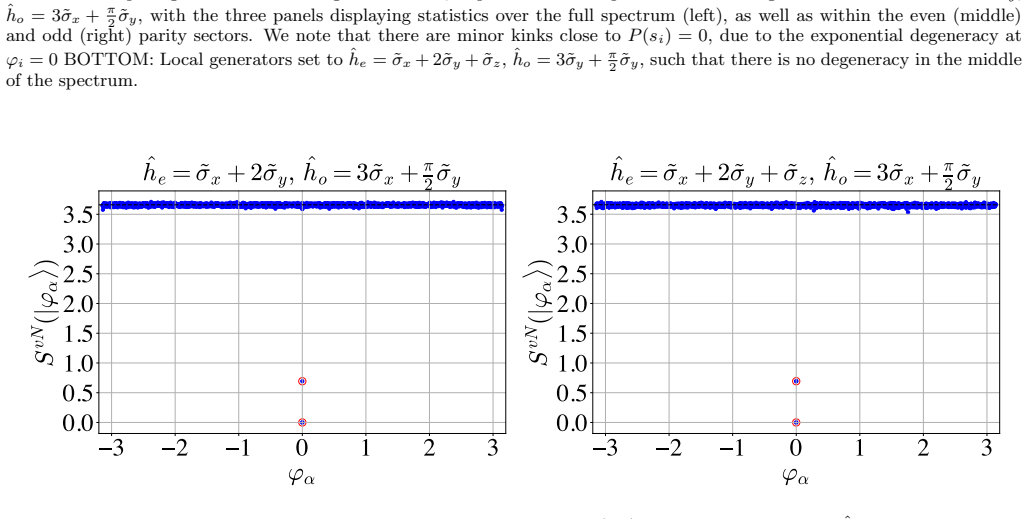
From now on, we will write the local generators in terms of Pauli matrices acting in the{|ψ (g)⟩,|11⟩}subspace: ˜σx =|ψ (g)⟩⟨11|+|11⟩⟨ψ (g)|,˜σy =i|ψ (g)⟩⟨11| −i|11⟩⟨ψ (g)|,˜σz =|ψ (g)⟩⟨ψ(g)| − |11⟩⟨11|, for brevity. Both symmetry subsectors exhibit level spacing statistics in accordance with the Gaussian unitary ensemble, for both sets of probed generato...
discussion (0)
Sign in with ORCID, Apple, or X to comment. Anyone can read and Pith papers without signing in.