Recognition: unknown
Machine learning for four-dimensional SU(3) lattice gauge theories
Pith reviewed 2026-05-10 14:21 UTC · model grok-4.3
The pith
Machine learning produces fixed-point gauge actions that scale to the continuum limit in four-dimensional SU(3) lattice theory.
A machine-rendered reading of the paper's core claim, the machinery that carries it, and where it could break.
Core claim
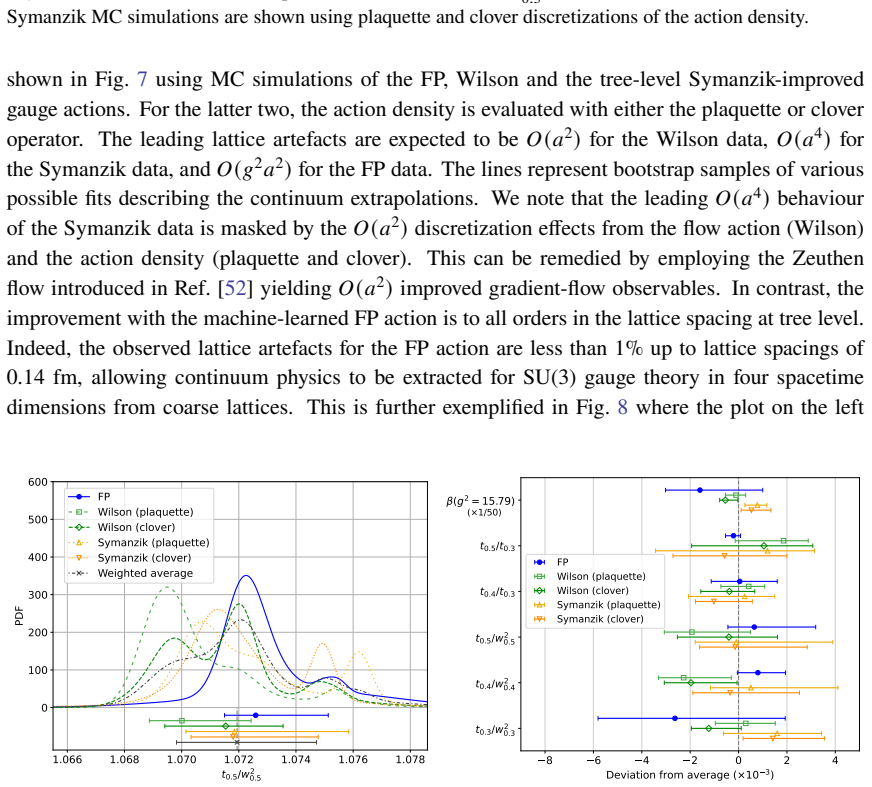
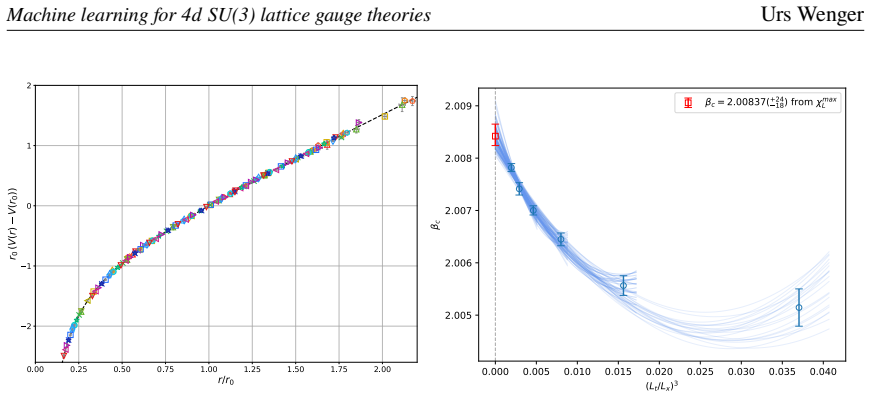
A fixed-point action obtained by training gauge-equivariant convolutional neural networks on renormalization-group transformations yields ensembles whose gradient-flow scales, static potential, and deconfinement observables approach their continuum values without residual tree-level discretization errors, as demonstrated by explicit scaling studies in four-dimensional SU(3) gauge theory.
What carries the argument
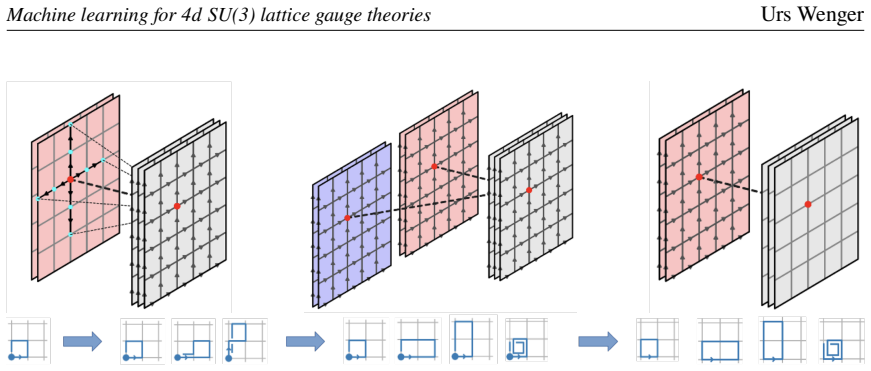
Gauge-equivariant convolutional neural networks that learn renormalization-group improved fixed-point actions, paired with generative models for unbiased configuration sampling.
If this is right
- Continuum extrapolations of physical quantities become feasible with smaller lattice artifacts.
- Autocorrelation times and critical slowing down are reduced, allowing finer lattices to be simulated at comparable cost.
- The same learned-action framework can be applied to other observables and to theories with dynamical fermions.
- Direct comparison of the learned fixed-point action with perturbative and non-perturbative benchmarks becomes a quantitative test of the method.
Where Pith is reading between the lines
- The technique could be extended to full QCD with sea quarks once the pure-gauge case is validated.
- Learned actions might reveal non-perturbative fixed-point structures not captured by conventional blocking schemes.
- Integration with existing lattice QCD codes would allow immediate use in production calculations of hadron spectroscopy or thermodynamics.
Load-bearing premise
The machine-learned fixed-point action and generative models produce unbiased ensembles whose continuum extrapolations are controlled by the stated observables without residual systematic errors from the training procedure or the neural network architecture.
What would settle it
A clear mismatch between the machine-learned action and established continuum results for the gradient-flow scales or the static potential when the lattice spacing is decreased further while keeping physical volume fixed.
Figures




read the original abstract
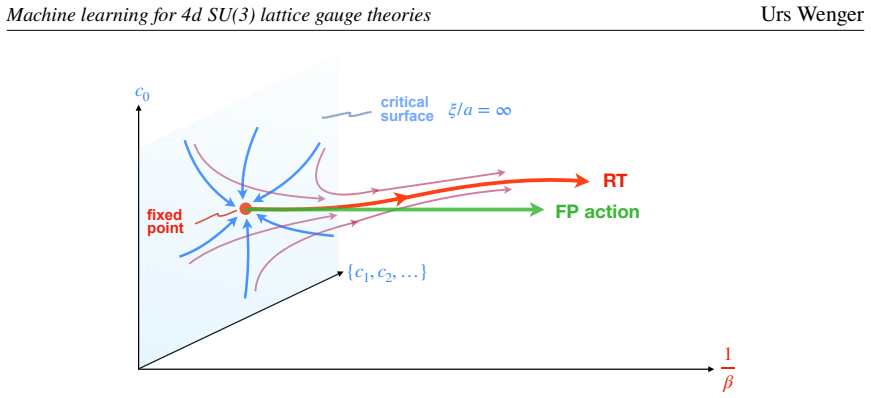
In this review I summarize how machine learning can be used in lattice gauge theory simulations and what ap\-proaches are currently available to improve the sampling of gauge field configurations, with a focus on applications in four-dimensional SU(3) gauge theories. These include approaches based on generative machine-learning models such as (stochastic) normalizing flows and diffusion processes, and an approach based on renormalization group (RG) transformations, more specifically the machine learning of RG-improved gauge actions using gauge-equivariant convolutional neural networks. In particular, I present scaling results for a machine-learned fixed-point action in four-dimensional SU(3) gauge theory towards the continuum limit. The results include observables based on the classically perfect gradient-flow scales, which are free of tree-level lattice artefacts to all orders, and quantities related to the static potential and the deconfinement transition.
Editorial analysis
A structured set of objections, weighed in public.
Referee Report
Summary. The paper reviews machine learning methods for lattice gauge theory simulations in four-dimensional SU(3) gauge theories, covering generative models (normalizing flows, diffusion processes) for configuration sampling and renormalization-group improved actions learned via gauge-equivariant convolutional neural networks. It presents explicit scaling results for a machine-learned fixed-point action, demonstrating controlled continuum extrapolations using classically perfect gradient-flow scales (free of tree-level artifacts to all orders), static-potential observables, and the deconfinement transition.
Significance. If the scaling results hold with controlled systematics, the work demonstrates that ML-derived actions and sampling methods can achieve reliable continuum limits in 4D SU(3) theories, with the choice of classically perfect observables providing a clear advantage in eliminating discretization errors. This strengthens the case for ML techniques as practical tools in lattice QCD simulations.
major comments (2)
- [§4] §4 (scaling results): The continuum extrapolations for the deconfinement transition and static potential rely on the assumption that the machine-learned action produces unbiased ensembles; the manuscript should include a quantitative assessment of residual training biases (e.g., via comparison of autocorrelation times or reweighting factors) to confirm that these do not affect the extrapolated values at the reported precision.
- [§3.2] §3.2 (equivariant CNN architecture): The claim that the learned action approximates a fixed-point action requires explicit verification that the RG transformation converges under iteration; without a demonstration that the learned coupling flow stabilizes (e.g., via a plot of effective couplings after multiple RG steps), the 'fixed-point' designation remains approximate rather than demonstrated.
minor comments (3)
- [Abstract] The abstract states that results are 'free of tree-level lattice artefacts to all orders' but does not specify the lattice spacings or number of ensembles used in the scaling study; adding these details would improve clarity.
- [Figures in §4] Figure captions for the gradient-flow scale plots should include the fit form and goodness-of-fit metrics to allow readers to assess the quality of the continuum extrapolation.
- [§2.3] Notation for the neural-network layers (e.g., the precise definition of gauge-equivariant convolutions) is introduced without a compact summary table; a small table listing layer types, channel dimensions, and activation functions would aid readability.
Simulated Author's Rebuttal
We thank the referee for the careful reading of our manuscript and the constructive comments. We are pleased with the positive assessment of the work and the recommendation for minor revision. We address each major comment below and will update the manuscript accordingly.
read point-by-point responses
-
Referee: [§4] §4 (scaling results): The continuum extrapolations for the deconfinement transition and static potential rely on the assumption that the machine-learned action produces unbiased ensembles; the manuscript should include a quantitative assessment of residual training biases (e.g., via comparison of autocorrelation times or reweighting factors) to confirm that these do not affect the extrapolated values at the reported precision.
Authors: We agree that a quantitative assessment of residual training biases is important to confirm the reliability of the continuum extrapolations. While the current manuscript presents the scaling results under the assumption of unbiased ensembles from the generative models, we will add an explicit analysis in the revised §4. This will include comparisons of autocorrelation times for the gradient-flow scales and static-potential observables, as well as estimates of reweighting factors, to demonstrate that any residual biases do not affect the extrapolated values at the reported precision. revision: yes
-
Referee: [§3.2] §3.2 (equivariant CNN architecture): The claim that the learned action approximates a fixed-point action requires explicit verification that the RG transformation converges under iteration; without a demonstration that the learned coupling flow stabilizes (e.g., via a plot of effective couplings after multiple RG steps), the 'fixed-point' designation remains approximate rather than demonstrated.
Authors: We acknowledge that an explicit demonstration of convergence under iterated RG transformations would strengthen the fixed-point claim. The manuscript supports the approximation through the gauge-equivariant CNN training objective and the observed continuum scaling behavior. To address this directly, we will add to the revised §3.2 a plot of effective couplings after multiple RG steps, along with a discussion showing stabilization of the coupling flow. revision: yes
Circularity Check
No significant circularity in derivation or scaling claims
full rationale
The paper is a review summarizing ML methods for lattice gauge theory in 4D SU(3), covering generative models like normalizing flows and an RG-based approach using gauge-equivariant CNNs to learn improved actions. It presents scaling results for a machine-learned fixed-point action, employing classically perfect gradient-flow scales (free of tree-level artifacts) plus static potential and deconfinement observables for continuum extrapolations. No load-bearing step reduces a claimed prediction or result to a fitted parameter or self-citation by construction; the observables are chosen precisely to control artifacts independently of the training procedure. Self-citations to prior literature on flows and equivariant networks are present but not used to justify uniqueness or force the central scaling demonstrations, which remain empirically grounded and externally falsifiable via the stated observables.
Axiom & Free-Parameter Ledger
Forward citations
Cited by 3 Pith papers
-
Testing machine-learned distributions against Monte Carlo data for the QCD chiral phase transition
Conditional MAFs interpolate QCD chiral phase structure across coupling, mass, and volume, reproducing reweighting while cutting required ensembles despite bias near transitions.
-
Lattice fermion formulation via Physics-Informed Neural Networks: Ginsparg-Wilson relation and Overlap fermions
Physics-informed neural networks construct overlap fermions by optimizing to the Ginsparg-Wilson relation and autonomously discover both the standard and generalized Fujikawa-type versions of the relation.
-
Lattice fermion formulation via Physics-Informed Neural Networks: Ginsparg-Wilson relation and Overlap fermions
Physics-Informed Neural Networks construct lattice Dirac operators satisfying the Ginsparg-Wilson relation, reproducing overlap fermions to high accuracy and discovering a Fujikawa-type generalized relation via algebr...
Reference graph
Works this paper leans on
-
[1]
S. Lawrence,Machine-learning approaches to accelerating lattice simulations,PoS LATTICE2024(2025) 010, [2502.02670]
- [2]
-
[3]
W. Detmold, G. Kanwar, Y. Lin, P. E. Shanahan and M. L. Wagman,Exploring gauge-fixing conditions with gradient-based optimization, in41st International Symposium on Lattice Field Theory, 10, 2024.2410.03602
-
[4]
Wilson loops with neural networks
V. Bellscheidt, N. Brambilla, A. S. Kronfeld and J. Mayer-Steudte,Wilson loops with neural networks,2602.02436
work page internal anchor Pith review Pith/arXiv arXiv
-
[5]
T. Spriggs, E. Greplova, J. Carrasquilla and J. Nys,Accurate Ground States of SU(2) Lattice Gauge Theory in 2+1D and 3+1D,Phys. Rev. Lett.136(2026) 101902, [2509.12323]
-
[6]
Romiti,SU(N) lattice gauge theories with physics-informed neural networks,Phys
S. Romiti,SU(N) lattice gauge theories with physics-informed neural networks,Phys. Rev. D 113(2026) 054511, [2510.26904]
-
[7]
G. Kanwar,Flow-based sampling for lattice field theories, in40th International Symposium on Lattice Field Theory, 1, 2024.2401.01297
- [8]
- [9]
-
[10]
R. Abbott et al.,Gauge-equivariant flow models for sampling in lattice field theories with pseudofermions,Phys. Rev. D106(2022) 074506, [2207.08945]
-
[11]
Abbott, et al., Normalizing flows for lattice gauge theory in arbitrary space-time dimension (2023)
R. Abbott et al.,Normalizing flows for lattice gauge theory in arbitrary space-time dimension,2305.02402
- [12]
- [13]
- [14]
-
[15]
R. Abbott et al.,Aspects of scaling and scalability for flow-based sampling of lattice QCD, Eur. Phys. J. A59(2023) 257, [2211.07541]
-
[16]
C.-H. Lai, Y. Song, D. Kim, Y. Mitsufuji and S. Ermon,The principles of diffusion models, 2025. 15 Machine learning for 4𝑑SU(3) lattice gauge theoriesUrs Wenger
2025
- [17]
-
[18]
K. Fukushima, S. Kamata and Y. Hirono,Stochastic Quantization and Diffusion Models,J. Phys. Soc. Jap.94(2025) 031010, [2411.11297]
- [19]
- [20]
- [21]
-
[22]
A. Lou, M. Xu and S. Ermon,Scaling riemannian diffusion models, 2023
2023
-
[23]
G. Kanwar and O. Vega,Spectral Diffusion for Sampling onSU(𝑁), in42th International Symposium on Lattice Field Theory, 12, 2025.2512.19877
- [24]
-
[25]
H. Alharazin, J. Y. Panteleeva and B. D. Sun,Diffusion Models for SU(2) Lattice Gauge Theory in Two Dimensions,2602.09045
-
[26]
C. Bonanno, A. Nada and D. Vadacchino,Mitigating topological freezing using out-of-equilibrium simulations,JHEP04(2024) 126, [2402.06561]
-
[27]
D. Vadacchino, A. Nada and C. Bonanno,Topological susceptibility of SU(3) pure-gauge theoryfromout-of-equilibriumsimulations,PoSLATTICE2024(2025)415,[2411.00620]
-
[28]
Hasenbusch,Fighting topological freezing in the two-dimensional𝐶𝑃𝑁−1 model,Phys
M. Hasenbusch,Fighting topological freezing in the two-dimensional CPN-1 model,Phys. Rev. D96(2017) 054504, [1706.04443]
-
[29]
C. Bonanno, C. Bonati and M. D’Elia,Large-𝑁 𝑆𝑈(𝑁)Yang-Mills theories with milder topological freezing,JHEP03(2021) 111, [2012.14000]
-
[30]
Jarzynski,Nonequilibrium equality for free energy differences,Phys
C. Jarzynski,Nonequilibrium equality for free energy differences,Phys. Rev. Lett.78(Apr,
- [31]
-
[32]
M. Caselle, G. Costagliola, A. Nada, M. Panero and A. Toniato,Jarzynski’s theorem for lattice gauge theory,Phys. Rev. D94(2016) 034503, [1604.05544]
-
[33]
C. Bonanno, A. Bulgarelli, E. Cellini, A. Nada, D. Panfalone, D. Vadacchino et al.,A scalable flow-based approach to mitigate topological freezing, in42th International Symposium on Lattice Field Theory, 1, 2026.2601.20708
-
[34]
M. Caselle, E. Cellini, A. Nada and M. Panero,Stochastic normalizing flows as non-equilibrium transformations,JHEP07(2022) 015, [2201.08862]. 16 Machine learning for 4𝑑SU(3) lattice gauge theoriesUrs Wenger
-
[35]
A. Bulgarelli, E. Cellini and A. Nada,Sampling SU(3) pure gauge theory with Stochastic Normalizing Flows,PoSLATTICE2024(2025) 040, [2409.18861]
-
[36]
A. Bulgarelli, E. Cellini and A. Nada,Scaling of stochastic normalizing flows in SU(3) lattice gauge theory,Phys. Rev. D111(2025) 074517, [2412.00200]
-
[37]
A. Bulgarelli, E. Cellini, K. Jansen, S. Kühn, A. Nada, S. Nakajima et al.,Flow-Based Sampling for Entanglement Entropy and the Machine Learning of Defects,Phys. Rev. Lett. 134(2025) 151601, [2410.14466]
-
[38]
Scaling flow-based approaches for topology sampling in $\mathrm{SU}(3)$ gauge theory
C. Bonanno, A. Bulgarelli, E. Cellini, A. Nada, D. Panfalone, D. Vadacchino et al.,Scaling flow-based approaches for topology sampling in SU(3) gauge theory,JHEP04(2026) 051, [2510.25704]
work page internal anchor Pith review Pith/arXiv arXiv 2026
-
[39]
Fixed point actions from convolutional neural networks,
K. Holland, A. Ipp, D. I. Müller and U. Wenger,Fixed point actions from convolutional neural networks,PoSLATTICE2023(2024) 038, [2311.17816]
-
[40]
K. Holland, A. Ipp, D. I. Müller and U. Wenger,Machine learning a fixed point action for SU(3) gauge theory with a gauge equivariant convolutional neural network,Phys. Rev. D110 (2024) 074502, [2401.06481]
-
[41]
Perfect lattice action for asymptotically free theories
P. Hasenfratz and F. Niedermayer,Perfect lattice action for asymptotically free theories, Nucl. Phys. B414(1994) 785–814, [hep-lat/9308004]
work page Pith review arXiv 1994
-
[42]
M. Blatter, R. Burkhalter, P. Hasenfratz and F. Niedermayer,Instantons and the fixed point topological charge in the two-dimensional O(3) sigma model,Phys. Rev. D53(1996) 923–932, [hep-lat/9508028]
- [43]
- [44]
- [45]
-
[46]
HMC and gradient flow with machine-learned classically perfect fixed point actions,
U. Wenger, K. Holland, A. Ipp and D. I. Müller,HMC and gradient flow with machine-learned classically perfect fixed point actions,PoSLATTICE2024(2025) 466, [2502.03315]
-
[47]
Machine-Learned Renormalization-Group-Improved Gauge Actions and Classically Perfect Gradient Flows,
K. Holland, A. Ipp, D. I. Müller and U. Wenger,Machine-Learned Renormalization-Group-Improved Gauge Actions and Classically Perfect Gradient Flows, Phys. Rev. Lett.136(2026) 031901, [2504.15870]
-
[48]
M. Blatter and F. Niedermayer,New fixed point action for SU(3) lattice gauge theory,Nucl. Phys. B482(1996) 286–304, [hep-lat/9605017]. 17 Machine learning for 4𝑑SU(3) lattice gauge theoriesUrs Wenger
-
[49]
F. Niedermayer, P. Rufenacht and U. Wenger,Fixed point gauge actions with fat links: Scaling and glueballs,Nucl. Phys. B597(2001) 413–450, [hep-lat/0007007]
- [50]
-
[51]
Properties and uses of the Wilson flow in lattice QCD,
M. Lüscher,Properties and uses of the Wilson flow in lattice QCD,JHEP08(2010) 071, [1006.4518]. [51]BMWcollaboration, S. Borsányi, S. Dürr, Z. Fodor, C. Hoelbling, S. D. Katz, S. Krieg et al., High-precision scale setting in lattice QCD,JHEP09(2012) 010, [1203.4469]
-
[52]
A. Ramos and S. Sint,Symanzik improvement of the gradient flow in lattice gauge theories, Eur. Phys. J. C76(2016) 15, [1508.05552]
- [53]
discussion (0)
Sign in with ORCID, Apple, or X to comment. Anyone can read and Pith papers without signing in.