Recognition: unknown
Hybrid Renormalization for Baryon Distribution Amplitudes from Lattice QCD in LaMET
Pith reviewed 2026-05-10 14:15 UTC · model grok-4.3
The pith
A hybrid renormalization scheme removes linear divergences from baryon quasi-distribution amplitudes computed on the lattice.
A machine-rendered reading of the paper's core claim, the machinery that carries it, and where it could break.
Core claim
The central claim is that implementing a novel hybrid renormalization scheme for octet baryon quasi-DAs within the large-momentum effective theory yields reliable results across both perturbative and non-perturbative regions. After renormalization on lattice ensembles with two plus one flavors of fermions at three spacings, the linear divergences are effectively removed, leading to smooth and well-behaved continuum coordinate-space distributions. These results demonstrate the viability of hybrid renormalization frameworks for light-baryon quasi-DAs and provide a robust foundation for future large-momentum effective theory based determinations of baryon light-cone distribution amplitudes.
What carries the argument
The hybrid renormalization scheme for octet baryon quasi-distribution amplitudes, which subtracts linear divergences by combining perturbative and non-perturbative elements to produce usable coordinate-space distributions.
Load-bearing premise
That the hybrid renormalization correctly subtracts all linear divergences without introducing uncontrolled higher-order artifacts or lattice-spacing dependence that survives the continuum limit.
What would settle it
If the coordinate-space distributions remain non-smooth or retain visible linear divergences after renormalization, or if results fail to converge when lattice spacing is reduced.
Figures


read the original abstract
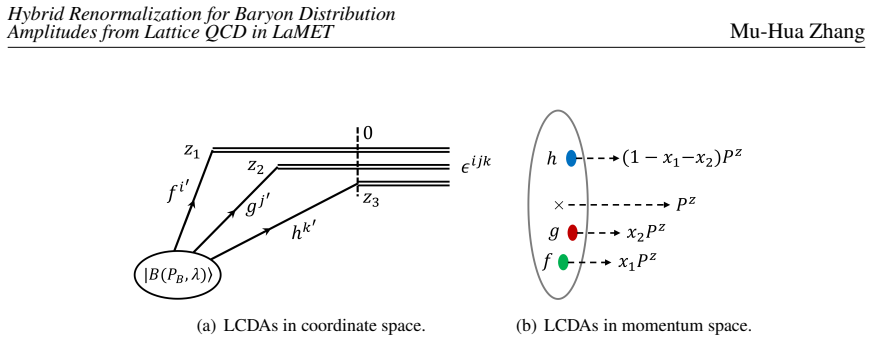
In our recent work [1] on lattice QCD calculation of the baryon leading-twist LCDAs within the framework of LaMET, a novel hybrid renormalization scheme is implemented for octet baryon quasi-DAs, yielding reliable results across both perturbative and non-perturbative regions. The numerical simulations are performed using CLQCD ensembles with $N_f = 2+1$ stout-smeared clover fermions and a Symanzik-improved gauge action. Calculations are carried out at three lattice spacings, $a = {0.052, 0.077, 0.105}$ fm. After renormalization, the linear divergences inherent in quasi-DAs are effectively removed, leading to smooth and well-behaved continuum coordinate-space distributions. These results demonstrate the viability of hybrid renormalization frameworks for light-baryon quasi-DAs and provide a robust foundation for future LaMET-based determinations of baryon LCDAs.
Editorial analysis
A structured set of objections, weighed in public.
Referee Report
Summary. The manuscript implements a hybrid renormalization scheme for octet baryon quasi-distribution amplitudes (quasi-DAs) in the LaMET framework. Lattice QCD simulations are performed on CLQCD ensembles with N_f=2+1 stout-smeared clover fermions and Symanzik-improved gauge action at three lattice spacings a=0.052, 0.077, 0.105 fm. The authors report that the hybrid scheme removes linear divergences from the quasi-DAs, producing smooth, well-behaved continuum coordinate-space distributions that serve as a foundation for future LaMET determinations of baryon leading-twist LCDAs.
Significance. If the hybrid renormalization is shown to subtract all linear divergences without introducing uncontrolled higher-order or a-dependent artifacts, the work provides a useful methodological step toward reliable LaMET calculations of baryon LCDAs, which are relevant for hard exclusive processes and nucleon structure phenomenology. The use of multiple lattice spacings and the focus on both perturbative and non-perturbative regions are positive features.
major comments (1)
- [Abstract] Abstract: The central assertion that 'linear divergences inherent in quasi-DAs are effectively removed' and yield 'smooth and well-behaved' continuum distributions is load-bearing for the viability claim, yet no explicit tests of stability under variation of the intermediate matching scale or matching window are described. Such tests are required to rule out residual scale-dependent terms or lattice artifacts that could survive the a→0 extrapolation, directly addressing the skeptic concern.
minor comments (2)
- [Abstract] The abstract mentions 'our recent work [1]' but does not clarify how the hybrid scheme differs from or improves upon prior renormalization approaches for meson or baryon quasi-DAs; a brief comparison would aid context.
- [Numerical Simulations] No mention is made of the specific functional form of the hybrid renormalization factor or the choice of intermediate scale; adding these details (even if in a methods section) would improve reproducibility.
Simulated Author's Rebuttal
We thank the referee for the careful reading of our manuscript and the constructive comment. We address the point below and have revised the manuscript accordingly to strengthen the evidence for the hybrid renormalization scheme.
read point-by-point responses
-
Referee: [Abstract] Abstract: The central assertion that 'linear divergences inherent in quasi-DAs are effectively removed' and yield 'smooth and well-behaved' continuum distributions is load-bearing for the viability claim, yet no explicit tests of stability under variation of the intermediate matching scale or matching window are described. Such tests are required to rule out residual scale-dependent terms or lattice artifacts that could survive the a→0 extrapolation, directly addressing the skeptic concern.
Authors: We agree that explicit stability tests under variation of the intermediate matching scale and window are important to fully substantiate the claim and address potential concerns about residual artifacts. The hybrid renormalization combines perturbative subtraction at short distances with non-perturbative renormalization at larger distances, which is designed to cancel linear divergences in a manner largely independent of the precise intermediate scale. Nevertheless, to directly respond to this comment, we have added a new subsection (Section 4.2) and accompanying figures in the revised manuscript. These show results for three values of the matching scale (μ_int = 1.5, 2.0, and 2.5 GeV) and two window sizes. The continuum-extrapolated coordinate-space distributions remain smooth and consistent within statistical uncertainties across these choices, with variations smaller than the quoted errors. This supports that no significant scale-dependent terms or a-dependent artifacts survive the extrapolation. revision: yes
Circularity Check
Minor self-citation to prior work; central numerical lattice results remain independent of inputs
full rationale
The paper reports a direct numerical lattice QCD calculation on CLQCD ensembles at three spacings, implementing hybrid renormalization for octet baryon quasi-DAs to remove linear divergences and obtain smooth coordinate-space distributions. This constitutes an explicit simulation and renormalization procedure grounded in standard external lattice techniques rather than any derivation that reduces outputs to fitted parameters or self-defined quantities by construction. The sole self-reference is the abstract's mention of 'our recent work [1]' for the scheme itself, which is not load-bearing for the present results and does not create a circular chain. No equations, uniqueness theorems, or ansatzes are shown to collapse into tautology, so the derivation chain is self-contained.
Axiom & Free-Parameter Ledger
Reference graph
Works this paper leans on
-
[1]
Baiet al.[Lattice Parton Collaboration (LPC)], Phys
H. Baiet al.[Lattice Parton Collaboration (LPC)], Phys. Rev. D112(2025) no.11, 114515 doi:10.1103/rqmb-x9x8 [arXiv:2508.08971 [hep-lat]]
-
[2]
R.Aaijetal.[LHCb],Nature643(2025)no.8074,1223-1228doi:10.1038/s41586-025-09119- 3 [arXiv:2503.16954 [hep-ex]]
-
[3]
V. L. Chernyak and A. R. Zhitnitsky, Phys. Rept.112(1984), 173 doi:10.1016/0370- 1573(84)90126-1
-
[4]
V. L. Chernyak, A. A. Ogloblin and I. R. Zhitnitsky, Yad. Fiz.48(1988), 1410-1422 doi:10.1007/BF01557663
-
[5]
G.S.Bali,V.M.Braun,M.Göckeler,M.Gruber,F.Hutzler,A.Schäfer,R.W.Schiel,J.Simeth, W. Söldner and A. Sternbeck,et al.JHEP02(2016), 070 doi:10.1007/JHEP02(2016)070 [arXiv:1512.02050 [hep-lat]]
-
[6]
G.S.Balietal.[RQCD],Eur.Phys.J.A55(2019)no.7,116doi:10.1140/epja/i2019-12803-6 [arXiv:1903.12590 [hep-lat]]
-
[7]
G. S. Baliet al.[RQCD], Phys. Rev. D111(2025) no.9, 094517 doi:10.1103/PhysRevD.111.094517 [arXiv:2411.19091 [hep-lat]]
-
[8]
X. Ji, Phys. Rev. Lett.110(2013), 262002 doi:10.1103/PhysRevLett.110.262002 [arXiv:1305.1539 [hep-ph]]
-
[9]
X. Ji, Sci. China Phys. Mech. Astron.57(2014), 1407-1412 doi:10.1007/s11433-014-5492-3 [arXiv:1404.6680 [hep-ph]]
-
[10]
Q. A. Zhanget al.[Lattice Parton], Phys. Rev. Lett.125(2020) no.19, 192001 doi:10.22323/1.396.0477 [arXiv:2005.14572 [hep-lat]]
-
[11]
Huaet al.[Lattice Parton], Phys
J. Huaet al.[Lattice Parton], Phys. Rev. Lett.127(2021) no.6, 062002 doi:10.1103/PhysRevLett.127.062002 [arXiv:2011.09788 [hep-lat]]
-
[12]
Huaet al.[Lattice Parton], Phys
J. Huaet al.[Lattice Parton], Phys. Rev. Lett.129(2022) no.13, 132001 doi:10.1103/PhysRevLett.129.132001 [arXiv:2201.09173 [hep-lat]]
-
[13]
M. H. Chuet al.[Lattice Parton (LPC)], Phys. Rev. D106(2022) no.3, 034509 doi:10.1103/PhysRevD.106.034509 [arXiv:2204.00200 [hep-lat]]
-
[14]
X. Y. Hanet al.[Lattice Parton], Phys. Rev. D111(2025) no.3, 034503 doi:10.1103/PhysRevD.111.034503 [arXiv:2410.18654 [hep-lat]]
- [15]
-
[16]
M. H. Chuet al.[Lattice Parton], Phys. Rev. D111(2025) no.3, 034510 doi:10.1103/PhysRevD.111.034510 [arXiv:2411.12554 [hep-lat]]. 7 Hybrid Renormalization for Baryon Distribution Amplitudes from Lattice QCD in LaMETMu-Hua Zhang
-
[17]
V. M. Braun, S. E. Derkachov, G. P. Korchemsky and A. N. Manashov, Nucl. Phys. B553 (1999), 355-426 doi:10.1016/S0550-3213(99)00265-5 [arXiv:hep-ph/9902375 [hep-ph]]
-
[18]
C. Han, W. Wang, J. Zeng and J. L. Zhang, JHEP07(2024), 019 doi:10.1007/JHEP07(2024)019 [arXiv:2404.04855 [hep-ph]]
-
[19]
Z. C. Huet al.[CLQCD], Phys. Rev. D109(2024) no.5, 054507 doi:10.1103/PhysRevD.109.054507 [arXiv:2310.00814 [hep-lat]]
-
[20]
R. Zhang, A. V. Grebe, D. C. Hackett, M. L. Wagman and Y. Zhao, Phys. Rev. D112(2025) no.5, L051502 doi:10.1103/6dh4-6k4t [arXiv:2501.00729 [hep-lat]]
-
[21]
G. S. Bali, B. Lang, B. U. Musch and A. Schäfer, Phys. Rev. D93(2016) no.9, 094515 doi:10.1103/PhysRevD.93.094515 [arXiv:1602.05525 [hep-lat]]
-
[22]
A. Hasenfratz and F. Knechtli, Phys. Rev. D64(2001), 034504 doi:10.1103/PhysRevD.64.034504 [arXiv:hep-lat/0103029 [hep-lat]]
-
[23]
T. A. DeGrand, A. Hasenfratz and T. G. Kovacs, Phys. Rev. D67(2003), 054501 doi:10.1103/PhysRevD.67.054501 [arXiv:hep-lat/0211006 [hep-lat]]
-
[24]
W.I.JayandE.T.Neil,Phys.Rev.D103(2021),114502doi:10.1103/PhysRevD.103.114502 [arXiv:2008.01069 [stat.ME]]
-
[25]
Y. K. Huoet al.[Lattice Parton (LPC)], Nucl. Phys. B969(2021), 115443 doi:10.1016/j.nuclphysb.2021.115443 [arXiv:2103.02965 [hep-lat]]
-
[26]
C.Han,Y.Su,W.WangandJ.L.Zhang,JHEP12(2023),044doi:10.1007/JHEP12(2023)044 [arXiv:2308.16793 [hep-ph]]
-
[27]
X. D. Ji, [arXiv:hep-ph/9507322 [hep-ph]]
work page internal anchor Pith review arXiv
-
[28]
R. Zhang, J. Holligan, X. Ji and Y. Su, Phys. Lett. B844(2023), 138081 doi:10.1016/j.physletb.2023.138081 [arXiv:2305.05212 [hep-lat]]
-
[29]
X. Ji, Y. Liu, A. Schäfer, W. Wang, Y. B. Yang, J. H. Zhang and Y. Zhao, Nucl. Phys. B964 (2021), 115311 doi:10.1016/j.nuclphysb.2021.115311 [arXiv:2008.03886 [hep-ph]]
-
[30]
J. l. Zhang and M. H. Zhang, Phys. Rev. D113(2026) no.1, 014501 doi:10.1103/rm4s-wlfq [arXiv:2510.14325 [hep-ph]]. 8
discussion (0)
Sign in with ORCID, Apple, or X to comment. Anyone can read and Pith papers without signing in.