Recognition: unknown
Efficient classical training of model-free quantum photonic reservoir
Pith reviewed 2026-05-10 14:55 UTC · model grok-4.3
The pith
Classical coherent-state training enables accurate reconstruction of single-qubit Pauli observables and two-qubit entanglement witnesses on unseen quantum states in photonic reservoirs.
A machine-rendered reading of the paper's core claim, the machinery that carries it, and where it could break.
Core claim
The central claim is that the identity between normalized output intensities following coherent-state evolution through a linear optical reservoir and the output statistics of separable quantum inputs permits fully classical, gradient-based optimization of the reservoir measurement projections on experimental data. This model-free procedure then transfers to quantum inference, enabling accurate reconstruction of single-qubit Pauli observables for previously unseen single-photon states and estimation of a two-qubit entanglement witness for arbitrary bipartite states.
What carries the argument
The identity between normalized output intensities of coherent states through the linear optical reservoir and the statistics obtained with separable quantum inputs, which carries the classical-to-quantum transfer for model-free optimization.
If this is right
- Accurate reconstruction of single-qubit Pauli observables becomes possible for previously unseen single-photon states.
- Estimation of two-qubit entanglement witnesses extends to arbitrary bipartite states.
- Gradient-based optimization of the reservoir measurement settings can be performed entirely on experimental data without a device model.
- Training of photonic quantum learning devices becomes faster and adaptive using only classical resources for the learning stage.
Where Pith is reading between the lines
- The same intensity-statistic correspondence may simplify calibration in other linear-optical estimation tasks where full quantum modeling is impractical.
- Resource savings from classical-only training could allow repeated adaptive retraining during long experimental runs to compensate for drifts.
- The approach suggests a route to efficient out-of-distribution generalization across classical and quantum regimes in linear systems.
Load-bearing premise
The normalized output intensities from coherent states through the linear optical reservoir exactly match the output statistics obtained with separable input quantum states.
What would settle it
A direct comparison experiment in which the output statistics measured for a separable quantum input state deviate from the normalized intensities predicted by the corresponding coherent-state training data, producing reconstruction errors for Pauli observables or the entanglement witness.
Figures


read the original abstract
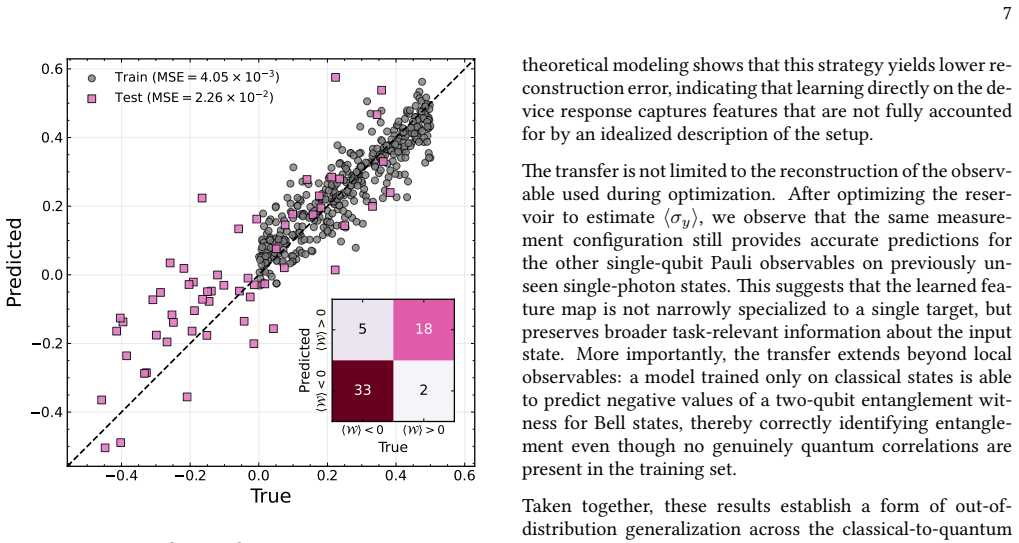
Model-independent estimation of the properties of quantum states is a central challenge in quantum technologies, as experimental imperfections, drifts, and imprecise models of the actual quantum dynamics inevitably hinder accurate reconstructions. Here, we introduce a training strategy for photonic quantum extreme learning machines in which both the learning stage and the optimization of the measurement settings are performed entirely with classical light, while inference is carried out on genuinely quantum states. The protocol is based on the identity between the normalized output intensities following the evolution of coherent states through a linear optical reservoir, and the output statistics obtained with separable input quantum states. Building on this correspondence, we implemented a model-free, gradient-based optimization of the reservoir measurement projection directly on experimental data, without relying on a prior model of the device transformation. We experimentally show that the resulting classical-to-quantum transfer enables accurate reconstruction of single-qubit Pauli observables for previously unseen single-photon states, and extends to the estimation of a two-qubit entanglement witness for arbitrary bipartite states. Beyond demonstrating a qualitatively distinct form of out-of-distribution generalization across the classical-to-quantum boundary, our results identify a practical route to fast, adaptive, and resource-efficient training of photonic quantum learning devices.
Editorial analysis
A structured set of objections, weighed in public.
Referee Report
Summary. The manuscript introduces a model-free training protocol for photonic quantum extreme learning machines (reservoirs) in which both the learning stage and optimization of measurement settings are performed exclusively with classical coherent light. The approach exploits an exact identity between normalized output intensities obtained from coherent states propagating through a linear optical network and the output statistics for separable quantum input states. Gradient-based optimization is carried out directly on experimental classical data without a prior model of the device transformation. The resulting readout weights are then transferred to inference on genuine quantum states, with experimental demonstrations of accurate reconstruction of single-qubit Pauli observables for previously unseen single-photon states and estimation of a two-qubit entanglement witness for arbitrary bipartite states.
Significance. If the reported results hold, the work establishes a practical route to resource-efficient, adaptive training of photonic quantum learning devices by leveraging classical-to-quantum transfer. The model-free gradient optimization on real experimental data and the explicit demonstration of out-of-distribution generalization across the classical-quantum boundary are notable strengths. The protocol exploits the state-independent nature of linear optics and the linearity of the target observables, which aligns with the physical constraints of the platform.
major comments (1)
- [Abstract] Abstract and experimental results section: the claim that the protocol 'enables accurate reconstruction' of single-qubit Pauli observables and the two-qubit entanglement witness is presented without accompanying quantitative metrics (e.g., mean-squared error, fidelity, or statistical uncertainties), error bars, or controls. This absence prevents assessment of the actual performance and robustness of the classical-to-quantum transfer.
minor comments (1)
- The manuscript would benefit from an explicit statement of the precise form of the linear-optical transformation matrix and the number of trainable readout parameters used in the gradient optimization.
Simulated Author's Rebuttal
We thank the referee for their detailed and constructive review. We address the major comment below and will incorporate the suggested improvements in the revised manuscript.
read point-by-point responses
-
Referee: [Abstract] Abstract and experimental results section: the claim that the protocol 'enables accurate reconstruction' of single-qubit Pauli observables and the two-qubit entanglement witness is presented without accompanying quantitative metrics (e.g., mean-squared error, fidelity, or statistical uncertainties), error bars, or controls. This absence prevents assessment of the actual performance and robustness of the classical-to-quantum transfer.
Authors: We agree that quantitative metrics, error bars, and controls are essential for rigorously evaluating the performance and robustness of the classical-to-quantum transfer. The experimental results section of the manuscript does include mean-squared error values for the single-qubit Pauli observable reconstructions (typically below 0.05 across tested states) and for the two-qubit entanglement witness estimation, along with statistical uncertainties derived from repeated measurements. However, these details are not summarized in the abstract, and error bars are not explicitly shown in all figures. We will revise the abstract to include specific quantitative performance metrics (e.g., average MSE and associated uncertainties) and add error bars plus control experiments (such as comparisons to random readout weights) to the relevant figures in the revised version. This will strengthen the assessment of out-of-distribution generalization. revision: yes
Circularity Check
No significant circularity detected
full rationale
The paper grounds its classical-to-quantum transfer on the exact identity that normalized output intensities for coherent states equal the output statistics for separable quantum states under linear optics. This identity follows directly from the fact that both quantities are determined solely by the input one-body matrix and is independent of the target observables (Pauli expectations or the entanglement witness). The model-free gradient optimization is performed on experimental classical data to obtain readout weights; these weights are then applied to quantum inputs without any re-fitting or re-definition of the targets in terms of the fitted parameters. No self-citation chain, ansatz smuggling, or renaming of known results is used to justify the central claim. The derivation therefore remains self-contained against external physical principles and does not reduce any prediction to its own inputs by construction.
Axiom & Free-Parameter Ledger
axioms (1)
- domain assumption Identity between the normalized output intensities following the evolution of coherent states through a linear optical reservoir, and the output statistics obtained with separable input quantum states.
Reference graph
Works this paper leans on
-
[1]
National Centre for HPC, Big Data and Quantum Computing (HPC)
Classical or quantum signals enter the setup through single-mode fibers (SMFs), then a combination of a half-wave plates (HWPs) followed by a quarter-wave plates (QWPs) is used to modify their polarization and encode the protocol in- put states. In particular, a continuous wave (CW) laser is used to create a classical training set, while single-photon sta...
-
[2]
10032223)
MP is grateful to the Royal Society Wolfson Fellow- ship (RSWF/R3/183013), the Department for the Economy of Northern Ireland under the US-Ireland R&D Partnership Pro- gramme, the PNRR PE Italian National Quantum Science and Technology Institute (PE0000023), and the EU Horizon Eu- rope EIC Pathfinder project QuCoM (GA no. 10032223). 11
-
[3]
Paris and J
M. Paris and J. ˇReh´aˇcek, eds.,Quantum State Estimation, Lec- ture Notes in Physics, Vol. 649 (Springer Berlin Heidelberg, Berlin, Heidelberg, 2004)
2004
- [4]
-
[5]
S. Aaronson, Shadow tomography of quantum states, inPro- ceedings of the 50th Annual ACM SIGACT Symposium on Theory of Computing(ACM, Los Angeles CA USA, 2018) pp. 325–338, arXiv:1711.01053 [quant-ph]
- [6]
- [7]
-
[8]
A. Acharya, S. Saha, and A. M. Sengupta, Shadow tomog- raphy based on informationally complete positive operator- valued measure, Physical Review A104, 052418 (2021), arXiv:2105.05992 [quant-ph]
- [9]
-
[10]
G. Lo Monaco, S. Lorenzo, A. Ferraro, M. Paternostro, G. M. Palma, and L. Innocenti, The non-stabilizerness cost of quan- tum state estimation (2025), arXiv:2510.00157
-
[11]
R. Stricker, M. Meth, L. Postler, C. Edmunds, C. Ferrie, R. Blatt, P. Schindler, T. Monz, R. Kueng, and M. Ringbauer, Experimen- tal Single-Setting Quantum State Tomography, PRX Quantum 3, 040310 (2022), arXiv:2206.00019 [quant-ph]
- [12]
- [13]
- [14]
- [15]
- [16]
-
[17]
P. Ivashkov, G. Uchehara, L. Jiang, D. S. Wang, and A. Seif, High-Fidelity, Multiqubit Generalized Measurements with Dynamic Circuits, PRX Quantum5, 030315 (2024), arXiv:2312.14087 [quant-ph]
- [18]
-
[19]
S. Ghosh, A. Opala, M. Matuszewski, T. Paterek, and T. C. H. Liew, Quantum reservoir processing, npj Quantum Informa- tion5, 1 (2019), arXiv:1811.10335 [cond-mat, physics:quant- ph]
-
[20]
K. Nakajima, K. Fujii, M. Negoro, K. Mitarai, and M. Kitagawa, Boosting Computational Power through Spatial Multiplexing in Quantum Reservoir Computing, Physical Review Applied 11, 034021 (2019), arXiv:1803.04574 [quant-ph]
-
[21]
R. Mart ´ınez-Pe˜na, J. Nokkala, G. L. Giorgi, R. Zambrini, and M. C. Soriano, Information Processing Capacity of Spin-Based Quantum Reservoir Computing Systems, Cognitive Computa- tion 10.1007/s12559-020-09772-y (2020), arXiv:2010.06369
-
[22]
K. Fujii and K. Nakajima, Quantum Reservoir Computing: A Reservoir Approach Toward Quantum Machine Learning on Near-Term Quantum Devices, inReservoir Computing: Theory, Physical Implementations, and Applications, edited by K. Naka- jima and I. Fischer (Springer, Singapore, 2021) pp. 423–450, arXiv:2011.04890 [nlin, physics:quant-ph]
-
[23]
J. Nokkala, R. Mart ´ınez-Pe˜na, G. L. Giorgi, V. Parigi, M. C. Soriano, and R. Zambrini, Gaussian states of continuous- variable quantum systems provide universal and versatile reservoir computing, Communications Physics4, 53 (2021), arXiv:2006.04821 [quant-ph]
-
[24]
Mujal, R
P. Mujal, R. Mart ´ınez-Pe˜na, J. Nokkala, J. Garc ´ıa-Beni, G. L. Giorgi, M. C. Soriano, and R. Zambrini, Opportunities in Quan- tum Reservoir Computing and Extreme Learning Machines, Advanced Quantum Technologies4, 2100027 (2021)
2021
-
[25]
R. Mart ´ınez-Pe˜na, G. L. Giorgi, J. Nokkala, M. C. Soriano, and R. Zambrini, Dynamical Phase Transitions in Quantum Reser- voir Computing, Physical Review Letters127, 100502 (2021), arXiv:2103.05348
-
[26]
Mujal, R
P. Mujal, R. Mart ´ınez-Pe˜na, G. L. Giorgi, M. C. Soriano, and R. Zambrini, Time-series quantum reservoir computing with weak and projective measurements, npj Quantum Information 9, 1 (2023)
2023
-
[27]
G. Llodr `a, C. Charalambous, G. L. Giorgi, and R. Zambrini, Benchmarking the role of particle statistics in Quantum Reser- voir Computing, Advanced Quantum Technologies6, 2200100 (2023), arXiv:2302.07164 [quant-ph]
-
[28]
K. Kobayashi, K. Fujii, and N. Yamamoto, Feedback-Driven Quantum Reservoir Computing for Time-Series Analysis, PRX Quantum5, 040325 (2024), arXiv:2406.15783 [quant-ph]
- [29]
-
[30]
A. Palacios, R. Mart ´ınez-Pe˜na, M. C. Soriano, G. L. Giorgi, and R. Zambrini, Role of coherence in many-body Quantum Reservoir Computing, Communications Physics7, 369 (2024), arXiv:2409.17734 [quant-ph]
-
[31]
Nokkala, G
J. Nokkala, G. L. Giorgi, and R. Zambrini, Retrieving past quantum features with deep hybrid classical-quantum reser- voir computing, Machine Learning: Science and Technology 5, 035022 (2024)
2024
-
[32]
S. ˇCindrak, L. Giebeler, N. G ¨otting, C. Gies, and K. L ¨udge, Memory-Nonlinearity Trade-off across Quantum Reservoir Computing Frameworks (2026), arXiv:2603.21371
- [33]
- [34]
- [35]
-
[36]
G. Llodr `a, P. Mujal, R. Zambrini, and G. L. Giorgi, Quantum reservoir computing in atomic lattices, Chaos, Solitons & Frac- tals195, 116289 (2025), arXiv:2411.13401 [quant-ph]
- [37]
-
[38]
L. Innocenti, S. Lorenzo, I. Palmisano, A. Ferraro, M. Pater- nostro, and G. M. Palma, Potential and limitations of quan- tum extreme learning machines, Communications Physics6, 118 (2023), arXiv:2210.00780 [quant-ph]
-
[39]
G. Lo Monaco, M. Bertini, S. Lorenzo, and G. Massimo Palma, Quantum extreme learning of molecular potential energy sur- faces and force fields, Machine Learning: Science and Technol- ogy5, 035014 (2024), arXiv:2406.14607 [quant-ph]
-
[40]
W. Xiong, G. Facelli, M. Sahebi, O. Agnel, T. Chotibut, S. Thanasilp, and Z. Holmes, On fundamental aspects of quan- tum extreme learning machines, Quantum Machine Intelli- gence7, 10.1007/s42484-025-00239-7 (2025), arXiv:2312.15124 [quant-ph]
- [41]
- [42]
- [43]
-
[44]
J. Garc ´ıa-Beni, G. L. Giorgi, M. C. Soriano, and R. Zambrini, Scalable Photonic Platform for Real-Time Quantum Reser- voir Computing, Physical Review Applied20, 014051 (2023), arXiv:2207.14031 [physics, physics:quant-ph]
-
[45]
A. Labay-Mora, J. Garc´ıa-Beni, G. L. Giorgi, M. C. Soriano, and R. Zambrini, Neural networks with quantum states of light, Philosophical Transactions of the Royal Society A: Mathemat- ical, Physical and Engineering Sciences382, 20230346 (2024), arXiv:2410.17702 [quant-ph]
-
[46]
A. Senanian, S. Prabhu, V. Kremenetski, S. Roy, Y. Cao, J. Kline, T. Onodera, L. G. Wright, X. Wu, V. Fatemi, and P. L. McMa- hon, Microwave signal processing using an analog quantum reservoir computer, Nature Communications15, 7490 (2024), arXiv:2312.16166 [quant-ph]
- [47]
-
[48]
Paparelle, J
I. Paparelle, J. Henaff, J. Garcia-Beni, E. Gillet, D. Montesinos, G. L. Giorgi, M. C. Soriano, R. Zambrini, and V. Parigi, Exper- imental memory control in continuous-variable optical quan- tum reservoir computing, Nature Photonics , 1 (2026)
2026
-
[49]
R. Di Bartolo, S. Piacentini, F. Ceccarelli, G. Corrielli, R. Osel- lame, V. Cimini, and F. Sciarrino, Time-series forecasting with multiphoton quantum states and integrated photonics (2025), arXiv:2512.02928 [quant-ph]
- [50]
-
[51]
Sakurai, A
A. Sakurai, A. Hayashi, W. J. Munro, and K. Nemoto, Quan- tum optical reservoir computing powered by boson sampling, Optica Quantum3, 238 (2025)
2025
-
[53]
D. Zia, L. Innocenti, G. Minati, S. Lorenzo, A. Suprano, R. Di Bartolo, N. Spagnolo, T. Giordani, V. Cimini, G. M. Palma, et al., Quantum reservoir computing for photonic entangle- ment witnessing, Science Advances11, eady7987 (2025)
2025
-
[54]
arXiv preprint arXiv:2505.13695 (2025)
V. Cimini, M. M. Sohoni, F. Presutti, B. K. Malia, S.-Y. Ma, R. Yanagimoto, T. Wang, T. Onodera, L. G. Wright, and P. L. McMahon, Large-scale quantum reservoir computing using a gaussian boson sampler, arXiv preprint arXiv:2505.13695 (2025)
- [55]
-
[56]
E. Brusaschi, M. Clementi, M. Liscidini, D. Bajoni, M. Galli, and M. Borghi, Quantum inference on a classically trained quantum extreme learning machine (2026), arXiv:2603.20167 [quant-ph]
-
[57]
T. Dao, E. Yilmaz, I. Shehzad, C. Pere, K. Ghosh, I. Wittmann, T. Brunschwiler, G. Cortiana, C. O’Meara, S. Woerner, and F. Tacchino, Breaking concentration barriers for quantum ex- treme learning on digital quantum processors (2026)
2026
-
[58]
S. ´Swierczewski, W. Verstraelen, P. Deuar, T. C. H. Liew, A. Opala, and M. Matuszewski, Quantum reservoir computing with classical and nonclassical states in an integrated optical circuit (2026), arXiv:2603.17103
-
[59]
ˇReh´aˇcek, D
J. ˇReh´aˇcek, D. Mogilevtsev, and Z. Hradil, Operational Tomog- raphy: Fitting of Data Patterns, Physical Review Letters105, 010402 (2010)
2010
-
[60]
Mogilevtsev, J
D. Mogilevtsev, J. ˇReh´aˇcek, and Z. Hradil, Self-calibration for self-consistent tomography, New Journal of Physics14, 095001 (2012)
2012
-
[61]
E. Onorati, J. Kitzinger, J. Helsen, M. Ioannou, A. H. Werner, I. Roth, and J. Eisert, Noise-mitigated randomized measurements and self-calibrating shadow estimation (2024), arXiv:2403.04751 [cond-mat, physics:math-ph, physics:quant- ph]
-
[62]
Cooper, M
M. Cooper, M. Karpi ´nski, and B. J. Smith, Local mapping of detector response for reliable quantum state estimation, Nature Communications5, 4332 (2014)
2014
- [63]
-
[64]
Zhang, J
A. Zhang, J. Xie, H. Xu, K. Zheng, H. Zhang, Y.-T. Poon, V. Vedral, and L. Zhang, Experimental Self-Characterization of Quantum Measurements, Physical Review Letters124, 040402 (2020)
2020
- [65]
- [66]
-
[67]
S. Theresa Jose and O. Simeone, Transfer Learning for Quan- tum Classifiers: An Information-Theoretic Generalization Analysis, in2023 IEEE Information Theory Workshop (ITW) (IEEE, Saint-Malo, France, 2023) pp. 532–537, arXiv:2201.06297 [quant-ph]
- [68]
-
[69]
J. L. Pereira, Q. Zhuang, and L. Banchi, Out-of-Distribution Generalization for Learning Quantum Channels with Low- Energy Coherent States, PRX Quantum6, 040306 (2025)
2025
-
[70]
D. Mart ´ın-P´erez, F. Rodr ´ıguez-D´ıaz, D. Guti ´errez-Avil´es, A. Troncoso, and F. Mart ´ınez-´Alvarez, Hybrid Classical- Quantum Transfer Learning with Noisy Quantum Circuits (2026), arXiv:2603.16973 [quant-ph]
- [71]
-
[72]
M. C. Caro, E. Gil-Fuster, J. J. Meyer, J. Eisert, and R. Sweke, Encoding-dependent generalization bounds for parametrized quantum circuits, Quantum5, 582 (2021)
2021
- [73]
- [74]
-
[75]
E. Peters and M. Schuld, Generalization despite overfitting in quantum machine learning models, Quantum7, 1210 (2023), arXiv:2209.05523 [quant-ph]
-
[76]
T. Haug and M. S. Kim, Generalization of Quantum Machine Learning Models Using Quantum Fisher Information Metric, Physical Review Letters133, 050603 (2024), arXiv:2303.13462 [quant-ph]
-
[77]
J. Berberich, D. Fink, D. Pranji ´c, C. Tutschku, and C. Holm, Training robust and generalizable quantum models, Physical Review Research6, 043326 (2024), arXiv:2311.11871 [quant- ph]
-
[78]
P. Rodriguez-Grasa, M. C. Caro, J. Eisert, E. Gil-Fuster, F. J. Schreiber, and C. Bravo-Prieto, A PAC-Bayesian approach to generalization for quantum models (2026), arXiv:2603.22964
-
[79]
R. Molteni, C. Gyurik, and V. Dunjko, Exponential quantum advantages in learning quantum observables from classical data, npj Quantum Information12, 19 (2026), arXiv:2405.02027 [quant-ph]
-
[80]
Cosmological baryon and lepto n number in the presence of electroweak fermion number violation,
L. Marrucci, C. Manzo, and D. Paparo, Optical Spin-to- Orbital Angular Momentum Conversion in Inhomogeneous Anisotropic Media, Physical Review Letters96, 10.1103/Phys- RevLett.96.163905 (2006)
-
[81]
Marrucci, E
L. Marrucci, E. Karimi, S. Slussarenko, B. Piccirillo, E. Santam- ato, E. Nagali, and F. Sciarrino, Spin-to-orbital conversion of the angular momentum of light and its classical and quantum applications, Journal of Optics13, 064001 (2011)
2011
discussion (0)
Sign in with ORCID, Apple, or X to comment. Anyone can read and Pith papers without signing in.