Recognition: unknown
Experimental Determination of the D1 Magic Wavelength for ⁴⁰K
Pith reviewed 2026-05-10 14:11 UTC · model grok-4.3
The pith
The D1 magic wavelength for fermionic potassium-40 is 1227.54(3) nm, where differential light shifts between states cancel.
A machine-rendered reading of the paper's core claim, the machinery that carries it, and where it could break.
Core claim
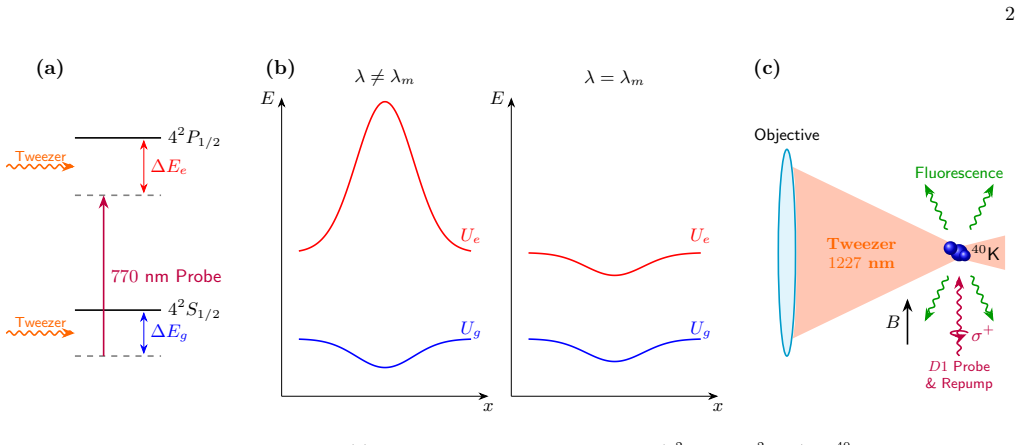
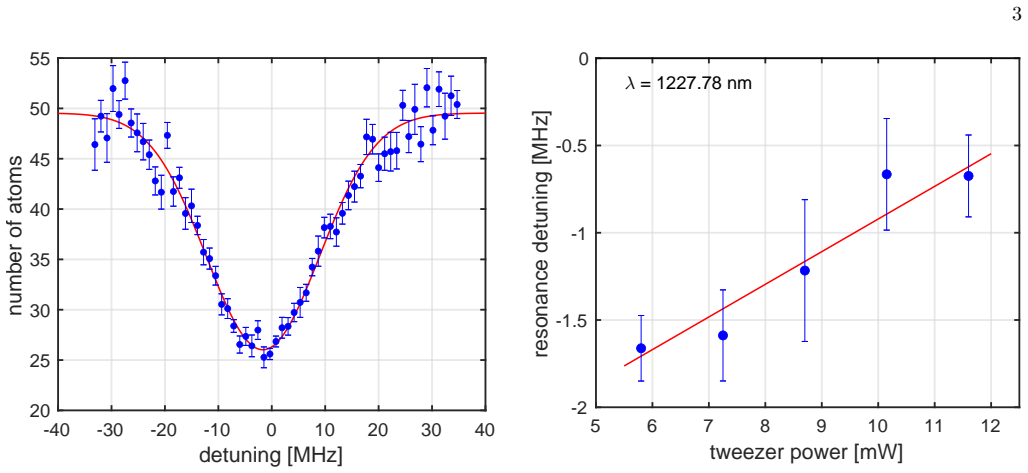
In-trap loss spectroscopy performed in a wavelength-tunable optical tweezer maps the differential AC Stark shift across a range of powers and wavelengths; conversion of these shifts to differential scalar polarizabilities identifies the D1 magic wavelength of 40K as 1227.54(3) nm, in excellent agreement with all-order theory. Benchmark data at 1064.49 nm demonstrate the systematic intensity-sampling errors avoided under the magic condition.
What carries the argument
Wavelength-tunable optical tweezer combined with in-trap loss spectroscopy that extracts the wavelength where the differential scalar polarizability vanishes.
Load-bearing premise
In-trap loss spectroscopy accurately maps the differential AC Stark shift across powers and wavelengths with no significant unaccounted systematics in the conversion to polarizabilities.
What would settle it
A direct measurement of the differential light shift at 1227.54 nm that remains nonzero, or the absence of improved cooling and imaging performance when atoms are held at this wavelength versus 1064 nm.
Figures

read the original abstract
Neutral-atom arrays offer a promising path for quantum simulation, yet the potential of fermionic $^{40}$K remains largely constrained by state-dependent light shifts that degrade cooling and detection fidelities. This problem can be resolved by working at a magic wavelength, where the differential light shift vanishes. We report the first experimental determination of the magic wavelength for the D1 transition in fermionic $^{40}$K at 1227.54(3) nm. Using in-trap loss spectroscopy in a wavelength-tunable optical tweezer, we map the differential AC Stark shift across a range of trapping powers and wavelengths. By converting these shifts to differential scalar polarizabilities, we find excellent agreement with relativistic all-order calculations. Benchmark measurements at 1064.49 nm further reveal the significant intensity-sampling systematics that plague standard trapping wavelengths, contrasting with the "mechanically clean" environment provided by the magic condition. Our results provide an important step toward high-fidelity in-trap D1 cooling, fluorescence imaging, and light-assisted loading, establishing a robust path toward scaling fermionic neutral-atom arrays for quantum information science.
Editorial analysis
A structured set of objections, weighed in public.
Referee Report
Summary. The manuscript reports the first experimental determination of the magic wavelength for the D1 transition in fermionic 40K, measured as 1227.54(3) nm via in-trap loss spectroscopy in a wavelength-tunable optical tweezer. Differential AC Stark shifts are mapped across trapping powers and wavelengths, converted to scalar polarizabilities, and shown to agree with relativistic all-order calculations; benchmark data at 1064.49 nm are used to illustrate intensity-sampling systematics that are absent at the magic wavelength.
Significance. If the central result holds, the work supplies a practical wavelength for state-independent trapping of 40K, directly enabling higher-fidelity D1 cooling, fluorescence detection, and light-assisted loading in neutral-atom arrays. This addresses a key technical barrier to scaling fermionic quantum simulators and processors.
major comments (3)
- [Results section on loss spectroscopy and polarizability conversion] The conversion of loss-rate differences to differential scalar polarizabilities (described in the section on in-trap loss spectroscopy and the subsequent polarizability extraction) rests on the assumption that observed losses arise solely from trap-depth changes due to the differential AC Stark shift. No quantitative assessment is given of possible wavelength-dependent photon-scattering contributions (which vary with detuning from the D1/D2 lines) or anharmonicity-induced position-dependent loss; either effect could systematically shift the reported zero-crossing and the quoted 1227.54(3) nm value.
- [Results and discussion of the 1227.54 nm determination] The manuscript states that the central numerical claim is supported by 'excellent agreement' with all-order calculations and provides the value 1227.54(3) nm, yet supplies neither data tables of the measured loss rates or extracted shifts, nor a detailed error budget or exclusion criteria for the wavelength scan. Without these, the uncertainty and robustness of the reported magic wavelength cannot be independently evaluated.
- [Benchmark measurements at 1064.49 nm] The benchmark comparison at 1064.49 nm is invoked to demonstrate intensity-sampling systematics, but the text does not include the underlying loss-rate versus power data or the quantitative size of the bias; this weakens the claim that the magic-wavelength environment is 'mechanically clean' relative to standard trapping wavelengths.
minor comments (1)
- [Abstract] The abstract asserts 'excellent agreement' with relativistic calculations; adding a quantitative metric (e.g., the difference in nm or the number of standard deviations) would improve clarity.
Simulated Author's Rebuttal
We thank the referee for their careful reading of the manuscript and for highlighting the potential impact of this work on fermionic neutral-atom arrays. We address each of the major comments below. Where the comments identify gaps in the presentation of data or analysis, we have revised the manuscript accordingly.
read point-by-point responses
-
Referee: [Results section on loss spectroscopy and polarizability conversion] The conversion of loss-rate differences to differential scalar polarizabilities (described in the section on in-trap loss spectroscopy and the subsequent polarizability extraction) rests on the assumption that observed losses arise solely from trap-depth changes due to the differential AC Stark shift. No quantitative assessment is given of possible wavelength-dependent photon-scattering contributions (which vary with detuning from the D1/D2 lines) or anharmonicity-induced position-dependent loss; either effect could systematically shift the reported zero-crossing and the quoted 1227.54(3) nm value.
Authors: We agree that the original manuscript did not include a quantitative assessment of these possible systematics. In the revised version we have added a paragraph to the in-trap loss spectroscopy section that estimates the differential photon-scattering rate between the two states using the known detunings from the D1 and D2 lines. The calculation shows that this contribution is small relative to the loss-rate variations used to extract the differential shift and does not move the zero-crossing outside the quoted uncertainty. For anharmonicity, we note that the tweezer is operated in the regime where the atomic motion remains harmonic for the relevant temperatures; any residual position-dependent loss is common to both states and cancels in the differential measurement. These estimates and the supporting formulas are now provided in the supplementary material. revision: yes
-
Referee: [Results and discussion of the 1227.54 nm determination] The manuscript states that the central numerical claim is supported by 'excellent agreement' with all-order calculations and provides the value 1227.54(3) nm, yet supplies neither data tables of the measured loss rates or extracted shifts, nor a detailed error budget or exclusion criteria for the wavelength scan. Without these, the uncertainty and robustness of the reported magic wavelength cannot be independently evaluated.
Authors: We acknowledge that the absence of tabulated data and a full error budget limits independent assessment. The revised manuscript now includes a table of representative loss rates, extracted differential shifts, and the wavelengths and powers at which they were measured. A new subsection titled 'Uncertainty Analysis' has been added that presents the complete error budget, incorporating statistical uncertainties from the loss-curve fits, wavelength calibration, power-meter precision, and long-term drifts. Explicit exclusion criteria (minimum signal-to-noise ratio and consistency across repeated scans) are stated. The quoted 0.03 nm uncertainty is the result of this budget. The tabulated data and error analysis are also deposited in the supplementary material. revision: yes
-
Referee: [Benchmark measurements at 1064.49 nm] The benchmark comparison at 1064.49 nm is invoked to demonstrate intensity-sampling systematics, but the text does not include the underlying loss-rate versus power data or the quantitative size of the bias; this weakens the claim that the magic-wavelength environment is 'mechanically clean' relative to standard trapping wavelengths.
Authors: We agree that the benchmark section would be strengthened by the inclusion of the raw data and a quantitative statement of the bias. The revised manuscript adds a figure displaying loss rate versus trapping power at 1064.49 nm together with the linear fit used to infer the apparent differential shift. We now explicitly quantify the intensity-sampling bias by comparing the observed power dependence to the expectation from the known differential polarizability; the comparison shows a clear systematic deviation at the non-magic wavelength that is eliminated when the differential polarizability vanishes. This contrast is used to support the statement that the magic-wavelength environment is mechanically cleaner. revision: yes
Circularity Check
No circularity: experimental zero-crossing measurement with external theoretical benchmark
full rationale
The paper reports a direct experimental extraction of the D1 magic wavelength for 40K via in-trap loss spectroscopy that maps differential AC Stark shifts versus wavelength and power, followed by conversion to scalar polarizabilities and identification of the zero-crossing point. This measured value (1227.54(3) nm) is not obtained by fitting a parameter that is then re-labeled as a prediction, nor does any equation reduce the reported wavelength to a self-defined input. The result is benchmarked against independent relativistic all-order calculations, providing external validation rather than a closed loop. No self-citations, ansatzes, or uniqueness theorems are invoked as load-bearing steps in the central claim. The derivation chain is therefore self-contained against external benchmarks.
Axiom & Free-Parameter Ledger
axioms (1)
- domain assumption Differential AC Stark shift is proportional to differential scalar polarizability and vanishes at the magic wavelength.
Reference graph
Works this paper leans on
-
[1]
Bloch, J
I. Bloch, J. Dalibard, and W. Zwerger, Many-body physics with ultracold gases, Rev. Mod. Phys.80, 885 (2008)
2008
-
[2]
Noh and D
C. Noh and D. G. Angelakis, Quantum simulations and many-body physics with light, Reports on Progress in Physics80, 016401 (2016)
2016
-
[3]
Browaeys and T
A. Browaeys and T. Lahaye, Many-body physics with in- dividually controlled rydberg atoms, Nature Physics16, 132 (2020)
2020
- [4]
- [5]
-
[6]
Cooper, J
A. Cooper, J. P. Covey, I. S. Madjarov, S. G. Porsev, M. S. Safronova, and M. Endres, Alkaline-earth atoms in optical tweezers, Phys. Rev. X8, 041055 (2018)
2018
-
[7]
Y. Wang, S. Shevate, T. Wintermantel, M. Morgado, G. Lochead, and S. Whitlock, Preparation of hundreds of microscopic atomic ensembles in optical tweezer arrays, npj Quantum Information6, 54 (2020)
2020
-
[8]
A. D. Cronin, J. Schmiedmayer, and D. E. Pritchard, Op- tics and interferometry with atoms and molecules, Rev. Mod. Phys.81, 1051 (2009)
2009
-
[9]
X. Wu, Z. Pagel, B. S. Malek, T. H. Nguyen, F. Zi, D. S. Scheirer, and H. M¨ uller, Gravity surveys using a mobile atom interferometer, Science Advances5, 10.1126/sci- adv.aax0800 (2019)
-
[10]
Grimm, M
R. Grimm, M. Weidem¨ uller, and Y. B. Ovchinnikov, Optical dipole traps for neutral atoms, inAdvances In Atomic, Molecular, and Optical Physics(Elsevier, 2000) pp. 95–170
2000
-
[11]
H. J. Manetsch, G. Nomura, E. Bataille, X. Lv, K. H. Leung, and M. Endres, A tweezer array with 6,100 highly coherent atomic qubits, Nature647, 60 (2025)
2025
-
[12]
C. Weitenberg, S. Kuhr, K. Mølmer, and J. F. Sherson, Quantum computation architecture using optical tweez- ers, Physical Review A84, 10.1103/physreva.84.032322 (2011)
-
[13]
A. M. Kaufman and K.-K. Ni, Quantum science with optical tweezer arrays of ultracold atoms and molecules, Nature Physics17, 1324 (2021)
2021
-
[14]
S. Ma, A. P. Burgers, G. Liu, J. Wilson, B. Zhang, and J. D. Thompson, Universal gate operations on nuclear spin qubits in an optical tweezer array of 171Yb atoms, Phys. Rev. X12, 021028 (2022)
2022
-
[15]
Levine, A
H. Levine, A. Keesling, G. Semeghini, A. Omran, T. T. Wang, S. Ebadi, H. Bernien, M. Greiner, V. Vuleti´ c, H. Pichler, and M. D. Lukin, Parallel implementation of high-fidelity multiqubit gates with neutral atoms, Phys. Rev. Lett.123, 170503 (2019)
2019
-
[16]
Giardini, L
V. Giardini, L. Guariento, A. Fantini, S. Storm, M. In- guscio, J. Catani, G. Cappellini, V. Gavryusev, and L. Fallani, Single Sr atoms in optical tweezer arrays for quantum simulation, Atoms14, 1 (2026)
2026
-
[17]
T. M. Graham, Y. Song, J. Scott, C. Poole, L. Phut- titarn, K. Jooya, P. Eichler, X. Zhu, M. Joas, A. G. Williams,et al., Multi-qubit entanglement and algo- rithms on a neutral-atom quantum computer, Nature 604, 457 (2022)
2022
-
[18]
S. J. Evered, D. Bluvstein, M. Kalinowski, S. Ebadi, T. Manovitz, H. Zhou, S. H. Li, M. A. Geim, M. J. Gul- lans, M. D. Lukin,et al., High-fidelity parallel entangling gates on a neutral-atom quantum computer, Nature622, 481 (2023)
2023
-
[19]
Bluvstein, S
D. Bluvstein, S. J. Evered, M. A. Geim, S. H. Li, H. Zhou, T. Manovitz, S. Ebadi, M. Cain, M. Kalinowski, K. Hsin, et al., Logical quantum processor based on reconfigurable atom arrays, Nature626, 58 (2024)
2024
-
[20]
Bluvstein, A
D. Bluvstein, A. A. Geim, S. H. Li, S. J. Evered, J. P. Bonilla Ataides, G. Baranes, A. Gu, T. Manovitz, M. Xu, M. Kalinowski, S. Majidy, C. Kokail, N. Maskara, E. C. Trapp, L. M. Stewart, S. Hollerith, H. Zhou, M. J. Gullans, S. F. Yelin, M. Greiner, V. Vuleti´ c, M. Cain, and M. D. Lukin, A fault-tolerant neutral-atom architec- ture for universal quantu...
2025
-
[21]
W. C. Chung, D. C. Cole, P. Gokhale, E. B. Jones, K. W. Kuper, D. Mason, V. Omole, A. G. Radnaev, R. Rines, M. H. Teo, M. J. Bedalov, M. Blakely, P. D. But- tler, C. Carnahan, F. T. Chong, P. Goiporia, B. Heim, G. T. Hickman, R. A. Jones, P. Khalate, J.-S. Kim, M. T. Lichtman, S. Lee, N. A. Neff-Mallon, T. W. Noel, M. Saffman, E. Shabtai, B. Thotakura, T....
-
[22]
A. M. Kaufman, B. J. Lester, C. M. Reynolds, M. L. Wall, M. Foss-Feig, K. R. A. Hazzard, A. M. Rey, and C. A. Regal, Two-particle quantum interference in tunnel-coupled optical tweezers, Science345, 306 (2014)
2014
-
[23]
Murmann, A
S. Murmann, A. Bergschneider, V. M. Klinkhamer, G. Z¨ urn, T. Lompe, and S. Jochim, Two fermions in a double well: Exploring a fundamental building block of the hubbard model, Physical Review Letters114, 080402 (2015)
2015
-
[24]
B. M. Spar, E. Guardado-Sanchez, S. Chi, Z. Z. Yan, and W. S. Bakr, Realization of a fermi-hubbard opti- cal tweezer array, Physical Review Letters128, 223202 (2022)
2022
-
[25]
A. W. Young, W. J. Eckner, N. Schine, A. M. Childs, and A. M. Kaufman, Tweezer-programmable 2d quan- tum walks in a hubbard-regime lattice, Science377, 885 (2022)
2022
-
[26]
Y. Florshaim, E. Zohar, D. Z. Koplovich, I. Meltzer, R. Weill, J. Nemirovsky, A. Stern, and Y. Sagi, Spatial adiabatic passage of ultracold atoms in optical tweezers, Science Advances10, 10.1126/sciadv.adl1220 (2024)
-
[27]
W. J. Eckner, T. Lukin Yelin, A. Cao, A. W. Young, N. Darkwah Oppong, L. Pollet, and A. M. Kaufman, Assembling a bose-hubbard superfluid from tweezer-controlled single atoms, arXiv preprint 10.48550/arXiv.2512.24374 (2025), arXiv:2512.24374 [cond-mat.quant-gas]
-
[28]
N. Jain, J. Zhang, M. Culemann, and P. M. Preiss, Programmable assembly of ground-state fermionic tweezer arrays, arXiv 10.48550/arxiv.2512.09849 (2025), arXiv:2512.09849 [cond-mat.quant-gas]
-
[29]
M. A. Norcia, A. W. Young, W. J. Eckner, E. Oelker, J. Ye, and A. M. Kaufman, Seconds-scale coherence on an optical clock transition in a tweezer array, Science 366, 93 (2019)
2019
-
[30]
I. S. Madjarov, A. Cooper, A. L. Shaw, J. P. Covey, V. Schkolnik, T. H. Yoon, J. R. Williams, and M. Endres, An atomic-array optical clock with single-atom readout, Physical Review X9, 041052 (2019)
2019
-
[31]
A. W. Young, W. J. Eckner, W. R. Milner, D. Kedar, M. A. Norcia, E. Oelker, N. Schine, J. Ye, and A. M. Kaufman, Half-minute-scale atomic coherence and high relative stability in a tweezer clock, Nature588, 408 (2020)
2020
-
[32]
Nemirovsky, R
J. Nemirovsky, R. Weill, I. Meltzer, and Y. Sagi, Atomic interferometer based on optical tweezers, Physical Re- view Research5, 043300 (2023)
2023
-
[33]
Meltzer and Y
I. Meltzer and Y. Sagi, Atomic clock interferometry using optical tweezers, Physical Review A110, 032602 (2024)
2024
-
[34]
Sch¨ affner, T
D. Sch¨ affner, T. Schreiber, F. Lenz, M. Schlosser, and G. Birkl, Quantum sensing in tweezer arrays: Optical magnetometry on an individual-atom sensor grid, PRX Quantum5, 010311 (2024)
2024
-
[35]
Finkelstein, R
R. Finkelstein, R. B.-S. Tsai, X. Sun, P. Scholl, S. Di- rekci, T. Gefen, J. Choi, A. L. Shaw, and M. Endres, Universal quantum operations and ancilla-based read-out for tweezer clocks, Nature634, 321 (2024)
2024
-
[36]
Arora, M
B. Arora, M. S. Safronova, and C. W. Clark, Magic wave- lengths for thenp−nstransitions in alkali-metal atoms, Phys. Rev. A76, 052509 (2007)
2007
-
[37]
M. S. Safronova, U. I. Safronova, and C. W. Clark, Magic wavelengths for optical cooling and trapping of potas- sium, Phys. Rev. A87, 052504 (2013)
2013
- [38]
-
[39]
N. Lundblad, M. Schlosser, and J. V. Porto, Experimen- tal observation of magic-wavelength behavior of atoms in an optical lattice, Physical Review A81, 10.1103/phys- reva.81.031611 (2010)
-
[40]
B. Liu, G. Jin, R. Sun, J. He, and J. Wang, Measure- ment of magic-wavelength optical dipole trap by using the laser-induced fluorescence spectra of trapped single cesium atoms, Optics Express25, 15861 (2017)
2017
-
[41]
M. M. Aliyu, L. Zhao, X. Q. Quek, K. C. Yellapragada, and H. Loh, d 1 magic wavelength tweezers for scaling atom arrays, Phys. Rev. Res.3, 043059 (2021)
2021
- [42]
-
[43]
Zohar, Y
E. Zohar, Y. Florshaim, O. Zilberman, A. Stern, and Y. Sagi, Degenerate raman sideband cooling of 40K atoms, Phys. Rev. A106, 063111 (2022)
2022
-
[44]
Tuchendler, A
C. Tuchendler, A. M. Lance, A. Browaeys, Y. R. P. Sor- tais, and P. Grangier, Energy distribution and cooling of a single atom in an optical tweezer, Physical Review A 78, 033425 (2008)
2008
-
[45]
Shkedrov, Y
C. Shkedrov, Y. Florshaim, G. Ness, A. Gandman, and Y. Sagi, High-sensitivity rf spectroscopy of a strongly in- teracting fermi gas, Physical Review Letters121, 093402 (2018)
2018
discussion (0)
Sign in with ORCID, Apple, or X to comment. Anyone can read and Pith papers without signing in.