Recognition: 1 theorem link
· Lean TheoremEnergies and lifetimes of the 9p and 10p excited states in atomic francium
Pith reviewed 2026-05-13 06:23 UTC · model grok-4.3
The pith
First measurements of francium 9p and 10p state energies and lifetimes test relativistic theory with good agreement on lifetimes but a global energy offset.
A machine-rendered reading of the paper's core claim, the machinery that carries it, and where it could break.
Core claim
The central claim is that the measured absolute wavenumbers for the 9p ²P_{1/2,3/2} and 10p ²P_{1/2,3/2} levels together with their radiative lifetimes supply a new experimental benchmark for relativistic coupled-cluster theory, agreeing well on lifetimes and relative excitation energies yet revealing a residual global offset in absolute energies.
What carries the argument
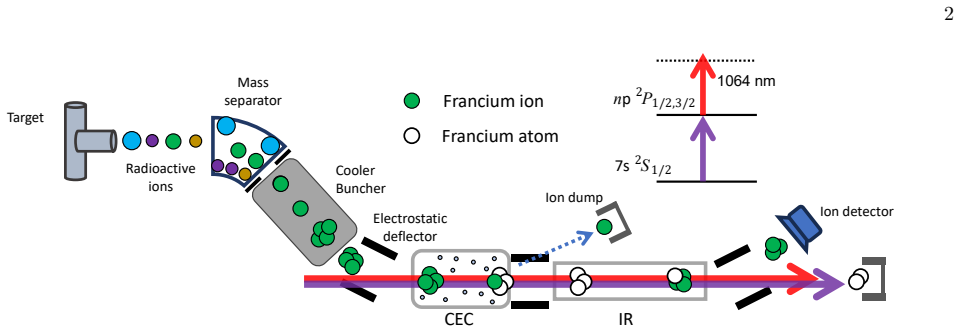
Collinear resonance ionization spectroscopy (CRIS) on a 221Fr atomic beam, compared directly to relativistic coupled-cluster predictions for the same quantities.
If this is right
- The observed agreement on lifetimes supports the reliability of relativistic coupled-cluster methods for calculating transition rates in other heavy alkali atoms.
- The persistent offset in absolute energies points to the need for refined treatment of core-valence correlation or higher-order relativistic corrections in the theory.
- These data enable quantitative planning of laser-cooling and trapping sequences that rely on the 9p and 10p states as intermediate levels.
- Relative energy spacings that match theory allow accurate prediction of additional unobserved transitions within the same n-manifolds.
Where Pith is reading between the lines
- If the energy offset scales with principal quantum number, it may arise from a common underestimation of the valence-electron screening of the nuclear field.
- Extending the same CRIS approach to the 11p and 12p states would test whether the offset remains constant or changes with increasing n.
- The measured lifetimes supply a direct calibration point for optical-pumping efficiencies in future francium parity-violation experiments.
Load-bearing premise
The CRIS measurements on the 221Fr beam capture the true absolute wavenumbers and lifetimes without significant unaccounted systematic effects from laser calibration, beam velocity, or background contributions.
What would settle it
An independent determination of the same 9p or 10p transition wavenumbers or lifetimes by a different method, such as two-step laser excitation in a trapped francium sample, that differs from the reported values by more than the stated experimental uncertainty would falsify the central claim.
Figures




read the original abstract
We present the first measurement of 9p 2P1/2,3/2 and 10p 2P1/2,3/2 excited levels absolute wavenumbers and radiative lifetime in francium. We used the Collinear Resonance Ionization Spectroscopy (CRIS) technique, applied on a beam of 221Fr atoms. Prior to this work, no experimental data existed for francium p-states with n > 8. The results provide a precision experimental test of relativistic coupled-cluster theory for the heaviest alkali, showing good agreement for lifetimes and relative excitation energies, despite a residual global offset in absolute energies.
Editorial analysis
A structured set of objections, weighed in public.
Referee Report
Summary. The manuscript reports the first experimental determination of absolute wavenumbers and radiative lifetimes for the 9p ²P_{1/2,3/2} and 10p ²P_{1/2,3/2} states in ²²¹Fr using collinear resonance ionization spectroscopy (CRIS) on a radioactive ion beam. These new data are compared to relativistic coupled-cluster calculations, with the authors claiming good agreement for lifetimes and relative excitation energies despite a noted residual global offset in the absolute energy scale.
Significance. If the absolute calibration holds, the work supplies the first precision experimental benchmarks for n=9,10 p-states in the heaviest alkali atom, extending the francium database and providing a direct test of many-body relativistic methods that are central to ongoing fundamental-physics searches with Fr. The agreement on relative quantities and lifetimes would strengthen in the theoretical framework for heavy alkalis.
major comments (2)
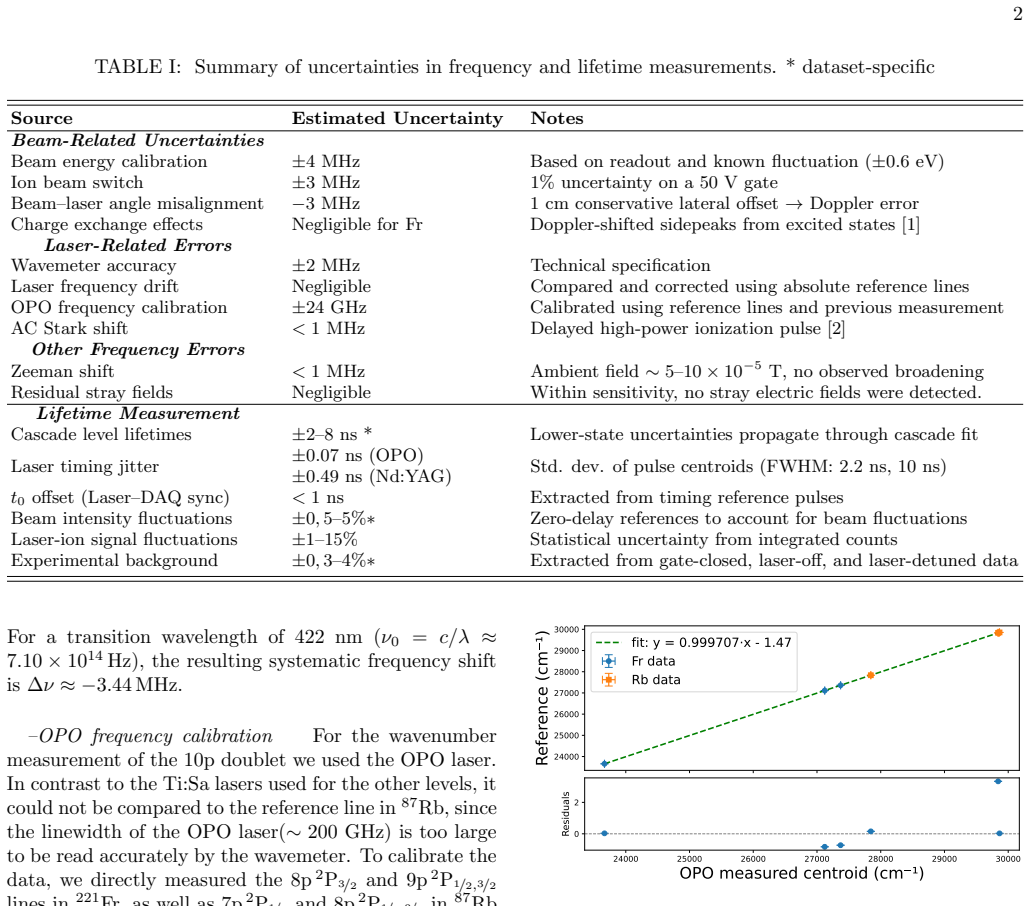
- [Experimental methods and results sections] The central claim of a precision test of relativistic coupled-cluster theory rests on the accuracy of the absolute wavenumbers. The manuscript reports a global offset in absolute energies but provides no line-by-line uncertainty budget that quantifies contributions from cw-laser frequency calibration, ²²¹Fr beam-velocity determination (including space-charge and residual-gas effects), and collinear Doppler-shift corrections. Without this, the observed offset cannot be distinguished from an unaccounted systematic scale error.
- [Discussion and comparison with theory] The comparison to theory is presented only in summary form. The manuscript should include a table or figure that explicitly lists the measured absolute wavenumbers, relative intervals, lifetimes, and their uncertainties alongside the theoretical values, together with the numerical size of the reported global offset relative to the combined experimental and theoretical uncertainties.
minor comments (2)
- [Abstract] The abstract states that 'no experimental data existed for francium p-states with n > 8' prior to this work; a brief literature check or citation confirming the status of n=8 data would strengthen this claim.
- [Figures] Figure captions and axis labels should explicitly state whether the plotted energies are absolute wavenumbers or relative to a reference level, and whether error bars include statistical and systematic contributions.
Simulated Author's Rebuttal
We thank the referee for their careful reading of the manuscript and for the constructive comments. We address each major point below and have revised the manuscript to provide the requested details on uncertainties and the theory comparison.
read point-by-point responses
-
Referee: [Experimental methods and results sections] The central claim of a precision test of relativistic coupled-cluster theory rests on the accuracy of the absolute wavenumbers. The manuscript reports a global offset in absolute energies but provides no line-by-line uncertainty budget that quantifies contributions from cw-laser frequency calibration, ²²¹Fr beam-velocity determination (including space-charge and residual-gas effects), and collinear Doppler-shift corrections. Without this, the observed offset cannot be distinguished from an unaccounted systematic scale error.
Authors: We agree that a detailed uncertainty budget is required to substantiate the absolute energy scale and to interpret the reported global offset. In the revised manuscript we have added a new subsection and accompanying table that provides a line-by-line uncertainty budget. The table quantifies the contributions from cw-laser frequency calibration (wavemeter and frequency-comb traceability), ²²¹Fr beam-velocity determination (including space-charge and residual-gas corrections), and the collinear Doppler-shift evaluation. With these values we show that the observed offset exceeds the combined experimental uncertainty, supporting its interpretation as a genuine discrepancy rather than an unaccounted systematic. revision: yes
-
Referee: [Discussion and comparison with theory] The comparison to theory is presented only in summary form. The manuscript should include a table or figure that explicitly lists the measured absolute wavenumbers, relative intervals, lifetimes, and their uncertainties alongside the theoretical values, together with the numerical size of the reported global offset relative to the combined experimental and theoretical uncertainties.
Authors: We concur that an explicit side-by-side comparison improves clarity. The revised manuscript now contains a new table that lists all measured absolute wavenumbers, relative intervals, and lifetimes (with uncertainties) next to the corresponding relativistic coupled-cluster theoretical predictions. The table also reports the numerical value of the global offset and compares it directly to the quadrature sum of experimental and theoretical uncertainties, allowing the reader to evaluate the agreement on relative energies and lifetimes at a glance. revision: yes
Circularity Check
No circularity: primary experimental measurements compared to independent external theory
full rationale
The paper reports the first experimental determination of absolute wavenumbers and radiative lifetimes for the 9p and 10p states in francium via the CRIS technique applied to a 221Fr beam. These constitute new primary data. The comparison to relativistic coupled-cluster calculations (showing agreement on relative energies and lifetimes with a noted global offset in absolute energies) relies on external theory results rather than any internal fitting, self-definition, or load-bearing self-citation chain. No derivation step reduces by construction to the paper's own inputs; the experimental procedure and results stand independently against external benchmarks.
Axiom & Free-Parameter Ledger
Reference graph
Works this paper leans on
-
[1]
X. C. Vidal, M. D’Onofrio, P. J. Fox, R. Torre, K. A. Ulmer, A. Aboubrahim, A. Albert, J. Alimena, B. C. Allanach,et al., Beyond the standard model physics at the hl-lhc and he-lhc (2019)
work page 2019
-
[2]
M. R. Tarbutt, J. J. Hudson, B. E. Sauer, and E. A. Hinds, Faraday Discussions142, 37 (2009)
work page 2009
- [3]
- [4]
- [5]
-
[6]
T. Aoki, Y. Torii, B. Sahoo, B. Das, K. Harada, T. Hayamizu, K. Sakamoto, H. Kawamura, T. Inoue, A. Uchiyama,et al., Appl. Phys. B , 509 (2018)
work page 2018
-
[7]
A. Kastberg, T. Aoki, B. Sahoo, Y. Sakemi, and B. Das, Physical Review A100, 050101 (2019)
work page 2019
- [8]
-
[9]
W. Z. Zhao, J. E. Simsarian, L. A. Orozco, W. Shi, and G. D. Sprouse, Phys. Rev. Lett.78, 4169 (1997)
work page 1997
-
[10]
U. I. Safronova, W. R. Johnson, and M. S. Safronova, Phys. Rev. A76, 042504 (2007)
work page 2007
-
[11]
B. K. Sahoo, D. K. Nandy, B. P. Das, and Y. Sakemi, Phys. Rev. A91, 042507 (2015)
work page 2015
-
[12]
M. Vajed-Samii, J. Andriessen, B. P. Das, S. N. Ray, T. Lee, and T. P. Das, Phys. Rev. Lett.49, 1800 (1982)
work page 1982
- [13]
-
[14]
A. Kramida, Y. Ralchenko, J. Reader, and NIST ASD Team, NIST Atomic Spectra Database (2024)
work page 2024
-
[15]
E. Bi´ emont, P. Quinet, and V. Van Renterghem, J. Phys. B: At. Mol. Opt. Phys.31, 5301 (1998)
work page 1998
- [16]
- [18]
-
[19]
R. Catherall, W. Andreazza, M. Breitenfeldt, A. Dorsi- val, G. J. Focker, T. P. Gharsa, T. J. Giles, J.-L. Grenard, et al., J. Phys. G: Nucl. Part. Phys.44, 094002 (2017)
work page 2017
-
[20]
T. J. Giles, R. Catherall, V. Fedosseev, U. Georg, E. Ku- gler, J. Lettry, and M. Lindroos, Nucl. Instrum. Methods Phys. Res. Sect. B204, 497 (2003)
work page 2003
- [21]
-
[22]
A. Koszor´ us, J. Billowes, C. L. Binnersley, M. L. Bissell, T. E. Cocolios, B. S. Cooper, R. P. de Groote, G. Farooq- Smith, V. N. Fedosseev, K. T. Flanagan,et al., Nucl. Instrum. Methods Phys. Res. B463, 398 (2020)
work page 2020
-
[23]
A. R. Vernon, R. P. de Groote, J. Billowes, C. L. Binner- sley, T. E. Cocolios, G. J. Farooq-Smith, K. T. Flanagan, R. F. Garcia Ruiz, W. Gins,et al., Nucl. Instrum. Meth- ods Phys. Res. B463, 384 (2020)
work page 2020
-
[24]
D. A. Steck, Rubidium 87 d line data (2001)
work page 2001
-
[25]
W. Gins, R. P. de Groote, M. L. Bissell, C. Granados Buitrago, R. Ferrer, K. M. Lynch, G. Neyens, and S. Sels, Comp. Phys. Comm.222, 286 (2018)
work page 2018
- [26]
-
[27]
J. E. Sansonetti, J. Phys. Chem. Ref. Data36, 497 (2007)
work page 2007
-
[28]
I. Budinˇ cevi´ c, J. Billowes, M. Bissell, T. E. Cocolios, R. P. De Groote, S. De Schepper, V. N. Fedosseev, K. T. Flanagan, S. Franchoo, R. G. Ruiz, and others, Phys. Rev. C90, 014317 (2014)
work page 2014
- [29]
- [30]
- [31]
-
[34]
R. Pal, M. S. Safronova, W. R. Johnson, A. Derevianko, and S. G. Porsev, Phys. Rev. A75, 042515 (2007)
work page 2007
-
[35]
M. S. Safronova and U. I. Safronova, Phys. Rev. A83, 052508 (2011). Energies and lifetimes of the 9p and 10p excited states in atomic francium P. Lass` egues ,1,∗ A. Ajayakumar,2 M. Athanasakis-Kaklamanakis ,3 O. Ahmad,1 M. Au ,2, 4 J. Berbalk,1, 2 D. Bettaney,5 B. van den Borne ,1 A. Chakraborty ,6 T.E. Cocolios ,1 M. Duggan,5 C. Fajardo ,1, 7 K.T. Flana...
work page 2011
-
[36]
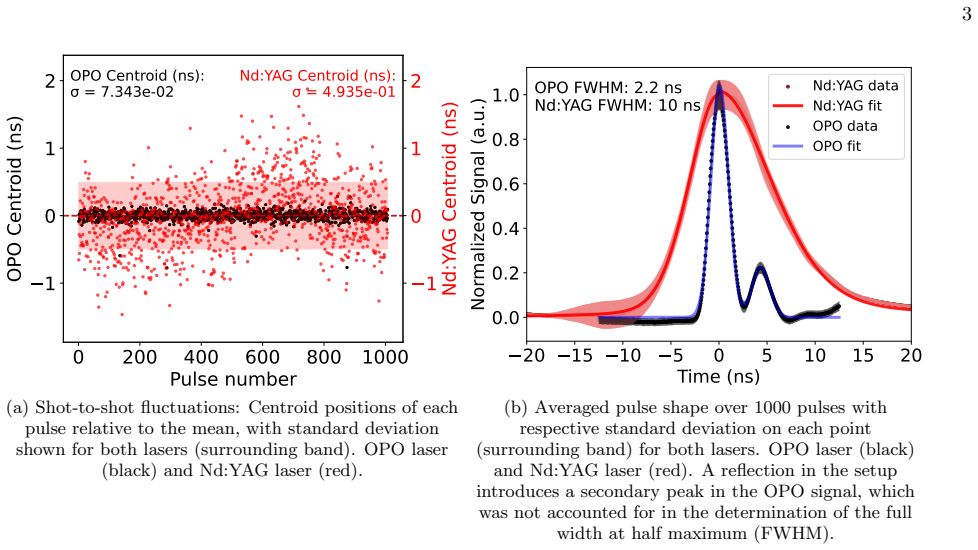
were then fitted with a skewed Voigt profile, to extract the full-width at half-maximum (FWHM), 2.2 ns for the OPO and 10 ns for the Nd:YAG at the centroid. The timing jitter was determined as the standard deviation of the centroid distribution, with a value of 0.07 ns for the OPO and 0.49 ns for the Nd:YAG. –Experimental backgroundFor each lifetime mea- ...
work page 1915
-
[37]
A. R. Vernon, J. Billowes, C. L. Binnersley, M. L. Bis- sell, T. E. Cocolios, G. J. Farooq-Smith, K. T. Flanagan, R. F. Garcia Ruiz, W. Gins, R. P. de Groote,et al., Spec. Acta B153, 61 (2019)
work page 2019
-
[38]
R. P. de Groote, M. Verlinde, V. Sonnenschein, K. T. Flanagan, I. Moore, and G. Neyens, Phys. Rev. A95, 032502 (2017)
work page 2017
-
[39]
R. P. De Groote, I. Budinˇ cevi´ c, J. Billowes, M. L. Bis- sell, T. E. Cocolios, G. J. Farooq-Smith, V. Fedosseev, K. Flanagan, S. Franchoo, R. G. Ruiz, and others, Phys. Rev. Lett.115, 132501 (2015)
work page 2015
-
[40]
D. C. Morton, Astrophys. J. Suppl. Ser.130, 403 (2000)
work page 2000
-
[41]
B. K. Sahoo and B. P. Das, Phys. Rev. Lett.120, 203001 (2018)
work page 2018
-
[42]
N. Yamanaka, B. K. Sahoo, N. Yoshinaga, T. Sato, K. Asahi, and B. P. Das, EPJA53, 54 (2017)
work page 2017
-
[43]
M. Athanasakis-Kaklamanakis, S. G. Wilkins, P. Lass` egues, L. Lalanne, J. R. Reilly, O. Ahmad, M. Au, S. W. Bai, J. Berbalk,et al., Phys. Rev. A110, L010802 (2024)
work page 2024
- [44]
-
[45]
W. Van Wijngaarden and J. Xia, J. Quant. Spec. Rad. Tr.61, 557 (1999)
work page 1999
- [46]
- [47]
-
[48]
J. Simsarian, L. A. Orozco, G. Sprouse, and W. Zhao, Phys. Rev. A57, 2448 (1998)
work page 1998
-
[49]
J. M. Grossman, R. P. Fliller, L. A. Orozco, M. R. Pear- son, and G. D. Sprouse, Phys. Rev. A62, 062502 (2000)
work page 2000
discussion (0)
Sign in with ORCID, Apple, or X to comment. Anyone can read and Pith papers without signing in.