Recognition: unknown
Explicit proof of Anderson's orthogonality catastrophe for the one-dimensional Fermi polaron with attractive interaction
Pith reviewed 2026-05-10 14:27 UTC · model grok-4.3
The pith
The quasi-particle residue of the one-dimensional Fermi polaron decays algebraically as Z = W N^{-θ} with θ = 2δ_F²/π².
A machine-rendered reading of the paper's core claim, the machinery that carries it, and where it could break.
Core claim
In the thermodynamic limit the two determinants yield the quasi-particle residue Z = W N^{-θ}, where the Anderson exponent θ equals 2δ_F²/π² and δ_F is the Bethe-ansatz phase shift evaluated at the Fermi momentum. The prefactor W is computed numerically as a function of the interaction strength.
What carries the argument
Determinant representations of the norm and overlap obtained from the Bethe-ansatz solution, whose leading asymptotics are found using the special properties of Cauchy matrices.
If this is right
- The interacting ground state becomes orthogonal to the non-interacting Fermi sea in the infinite-volume limit.
- The power-law exponent is locked to the two-body phase shift at the Fermi edge.
- Finite-size corrections to the quasi-particle weight follow the same algebraic scaling for any interaction strength.
- The prefactor W supplies a concrete interaction-dependent amplitude that can be compared with other calculations.
Where Pith is reading between the lines
- The same determinant-plus-Cauchy-matrix route may give exact decay rates in other one-dimensional integrable models whose wave functions are known explicitly.
- Spectroscopic measurements on finite one-dimensional polaron systems will need to include this power-law suppression when extracting residues.
- The result provides a benchmark for numerical methods that simulate the same model at large but finite N.
Load-bearing premise
The determinant expressions coming from the Bethe-ansatz solution share the same leading asymptotic behavior as Cauchy matrices when the system size is taken to infinity at fixed density.
What would settle it
Direct numerical evaluation of the overlap determinant for increasing particle numbers N at fixed density, to check whether log(Z) versus log(N) approaches a slope equal to the predicted −θ.
Figures



read the original abstract
We provide a fully analytical derivation of Anderson's orthogonality catastrophe for the one dimensional Fermi polaron integrable model, describing a system of $N$ spin-up fermions, with fixed density $n=N/L$, interacting with a single spin-down fermion via an attractive contact potential. The proof combines the determinant representations of the norm of the many-body wave function and of its scalar product with the noninteracting ground state, obtained from the Bethe ansatz solution, with the special properties of Cauchy matrices. We derive the leading asymptotics of the two determinants in the thermodynamic limit and show that the quasi-particle residue $Z$ decays algebraically, $Z=W N^{-\theta}$. We confirm that the Anderson exponent $\theta$ is equal to $2\delta_F^2/\pi^2$, where $\delta_F$ is the Bethe-ansatz phase shift at the Fermi edge. The prefactor $W$ is obtained numerically as a function of the interaction parameter.
Editorial analysis
A structured set of objections, weighed in public.
Referee Report
Summary. The manuscript presents an explicit analytical proof of Anderson's orthogonality catastrophe for the one-dimensional Fermi polaron with attractive contact interaction. Using Bethe-ansatz determinant representations for the wave-function norm and the overlap with the non-interacting ground state, the authors apply asymptotic properties of Cauchy matrices in the thermodynamic limit at fixed density to show that the quasiparticle residue Z decays algebraically as Z = W N^{-θ}, where the exponent θ equals 2 δ_F² / π² with δ_F the Bethe-ansatz phase shift at the Fermi edge, and W is a numerically determined prefactor.
Significance. If the central derivation is correct, this work provides a valuable explicit verification of the Anderson exponent in an exactly solvable model, linking it directly to the phase shift without fitting parameters. The combination of integrable-model techniques with Cauchy-matrix asymptotics offers a template for similar analyses in other one-dimensional systems, and the numerical evaluation of the prefactor adds practical utility for comparisons with experiments or numerics in quantum gases.
major comments (1)
- [Thermodynamic limit analysis of the determinants] The application of known large-N asymptotics for Cauchy matrices to the Bethe-ansatz determinants requires justification that corrections arising from the non-uniform distribution of rapidities (due to the transcendental BA equations with δ(k) = -arctan(k/c)), the Jacobian of the root map, and finite-size effects are either exponentially suppressed or affect only the prefactor W and not the power-law exponent θ. Explicit error bounds or a detailed analysis of these corrections in the thermodynamic limit at fixed density n = N/L should be provided to confirm that θ = 2δ_F²/π² holds rigorously.
minor comments (2)
- [Abstract and Introduction] The abstract claims a 'fully analytical derivation' while noting that the prefactor W is obtained numerically; this distinction should be stated clearly in the introduction and conclusion to avoid any misinterpretation of the scope of the analytic result.
- [Bethe-ansatz solution section] Ensure that the definition of the Fermi-edge phase shift δ_F is explicitly tied to the specific Bethe-ansatz quantization condition used in the thermodynamic limit, including any reference to the two-body phase shift function.
Simulated Author's Rebuttal
We thank the referee for the careful reading of our manuscript and the positive overall assessment. We address the single major comment below, providing additional clarification on the thermodynamic-limit analysis while agreeing that further explicit bounds would strengthen the presentation.
read point-by-point responses
-
Referee: [Thermodynamic limit analysis of the determinants] The application of known large-N asymptotics for Cauchy matrices to the Bethe-ansatz determinants requires justification that corrections arising from the non-uniform distribution of rapidities (due to the transcendental BA equations with δ(k) = -arctan(k/c)), the Jacobian of the root map, and finite-size effects are either exponentially suppressed or affect only the prefactor W and not the power-law exponent θ. Explicit error bounds or a detailed analysis of these corrections in the thermodynamic limit at fixed density n = N/L should be provided to confirm that θ = 2δ_F²/π² holds rigorously.
Authors: We agree that a more explicit discussion of error terms is desirable. In the thermodynamic limit at fixed density the Bethe-ansatz rapidities become dense according to the smooth density ρ(k) solving the integral equation obtained from the BA equations; the discrete sum over roots is replaced by an integral weighted by this density. The Cauchy-matrix determinants that appear in the norm and overlap admit a continuum representation whose logarithm yields an integral whose singular part at the Fermi points is controlled solely by the phase shift δ_F. The Jacobian of the root map and the global shape of ρ(k) contribute only multiplicative constants to the prefactor W. Finite-size corrections to the rapidity distribution are O(1/N) and produce corrections to log Z that are either exponentially small or O(1/N), leaving the algebraic exponent θ unaffected. In the revised manuscript we will add an appendix that (i) recalls the relevant large-N asymptotics for Cauchy determinants with points sampled from a smooth density, (ii) derives the leading singular contribution from the Fermi-edge phase shift, and (iii) supplies explicit bounds showing that all other corrections are o(1) in the exponent as N→∞ at fixed n. revision: yes
Circularity Check
No circularity: derivation applies external Cauchy-matrix asymptotics to BA-derived determinants without reduction to fitted inputs or self-citations
full rationale
The paper obtains norm and overlap determinants from the standard Bethe-ansatz solution for the integrable 1D Fermi polaron, then invokes known large-N asymptotics of Cauchy matrices to extract the algebraic decay of the overlap Z ~ N^{-θ} with θ expressed via the BA phase shift δ_F. No step defines the target exponent in terms of itself, renames a fitted quantity as a prediction, or relies on a load-bearing self-citation whose validity is internal to the present work. The phase shift δ_F is an output of the BA equations rather than an adjustable parameter tuned to the orthogonality result, and the thermodynamic-limit analysis at fixed density is presented as a direct application of external mathematical results on Cauchy determinants. The derivation chain therefore remains self-contained against external benchmarks.
Axiom & Free-Parameter Ledger
free parameters (1)
- interaction strength
axioms (2)
- domain assumption Bethe-ansatz solution supplies exact determinant representations for the norm and overlap
- standard math Cauchy matrices possess known leading asymptotics in the thermodynamic limit
Reference graph
Works this paper leans on
-
[1]
3 as a function ofy= nj/nN , together with the approximating functionln(1 +y)− ln(1−y)appearing in Eq
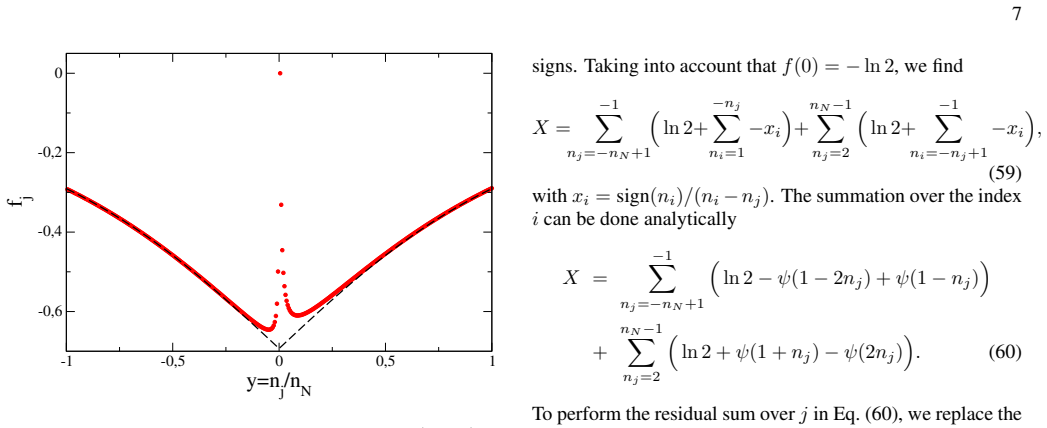
The result is displayed in Fig. 3 as a function ofy= nj/nN , together with the approximating functionln(1 +y)− ln(1−y)appearing in Eq. (72). Sizeable differences are seen foryclose to±1, with the approximation overestimating the correct result, implying that the logarithmic correction will have negative sign. We writeF 3 −a 3N=X+Y+..., where againXandY ar...
-
[2]
P. W. Anderson, Infrared catastrophe in fermi gases with local scattering potentials, Phys. Rev. Lett.18, 1049 (1967)
1967
-
[3]
P. W. Anderson, Ground state of a magnetic impurity in a metal, Phys. Rev.164, 352 (1967)
1967
-
[4]
Nozières and C
P. Nozières and C. T. De Dominicis, Singularities in the x-ray absorption and emission of metals. iii. one-body theory exact solution, Phys. Rev.178, 1097 (1969)
1969
-
[5]
M. Knap, A. Shashi, Y . Nishida, A. Imambekov, D. A. Abanin, and E. Demler, Time-dependent impurity in ultracold fermions: Orthogonality catastrophe and beyond, Phys. Rev. X2, 041020 (2012)
2012
-
[6]
Schiró and A
M. Schiró and A. Mitra, Transient orthogonality catastrophe in a time-dependent nonequilibrium environment, Phys. Rev. Lett. 112, 246401 (2014)
2014
-
[7]
Fogarty, S
T. Fogarty, S. Deffner, T. Busch, and S. Campbell, Orthogonality catastrophe as a consequence of the quantum speed limit, Phys. Rev. Lett.124, 110601 (2020)
2020
-
[8]
Zanardi and N
P. Zanardi and N. Paunkovi´c, Ground state overlap and quantum phase transitions, Phys. Rev. E74, 031123 (2006)
2006
-
[9]
I. Affleck, Quantum impurity problems in condensed matter physics (2009), arXiv:0809.3474 [cond-mat.str-el]
-
[10]
Massignan, M
P. Massignan, M. Zaccanti, and G. M. Bruun, Polarons, dressed molecules and itinerant ferromagnetism in ultracold fermi gases, Reports on Progress in Physics77, 034401 (2014)
2014
-
[11]
Schmidt, M
R. Schmidt, M. Knap, D. A. Ivanov, J.-S. You, M. Cetina, and E. Demler, Universal many-body response of heavy impurities coupled to a fermi sea: a review of recent progress, Reports on Progress in Physics81, 024401 (2018)
2018
-
[12]
F. Scazza, M. Zaccanti, P. Massignan, M. M. Parish, and J. Levinsen, Repulsive fermi and bose polarons in quantum gases, Atoms10, 10.3390/atoms10020055 (2022)
-
[13]
M. M. Parish and J. Levinsen, Fermi polarons and beyond (2025) p. 221
2025
-
[14]
Polarons in atomic gases and two-dimensional semiconductors
P. Massignan, R. Schmidt, G. E. Astrakharchik, A. ˙Imamoglu, M. Zwierlein, J. J. Arlt, and G. M. Bruun, Polarons in atomic gases and two-dimensional semiconductors (2025), arXiv:2501.09618 [cond-mat.quant-gas]
work page internal anchor Pith review Pith/arXiv arXiv 2025
-
[15]
Giamarchi, Bosonization, inQuantum Physics in One Dimension(Oxford University Press, 2003)
T. Giamarchi, Bosonization, inQuantum Physics in One Dimension(Oxford University Press, 2003)
2003
-
[16]
J. B. McGuire, Interacting fermions in one dimension. i. repulsive potential, Journal of Mathematical Physics6, 432 (1965)
1965
-
[17]
McGuire, Interacting fermions in one dimension
J. McGuire, Interacting fermions in one dimension. ii. attractive potential, J. Math. Phys.7, 123 (1966)
1966
-
[18]
Castella and X
H. Castella and X. Zotos, Exact calculation of spectral properties of a particle interacting with a one-dimensional fermionic system, Phys. Rev. B47, 16186 (1993)
1993
-
[19]
D. M. Edwards, Magnetism in Single-Band Models: Exact One-Dimensional Wave Functions Generalised to Higher Dimensions, Progress of Theoretical Physics Supplement101, 453 (1990)
1990
-
[20]
Takahashi,Thermodynamics of One Dimensional Solvable Models(Cambridge University Press, Cambridge, UK, 1999)
M. Takahashi,Thermodynamics of One Dimensional Solvable Models(Cambridge University Press, Cambridge, UK, 1999)
1999
-
[21]
R. Mao, X. W. Guan, and B. Wu, Exact results for polaron and molecule in one-dimensional spin-1/2 fermi gas, Phys. Rev. A 94, 043645 (2016)
2016
-
[22]
G. Orso, L. A. Bariši ´c, E. Gradova, F. Chevy, and K. Van Houcke, Quasiparticle residue and charge of the one- dimensional fermi polaron, Phys. Rev. A113, 013310 (2026)
2026
-
[23]
Prokof’ev and B
N. Prokof’ev and B. Svistunov, Fermi-polaron problem: Diagrammatic monte carlo method for divergent sign- alternating series, Phys. Rev. B77, 020408 (2008)
2008
-
[24]
N. V . Prokof’ev and B. V . Svistunov, Bold diagrammatic monte carlo: A generic sign-problem tolerant technique for polaron models and possibly interacting many-body problems, Phys. Rev. B77, 125101 (2008)
2008
-
[25]
Vlietinck, J
J. Vlietinck, J. Ryckebusch, and K. Van Houcke, Quasiparticle properties of an impurity in a fermi gas, Phys. Rev. B87, 115133 (2013)
2013
-
[26]
Vlietinck, J
J. Vlietinck, J. Ryckebusch, and K. Van Houcke, Diagrammatic monte carlo study of the fermi polaron in two dimensions, Phys. Rev. B89, 085119 (2014)
2014
-
[27]
Chevy, Universal phase diagram of a strongly interacting fermi gas with unbalanced spin populations, Phys
F. Chevy, Universal phase diagram of a strongly interacting fermi gas with unbalanced spin populations, Phys. Rev. A74, 063628 (2006)
2006
-
[28]
Combescot and S
R. Combescot and S. Giraud, Normal state of highly polarized fermi gases: Full many-body treatment, Phys. Rev. Lett.101, 050404 (2008)
2008
-
[29]
Affleck and A
I. Affleck and A. W. W. Ludwig, The fermi edge singularity and boundary condition changing operators, Journal of Physics A: Mathematical and General27, 5375 (1994)
1994
-
[30]
I. Affleck, Boundary condition changing operations in conformal field theory and condensed matter physics, Nuclear Physics B - Proceedings Supplements58, 35 (1997), proceedings of the European Research Conference in the Memory of Claude Itzykson
1997
-
[31]
H. Hu, J. Wang, and X.-J. Liu, Exact spectral properties of fermi polarons in one-dimensional lattices: Anomalous fermi singularities and polaron quasiparticles, Phys. Rev. Lett.134, 153403 (2025)
2025
-
[32]
Levinsen, P
J. Levinsen, P. Massignan, G. M. Bruun, and M. M. Parish, Strong-coupling ansatz for the one-dimensional fermi gas in a harmonic potential, Science Advances1, e1500197 (2015)
2015
- [33]
-
[34]
C. N. Yang, Some exact results for the many-body problem in one dimension with repulsive delta-function interaction, Phys. Rev. Lett.19, 1312 (1967)
1967
-
[35]
Gaudin, Un systeme a une dimension de fermions en interaction, Physics Letters A24, 55 (1967)
M. Gaudin, Un systeme a une dimension de fermions en interaction, Physics Letters A24, 55 (1967)
1967
-
[36]
X.-W. Guan, M. T. Batchelor, and C. Lee, Fermi gases in one dimension: From bethe ansatz to experiments, Rev. Mod. Phys. 85, 1633 (2013)
2013
-
[37]
X. Chen, E. Dizer, E. R. Rodríguez, and R. Schmidt, Mass-gap description of heavy impurities in fermi gases, Phys. Rev. Lett. 135, 193401 (2025)
2025
discussion (0)
Sign in with ORCID, Apple, or X to comment. Anyone can read and Pith papers without signing in.