Recognition: unknown
Deciphering the nature of P^{Sigma}_{psi s} pentaquarks in the light of their electromagnetic multipole moments
Pith reviewed 2026-05-10 15:48 UTC · model grok-4.3
The pith
Electromagnetic multipole moments distinguish the internal structure of strange hidden-charm pentaquarks.
A machine-rendered reading of the paper's core claim, the machinery that carries it, and where it could break.
Core claim
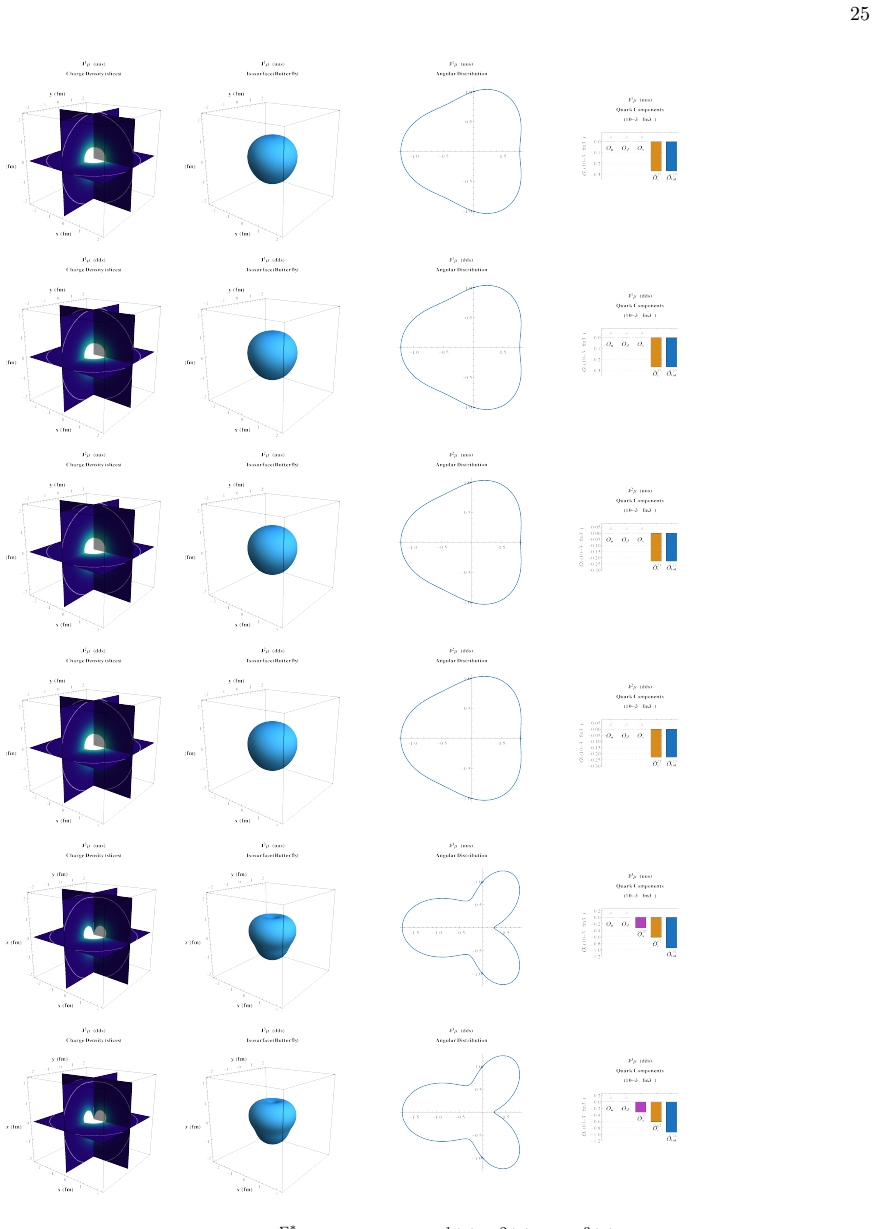
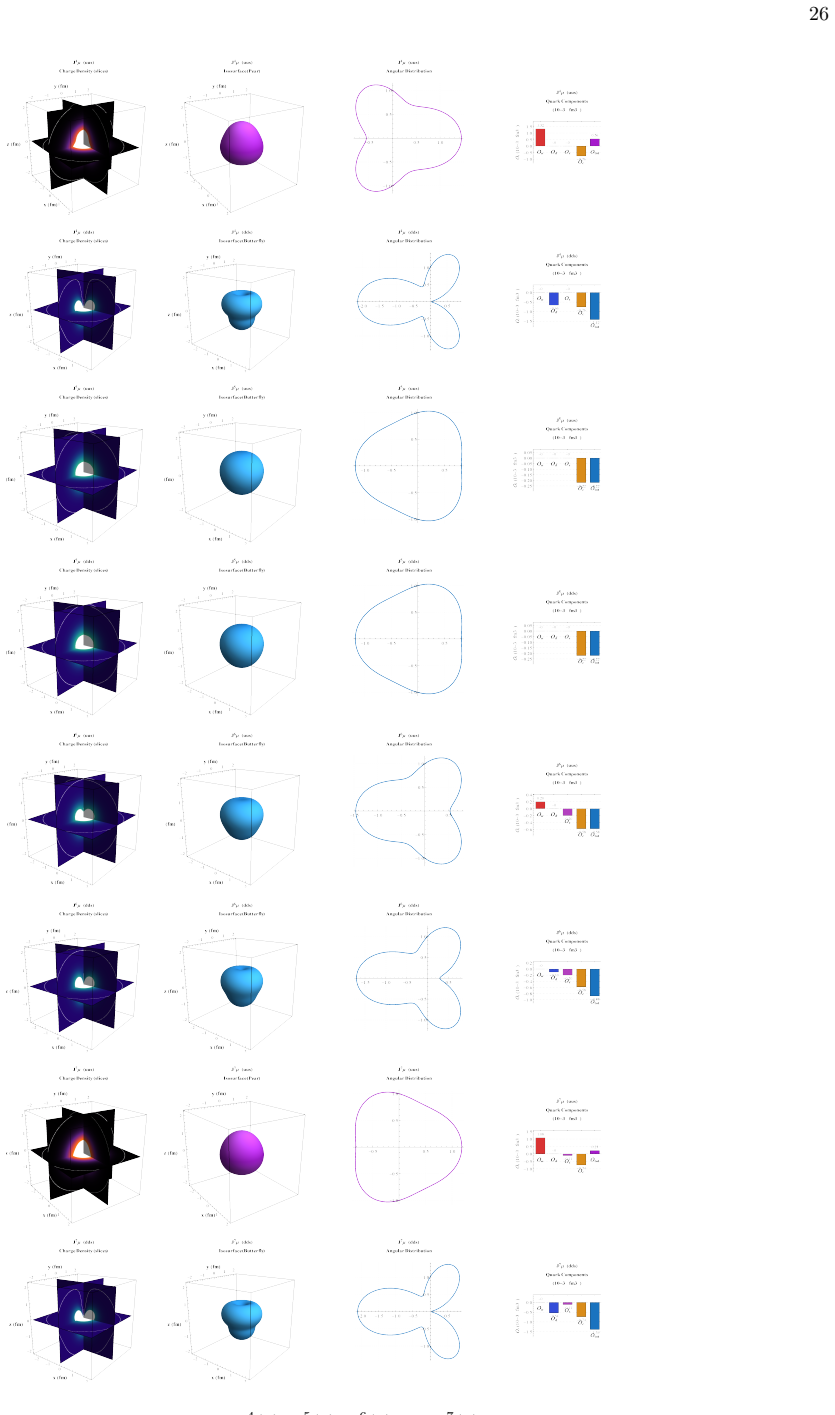
Using six spin-1/2 and seven spin-3/2 diquark-diquark-antiquark interpolating currents in light-cone sum rules, the magnetic moments lie in the range -1.92 to -1.21 nuclear magnetons for scalar-diquark spin-1/2 states and remain small for spin-3/2 states, while axial-vector currents give larger values with sign reversals governed by the up-to-down charge ratio. Scalar-diquark currents produce oblate quadrupole deformations around -2.0 times 10 to the minus 2 fm squared dominated by the charm quark, whereas two-axial-vector currents can yield prolate values up to +8.0 times 10 to the minus 2 fm squared with occasional sign reversal; the octupole moment is topology-independent at approximately
What carries the argument
Diquark-diquark-antiquark interpolating currents in QCD light-cone sum rules that extract the electromagnetic multipole moments as direct probes of the pentaquark wave-function structure.
If this is right
- Scalar diquark currents produce charm-dominated magnetic moments insensitive to light-quark flavor for both spin values.
- Axial-vector diquark currents generate larger magnetic moments whose signs flip according to the ratio of up and down quark charges.
- Non-zero electric quadrupole moments appear for most current choices and vanish only for S-wave molecular configurations.
- The sign correlation between quadrupole and octupole moments directly reflects the relative 1/m_q weighting inside the state.
- Currents with scalar antiquark coupling yield a universal octupole moment near -0.25 times 10 to the minus 3 fm cubed.
Where Pith is reading between the lines
- Future precision measurements at electron-ion colliders or upgraded LHCb could fix which current structure best matches the physical states.
- The flavor sensitivity found for axial-vector currents implies that isospin-breaking differences within the Sigma triplet may be detectable.
- The same sum-rule approach could be applied to non-strange hidden-charm pentaquarks to test whether the four discriminants remain universal.
Load-bearing premise
The chosen diquark-diquark-antiquark interpolating currents couple dominantly to the physical pentaquark states with negligible contamination from other resonances or continuum states.
What would settle it
An experimental measurement of the spin-1/2 magnetic moment with absolute value below 3 nuclear magnetons, or a vanishing electric quadrupole moment for any spin-3/2 state, would contradict the predictions from the axial-vector and scalar diquark currents.
Figures


read the original abstract
We calculate electromagnetic multipole moments of $\Sigma$-type strange hidden-charm pentaquarks $P^{\Sigma}_{\psi s}$ (isospin triplet $\Sigma^+,\Sigma^0,\Sigma^-$) using QCD light-cone sum rules, with six (spin-1/2) and seven (spin-3/2) interpolating currents built from diquark-diquark-antiquark operators. We compute magnetic dipole $\mu$ for all channels and, for spin-3/2, electric quadrupole ${\cal Q}$ and magnetic octupole ${\cal O}$ moments (first computation), and give the first quark-flavor decomposition. Scalar diquark currents yield charm-dominated, flavor-insensitive moments ($\mu\in[-1.92,-1.21]\mu_N$ for spin-1/2, $|\mu|\lesssim1.2\mu_N$ for spin-3/2), consistent with heavy-quark spin symmetry. Axial-vector diquark currents produce larger, flavor-sensitive moments with sign reversals governed by $e_u/e_d=-2$. For ${\cal Q}$, scalar-diquark currents give oblate deformations ($Q_0\approx-2.0\times10^{-2}{\rm fm}^2$) dominated by charm, while two-axial-vector-diquark currents predict prolate values up to $Q_0=+8.0\times10^{-2}{\rm fm}^2$, with sign reversal for $[su][uc]\bar{c}$ in two currents. Currents with scalar antiquark coupling yield a topology-independent octupole ${\cal O}\approx-0.25\times10^{-3}{\rm fm}^3$, a lattice QCD benchmark. Comparison with constituent quark models identifies four discriminants: $|\mu|\gtrsim3\mu_N$ in spin-1/2; sign of $\mu$ for $[su][uc]\bar{c}$ in spin-3/2; non-zero ${\cal Q}$ (vanishes in $S$-wave molecules); and the ${\cal Q}$-${\cal O}$ sign correlation, probing $1/m_q$ weighting.
Editorial analysis
A structured set of objections, weighed in public.
Referee Report
Summary. The paper calculates the electromagnetic multipole moments of Σ-type strange hidden-charm pentaquarks P^Σ_ψs using QCD light-cone sum rules. With six spin-1/2 and seven spin-3/2 diquark-diquark-antiquark interpolating currents, it computes magnetic dipole moments μ for all channels and, for spin-3/2 states, the electric quadrupole Q and magnetic octupole O moments (claimed first computation). Numerical ranges are reported (e.g., μ ∈ [-1.92, -1.21] μ_N for scalar-diquark spin-1/2 currents; Q_0 ≈ -2.0×10^{-2} fm² for scalar cases), together with quark-flavor decompositions and sign-reversal patterns governed by e_u/e_d = -2. Comparison with constituent quark models yields four proposed discriminants: |μ| ≳ 3 μ_N for spin-1/2, sign of μ for [su][uc]c̄ in spin-3/2, non-zero Q (vanishes in S-wave molecules), and the Q-O sign correlation.
Significance. If the central assumption of dominant coupling holds, the work supplies the first Q and O moments for these states, the first flavor decomposition, and concrete, testable signatures that can discriminate pentaquark structures from molecular or quark-model pictures. The explicit numerical predictions and symmetry-based patterns (e.g., charm dominance for scalar currents, flavor sensitivity for axial-vector currents) add falsifiable content to the literature on exotic hadrons.
major comments (2)
- The claim that the computed moments furnish four model-discriminating observables rests on the unverified assumption that the six (spin-1/2) and seven (spin-3/2) diquark-diquark-antiquark currents couple dominantly to the physical P^Σ_ψs states with negligible contamination from other resonances or continuum. No quantitative check of pole dominance, residue extraction, or comparison with alternative interpolators is supplied to support this; if the assumption fails, the reported ranges (μ ∈ [-1.92, -1.21] μ_N, Q_0 values, O ≈ -0.25×10^{-3} fm³) and the four discriminants do not apply to the observed states.
- In the numerical analysis, the Borel mass parameters and continuum thresholds (free parameters in the light-cone sum rules) are chosen to produce the quoted moment ranges, yet no explicit stability windows, variation plots, or sensitivity analysis are described that would confirm the results are robust rather than tuned to expected mass or decay-constant ranges.
minor comments (2)
- The abstract states that scalar-diquark currents are 'consistent with heavy-quark spin symmetry'; a brief explicit reference to the relevant heavy-quark limit relations in the introduction would clarify this connection.
- Ensure that the claim of 'first computation' for Q and O is accompanied by citations to all prior light-cone or lattice works on pentaquark electromagnetic moments to avoid any perception of overstatement.
Simulated Author's Rebuttal
We thank the referee for the careful reading of our manuscript and the constructive comments. We address each major point below, indicating where we agree and how we will strengthen the presentation in a revised version.
read point-by-point responses
-
Referee: The claim that the computed moments furnish four model-discriminating observables rests on the unverified assumption that the six (spin-1/2) and seven (spin-3/2) diquark-diquark-antiquark currents couple dominantly to the physical P^Σ_ψs states with negligible contamination from other resonances or continuum. No quantitative check of pole dominance, residue extraction, or comparison with alternative interpolators is supplied to support this; if the assumption fails, the reported ranges (μ ∈ [-1.92, -1.21] μ_N, Q_0 values, O ≈ -0.25×10^{-3} fm³) and the four discriminants do not apply to the observed states.
Authors: We agree that the validity of the reported moment ranges and the four proposed discriminants depends on the assumption of dominant coupling of the chosen interpolating currents to the physical states. This is a standard working hypothesis in light-cone sum-rule analyses of exotic hadrons, where currents are built to match the quantum numbers and diquark configurations under study. We acknowledge that the manuscript does not contain explicit quantitative checks such as pole-dominance ratios or comparisons with alternative interpolators. In the revised version we will add a dedicated paragraph clarifying this assumption, emphasizing that the discriminants are conditional on it, and providing a qualitative estimate of ground-state dominance based on the stability of the sum rules. Full numerical verification would require additional calculations beyond the present scope. revision: partial
-
Referee: In the numerical analysis, the Borel mass parameters and continuum thresholds (free parameters in the light-cone sum rules) are chosen to produce the quoted moment ranges, yet no explicit stability windows, variation plots, or sensitivity analysis are described that would confirm the results are robust rather than tuned to expected mass or decay-constant ranges.
Authors: We thank the referee for highlighting this presentational gap. The Borel windows and continuum thresholds were chosen according to the usual criteria of OPE convergence and ground-state dominance, guided by our prior light-cone sum-rule studies of related hidden-charm pentaquarks. Although the manuscript does not display explicit variation plots, the quoted results remain stable inside the selected intervals. In the revised manuscript we will include supplementary figures showing the dependence of the moments on the Borel parameter and continuum threshold, together with a more detailed discussion of the parameter-selection procedure, to demonstrate robustness. revision: yes
Circularity Check
Borel/continuum parameters tuned to mass sum rules before extracting moments; dominant-coupling assumption for currents is unverified but not self-referential
specific steps
-
fitted input called prediction
[Numerical analysis / sum-rule stability section (after Eq. for the LCSR for moments)]
"The continuum threshold s0 is chosen in the interval ... so that the mass sum rule yields a stable plateau consistent with the experimental mass of P^Σ_ψs; the same Borel window and s0 are then employed to extract the magnetic dipole moment μ and the higher multipoles."
s0 is adjusted to reproduce the mass (a closely related hadronic parameter), after which the electromagnetic moments are presented as predictions. The moments therefore inherit the tuning that was performed on the mass channel rather than being obtained independently.
full rationale
The derivation proceeds by constructing LCSR for the multipole moments from the chosen diquark-diquark-antiquark currents, performing Borel transformation, and subtracting continuum. The continuum threshold s0 and Borel window are selected so that the auxiliary mass sum rule reproduces the known pentaquark mass; the same window is then used to read off μ, Q, and O. This is a standard but fitted-input step rather than a pure first-principles prediction. No self-citation chain is load-bearing for the final discriminants, and the currents themselves are defined independently of the moments. The assumption of dominant overlap is stated explicitly but not derived, so it does not create definitional circularity. Overall moderate dependence on auxiliary tuning, not full reduction to input by construction.
Axiom & Free-Parameter Ledger
free parameters (2)
- Borel mass parameter
- Continuum threshold
axioms (1)
- domain assumption Validity of QCD light-cone sum rules for exotic multiquark states
Reference graph
Works this paper leans on
-
[1]
17 CurrentsJ 1 µ(x),J 2 µ(x),J 3 µ(x), andJ 5 µ(x)couple the diquark system to the charm sector viaΓ 3 =C, a scalar coupling
Magnetic dipole moments The spin-3/2magnetic moments are uniformly negative and reproduce the same diquark-spin dependence estab- lished in the spin-1/2sector. 17 CurrentsJ 1 µ(x),J 2 µ(x),J 3 µ(x), andJ 5 µ(x)couple the diquark system to the charm sector viaΓ 3 =C, a scalar coupling. Their moments are small (|µ|≲1.2µN), charm-dominated, and flavor-insens...
-
[2]
Electric quadrupole moments and intrinsic deformation The electric quadrupole moments are the most structurally informative observable in this work and, to our knowl- edge, constitute the first systematic predictions of this quantity forPΣ∗ ψspentaquarks. No counterpart predictions exist in the molecular or constituent quark model approaches: in the simpl...
-
[3]
pert” and “DA
Magnetic octupole moments The magnetic octupole momentsOare an order of magnitude smaller than the quadrupole moments, as expected from the multipole hierarchy, and constitute new predictions with no molecular or quark model counterpart. They range from−1.42×10⁻³fm3 (J4 µ(x),[sd][dc]¯c) to+0.56×10⁻³fm3 (J4 µ(x),[su][uc]¯c). The numerical results of Table ...
-
[4]
S. K. Choi, et al., Observation of a narrow charmonium-like state in exclusiveB± →K±π+π−J/ψdecays, Phys. Rev. Lett. 91 (2003) 262001.arXiv:hep-ex/0309032,doi:10.1103/PhysRevLett.91.262001
-
[5]
A. Esposito, A. L. Guerrieri, F. Piccinini, A. Pilloni, A. D. Polosa, Four-Quark Hadrons: an Updated Review, Int. J. Mod. Phys. A 30 (2015) 1530002.arXiv:1411.5997,doi:10.1142/S0217751X15300021
-
[6]
A. Esposito, A. Pilloni, A. D. Polosa, Multiquark Resonances, Phys. Rept. 668 (2017) 1–97.arXiv:1611.07920,doi: 10.1016/j.physrep.2016.11.002
-
[7]
S. L. Olsen, T. Skwarnicki, D. Zieminska, Nonstandard heavy mesons and baryons: Experimental evidence, Rev. Mod. Phys. 90 (1) (2018) 015003.arXiv:1708.04012,doi:10.1103/RevModPhys.90.015003
-
[8]
R. F. Lebed, R. E. Mitchell, E. S. Swanson, Heavy-Quark QCD Exotica, Prog. Part. Nucl. Phys. 93 (2017) 143–194. arXiv:1610.04528,doi:10.1016/j.ppnp.2016.11.003
-
[9]
M. Nielsen, F. S. Navarra, S. H. Lee, New Charmonium States in QCD Sum Rules: A Concise Review, Phys. Rept. 497 (2010) 41–83.arXiv:0911.1958,doi:10.1016/j.physrep.2010.07.005
-
[11]
S. Agaev, K. Azizi, H. Sundu, Four-quark exotic mesons, Turk. J. Phys. 44 (2) (2020) 95–173.arXiv:2004.12079, doi:10.3906/fiz-2003-15
-
[12]
H.-X. Chen, W. Chen, X. Liu, S.-L. Zhu, The hidden-charm pentaquark and tetraquark states, Phys. Rept. 639 (2016) 1–121.arXiv:1601.02092,doi:10.1016/j.physrep.2016.05.004
-
[13]
A. Ali, J. S. Lange, S. Stone, Exotics: Heavy Pentaquarks and Tetraquarks, Prog. Part. Nucl. Phys. 97 (2017) 123–198. arXiv:1706.00610,doi:10.1016/j.ppnp.2017.08.003
-
[14]
F.-K. Guo, C. Hanhart, U.-G. Meißner, Q. Wang, Q. Zhao, B.-S. Zou, Hadronic molecules, Rev. Mod. Phys. 90 (1) (2018) 015004, [Erratum: Rev.Mod.Phys. 94, 029901 (2022)].arXiv:1705.00141,doi:10.1103/RevModPhys.90.015004
-
[15]
Y.-R. Liu, H.-X. Chen, W. Chen, X. Liu, S.-L. Zhu, Pentaquark and Tetraquark states, Prog. Part. Nucl. Phys. 107 (2019) 237–320.arXiv:1903.11976,doi:10.1016/j.ppnp.2019.04.003
-
[16]
G. Yang, J. Ping, J. Segovia, Tetra- and penta-quark structures in the constituent quark model, Symmetry 12 (11) (2020) 1869.arXiv:2009.00238,doi:10.3390/sym12111869
-
[17]
X.-K. Dong, F.-K. Guo, B.-S. Zou, A survey of heavy-antiheavy hadronic molecules, Progr. Phys. 41 (2021) 65–93.arXiv: 2101.01021,doi:10.13725/j.cnki.pip.2021.02.001
-
[18]
X.-K. Dong, F.-K. Guo, B.-S. Zou, A survey of heavy–heavy hadronic molecules, Commun. Theor. Phys. 73 (12) (2021) 125201.arXiv:2108.02673,doi:10.1088/1572-9494/ac27a2
-
[19]
H.-X. Chen, W. Chen, X. Liu, Y.-R. Liu, S.-L. Zhu, An updated review of the new hadron states, Rept. Prog. Phys. 86 (2) (2023) 026201.arXiv:2204.02649,doi:10.1088/1361-6633/aca3b6
-
[20]
L. Meng, B. Wang, G.-J. Wang, S.-L. Zhu, Chiral perturbation theory for heavy hadrons and chiral effective field theory for heavy hadronic molecules, Phys. Rept. 1019 (2023) 1–149.arXiv:2204.08716,doi:10.1016/j.physrep.2023.04.003
-
[21]
R. Aaij, et al., Observation ofJ/ψpResonances Consistent with Pentaquark States inΛ0 b→J/ψK−pDecays, Phys. Rev. Lett. 115 (2015) 072001.arXiv:1507.03414,doi:10.1103/PhysRevLett.115.072001
-
[22]
R. Aaij, et al., Observation of a narrow pentaquark state,Pc(4312)+, and of two-peak structure of thePc(4450)+, Phys. Rev. Lett. 122 (22) (2019) 222001.arXiv:1904.03947,doi:10.1103/PhysRevLett.122.222001
-
[23]
R. Aaij, et al., Evidence of aJ/ψΛstructure and observation of excitedΞ− states in theΞ− b →J/ψΛK− decay, Sci. Bull. 66 (2021) 1278–1287.arXiv:2012.10380,doi:10.1016/j.scib.2021.02.030
-
[24]
R. Aaij, et al., Observation of a J/ψΛResonance Consistent with a Strange Pentaquark Candidate in B-→J/ψΛp¯Decays, Phys. Rev. Lett. 131 (3) (2023) 031901.arXiv:2210.10346,doi:10.1103/PhysRevLett.131.031901
-
[25]
Adachi, et al., Search for Pcs(4459) and Pcs(4338) in Upsilon(1S,2S) inclusive decays at Belle, Phys
I. Adachi, et al., Search for Pcs(4459) and Pcs(4338) in Upsilon(1S,2S) inclusive decays at Belle, Phys. Rev. Lett. 135 (4) (2025) 041901.arXiv:2502.09951,doi:10.1103/pf8m-6j69
-
[26]
R. Aaij, et al., Physics case for an LHCb Upgrade II - Opportunities in flavour physics, and beyond, in the HL-LHC era (8 2018).arXiv:1808.08865
-
[27]
U. Özdem, Electromagnetic tomography of spin-3 2 hidden-charm strange pentaquarks, JHEP 02 (2026) 207.arXiv: 2510.26893,doi:10.1007/JHEP02(2026)207
-
[28]
Özdem, Shedding light on the nature of the Pcs(4459) pentaquark state, Phys
U. Özdem, Shedding light on the nature of the Pcs(4459) pentaquark state, Phys. Rev. D 111 (7) (2025) 074038.arXiv: 2411.11442,doi:10.1103/PhysRevD.111.074038
-
[29]
U. Özdem, Elucidating the nature of hidden-charm pentaquark states with spin-32 through their electromagnetic form factors, Phys. Lett. B 851 (2024) 138551.arXiv:2402.03802,doi:10.1016/j.physletb.2024.138551
-
[30]
Özdem, Electromagnetic properties of D¯(∗)Ξc’, D¯(∗)Λc, D¯s(∗)Λc and D¯s(∗)Ξc pentaquarks, Phys
U. Özdem, Electromagnetic properties of D¯(∗)Ξc’, D¯(∗)Λc, D¯s(∗)Λc and D¯s(∗)Ξc pentaquarks, Phys. Lett. B 846 (2023) 138267.arXiv:2303.10649,doi:10.1016/j.physletb.2023.138267. 32
-
[31]
Özdem, Investigation of magnetic moment of Pcs(4338) and Pcs(4459) pentaquark states, Phys
U. Özdem, Investigation of magnetic moment of Pcs(4338) and Pcs(4459) pentaquark states, Phys. Lett. B 836 (2023) 137635.arXiv:2208.07684,doi:10.1016/j.physletb.2022.137635
-
[32]
G.-J. Wang, R. Chen, L. Ma, X. Liu, S.-L. Zhu, Magnetic moments of the hidden-charm pentaquark states, Phys. Rev. D 94 (9) (2016) 094018.arXiv:1605.01337,doi:10.1103/PhysRevD.94.094018
-
[33]
E. Ortiz-Pacheco, R. Bijker, C. Fernández-Ramírez, Hidden charm pentaquarks: mass spectrum, magnetic moments, and photocouplings, J. Phys. G 46 (6) (2019) 065104.arXiv:1808.10512,doi:10.1088/1361-6471/ab096d
-
[34]
Y.-J. Xu, Y.-L. Liu, M.-Q. Huang, The magnetic moment ofPc(4312)as a ¯DΣc molecular state, Eur. Phys. J. C 81 (5) (2021) 421.arXiv:2008.07937,doi:10.1140/epjc/s10052-021-09211-8
-
[35]
U. Özdem, K. Azizi, Electromagnetic multipole moments of theP+ c (4380)pentaquark in light-cone QCD, Eur. Phys. J. C 78 (5) (2018) 379.arXiv:1803.06831,doi:10.1140/epjc/s10052-018-5873-2
-
[36]
U. Özdem, Magnetic dipole moments of the hidden-charm pentaquark states:Pc(4440),P c(4457)andP cs(4459), Eur. Phys. J. C 81 (4) (2021) 277.arXiv:2102.01996,doi:10.1140/epjc/s10052-021-09070-3
-
[37]
M.-W. Li, Z.-W. Liu, Z.-F. Sun, R. Chen, Magnetic moments and transition magnetic moments of Pc and Pcs states, Phys. Rev. D 104 (5) (2021) 054016.arXiv:2106.15053,doi:10.1103/PhysRevD.104.054016
-
[38]
F. Gao, H.-S. Li, Magnetic moments of hidden-charm strange pentaquark states*, Chin. Phys. C 46 (12) (2022) 123111. arXiv:2112.01823,doi:10.1088/1674-1137/ac8651
-
[39]
F. Guo, H.-S. Li, Analysis of the hidden-charm pentaquark states based on magnetic moment and transition magnetic moment, Eur. Phys. J. C 84 (4) (2024) 392.arXiv:2304.10981,doi:10.1140/epjc/s10052-024-12699-5
-
[40]
F.-L. Wang, S.-Q. Luo, H.-Y. Zhou, Z.-W. Liu, X. Liu, Exploring the electromagnetic properties of theΞc(’,*)D¯s* and Ωc(*)D¯s*molecularstates, Phys.Rev.D108(3)(2023)034006.arXiv:2210.02809,doi:10.1103/PhysRevD.108.034006
-
[41]
F.-L. Wang, H.-Y. Zhou, Z.-W. Liu, X. Liu, What can we learn from the electromagnetic properties of hidden-charm molecular pentaquarks with single strangeness?, Phys. Rev. D 106 (5) (2022) 054020.arXiv:2208.10756,doi:10.1103/ PhysRevD.106.054020
-
[42]
U. Özdem, Analysis of the isospin eigenstate¯DΣc, ¯D∗Σc, and ¯DΣ ∗ c pentaquarks by their electromagnetic properties, Eur. Phys. J. C 84 (8) (2024) 769.arXiv:2401.12678,doi:10.1140/epjc/s10052-024-13124-7
-
[43]
H.-S. Li, F. Guo, Y.-D. Lei, F. Gao, Magnetic moments and axial charges of the octet hidden-charm molecular pentaquark family, Phys. Rev. D 109 (9) (2024) 094027.arXiv:2401.14767,doi:10.1103/PhysRevD.109.094027
-
[44]
Li, Molecular pentaquark magnetic moments in heavy pentaquark chiral perturbation theory, Phys
H.-S. Li, Molecular pentaquark magnetic moments in heavy pentaquark chiral perturbation theory, Phys. Rev. D 109 (11) (2024) 114039.arXiv:2401.14759,doi:10.1103/PhysRevD.109.114039
-
[45]
H. Mutuk, X.-W. Kang, Unveiling the structure of hidden-bottom strange pentaquarks via magnetic moments, Phys. Lett. B 855 (2024) 138772.arXiv:2405.07066,doi:10.1016/j.physletb.2024.138772
-
[46]
Mutuk, Magnetic moments of hidden-bottom pentaquark states, Eur
H. Mutuk, Magnetic moments of hidden-bottom pentaquark states, Eur. Phys. J. C 84 (8) (2024) 874.arXiv:2403.16616, doi:10.1140/epjc/s10052-024-13263-x
-
[47]
Mutuk, Magnetic moments of hidden-charm pentaquarks in the diquark–diquark–antiquark scheme, Chin
H. Mutuk, Magnetic moments of hidden-charm pentaquarks in the diquark–diquark–antiquark scheme, Chin. J. Phys. 97 (2025) 1406–1414.arXiv:2411.16486,doi:10.1016/j.cjph.2025.07.030
-
[48]
Özdem, Insight into the nature of thePc(4457)and related pentaquarks, Eur
U. Özdem, Insight into the nature of thePc(4457)and related pentaquarks, Eur. Phys. J. C 85 (6) (2025) 624.arXiv: 2409.09449,doi:10.1140/epjc/s10052-025-14323-6
-
[49]
DOI 10.1140/epjc/ s10052-022-10942-5
U. Özdem, Probing the electromagnetic structure of thePc(4337)+ pentaquark: insights from a diquark–diquark–antiquark picture forJ P = 1 2 − and 3 2 − states, Eur. Phys. J. C 85 (6) (2025) 704.arXiv:2506.04345,doi:10.1140/epjc/ s10052-025-14439-9
-
[50]
S.-H.Zhu, F.-L.Wang, X.Liu, ElectromagneticcharacteristicsasprobesintotheinnerstructuresofthepredictedΞ (′,∗) c D(∗) s molecular states (10 2025).arXiv:2510.18492
work page internal anchor Pith review Pith/arXiv arXiv 2025
-
[51]
Özdem, Hidden-charm pentaquarks: electromagnetic structure in a diquark–diquark–antiquark model, Eur
U. Özdem, Hidden-charm pentaquarks: electromagnetic structure in a diquark–diquark–antiquark model, Eur. Phys. J. C 86 (4) (2026) 359.arXiv:2603.19151,doi:10.1140/epjc/s10052-026-15591-6
-
[52]
U. Özdem, Electromagnetic form factors: A window into theDΛc,D ∗Λc, andDΛ ∗ c molecular structure (11 2025).arXiv: 2511.16052
-
[53]
Mutuk, X.-W
H. Mutuk, X.-W. Kang, Magnetic moments of open bottom–charm molecular pentaquark octets (3 2026).arXiv:2603. 27657
2026
-
[54]
Li, Axial charges and magnetic moments of the decuplet pentaquark family, Phys
H.-S. Li, Axial charges and magnetic moments of the decuplet pentaquark family, Phys. Rev. D 113 (5) (2026) 056017. arXiv:2511.12858,doi:10.1103/32n9-j3pp
-
[55]
V. L. Chernyak, I. R. Zhitnitsky, B meson exclusive decays into baryons, Nucl. Phys. B 345 (1990) 137–172.doi: 10.1016/0550-3213(90)90612-H
-
[56]
V. M. Braun, I. E. Filyanov, QCD Sum Rules in Exclusive Kinematics and Pion Wave Function, Z. Phys. C 44 (1989) 157. doi:10.1007/BF01548594
-
[57]
I. I. Balitsky, V. M. Braun, A. V. Kolesnichenko, Radiative Decay Sigma+ —>p gamma in Quantum Chromodynamics, Nucl. Phys. B 312 (1989) 509–550.doi:10.1016/0550-3213(89)90570-1
-
[58]
Wang, Analysis of the scalar and axial-vector heavy diquark states with QCD sum rules, Eur
Z.-G. Wang, Analysis of the scalar and axial-vector heavy diquark states with QCD sum rules, Eur. Phys. J. C 71 (2011) 1524.arXiv:1008.4449,doi:10.1140/epjc/s10052-010-1524-y
-
[59]
R. T. Kleiv, T. G. Steele, A. Zhang, I. Blokland, Heavy-light diquark masses from QCD sum rules and constituent diquark models of tetraquarks, Phys. Rev. D 87 (12) (2013) 125018.arXiv:1304.7816,doi:10.1103/PhysRevD.87.125018
-
[60]
P. Ball, V. M. Braun, N. Kivel, Photon distribution amplitudes in QCD, Nucl. Phys. B 649 (2003) 263–296.arXiv: hep-ph/0207307,doi:10.1016/S0550-3213(02)01017-9
-
[61]
V. A. Novikov, M. A. Shifman, A. I. Vainshtein, V. I. Zakharov, Calculations in External Fields in Quantum Chromody- 33 namics. Technical Review, Fortsch. Phys. 32 (1984) 585
1984
-
[62]
B. L. Ioffe, A. V. Smilga, Nucleon Magnetic Moments and Magnetic Properties of Vacuum in QCD, Nucl. Phys. B 232 (1984) 109–142.doi:10.1016/0550-3213(84)90364-X
-
[63]
I. I. Balitsky, V. M. Braun, Evolution Equations for QCD String Operators, Nucl. Phys. B 311 (1989) 541–584.doi: 10.1016/0550-3213(89)90168-5
-
[64]
V. M. Belyaev, B. Y. Blok, CHARMED BARYONS IN QUANTUM CHROMODYNAMICS, Z. Phys. C 30 (1986) 151. doi:10.1007/BF01560689
-
[65]
D. B. Leinweber, R. M. Woloshyn, T. Draper, Electromagnetic structure of octet baryons, Phys. Rev. D 43 (1991) 1659– 1678.doi:10.1103/PhysRevD.43.1659
- [66]
-
[67]
S. Nozawa, D. B. Leinweber, Electromagnetic form-factors of spin 3/2 baryons, Phys. Rev. D 42 (1990) 3567–3571. doi:10.1103/PhysRevD.42.3567
-
[68]
V. Pascalutsa, M. Vanderhaeghen, S. N. Yang, Electromagnetic excitation of the Delta(1232)-resonance, Phys. Rept. 437 (2007) 125–232.arXiv:hep-ph/0609004,doi:10.1016/j.physrep.2006.09.006
-
[69]
G. Ramalho, M. T. Pena, F. Gross, Electric quadrupole and magnetic octupole moments of the Delta, Phys. Lett. B 678 (2009) 355–358.arXiv:0902.4212,doi:10.1016/j.physletb.2009.06.052
-
[70]
V. M. Belyaev, B. L. Ioffe, Determination of the baryon mass and baryon resonances from the quantum-chromodynamics sum rule. Strange baryons, Sov. Phys. JETP 57 (1983) 716–721
1983
-
[71]
V. M. Belyaev, Delta - isobar magnetic form-factor in QCD (1 1993).arXiv:hep-ph/9301257
work page internal anchor Pith review arXiv 1993
-
[72]
S. Navas, et al., Review of particle physics, Phys. Rev. D 110 (3) (2024) 030001.doi:10.1103/PhysRevD.110.030001
-
[73]
B. L. Ioffe, QCD at low energies, Prog. Part. Nucl. Phys. 56 (2006) 232–277.arXiv:hep-ph/0502148,doi:10.1016/j. ppnp.2005.05.001
work page doi:10.1016/j 2006
-
[74]
Narison, mc,b, < αsG2 >andα s from Heavy Quarkonia, Nucl
S. Narison, mc,b, < αsG2 >andα s from Heavy Quarkonia, Nucl. Part. Phys. Proc. 300-302 (2018) 153–164.doi: 10.1016/j.nuclphysbps.2018.12.026
-
[75]
J. Rohrwild, Determination of the magnetic susceptibility of the quark condensate using radiative heavy meson decays, JHEP 09 (2007) 073.arXiv:0708.1405,doi:10.1088/1126-6708/2007/09/073
-
[76]
A. J. Buchmann, E. M. Henley, Intrinsic quadrupole moment of the nucleon, Phys. Rev. C 63 (2001) 015202.arXiv: hep-ph/0101027,doi:10.1103/PhysRevC.63.015202
-
[77]
Electromagnetic form factors and structure of the $T_{bb}$ tetraquark from lattice QCD
I. Vujmilovic, S. Collins, L. Leskovec, S. Prelovsek, Electromagnetic form factors and structure of theTbb tetraquark from lattice QCD (10 2025).arXiv:2510.17549
work page internal anchor Pith review Pith/arXiv arXiv 2025
-
[78]
V. I. Zakharov, L. A. Kondratyuk, L. A. Ponomarev, Bremsstrahlung and determination of electromagnetic parameters of particles, Yad. Fiz. 8 (1968) 783–792
1968
-
[79]
V. Pascalutsa, M. Vanderhaeghen, Magnetic moment of the Delta(1232)-resonance in chiral effective field theory, Phys. Rev. Lett. 94 (2005) 102003.arXiv:nucl-th/0412113,doi:10.1103/PhysRevLett.94.102003
-
[80]
V. Pascalutsa, M. Vanderhaeghen, Chiral effective-field theory in the Delta(1232) region: I. Pion electroproduction on the nucleon, Phys. Rev. D 73 (2006) 034003.arXiv:hep-ph/0512244,doi:10.1103/PhysRevD.73.034003
-
[81]
V. Pascalutsa, M. Vanderhaeghen, Chiral effective-field theory in the Delta(1232) region. II. Radiative pion photoproduc- tion, Phys. Rev. D 77 (2008) 014027.arXiv:0709.4583,doi:10.1103/PhysRevD.77.014027
discussion (0)
Sign in with ORCID, Apple, or X to comment. Anyone can read and Pith papers without signing in.