Recognition: unknown
Damage dose dependence of deuterium retention in high-temperature self-ion irradiated tungsten
Pith reviewed 2026-05-10 15:25 UTC · model grok-4.3
The pith
High-temperature self-ion irradiation of tungsten produces nm-sized voids that drive deuterium retention to 1.7 at.% at 2.3 dpa with no saturation.
A machine-rendered reading of the paper's core claim, the machinery that carries it, and where it could break.
Core claim
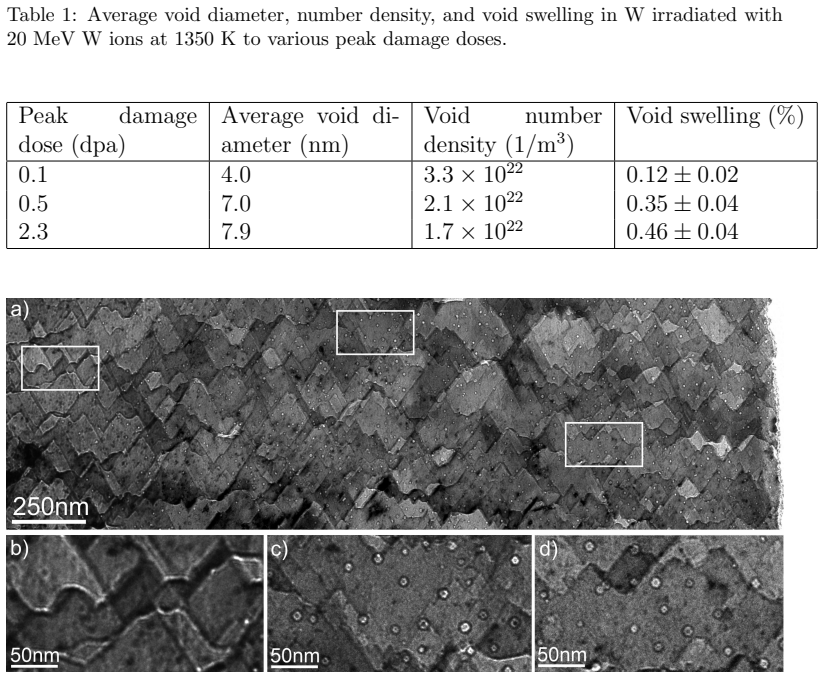
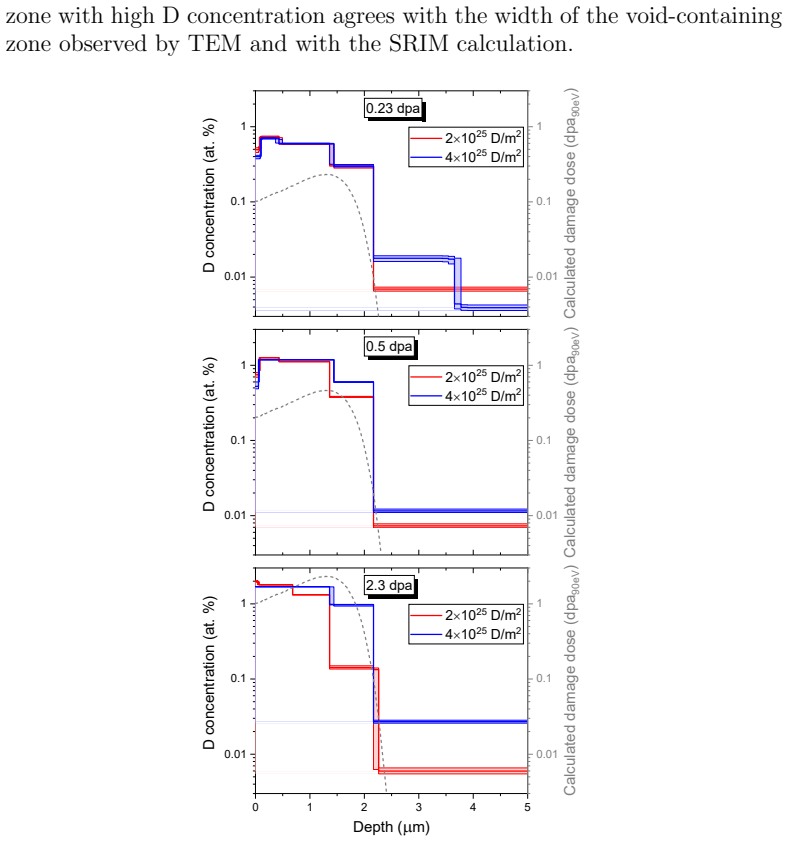
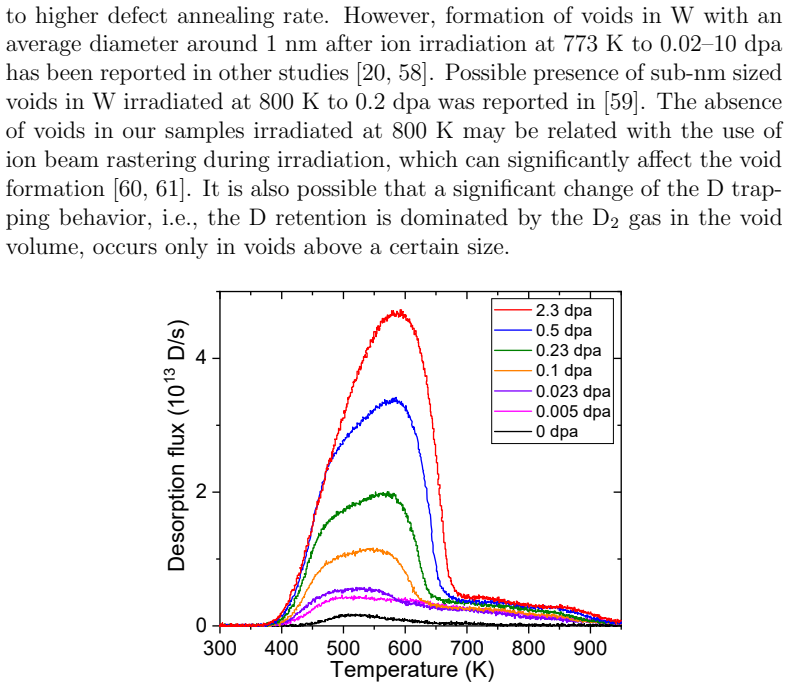
Recrystallized tungsten irradiated at 1350 K to peak damage doses of 0.001-2.3 dpa develops nm-sized voids visible by transmission electron microscopy. After low-energy deuterium plasma exposure at 370 K the maximum trapped deuterium concentration is lower than after 800 K irradiation for doses below 0.1 dpa, but exceeds it at higher doses and reaches 1.7 at.% at 2.3 dpa with no saturation. Thermal desorption spectra differ from those obtained after lower-temperature irradiations, and reaction-diffusion simulations account for the spectra by trapping deuterium as D2 molecules inside the void volume and as D atoms at the void surfaces.
What carries the argument
nm-sized voids that trap deuterium as D2 gas in their interior volume and as D atoms on their surfaces, modeled by reaction-diffusion simulations to match the measured thermal desorption spectra.
If this is right
- Deuterium retention in high-temperature-irradiated tungsten increases with damage dose beyond the levels seen after 800 K irradiation.
- The dominant trapping sites shift from those present at lower irradiation temperatures to the surfaces and interiors of the nm voids.
- Thermal desorption spectra can be reproduced by assuming D2 gas inside voids and D atoms on void surfaces without invoking additional trap types.
- Retention shows no saturation up to at least 2.3 dpa, implying continued growth of the void population or their trapping capacity.
Where Pith is reading between the lines
- If the same void-based trapping operates in fusion reactor walls, tritium inventory estimates for high-temperature regions may need upward revision at high neutron doses.
- The transition from lower to higher retention occurs between 0.1 and 2.3 dpa, suggesting a critical damage threshold at which voids become the controlling defect.
- Extending the irradiation temperature or dose range could test whether void growth eventually leads to blistering or other macroscopic surface changes.
Load-bearing premise
The nm-sized voids seen in TEM are the main reason for the changed retention behavior and that no other irradiation-induced defects contribute substantially to trapping.
What would settle it
Measuring deuterium retention and performing TEM on samples irradiated at 1350 K to doses above 2.3 dpa to check whether the concentration continues to rise or finally saturates, or finding additional defect types that trap deuterium outside the voids.
Figures





read the original abstract
Recrystallized tungsten (W) samples were irradiated by 20 MeV self-ions at 1350 K to peak damage doses in the range of 0.001-2.3 dpa. The irradiation-induced defects were then decorated with deuterium (D) by a gentle D plasma exposure ($<5$ eV/D, $5.6 \times 10^{19}$ $\text{D} / (\text{m}^2 \text{s})$) at 370 K. The D depth profiles in the samples were measured using $\rm D(^{3}He,p)\alpha$ nuclear reaction analysis. The maximum trapped D concentration evolves differently with the damage dose compared with the previously studied irradiations at 290 K and 800 K. At the damage doses below 0.1 dpa, the D concentrations are lower than those after the irradiation at 800 K. At higher damage doses, the D concentrations exceed the 800 K values and reach 1.7 at.% at 2.3 dpa, showing no clear tendency towards saturation. Transmission electron microscopy revealed the presence of nm-sized voids in the samples irradiated at 1350 K, in contrast to the ones irradiated at 290 K and 800 K. Thermal desorption spectroscopy (TDS) indicates that the dominant D trapping sites are different compared to the irradiations at 290 K and 800 K. Reaction-diffusion simulations show that the TDS spectra can be described by assuming that D is trapped as $\rm D_2$ gas in the void volume and as D atoms at the void surface.
Editorial analysis
A structured set of objections, weighed in public.
Referee Report
Summary. The manuscript reports experimental results on deuterium retention in recrystallized tungsten irradiated with 20 MeV self-ions at 1350 K to peak damage doses of 0.001–2.3 dpa, followed by low-energy D plasma exposure at 370 K. NRA depth profiling shows that D concentrations are lower than in prior 800 K irradiations below 0.1 dpa but exceed them at higher doses, reaching 1.7 at.% at 2.3 dpa with no saturation. TEM reveals nm-sized voids only in the 1350 K samples, and TDS spectra are reproduced by reaction-diffusion simulations assuming D2 gas in void volumes plus D atoms on void surfaces.
Significance. If the void-based trapping interpretation holds after quantitative validation, the work identifies a distinct high-temperature regime for defect evolution and D retention in W that differs from lower-temperature behavior, with direct relevance to tritium inventory predictions in fusion divertor materials.
major comments (3)
- [Abstract, TEM results, and reaction-diffusion simulations] The central claim that D retention reaches 1.7 at.% at 2.3 dpa with no saturation and is dominated by voids requires a forward calculation from the TEM-observed void number density and size distribution to the measured D inventory (via ideal-gas D2 pressure at the observed TDS release temperature plus surface coverage); this link is not provided in the results or simulation sections.
- [NRA profiling and dose-dependence results] The NRA-derived D concentrations versus dose lack reported error bars, uncertainties from counting statistics or depth resolution, and details on replicate measurements, which weakens the assertion of a clear crossover above 0.1 dpa and the lack of saturation.
- [TDS and simulations] The reaction-diffusion model reproduces TDS spectra under the void-trapping assumption, but the manuscript does not report whether alternative defect populations (e.g., dislocation loops or sub-TEM vacancy clusters) were tested or ruled out, nor the goodness-of-fit metrics or free-parameter values used.
minor comments (2)
- [Experimental methods] The D plasma exposure is specified by flux but the total fluence or exposure duration should be stated explicitly in the methods for reproducibility.
- [Figures] Figures showing NRA profiles and TDS spectra would be clearer with raw data points, error bars, and direct overlays of the simulation fits.
Simulated Author's Rebuttal
We thank the referee for the constructive and detailed comments, which help improve the clarity and rigor of our manuscript. We address each major comment point by point below, indicating where revisions will be made.
read point-by-point responses
-
Referee: [Abstract, TEM results, and reaction-diffusion simulations] The central claim that D retention reaches 1.7 at.% at 2.3 dpa with no saturation and is dominated by voids requires a forward calculation from the TEM-observed void number density and size distribution to the measured D inventory (via ideal-gas D2 pressure at the observed TDS release temperature plus surface coverage); this link is not provided in the results or simulation sections.
Authors: We agree that a quantitative forward calculation linking the TEM-observed void number density and size distribution to the NRA-measured D inventory would strengthen the central claim. In the revised manuscript, we will add this calculation in the results or discussion section. It will estimate the trapped deuterium from D2 gas (using the ideal gas law at the TDS release temperature) plus surface-bound D atoms (assuming monolayer coverage) and compare the result directly to the observed retention of 1.7 at.% at 2.3 dpa. revision: yes
-
Referee: [NRA profiling and dose-dependence results] The NRA-derived D concentrations versus dose lack reported error bars, uncertainties from counting statistics or depth resolution, and details on replicate measurements, which weakens the assertion of a clear crossover above 0.1 dpa and the lack of saturation.
Authors: We acknowledge that error bars, uncertainty details, and replicate information were omitted from the original submission. In the revised manuscript, we will add error bars to the D concentration versus dose plot, derived from counting statistics in the NRA measurements and depth resolution considerations. We will also include a statement on the number of replicate samples measured at each dose to support the reported crossover above 0.1 dpa and the absence of saturation up to 2.3 dpa. revision: yes
-
Referee: [TDS and simulations] The reaction-diffusion model reproduces TDS spectra under the void-trapping assumption, but the manuscript does not report whether alternative defect populations (e.g., dislocation loops or sub-TEM vacancy clusters) were tested or ruled out, nor the goodness-of-fit metrics or free-parameter values used.
Authors: We will revise the simulation section to report the specific free-parameter values used in the reaction-diffusion model and include quantitative goodness-of-fit metrics (e.g., reduced chi-squared) for the agreement with experimental TDS spectra. Regarding alternatives, the model is grounded in the TEM observation of nm-sized voids as the primary defect at 1350 K; we will add a discussion noting that other populations such as dislocation loops or sub-TEM clusters were not explicitly simulated but are expected to be less dominant based on the high-temperature release peak and dose dependence. This addresses the reporting gap while remaining consistent with the data presented. revision: partial
Circularity Check
No significant circularity; experimental results and model fits are independent of self-defined inputs
full rationale
The paper reports direct experimental measurements (NRA depth profiles, TDS spectra, TEM void observations) of D retention as a function of damage dose at 1350 K. The reaction-diffusion simulations are presented only as a descriptive fit ('can be described by assuming' D2 gas in voids plus surface atoms), with no equations or parameters shown to reduce the reported 1.7 at.% concentration or TDS peaks to quantities defined solely by prior fits from the same authors. Prior-temperature comparisons supply context but carry no load-bearing uniqueness theorem or ansatz that forces the current conclusions. The chain remains self-contained against external benchmarks.
Axiom & Free-Parameter Ledger
free parameters (1)
- void trapping energies and densities
axioms (1)
- domain assumption D trapping occurs primarily as D2 gas inside voids and atomic D on void surfaces
Reference graph
Works this paper leans on
-
[1]
G. Federici, W. Biel, M. Gilbert, R. Kemp, N. Taylor, R. Wenninger, European demo design strategy and consequences for materials, Nuclear Fusion 57 (9) (2017) 092002.doi:10.1088/1741-4326/57/9/092002. 23 W density ρ 6.306×10 28 at./m3 Jump distance between near- est interstitial sites λ 1.12×10 −10 m Number of interstitial sites per lattice atom h 6 Diffu...
-
[2]
Y. Ueda, K. Schmid, M. Balden, J. Coenen, T. Loewenhoff, A. Ito, A. Hasegawa, C. Hardie, M. Porton, M. Gilbert, Baseline high heat flux and plasma facing materials for fusion, Nuclear Fusion 57 (9) (2017) 092006.doi:10.1088/1741-4326/aa6b60
-
[3]
fireplace
S. J. Zinkle, A. Quadling, Extreme materials environment of the fusion 24 “fireplace”, MRS Bulletin 47 (11) (2022) 1113–1119.doi:10.1557/ s43577-022-00453-9
2022
-
[4]
S. J. Zinkle, 1.04 - radiation-induced effects on microstructure, in: R. J. Konings, R. E. Stoller (Eds.), Comprehensive Nuclear Materials (Second Edition), Elsevier, Oxford, 2020, pp. 91–129.doi:10.1016/ B978-0-12-803581-8.12075-2
2020
-
[5]
A. Bhattacharya, S. J. Zinkle, 1.12 - cavity swelling in irradiated ma- terials, in: R. J. Konings, R. E. Stoller (Eds.), Comprehensive Nu- clear Materials (Second Edition), Elsevier, Oxford, 2020, pp. 406–455. doi:10.1016/B978-0-12-803581-8.11599-1
-
[6]
X. Hu, Recent progress in experimental investigation of neutron irra- diation response of tungsten, Journal of Nuclear Materials 568 (2022) 153856.doi:10.1016/j.jnucmat.2022.153856
-
[7]
G. S. Was, S. J. Zinkle, 1.14 - Toward the Use of Ion Irradiation to Predict Reactor Irradiation Effects, in: R. J. Konings, R. E. Stoller (Eds.), Comprehensive Nuclear Materials (Second Edition), Elsevier, Oxford, 2020.doi:10.1016/B978-0-12-803581-8.12053-3
-
[8]
M. Boleininger, D. R. Mason, T. Schwarz-Selinger, P.-W. Ma, Atomistic simulations of irradiation damage on the engineering timescale: exam- ining the dose rate effect in tungsten, Mater. Adv. 6 (2025) 7379–7394. doi:10.1039/D5MA00677E
-
[9]
W. Zhao, Y.-H. Li, H.-Z. Ma, Y.-Z. Niu, Z. Yang, D. Terentyev, H.-B. Zhou, G.-H. Lu, Dependence of irradiation defects evolution on dose rate and pka energy spectrum in tungsten, Nuclear Materials and Energy 43 (2025) 101956.doi:10.1016/j.nme.2025.101956
-
[10]
T. Schwarz-Selinger, A critical review of experiments on deuterium retention in displacement-damaged tungsten as function of damaging dose, Materials Research Express 10 (2023) 102002.doi:10.1088/ 2053-1591/acfdf8
2023
-
[11]
D. R. Mason, F. Granberg, M. Boleininger, T. Schwarz-Selinger, K. Nordlund, S. L. Dudarev, Parameter-free quantitative simula- tion of high-dose microstructure and hydrogen retention in ion- 25 irradiated tungsten, Phys. Rev. Mater. 5 (2021) 095403.doi:10.1103/ PhysRevMaterials.5.095403
2021
-
[12]
M. Boleininger, D. R. Mason, A. E. Sand, S. L. Dudarev, Microstructure of a heavily irradiated metal exposed to a spectrum of atomic recoils, Sci- entific Reports 13 (1) (2023) 1684.doi:10.1038/s41598-022-27087-w
-
[13]
A. Hollingsworth, M.-F. Barthe, M. Y. Lavrentiev, P. Derlet, S. Du- darev, D. Mason, Z. Hu, P. Desgardin, J. Hess, S. Davies, B. Thomas, H. Salter, E. Shelton, K. Heinola, K. Mizohata, A. De Backer, A. Baron- Wiechec, I. Jepu, Y. Zayachuk, A. Widdowson, E. Meslin, A. Morellec, Comparative study of deuterium retention and vacancy content of self- ion irrad...
-
[14]
B. Wielu´ nska-Ku´ s, M. Dickmann, W. Egger, M. Zibrov, L. Ciupi´ nski, Positron lifetime study of ion-irradiated tungsten: Ion type and dose effects, Nuclear Materials and Energy 38 (2024) 101610.doi:10.1016/ j.nme.2024.101610
-
[15]
A. Reza, H. Yu, K. Mizohata, F. Hofmann, Thermal diffusivity degrada- tion and point defect density in self-ion implanted tungsten, Acta Ma- terialia 193 (2020) 270–279.doi:10.1016/j.actamat.2020.03.034
-
[16]
M. Klimenkov, M. D¨ urrschnabel, U. J¨ antsch, P. Lied, M. Rieth, H. Schneider, D. Terentyev, W. Van Renterghem, Microstructural anal- ysis of W irradiated at different temperatures, Journal of Nuclear Ma- terials 572 (2022) 154018.doi:10.1016/j.jnucmat.2022.154018
-
[17]
M. Klimenkov, U. J¨ antsch, M. Rieth, H. Schneider, D. Terentyev, W. Van Renterghem, Influence of transmutation-induced Re/Os con- tent on defect evolution in neutron-irradiated W, Journal of Nuclear Materials 592 (2024) 154950.doi:10.1016/j.jnucmat.2024.154950
-
[18]
M. Klimenkov, U. J¨ antsch, M. Rieth, H. Schneider, D. Terentyev, W. Van Renterghem, Effect of irradiation parameters on defect evo- lution in neutron irradiated tungsten, Journal of Nuclear Materials 607 (2025) 155673.doi:10.1016/j.jnucmat.2025.155673. 26
-
[19]
S. Wang, H. Wang, X. Yi, W. Tan, L. Ge, Y. Sun, W. Guo, Q. Yang, L. Cheng, X. Zhang, Y. Yuan, X. Cao, E. Fu, G.-H. Lu, Damage recov- ery stages revisited: Thermal evolution of non-saturated and saturated displacement damage in heavy-ion irradiated tungsten, Acta Materialia 273 (2024) 119942.doi:10.1016/j.actamat.2024.119942
-
[20]
S. Wang, H. Wang, W. Tan, X. Yi, Z. Hu, T. Schwarz-Selinger, D. R. Mason, M.-F. Barthe, P. Desgardin, S. Shen, L. Cheng, X. Zhang, Y. Yuan, E. Fu, G.-H. Lu, Displacement damage saturation in tung- sten at elevated temperatures, Acta Materialia 310 (2026) 122148. doi:10.1016/j.actamat.2026.122148
-
[21]
J. Hou, X.-S. Kong, X. Wu, J. Song, C. S. Liu, Predictive model of hydrogen trapping and bubbling in nanovoids in bcc metals, Nature Materials 18 (2019) 833–839.doi:10.1038/s41563-019-0422-4
-
[22]
Q.-Y. Ren, Y.-H. Li, H.-B. Zhou, Z.-Z. Li, L. Cheng, G.-H. Lu, Char- acterization of the energetics and configurations of hydrogen in va- cancy clusters in tungsten, Nuclear Fusion 59 (10) (2019) 106032. doi:10.1088/1741-4326/ab36a4
-
[23]
Van Veen, H
A. Van Veen, H. Filius, J. De Vries, K. Bijkerk, G. Rozing, D. Segers, Hydrogen exchange with voids in tungsten observed with TDS and PA, Journal of Nuclear Materials 155-157 (1988) 1113–1117.doi:10.1016/ 0022-3115(88)90478-3
1988
-
[25]
M. Zibrov, K. Schmid, Reaction–diffusion simulations of hydrogen iso- tope trapping and release from cavities in tungsten, II: Array of cavities, Nuclear Materials and Energy 32 (2022) 101219.doi:10.1016/j.nme. 2022.101219
-
[26]
O. Ogorodnikova, Y. Gasparyan, V. Efimov, L. Ciupi´ nski, J. Grzonka, Annealing of radiation-induced damage in tungsten under and after ir- radiation with 20 MeV self-ions, Journal of Nuclear Materials 451 (2014) 379 – 386.doi:10.1016/j.jnucmat.2014.04.011. 27
-
[27]
S. Sakurada, K. Yuyama, Y. Uemura, H. Fujita, C. Hu, T. Toyama, N. Yoshida, T. Hinoki, S. Kondo, M. Shimada, D. Buchenauer, T. Chikada, Y. Oya, Annealing effects on deuterium retention behavior in damaged tungsten, Nuclear Materials and Energy 9 (2016) 141–144. doi:10.1016/j.nme.2016.06.012
-
[28]
M. Simmonds, Y. Wang, J. Barton, M. Baldwin, J. Yu, R. Doerner, G. Tynan, Reduced deuterium retention in simultaneously damaged and annealed tungsten, Journal of Nuclear Materials 494 (2017) 67–71.doi: 10.1016/j.jnucmat.2017.06.010
-
[29]
S. Markelj, T. Schwarz-Selinger, M. Peˇ covnik, A. Zaloˇ znik, M. Kelemen, I. ˇCadeˇ z, J. Bauer, P. Pelicon, W. Chromi´ nski, L. Ciupinski, Displace- ment damage stabilization by hydrogen presence under simultaneous W ion damage and D ion exposure, Nuclear Fusion 59 (8) (2019) 086050. doi:10.1088/1741-4326/ab2261
-
[30]
M. Kobayashi, M. Shimada, C. N. Taylor, D. Buchenauer, R. Kolasin- ski, T. Koyanagi, Y. Nobuta, Y. Hatano, Y. Oya, Influence of dynamic annealing of irradiation defects on the deuterium retention behaviors in tungsten irradiated with neutron, Fusion Engineering and Design 146 (2019) 1624–1627.doi:10.1016/j.fusengdes.2019.03.003
-
[31]
J. Wang, Y. Hatano, T. Hinoki, V. K. Alimov, A. V. Spitsyn, N. P. Bobyr, S. Kondo, T. Toyama, H. T. Lee, Y. Ueda, T. Schwarz-Selinger, Deuterium retention in W and binary W alloys irradiated with high energy Fe ions, Journal of Nuclear Materials 545 (2021) 152749.doi: 10.1016/j.jnucmat.2020.152749
-
[32]
S. Markelj, M. Peˇ covnik, T. Schwarz-Selinger, M. Kelemen, The syner- gies between displacement damage creation and hydrogen presence: the effect of D ion energy and flux, Physica Scripta 97 (2) (2022) 024006. doi:10.1088/1402-4896/ac4860
-
[33]
X.-L. Zhu, Z.-H. Ke, L. Cheng, P. Zhang, Y. Yuan, X.-Z. Cao, G.-H. Lu, The effect of high-temperature pre-damage on vacancy-type defects and deuterium retention in tungsten, Nuclear Materials and Energy 38 (2024) 101620.doi:10.1016/j.nme.2024.101620. 28
-
[34]
M. Oya, M. Shimada, C. Taylor, M. Kobayashi, Y. Nobuta, Y. Ya- mauchi, Y. Oya, Y. Ueda, Y. Hatano, Deuterium retention in tungsten irradiated by high-dose neutrons at high temperature, Nuclear Materials and Energy 27 (2021) 100980.doi:10.1016/j.nme.2021.100980
-
[35]
Schwarz-Selinger, Unpublished data
T. Schwarz-Selinger, Unpublished data. Partially presented in: irradia- tions at 290 K [D. R. Mason et al., Phys. Rev. Mater. 5 (2021) 095403]; irradiations at 800 K [J. Dark et al., Nucl. Fusion 64 (2024) 086026] and [M. Boleininger et al, Mater. Adv. 6 (2025) 7379]
2021
-
[36]
W. Chrominski, L. Ciupinski, P. Bazarnik, S. Markelj, T. Schwarz- Selinger, TEM investigation of the influence of dose rate on radiation damage and deuterium retention in tungsten, Materials Characteriza- tion 154 (2019) 1–6.doi:10.1016/j.matchar.2019.05.028
-
[37]
M. Zibrov, A. Cintora, T. Schwarz-Selinger, K. Hunger, M. Mayer, N. Bobyr, Deuterium retention in displacement-damaged tungsten- rhenium alloys: Influence of rhenium concentration and irradiation temperature, Nuclear Materials and Energy 41 (2024) 101730.doi: 10.1016/j.nme.2024.101730
-
[38]
A. Manhard, G. Matern, M. Balden, A step-by-step analysis of the pol- ishing process for tungsten specimens, Practical Metallography 50 (1) (2013) 5–16.doi:10.3139/147.110215
-
[39]
A. Manhard, M. Balden, S. Elgeti, Quantitative microstructure and de- fect density analysis of polycrystalline tungsten reference samples after different heat treatments, Practical Metallography 52 (8) (2015) 437– 466.doi:10.3139/147.110354
-
[40]
T. Schwarz-Selinger, Deuterium retention in MeV self-implanted tung- sten: Influence of damaging dose rate, Nuclear Materials and Energy 12 (2017) 683 – 688.doi:10.1016/j.nme.2017.02.003
-
[41]
G. Was, S. Taller, Z. Jiao, A. Monterrosa, D. Woodley, D. Jennings, T. Kubley, F. Naab, O. Toader, E. Uberseder, Resolution of the carbon contamination problem in ion irradiation experiments, Nuclear Instru- ments and Methods in Physics Research Section B: Beam Interactions with Materials and Atoms 412 (2017) 58–65.doi:10.1016/j.nimb. 2017.08.039. 29
-
[43]
M. Guitart Corominas, T. Schwarz-Selinger, Experimental determina- tion of the 16o(3he,p0)18f differential cross section, Nuclear Instruments and Methods in Physics Research Section B: Beam Interactions with Ma- terials and Atoms 450 (2019) 13–18.doi:10.1016/j.nimb.2018.05. 018
-
[44]
J. F. Ziegler, J. P. Biersack, M. D. Ziegler, SRIM - The Stopping and Range of Ions in Matter, www.srim.org
-
[45]
ASTM E521-16, Standard Practice for Investigating the Effects of Neu- tron Radiation Damage Using Charged-Particle Irradiation, ASTM In- ternational, West Conshohocken, PA, USA, 2016, www.astm.org.doi: 10.1520/E0521-16
-
[46]
R. Stoller, M. Toloczko, G. Was, A. Certain, S. Dwaraknath, F. Garner, On the use of SRIM for computing radiation damage exposure, Nuclear Instruments and Methods in Physics Research Section B 310 (2013) 75 – 80.doi:10.1016/j.nimb.2013.05.008
-
[47]
A. Manhard, T. Schwarz-Selinger, W. Jacob, Quantification of the deu- terium ion fluxes from a plasma source, Plasma Sources Science and Technology 20 (2011) 015010.doi:10.1088/0963-0252/20/1/015010
-
[48]
M. Mayer, E. Gauthier, K. Sugiyama, U. von Toussaint, Quantitative depth profiling of deuterium up to very large depths, Nuclear Instru- ments and Methods in Physics Research Section B 267 (2009) 506 – 512.doi:10.1016/j.nimb.2008.11.033
-
[49]
Schmid, U
K. Schmid, U. von Toussaint, Statistically sound evaluation of trace element depth profiles by ion beam analysis, Nuclear Instruments and Methods in Physics Research Section B 281 (2012) 64 – 71.doi:10. 1016/j.nimb.2012.03.024
2012
-
[50]
Mayer, SIMNRA user’s guide, Tech
M. Mayer, SIMNRA user’s guide, Tech. Rep. IPP 9/113 (1997). URLhttp://home.mpcdf.mpg.de/ ~mam/Report%20IPP%209-113.pdf 30
1997
-
[51]
B. Wielunska, M. Mayer, T. Schwarz-Selinger, U. von Toussaint, J. Bauer, Cross section data for the D( 3He,p) 4He nuclear reaction from 0.25 to 6 MeV, Nuclear Instruments and Methods in Physics Research Section B 371 (2016) 41 – 45.doi:10.1016/j.nimb.2015.09.049
-
[52]
W. M¨ oller, F. Besenbacher, A note on the 3He + D nuclear-reaction cross section, Nuclear Instruments and Methods 168 (1) (1980) 111– 114.doi:10.1016/0029-554X(80)91239-2
-
[53]
T. Schwarz-Selinger, T. D¨ urbeck, A. Manhard, In-situ water signal cali- bration method for thermal desorption spectroscopy, Nuclear Materials and Energy 45 (2025) 102029.doi:10.1016/j.nme.2025.102029
-
[54]
S. Wang, H. Wang, X. Yi, Y. Sun, S. Shen, W. Guo, Q. Yang, L. Cheng, Y. Yuan, X. Cao, E. Fu, G.-H. Lu, A combinatorial scheme to tai- lor saturated displacement damage in heavy-ion irradiated tungsten via post-irradiation annealing, Nuclear Fusion 66 (5) (2026) 056015. doi:10.1088/1741-4326/ae4fe2
-
[55]
B. Horv´ ath, R. Sch¨ aublin, Y. Dai, Flash electropolishing of tem lamellas of irradiated tungsten, Nuclear Instruments and Methods in Physics Research Section B: Beam Interactions with Materials and Atoms 449 (2019) 29–34.doi:10.1016/j.nimb.2019.04.047
-
[56]
L. Shao, Z. Hu, A. French, Y. Li, Y. Hong, F. A. Garner, Origin of sub- surface swelling peaks in ion irradiation and their mitigation through dose rate control, Materials Today Communications 48 (2025) 113553. doi:10.1016/j.mtcomm.2025.113553
-
[57]
Agnoli, Kinetics of deuterium uptake in self-ion irradiated tungsten at different temperatures, Tech
D. Agnoli, Kinetics of deuterium uptake in self-ion irradiated tungsten at different temperatures, Tech. Rep. IPP 2026-07, Max-Planck-Institut f¨ ur Plasmaphysik, Garching (2026).doi:10.17617/2.3697177
-
[58]
Z. Hu, P. Desgardin, C. Genevois, J. Joseph, B. D´ ecamps, R. Sch¨ aublin, M.-F. Barthe, Effect of purity on the vacancy defects induced in self–irradiated tungsten: A combination of pas and tem, Journal of Nuclear Materials 556 (2021) 153175.doi:10.1016/j.jnucmat.2021. 153175. 31
-
[59]
J. Zavaˇ snik, A. ˇSestan, T. Schwarz-Selinger, K. Hunger, E. Lu, F. Tuomisto, K. Nordlund, E. Punz´ on-Quijorna, M. Kelemen, J. Pre- drag, M. Crespillo, G. G. L´ opez, P. Zhang, X. Cao, S. Markelj, Mi- crostructural analysis of tungsten single crystals irradiated by mev w ions: The effect of irradiation dose and temperature, Materials Charac- terization ...
-
[60]
E. Getto, Z. Jiao, A. Monterrosa, K. Sun, G. Was, Effect of ir- radiation mode on the microstructure of self-ion irradiated ferritic- martensitic alloys, Journal of Nuclear Materials 465 (2015) 116–126. doi:10.1016/j.jnucmat.2015.05.016
-
[61]
J. G. Gigax, E. Aydogan, T. Chen, D. Chen, L. Shao, Y. Wu, W. Lo, Y. Yang, F. Garner, The influence of ion beam rastering on the swelling of self-ion irradiated pure iron at 450°C, Journal of Nuclear Materials 465 (2015) 343–348.doi:10.1016/j.jnucmat.2015.05.025
-
[62]
S. Kapser, M. Balden, T. F. da Silva, S. Elgeti, A. Manhard, K. Schmid, T. Schwarz-Selinger, U. von Toussaint, Influence of sub- surface damage evolution on low-energy-plasma-driven deuterium per- meation through tungsten, Nuclear Fusion 58 (5) (2018) 056027.doi: 10.1088/1741-4326/aab571
-
[63]
I. Takagi, Diffusive Behaviors of Deuterium in Nickel under Irradiation of Helium-3, Journal of Nuclear Science and Technology 29 (10) (1992) 947–956.doi:10.1080/18811248.1992.9731618
-
[64]
Holzner, Determining fundamental transport parameters of hydrogen isotopes in tungsten, Ph.D
G. Holzner, Determining fundamental transport parameters of hydrogen isotopes in tungsten, Ph.D. thesis, Report IPP 2020-09 (2020). URLhttp://hdl.handle.net/21.11116/0000-0007-4806-2
2020
-
[65]
Frauenfelder, Solution and diffusion of hydrogen in tungsten, Journal of Vacuum Science and Technology 6 (3) (1969) 388–397.doi:10.1116/ 1.1492699
R. Frauenfelder, Solution and diffusion of hydrogen in tungsten, Journal of Vacuum Science and Technology 6 (3) (1969) 388–397.doi:10.1116/ 1.1492699
1969
-
[66]
P. Alnot, A. Cassuto, D. King, Adsorption and desorption kinetics with no precursor trapping: Hydrogen and deuterium on W 100, Surface Science 215 (1) (1989) 29–46.doi:10.1016/0039-6028(89)90697-3
-
[67]
M. Ajmalghan, Z. Piazza, E. Hodille, Y. Ferro, Surface coverage depen- dent mechanisms for the absorption and desorption of hydrogen from 32 the W(110) and W(100) surfaces: a density functional theory investiga- tion, Nuclear Fusion 59 (10) (2019) 106022.doi:10.1088/1741-4326/ ab33e7
-
[68]
Y. Ferro, E. Hodille, J. Denis, Z. Piazza, M. Ajmalghan, Hydrogen and oxygen on tungsten (110) surface: adsorption, absorption and desorption investigated by density functional theory, Nuclear Fusion 63 (3) (2023) 036017.doi:10.1088/1741-4326/acb0e2
-
[69]
E. Hodille, B. Pavec, J. Denis, A. Dunand, Y. Ferro, M. Minissale, T. Angot, C. Grisolia, R. Bisson, Deuterium uptake, desorption and sputtering from w(110) surface covered with oxygen, Nuclear Fusion 64 (4) (2024) 046022.doi:10.1088/1741-4326/ad2a29
-
[70]
P. W. Tamm, L. D. Schmidt, Binding states of hydrogen on tungsten, The Journal of Chemical Physics 54 (1971) 4775–4787.doi:10.1063/ 1.1674753
1971
-
[71]
M. Zibrov, S. Ryabtsev, Y. Gasparyan, A. Pisarev, Experimental deter- mination of the deuterium binding energy with vacancies in tungsten, Journal of Nuclear Materials 477 (2016) 292 – 297.doi:10.1016/j. jnucmat.2016.04.052
work page doi:10.1016/j 2016
-
[72]
Hagelstein, Equation of state and fugacity models forH 2 and forD 2, Journal of Condensed Matter Nuclear Science 16 (2015) 23–45
P. Hagelstein, Equation of state and fugacity models forH 2 and forD 2, Journal of Condensed Matter Nuclear Science 16 (2015) 23–45. URLhdl.handle.net/1721.1/122604
2015
-
[73]
E. Gregoryanz, C. Ji, P. Dalladay-Simpson, B. Li, R. T. Howie, H.-K. Mao, Everything you always wanted to know about metallic hydrogen but were afraid to ask, Matter and Radiation at Extremes 5 (3) (2020) 038101.doi:10.1063/5.0002104
-
[74]
V. Diatschenko, C. W. Chu, D. H. Liebenberg, D. A. Young, M. Ross, R. L. Mills, Melting curves of molecular hydrogen and molecular deu- terium under high pressures between 20 and 373 K, Phys. Rev. B 32 (1985) 381–389.doi:10.1103/PhysRevB.32.381
-
[75]
J.-M. Joubert, A calphad-type equation of state for hydrogen gas and its application to the assessment of Rh–H system, International Journal of Hydrogen Energy 35 (2010) 2104–2111.doi:10.1016/j.ijhydene. 2010.01.006. 33
-
[76]
Joubert, S
J.-M. Joubert, S. Thi´ ebaut, A thermodynamic description of the system Pd–Rh–H–D–T, Acta Materialia 59 (2011) 1680–1691.doi:10.1016/ j.actamat.2010.11.035
2011
-
[77]
R. Kolasinski, D. Cowgill, R. Causey, A continuum-scale model of hy- drogen precipitate growth in tungsten plasma-facing materials, Journal of Nuclear Materials 415 (2011) S676–S679.doi:10.1016/j.jnucmat. 2010.10.077
-
[78]
T. Schwarz-Selinger, J. Bauer, S. Elgeti, S. Markelj, Influence of the presence of deuterium on displacement damage in tungsten, Nuclear Materials and Energy 17 (2018) 228–234.doi:10.1016/j.nme.2018. 10.005
-
[79]
C. San Marchi, B. Somerday, S. Robinson, Permeability, solubility and diffusivity of hydrogen isotopes in stainless steels at high gas pressures, International Journal of Hydrogen Energy 32 (2007) 100–116.doi: 10.1016/j.ijhydene.2006.05.008. 34
discussion (0)
Sign in with ORCID, Apple, or X to comment. Anyone can read and Pith papers without signing in.