Role of diffusion-induced grain boundary migration during molten salt corrosion of a Ni-30Cr alloy
Pith reviewed 2026-05-10 15:23 UTC · model grok-4.3
The pith
Diffusion-induced grain boundary migration drives chromium loss beyond lattice diffusion limits in Ni-30Cr molten salt corrosion.
A machine-rendered reading of the paper's core claim, the machinery that carries it, and where it could break.
Core claim
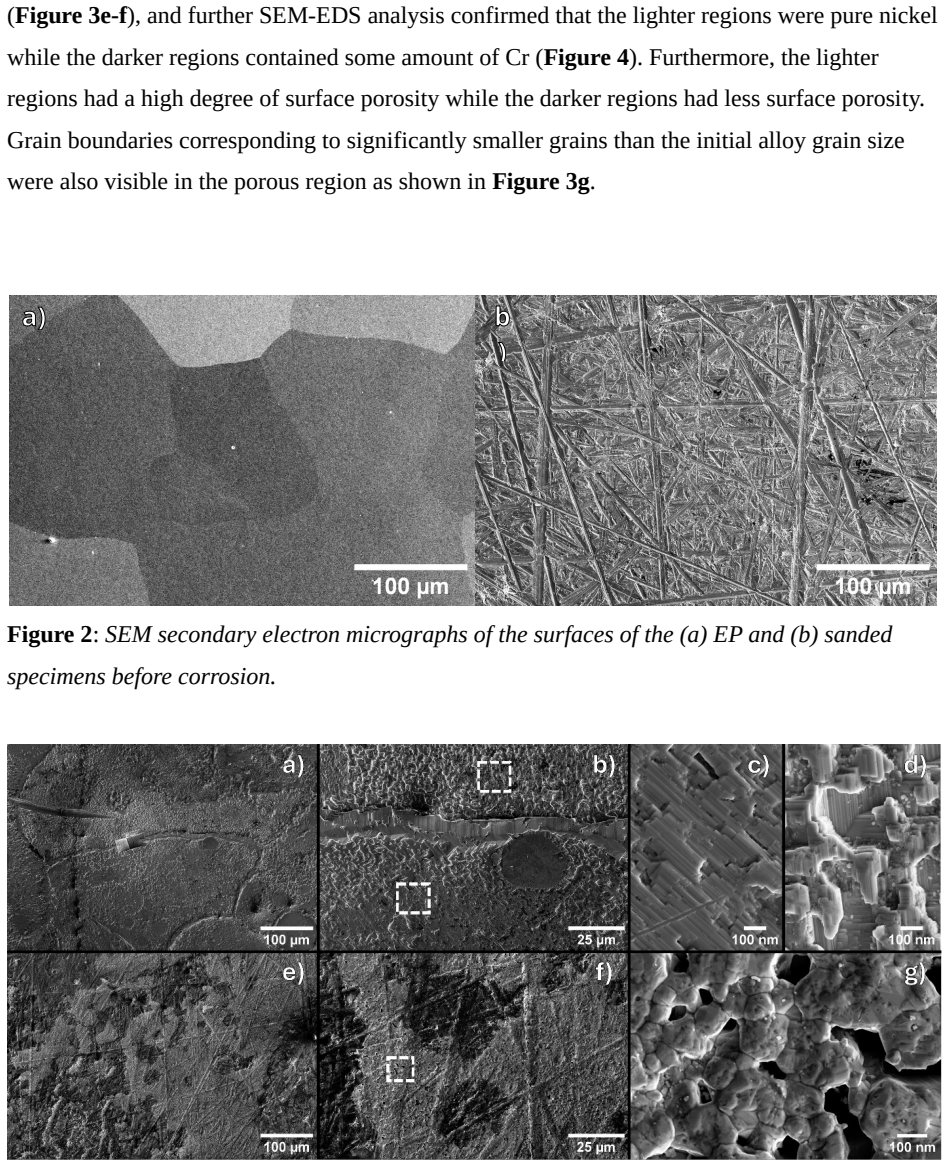
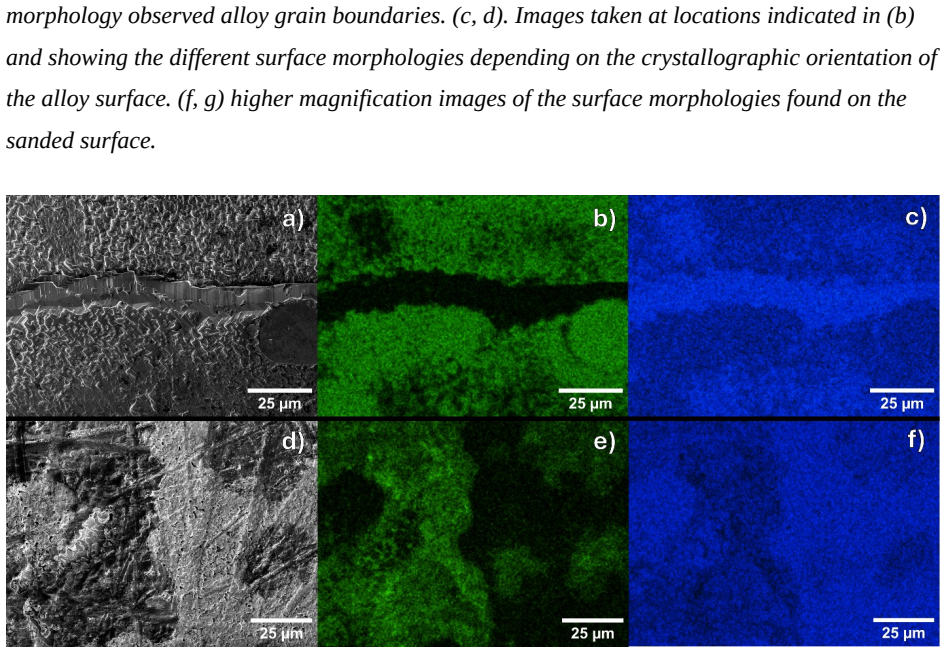
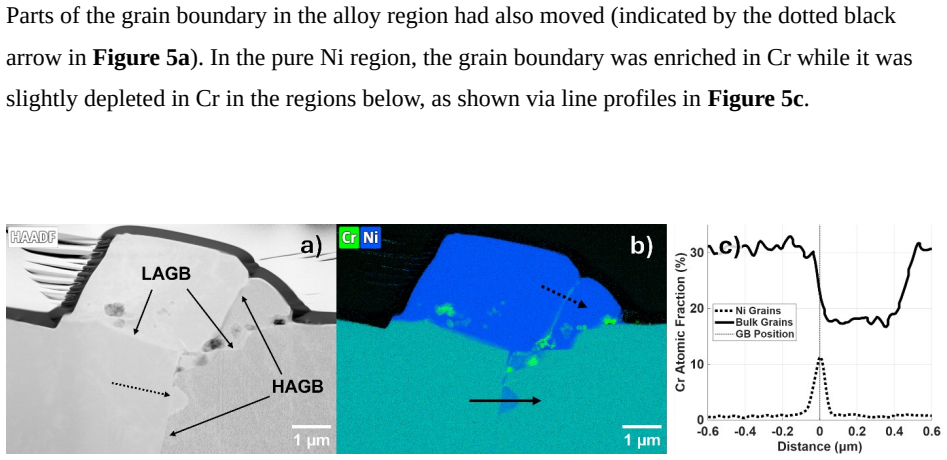
In the absence of fast diffusion pathways, dissolution occurred layer by layer and was kinetically controlled by Ni dissolution, as observed over the grain interiors of the electropolished sample. Grain boundaries were subject to diffusion-induced grain boundary migration (DIGM), leading to the formation of pure Ni islands above grain boundaries. This overall behavior contrasted with the sanded surface response that was characterized by several micrometer deep interconnected porosity and complete Cr depletion. DIGM of the dense grain boundaries created by recrystallization of the sanded surface was responsible for the observed sub-surface microstructure.
What carries the argument
Diffusion-induced grain boundary migration (DIGM), the motion of grain boundaries driven by solute diffusion that sweeps through the alloy, rapidly transports chromium outward and creates new nickel-rich structures.
If this is right
- Corrosion remains shallow and layer-limited when grain-boundary density is low, as seen on electropolished surfaces.
- Surface recrystallization activates extensive DIGM and produces deep, interconnected porosity.
- Kinetics inside unaffected grains are set by nickel dissolution rather than chromium diffusion rates.
- Alloy corrosion response in molten salts can be altered by changing initial grain-boundary density or character.
Where Pith is reading between the lines
- Alloys or processing routes that pin grain boundaries or suppress recrystallization could reduce DIGM-driven attack without changing bulk composition.
- The same boundary-migration process may operate in other dealloying or selective-dissolution systems, offering a general transport mechanism.
- Systematic variation of annealing temperature before exposure would separate recrystallization effects from mechanical damage introduced by sanding.
- In engineering components, fabrication steps that set near-surface grain structure could determine long-term performance under sustained molten-salt contact.
Load-bearing premise
The stark difference in corrosion depth and morphology between electropolished and sanded surfaces arises solely from DIGM enabled by recrystallization-induced grain boundary density, rather than from other unmeasured effects of sanding such as residual stress, surface contamination, or altered oxide layers.
What would settle it
In-situ microscopy that tracks whether grain boundaries migrate only on the sanded surface and whether that migration spatially correlates with the depth of porous chromium depletion would confirm the claim; deep porosity forming without observable boundary motion would falsify it.
Figures



read the original abstract
The response of Ni-Cr alloys to exposure to molten chloride and fluoride salts is typically characterized by Cr dealloying with the formation of a Cr-depleted bi-continuous porous subsurface layer. The exact mechanism behind the loss of Cr over distances unattainable by lattice diffusion alone is still debated. To address this question, two different surface finishes, namely electropolished and sanded, of a Ni-30Cr alloy were exposed to LiCl-KCl-2wt% EuCl3 eutectic salt at 500 {\deg}C for 96 hours. In the absence of fast diffusion pathways, dissolution occurred layer by layer and was kinetically controlled by Ni dissolution, as observed over the grain interiors of the electropolished sample. Grain boundaries were subject to diffusion-induced grain boundary migration (DIGM), leading to the formation of pure Ni islands above grain boundaries. This overall behavior contrasted with the sanded surface response that was characterized by several micrometer deep interconnected porosity and complete Cr depletion. DIGM of the dense grain boundaries created by recrystallization of the sanded surface was responsible for the observed sub-surface microstructure. This work unequivocally establishes DIGM as a key mechanism in alloy molten salt corrosion, and microstructure as a decisive contributor to an alloy's corrosion response.
Editorial analysis
A structured set of objections, weighed in public.
Referee Report
Summary. The manuscript examines the mechanism of Cr dealloying in a Ni-30Cr alloy during exposure to LiCl-KCl-2wt% EuCl3 molten salt at 500°C for 96 h by contrasting electropolished and sanded surface finishes. On electropolished surfaces, dissolution proceeds layer-by-layer in grain interiors while grain boundaries undergo DIGM to form pure-Ni islands; on sanded surfaces, recrystallization produces a high density of grain boundaries that enable extensive DIGM, resulting in several-micrometer-deep interconnected porosity and complete Cr depletion. The central claim is that DIGM is a key mechanism in alloy molten-salt corrosion and that microstructure is a decisive factor in the corrosion response.
Significance. If the mechanistic attribution holds, the work supplies direct comparative evidence that grain-boundary density and DIGM can dominate corrosion morphology over lattice diffusion in molten-salt environments. This would be relevant for surface-preparation protocols and alloy design in chloride-salt systems, and the purely observational, parameter-free character of the study is a methodological strength.
major comments (2)
- [Abstract] Abstract: the assertion that the study 'unequivocally establishes DIGM as a key mechanism' and that 'microstructure [is] a decisive contributor' rests on the untested premise that the observed morphological contrast arises solely from recrystallization-induced grain-boundary density. No pre-exposure data are presented on residual stress, surface-oxide thickness/composition, or contamination levels that could independently alter dissolution kinetics.
- [Results] Results section (qualitative descriptions of corrosion depths and morphologies): the manuscript reports only qualitative differences in porosity depth and Cr depletion without quantitative diffusion distances, error bars on depletion profiles, or measured grain-boundary densities before versus after exposure. This limits the ability to confirm that DIGM, rather than other sanding-induced effects, accounts for the several-micrometer penetration.
minor comments (1)
- [Abstract] The abstract would benefit from a concise statement of the key quantitative observations (e.g., approximate depletion depths or porosity depths) to allow readers to gauge the scale of the DIGM effect.
Simulated Author's Rebuttal
We thank the referee for their constructive and detailed review of our manuscript. We address each major comment below and describe the revisions we intend to make.
read point-by-point responses
-
Referee: [Abstract] Abstract: the assertion that the study 'unequivocally establishes DIGM as a key mechanism' and that 'microstructure [is] a decisive contributor' rests on the untested premise that the observed morphological contrast arises solely from recrystallization-induced grain-boundary density. No pre-exposure data are presented on residual stress, surface-oxide thickness/composition, or contamination levels that could independently alter dissolution kinetics.
Authors: We acknowledge that pre-exposure measurements of residual stress, surface-oxide thickness/composition, and contamination levels were not performed and could in principle influence dissolution kinetics. Our experimental design compares two surface preparations applied to material from the same alloy heat under identical exposure conditions, with the sanding step producing a recrystallized near-surface layer containing a high density of grain boundaries. This contrast allows us to link the enhanced DIGM and porosity to the increased grain-boundary density. We will revise the abstract to replace 'unequivocally establishes' with 'provides strong evidence for' and 'decisive contributor' with 'important contributor,' and we will add a sentence in the discussion section noting the absence of these pre-exposure characterizations as a limitation of the present study. revision: partial
-
Referee: [Results] Results section (qualitative descriptions of corrosion depths and morphologies): the manuscript reports only qualitative differences in porosity depth and Cr depletion without quantitative diffusion distances, error bars on depletion profiles, or measured grain-boundary densities before versus after exposure. This limits the ability to confirm that DIGM, rather than other sanding-induced effects, accounts for the several-micrometer penetration.
Authors: The manuscript is observational and focuses on the direct morphological evidence for DIGM (pure-Ni islands above grain boundaries in the electropolished condition and extensive interconnected porosity tied to recrystallized boundaries in the sanded condition). We will add quantitative estimates of grain-boundary density from the provided SEM images and report approximate corrosion depths with reference to multiple fields of view. These additions will help quantify the microstructural difference while preserving the mechanistic emphasis on DIGM. We note that the formation of pure-Ni islands specifically at grain boundaries in the electropolished sample provides direct evidence that DIGM, rather than generic sanding effects, drives the observed sub-surface evolution. revision: yes
Circularity Check
No circularity: purely observational comparison without equations or self-referential predictions
full rationale
The paper reports experimental observations of Ni-30Cr alloy corrosion in molten salt under two surface finishes (electropolished vs. sanded), noting layer-by-layer dissolution on electropolished grains versus deep interconnected porosity on sanded surfaces. It attributes the latter to DIGM enabled by recrystallization-induced grain boundaries based on post-exposure microstructure. No equations, fitted parameters, predictions, or derivation chain exist; the central claim rests on direct comparative imaging and interpretation rather than any reduction to inputs by construction or self-citation. This matches the default expectation for non-circular observational work.
Axiom & Free-Parameter Ledger
axioms (1)
- domain assumption Grain boundaries in recrystallized Ni-30Cr act as fast diffusion paths that enable DIGM under the imposed chemical potential gradient from Cr dissolution.
Reference graph
Works this paper leans on
-
[1]
https://doi.org/10.2172/4622532
Oak Ridge National Lab., Tenn., DEVELOPMENT STATUS OF MOLTEN-SALT BREEDER REACTORS., 1972. https://doi.org/10.2172/4622532
-
[2]
Williams, Assessment of Candidate Molten Salt Coolants for the NGNP/NHI Heat- Transfer Loop, 2006
D.F. Williams, Assessment of Candidate Molten Salt Coolants for the NGNP/NHI Heat- Transfer Loop, 2006. https://doi.org/10.2172/1360677
-
[3]
J. Serp, M. Allibert, O. Beneš, S. Delpech, O. Feynberg, V . Ghetta, D. Heuer, D. Holcomb, V . Ignatiev, J.L. Kloosterman, L. Luzzi, E. Merle-Lucotte, J. Uhlíř, R. Yoshioka, D. Zhimin, The molten salt reactor (MSR) in generation IV: Overview and perspectives, Progress in Nuclear Energy 77 (2014) 308–319. https://doi.org/10.1016/j.pnucene.2014.02.014
-
[4]
D. LeBlanc, Molten salt reactors: A new beginning for an old idea, Nuclear Engineering and Design 240 (2010) 1644–1656. https://doi.org/10.1016/j.nucengdes.2009.12.033
-
[5]
G.L. Fredrickson, T.-S. Yoo, Engineering Scale Pyroprocessing Activities in the United States, Idaho National Laboratory (INL), Idaho Falls, ID (United States), 2023. https://doi.org/10.2172/2529374
-
[6]
D. de Figueiredo Luiz, J. Boon, G. Otero Rodriguez, M. van Sint Annaland, Review of the molten salt technology and assessment of its potential to achieve an energy efficient heat management in a decarbonized chemical industry, Chemical Engineering Journal 498 (2024) 155819. https://doi.org/10.1016/j.cej.2024.155819
-
[7]
A. Caraballo, S. Galán-Casado, Á. Caballero, S. Serena, Molten Salts for Sensible Thermal Energy Storage: A Review and an Energy Performance Analysis, Energies 14 (2021) 1197. https://doi.org/10.3390/en14041197
-
[8]
L.C. Olson, J. Ambrosek, K. Sridharan, M. Anderson, T.R. Allen, Materials corrosion in molten LiF–NaF–KF salt, Journal of Fluorine Chemistry (2009). https://doi.org/10.1016/j.jfluchem.2008.05.008
-
[9]
Lyon, 1 - Overview of corrosion engineering, science and technology, in: D
S. Lyon, 1 - Overview of corrosion engineering, science and technology, in: D. Féron (Ed.), Nuclear Corrosion Science and Engineering, Woodhead Publishing, 2012: pp. 3–30. https://doi.org/10.1533/9780857095343.1.3
-
[10]
J. Zhang, C.W. Forsberg, M.F. Simpson, S. Guo, S.T. Lam, R.O. Scarlat, F. Carotti, K.J. Chan, P.M. Singh, W. Doniger, K. Sridharan, J.R. Keiser, Redox potential control in molten salt systems for corrosion mitigation, Corrosion Science 144 (2018) 44–53. https://doi.org/10.1016/j.corsci.2018.08.035
-
[11]
S.S. Raiman, S. Lee, Aggregation and data analysis of corrosion studies in molten chloride and fluoride salts, Journal of Nuclear Materials 511 (2018) 523–535. https://doi.org/10.1016/j.jnucmat.2018.07.036
-
[13]
L.-C. Yu, C. Clark, X. Liu, A. Ronne, B. Layne, P. Halstenberg, F. Camino, D. Nykypanchuk, H. Zhong, M. Ge, W.-K. Lee, S. Ghose, S. Dai, X. Xiao, J.F. Wishart, Y .- C.K. Chen-Wiegart, Evolution of micro-pores in Ni–Cr alloys via molten salt dealloying, Scientific Reports 12 (2022). https://doi.org/10.1038/s41598-022-20286-5
-
[14]
T. Ghaznavi, M.A. Bryk, S.Y . Persaud, R.C. Newman, Alloying effects in high temperature molten salt corrosion, Corrosion Science 197 (2022) 110003. https://doi.org/10.1016/j.corsci.2021.110003. - 19 -
-
[15]
X. Liu, K. Bawane, X. Zheng, M. Ge, P. Halstenberg, D.S. Maltsev, A.S. Ivanov, S. Dai, X. Xiao, W.-K. Lee, L. He, Y .K. Chen-Wiegart, Temperature-Dependent Morphological Evolution during Corrosion of the Ni-20Cr Alloy in Molten Salt Revealed by Multiscale Imaging, ACS Appl. Mater. Interfaces 15 (2023) 13772–13782. https://doi.org/10.1021/acsami.2c23207
-
[16]
J. Erlebacher, An Atomistic Description of Dealloying Porosity Evolution, the Critical Potential, and Rate-Limiting Behavior, (2004). https://doi.org/10.1149/1.1784820
-
[17]
I. McCue, E. Benn, B. Gaskey, J. Erlebacher, Dealloying and Dealloyed Materials, (2016). https://doi.org/10.1146/annurev-matsci-070115-031739
-
[18]
S.H. Mills, R.D. Hayes, N. Bieberdorf, S.E. Zeltmann, A.M. Kennedy, L. Capolungo, M. Asta, R.O. Scarlat, A.M. Minor, Elucidating the role of Cr migration in Ni-Cr exposed to molten FLiNaK via multiscale characterization, Acta Materialia 279 (2024) 120206. https://doi.org/10.1016/j.actamat.2024.120206
-
[20]
H. Li, X. Wang, X. Feng, X. Yang, J. Tang, J. Gong, S.B. Leen, On the corrosion cracking of austenitic stainless steel in molten solar salt: Experiments and modeling, Solar Energy Materials and Solar Cells 248 (2022) 111983. https://doi.org/10.1016/j.solmat.2022.111983
-
[21]
S. Bell, M.A. Rhamdhani, T. Steinberg, G. Will, Aggressive corrosion of C-276 nickel superalloy in chloride/sulphate eutectic salt, Solar Energy 227 (2021) 557–567. https://doi.org/10.1016/j.solener.2021.09.023
-
[22]
H. Sun, P. Zhang, J. Wang, Effects of alloying elements on the corrosion behavior of Ni- based alloys in molten NaCl-KCl-MgCl2 salt at different temperatures, Corrosion Science (2018). https://doi.org/10.1016/j.corsci.2018.08.021
-
[23]
T. Ghaznavi, S.Y . Persaud, R.C. Newman, The Effect of Temperature on Dealloying Mechanisms in Molten Salt Corrosion, Journal of the Electrochemical Society 169 (2022). https://doi.org/10.1149/1945-7111/aca07e
-
[24]
J. Weissmüller, R. Newman, H. Jin, A. Hodge, J. Kysar, Nanoporous Metals by Alloy Corrosion: Formation and Mechanical Properties, (2009). https://doi.org/10.1557/mrs2009.157
-
[25]
S. Guo, J. Zhang, W. Wu, W. Zhou, Corrosion in the molten fluoride and chloride salts and materials development for nuclear applications, Progress in Materials Science 97 (2018) 448–487. https://doi.org/10.1016/j.pmatsci.2018.05.003
-
[26]
M. Maríc, O. Muránsky, I. Karatchevtseva, T. Ungár, J. Hester, A. Studer, N. Scales, G. Ribárik, S. Primig, M.R. Hill, The effect of cold-rolling on the microstructure and corrosion behaviour of 316L alloy in FLiNaK molten salt, Corrosion Science (2018). https://doi.org/10.1016/j.corsci.2018.07.006
-
[27]
Y .L. Wang, Q. Wang, H.J. Liu, C.L. Zeng, Effect of grain refinement on the corrosion of Ni- Cr alloys in molten (Li,Na,K)F, Corrosion Science 109 (2016) 43–49. https://doi.org/10.1016/j.corsci.2016.03.027
-
[28]
N. Bieberdorf, M. Asta, L. Capolungo, Grain boundary effects in high-temperature liquid- metal dealloying: a multi-phase field study, Npj Comput Mater 9 (2023) 127. https://doi.org/10.1038/s41524-023-01076-7. - 20 -
-
[29]
R.W. Balluffi, J.W. Cahn, Mechanism for diffusion induced grain boundary migration, Acta Metallurgica 29 (1981) 493–500. https://doi.org/10.1016/0001-6160(81)90073-0
-
[30]
King, Diffusion induced grain boundary migration, International Materials Reviews 32 (1987) 173–189
A.H. King, Diffusion induced grain boundary migration, International Materials Reviews 32 (1987) 173–189. https://doi.org/10.1179/095066087790150304
-
[31]
F. Teng, W. Zhou, Y . Zhu, Y . Wang, X. Liu, D. Murray, Y . Yang, M.P. Short, L. He, Synergistic Effects of Molten Salt Corrosion and Proton Irradiation on Grain Boundary Strength in Ni-20Cr, Materials & Design 258 (2025) 114452. https://doi.org/10.1016/j.matdes.2025.114452
-
[32]
Y . Yang, W. Zhou, S. Yin, S.Y . Wang, Q. Yu, M.J. Olszta, Y .-Q. Zhang, S.E. Zeltmann, M. Li, M. Jin, D.K. Schreiber, J. Ciston, M.C. Scott, J.R. Scully, R.O. Ritchie, M. Asta, J. Li, M.P. Short, A.M. Minor, One dimensional wormhole corrosion in metals, Nat Commun 14 (2023) 988. https://doi.org/10.1038/s41467-023-36588-9
-
[33]
S.H. Mills, H.L. Chan, N. Bieberdorf, E. Romanovskaia, V . Romanovski, M.H. Tran, L. Capolungo, M. Asta, J.R. Scully, A.M. Minor, P. Hosemann, Uncovering the re-distribution mechanism of Ni in a de-alloyed Ni-Cr alloy in molten fluorinated salts, Npj Mater Degrad 9 (2025) 87. https://doi.org/10.1038/s41529-025-00634-2
-
[34]
J. Feng, L. Mao, G. Yuan, Y . Zhao, J. Vidal, L. (Emily) Liu, Grain size effect on corrosion behavior of Inconel 625 film against molten MgCl2-NaCl-KCl salt, Corrosion Science 197 (2022) 110097. https://doi.org/10.1016/j.corsci.2022.110097
-
[35]
H.L. Chan, E. Romanovskaia, S.H. Mills, V . Romanovski, X. Wang, I. Marrujo, H. Singh, A.M. Minor, P. Hosemann, J.R. Scully, Modification of Ni-20Cr corrosion dealloying behavior in molten fluorides via cold work induced plastic deformation, Npj Mater Degrad 9 (2025) 135. https://doi.org/10.1038/s41529-025-00678-4
-
[36]
F. Xue, E.A. Marquis, Role of diffusion-induced grain boundary migration in the oxidation response of a Ni-30 Cr alloy, Acta Materialia 240 (2022) 118343. https://doi.org/10.1016/j.actamat.2022.118343
-
[37]
Y . Wang, B. Goh, P. Nelaturu, T. Duong, N. Hassan, R. David, M. Moorehead, S. Chaudhuri, A. Creuziger, J. Hattrick‐Simpers, D.J. Thoma, K. Sridharan, A. Couet, Integrated High‐Throughput and Machine Learning Methods to Accelerate Discovery of Molten Salt Corrosion‐Resistant Alloys, Advanced Science 9 (2022) 2200370. https://doi.org/10.1002/advs.202200370
-
[38]
B. Goh, Y . Wang, P. Nelaturu, H. Zhang, M. Moorehead, T. Duong, P. Priya, D. Thoma, S. Chaudhuri, J. Hattrick-Simpers, K. Sridharan, A. Couet, Nobility vs. mobility: Insights into molten salt corrosion mechanisms of high-entropy alloys via high-throughput experiments and machine learning, Matter 7 (2024) 2313–2335. https://doi.org/10.1016/j.matt.2024.05.004
-
[39]
Roine, HSC Chemistry® 6.0 User’s Guide, Outokumpu Research Oy, Pori, Finland, 2006
A. Roine, HSC Chemistry® 6.0 User’s Guide, Outokumpu Research Oy, Pori, Finland, 2006
work page 2006
-
[40]
A. Cotarta, J. Bouteillon, J.C. Poignet, Electrochemistry of molten LiCl–KCl–CrCl3 and LiCl–KCl–CrCl2 mixtures, Journal of Applied Electrochemistry 27 (1997) 651–658. https://doi.org/10.1023/A:1018475401848
-
[41]
Y . Liu, M. Topsakal, K. Zheng, L.E. Betancourt, M. Woods, S. Roy, N. Patra, D. Leshchev, P. Halstenberg, D.S. Maltsev, S. Dai, A.S. Ivanov, V .S. Bryantsev, J.F. Wishart, R. Gakhar, A.I. Frenkel, S.K. Gill, Correlative analysis of Ni(II) coordination states in molten salts using a combination of X-ray and optical spectroscopies and simulations, Chem. Sci...
-
[42]
A. Ronne, L. He, D. Dolzhnikov, Y . Xie, M. Ge, P. Halstenberg, Y . Wang, B.T. Manard, X. Xiao, W.-K. Lee, K. Sasaki, S. Dai, S.M. Mahurin, Y .-C.K. Chen-Wiegart, Revealing 3D Morphological and Chemical Evolution Mechanisms of Metals in Molten Salt by Multimodal Microscopy, ACS Applied Materials and Interfaces 12 (2020) 17321–17333. https://doi.org/10.102...
-
[43]
X. Huang, L. Martinelli, S. Bosonnet, P.C.M. Fossati, L. Latu‐Romain, Y . Wouters, Chromium Depletion in a Ni-30Cr Alloy During High-Temperature Oxidation, High Temperature Corrosion of Mater. (2023). https://doi.org/10.1007/s11085-023-10198-8
-
[44]
H.L. Chan, E. Romanovskaia, S.H. Mills, M. Hong, V . Romanovski, N. Bieberdorf, C. Peddeti, A.M. Minor, P. Hosemann, M. Asta, J.R. Scully, Morphological Evolution and Dealloying During Corrosion of Ni20Cr (wt.%) in Molten FLiNaK Salts, J. Electrochem. Soc. 171 (2024) 081501. https://doi.org/10.1149/1945-7111/ad6037
-
[45]
N.R. Dudova, R.O. Kaibyshev, V .A. Valitov, Deformation mechanisms in Cr20Ni80 alloy at elevated temperatures, Phys. Metals Metallogr. 107 (2009) 409–418. https://doi.org/10.1134/S0031918X09040127
discussion (0)
Sign in with ORCID, Apple, or X to comment. Anyone can read and Pith papers without signing in.