Robust realization of spin-polarized specular Andreev reflection in V₂O-based altermagnets
Pith reviewed 2026-05-10 14:07 UTC · model grok-4.3
The pith
V2O-based altermagnets produce robust spin-polarized specular Andreev reflection at junctions with conventional superconductors.
A machine-rendered reading of the paper's core claim, the machinery that carries it, and where it could break.
Core claim
Calculations performed under various boundary conditions demonstrate the robust emergence of specular Andreev reflection with a distinctive spin polarization in a junction between a conventional superconductor and a V2O-based altermagnet exhibiting spin-split quasi-one-dimensional Fermi surfaces. An efficient multiterminal setup is proposed to detect this reflection through nonlocal conductance measurements, establishing V2O-based altermagnets as a platform for spin-resolved Cooper pair splitting essential for generating energy-entangled electron pairs.
What carries the argument
A microscopically motivated six-orbital model that incorporates sublattice degrees of freedom on both V and O sites; this model encodes the altermagnet's spin-split quasi-one-dimensional Fermi surfaces and permits explicit scattering calculations across different interface conditions.
Load-bearing premise
The six-orbital model correctly reproduces the altermagnet's spin-split quasi-one-dimensional Fermi surfaces and the relevant boundary conditions at the junction.
What would settle it
Observation of only retro Andreev reflection or absence of spin polarization in the reflected current for a superconductor-V2O altermagnet junction would falsify the claim.
Figures




read the original abstract
We theoretically investigate charge transport in a junction between a conventional superconductor and a V$_2$O-based altermagnet exhibiting distinctive spin-split quasi-one-dimensional Fermi surfaces. The altermagnet is described by a microscopically motivated six-orbital model that incorporates sublattice degrees of freedom associated with both V and O sites. Based on calculations performed under various boundary conditions, we demonstrate the robust emergence of specular Andreev reflection with a distinctive spin polarization. Furthermore, we propose an efficient multiterminal setup to detect this specular Andreev reflection through nonlocal conductance measurements. Our results establish V$_2$O-based altermagnets as a promising platform for realizing spin-resolved Cooper pair splitting, which is essential for generating energy-entangled electron pairs.
Editorial analysis
A structured set of objections, weighed in public.
Referee Report
Summary. The manuscript theoretically investigates charge transport in a junction between a conventional superconductor and a V₂O-based altermagnet with distinctive spin-split quasi-one-dimensional Fermi surfaces. The altermagnet is modeled by a microscopically motivated six-orbital Hamiltonian incorporating sublattice degrees of freedom for both V and O sites. Numerical calculations under various boundary conditions are used to demonstrate the robust emergence of specular Andreev reflection carrying distinctive spin polarization. The authors further propose a multiterminal setup to detect this process via nonlocal conductance measurements and position V₂O-based altermagnets as a platform for spin-resolved Cooper pair splitting.
Significance. If the six-orbital model faithfully reproduces the altermagnet's spin-split Fermi surfaces, orbital character, and interface scattering, the work would identify a concrete materials platform for realizing spin-polarized specular Andreev reflection and spin-resolved Cooper pair splitting. This has clear relevance to spintronics and to proposals for generating energy-entangled electron pairs. The internal consistency checks across multiple boundary conditions constitute a positive feature of the numerical approach.
major comments (1)
- [six-orbital model construction and parameter choice] The central claim that spin-polarized specular Andreev reflection emerges robustly depends on the quantitative accuracy of the six-orbital model's spin splitting, band velocities, and orbital projections at the superconductor interface. No comparison is presented to DFT-derived bands, ARPES data, or alternative tight-binding parametrizations that would confirm these quantities; if the effective parameters deviate from the real material (e.g., due to unaccounted hybridization or strain), the reported spin polarization and the proposed nonlocal conductance signature can disappear or reverse.
minor comments (1)
- [Abstract] The abstract and introduction would benefit from a brief statement of the specific spin polarization direction (e.g., relative to the altermagnetic Néel vector) observed in the specular Andreev channel.
Simulated Author's Rebuttal
We thank the referee for the careful reading of our manuscript and the constructive comments. We address the major concern below and have revised the manuscript to strengthen the presentation of the model and its limitations.
read point-by-point responses
-
Referee: [six-orbital model construction and parameter choice] The central claim that spin-polarized specular Andreev reflection emerges robustly depends on the quantitative accuracy of the six-orbital model's spin splitting, band velocities, and orbital projections at the superconductor interface. No comparison is presented to DFT-derived bands, ARPES data, or alternative tight-binding parametrizations that would confirm these quantities; if the effective parameters deviate from the real material (e.g., due to unaccounted hybridization or strain), the reported spin polarization and the proposed nonlocal conductance signature can disappear or reverse.
Authors: We acknowledge that the manuscript does not include direct comparisons of the six-orbital model to DFT band structures, ARPES data, or alternative parametrizations. The model is constructed from microscopic considerations of the V2O lattice, incorporating sublattice degrees of freedom for V and O sites to reproduce the characteristic spin-split quasi-one-dimensional Fermi surfaces of altermagnets, with parameters selected to match known orbital characters from prior literature on related compounds. The robustness of spin-polarized specular Andreev reflection is shown through explicit calculations under multiple boundary conditions, which test sensitivity to interface details and parameter variations. To address the referee's point, we have added a new subsection in the revised manuscript that discusses the model's relation to available DFT results for V2O-based systems, highlights the key features it captures, and explicitly notes the possible effects of unaccounted hybridization or strain as limitations that could affect quantitative predictions in real devices. This revision clarifies the scope of our claims without altering the core theoretical results. revision: partial
Circularity Check
No circularity: numerical transport calculations from independent model Hamiltonian
full rationale
The paper applies standard Bogoliubov-de Gennes scattering theory to a fixed six-orbital tight-binding Hamiltonian for the V2O altermagnet, computing Andreev reflection probabilities and nonlocal conductances for several boundary conditions. No parameter is fitted to the target Andreev or conductance observables, no self-referential definition equates the claimed spin-polarized specular reflection to an input, and no uniqueness theorem or ansatz from prior self-citations is invoked to force the result. The multiterminal detection proposal follows directly from the computed conductances without circular reduction. The central claims therefore remain independent of the model inputs.
Axiom & Free-Parameter Ledger
axioms (1)
- domain assumption The six-orbital model accurately describes the V2O-based altermagnet including sublattice degrees of freedom for V and O sites.
Reference graph
Works this paper leans on
-
[1]
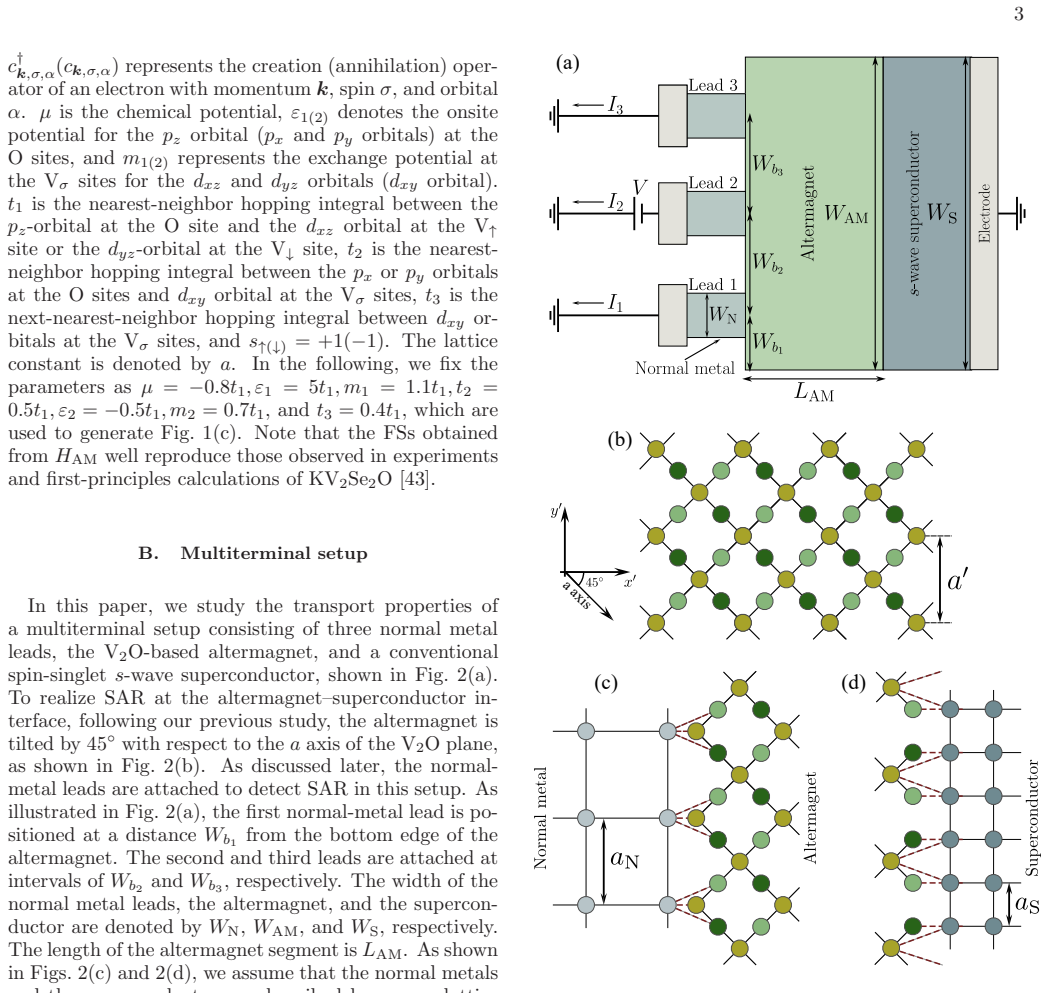
5t1, ε 2 = − 0. 5t1, m 2 = 0 . 7t1, and t3 = 0 . 4t1, which are used to generate Fig. 1(c). Note that the FSs obtained from HAM well reproduce those observed in experiments and first-principles calculations of KV 2Se2O [43]. B. Multiterminal setup In this paper, we study the transport properties of a multiterminal setup consisting of three normal metal lea...
-
[2]
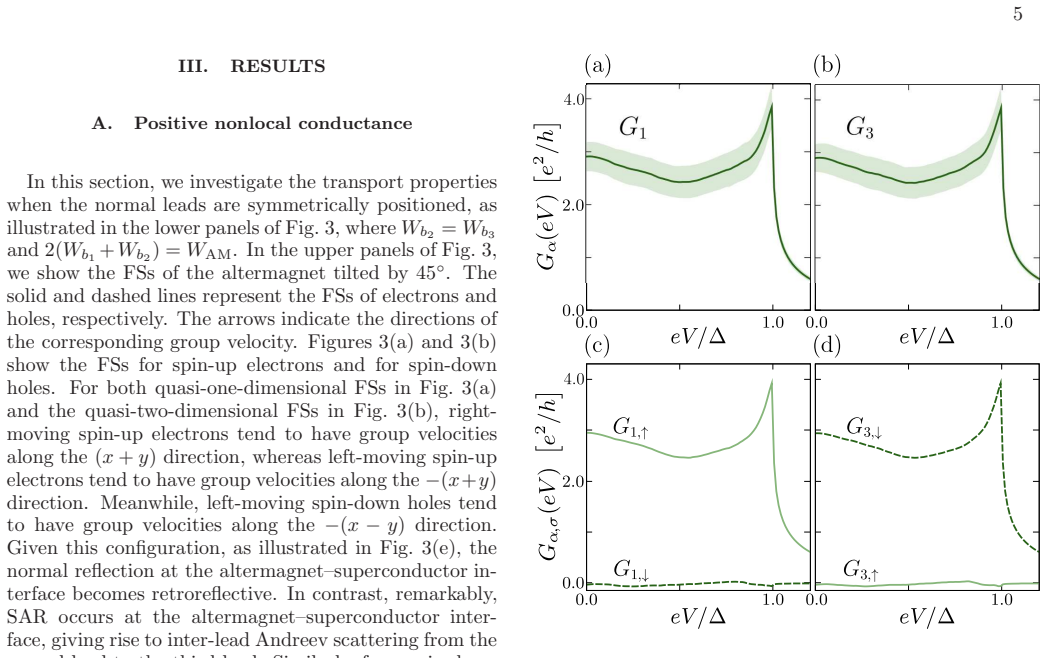
5t1 for α = px, p y, p z, while ¯tJN(S),α = δtJN(S),α = 0 for the other orbitals. Figure 5(d) shows the results when the hopping integrals exhibit a significant imbal- ance between the normal-metal–altermagnet interfaces and the altermagnet–superconductor interface, where we set ¯tJN,α = 0 . 7t1 and δtJN,α = 0 . 5t1 while ¯tJS,α = 0 . 3t1 and δtJS,α = 0 . ...
-
[3]
A. F. Andreev, Thermal conductivity of the intermedi- ate state of superconductors, Sov. Phys. JETP 46, 1823 (1964)
work page 1964
-
[4]
G. Deutscher and D. Feinberg, Coupling superconducting-ferromagnetic poing contact by Andreev reflections, Appl. Phys. Lett. 76, 487 (2000)
work page 2000
- [5]
-
[6]
C. W. J. Beenakker, Specular Andreev reflection in graphen, Phys. Rev. Lett. 97, 067007 (2006)
work page 2006
-
[7]
G. B. Lesovik, T. Martin, and G. Blatter, Electronic entanglement in the vicinity of a superconductor, Eur. Phys. J. B 24, 287 (2001)
work page 2001
-
[8]
N. M. Chtchelkatchev, G. Blatter, G. B. Lesovik, and T. Martin, Bell inequalities and entanglement in solid-state devices, Phys. Rev. B 66, 161320(R) (2002)
work page 2002
-
[9]
L. Hofstteter, S. Csonka, J. Nygøard, and C. Sch¨ onenberger, Cooper pair splitter realized in a two-quantum-dot Y-junction, Nature 461, 960-963 (2009)
work page 2009
-
[10]
L. Hofstetter, S. Csonka, A. Baumgartner, G. F¨ ul¨ op, S. d’Hollosy, J. Nygøard, and C. Sch¨ onenberger, Finite- Bias Cooper Pair Splitting, Phys. Rev. Lett. 107, 136801 (2011)
work page 2011
-
[11]
J. Schindele, A. Baumgartner, and C. Sch¨ onenberger, Near-Unity Cooper Pair Splitting Efficiency, Phys. Rev. 11 Lett. 109, 157002 (2012)
work page 2012
-
[12]
A. Das, Y. Ronen, M. Heiblum, D. Mahalu, A. V. Kre- tinin, and H. Shtrikman, High-efficiency Cooper pair splitting demonstrated by two-partivle conductance res- onance and positive noise cross-corelation, Nat. Comm. 3, 1165 (2012)
work page 2012
-
[13]
G. F¨ ul¨ op, S. d’Hollosy, A. Baumgartner, P. Makk, V. A. Guzenko, M. H. Madsen, J. Nygøard, C. Sch¨ onenberger, and S. Csonka, Local electrical tuning of the nonlocal signals in a Cooper pair splitter, Phys. Rev. B 90, 235412 (2014)
work page 2014
-
[14]
G. F¨ ul¨ op, F. Dom ´ ınguez, S. d’Hollosy, A. Baumgartner, P. Makk, M. H. Madsen, V. A. Guzenko, J. Nygøard, C. Schn¨ onenberger, A. L. Yeyati, and S. Csonka, Mag- netic Field Tuning and Quantum Interference in a Cooper Pair Splitter, Phys. Rev. Lett. 115, 227003 (2015)
work page 2015
-
[15]
S. Baba, C. J¨ unger, S. Matsuo, A. Baumgartner, Y. Sato, H. Kamata, K. Li, S. Jeppesen, L. Samuelson, H. Q. Xu, C. Sch¨ onenberger, and S. Tarucha, Cooper-pair splitting in two parallel InAs nanowires, New J. Phys. 20, 063012 (2018)
work page 2018
-
[16]
G. Wang, T. Dvir, G. P. Mazur, C. -X. Liu, N. van Loo, S. L. D. ten Haaf, A. Bordin, S. Gazibegovic, G. Badawy, E. P. A. M. Bakkers, M. Wimmer, and L. P. Kouwen- hoven, Singlet and triplet Cooper pair splitting in hybrid superconducting nanowires, Nature 612, 448-453 (2022)
work page 2022
-
[17]
A. Bordoloi, V. Zannier, L. Sorba, C. Sch¨ onenberger, and A. Baumgartner, Spin cross-correlation experiments in an electron entangler, Nature 612, 454-458 (2022)
work page 2022
-
[18]
D. de Jong, C. G. Prosko, L. Han, F. K. Malinowski, Y. Liu, L. P. Kouwenhoven and W. Pfaff, Controllable Single Cooper Pair Splitting in Hybrid Quantum Dot Systems, Phys. Rev. Lett. 131, 157001 (2023). Phys. Rev. Lett. 108, 106603 (2012)
work page 2023
-
[19]
W. Chen, L. Jiang, R. Shen, L. Sheng, B. G. Wang, and D. Y. Xing, Specular Andreev reflection in inversion- symmetric Weyl semimetals, Europhys. Lett. 103, 27006 (2013)
work page 2013
-
[20]
L. Majidi and R. Asgari, Specular Andreev reflection in thin films of topological insulators, Phys. Rev. B 93, 195404 (2016)
work page 2016
-
[21]
Z. Hou and Q.-F. Sun, Double Andreev reflections in type-II Weyl semimetal-superconductor junctions, Phys. Rev. B 96, 155305 (2017)
work page 2017
- [22]
- [23]
-
[24]
M. Naka, S. Hayami, H. Kusunose, Y. Yanagi, Y. Mo- tome, and H. Seo, Spin current generation in organic an- tiferromagnets, Nat. Commun., 10, 4305 (2019)
work page 2019
- [25]
- [26]
-
[27]
M. Naka, S. Hayami, H. Kusunose, Y. Yanagi, Y. Mo- tome, and H. Seo, Anomalous Hall effect in κ-type organic antiferromagnets, Phys. Rev. B 102, 075112 (2020)
work page 2020
-
[28]
L. ˇSmejkal, R. Gonz´ alez-Hern´ andez, T. Jungwirth, and J. Sinova, Crystal Time-Reversal Symmetry Breaking and Spontaneous Hall Effect in Collinear Antiferromagnets, Sci. Adv. 6, eaaz8809 (2020)
work page 2020
-
[29]
M. Naka, Y. Motome, H. Seo, Perovskite as a spin current generator, Phys. Rev. B 103, 125114 (2021)
work page 2021
-
[30]
I. I. Mazin, K. Koepernik, M. D. Johannes, and L. ˇSmejkal, Prediction of unconventional magnetism in doped FeSb 2, Proc. Natl. Acad. Sci. U. S. A. 118, e2108924118 (2021)
work page 2021
-
[31]
H. Seo, and M. Naka, Antiferromagnetic State in κ-type Molecular Conductors: Spin Splitting and Mott Gap, J. Phys. Soc. Jpn. 90, 064713 (2021)
work page 2021
-
[32]
L. ˇSmejkal, J. Sinova, and T. Jungwirth, Beyond Con- ventional Ferromagnetism and Antiferromagnetism: A Phase with Nonrelativistic Spin and Crystal Rotation Symmetry, Phys. Rev. X 12, 031042 (2022)
work page 2022
-
[33]
L. ˇSmejkal, J. Sinova, and T. Jungwirth, Emerging Re- search Landscape of Altermagnetism, Phys. Rev. X 12, 040501 (2022)
work page 2022
-
[34]
C. Sun, A. Brataas, and J. Linder, Andreev reflection in altermagnets, Phys. Rev. B 108, 054511 (2023)
work page 2023
-
[35]
C. W. J. Beenakker, and T. Vakhtel, Phase-shifted An- dreev levels in an altermagnet Josephson junction, Phys. Rev. B 108, 075425 (2023)
work page 2023
-
[36]
Papaj, Andreev reflection at the altermagnet- superconductor interface, Phys
M. Papaj, Andreev reflection at the altermagnet- superconductor interface, Phys. Rev. B 108, L060508 (2023)
work page 2023
-
[37]
H. G. Giil, B. Brekke, J. Linder, and A. Brataas, Qua- siclassical theory of superconducting spin-splitter effec ts and spin-filtering via altermagnets, Phys. Rev. B 110, L140506 (2024)
work page 2024
-
[38]
D. Y. Kazmin, V. D. Esin, Y. S¿ Barash, A. V. Timonina, N. N. Kolesnikov, and E. V. Deviatov, Andreev reflection for MnTe altermagnet candidate, Physica B: Condensed Matter 696, 416602 (2025)
work page 2025
- [39]
- [40]
-
[41]
I. V. Bobkova, P. J. Hirschfeld, and Yu. S. Barash, Spin- Dependent Quasiparticle Reflection and Bound States at Interfaces with Itinerant Antiferromagnets, Phys. Rev. Lett. 94, 037005 (2005)
work page 2005
-
[42]
B. M. Andersen, I. V. Bobkova, P. J. Hirschfeld, and Y. S. Barash, Bound states at the interface between an- tiferromagnets and superconductors, Phys. Rev. B 72, 184510 (2005)
work page 2005
-
[43]
B. M. Andersen, I. V. Bobkova, P. J. Hirschfeld, and Y. S. Barash, Bound states at the interface between an- tiferromagnets and superconductors, Phys. Rev. B 72, 184510 (2005). 0– π Transitions in Josephson Junctions with Antiferromagnetic Interlayers, Phys. Rev. Lett. 96, 117005(2006)
work page 2005
-
[44]
G. A. Bobkov, I. V. Bobkova, A. M. Bobkov, and A. Kamra, N´ eel proximity effect at antiferromag- net/superconductor interfaces, Phys. Rev. B 106, 144512 (2022). 12
work page 2022
- [45]
-
[46]
F. Zhang, X. Cheng, Z. Yin, C. Liu, L. Deng, Y. Qiao, Z. Shi, S. Zhang, J. Lin, Z. Liu, M. Yeo, Y. Huang, X. Meng, C. Zhang, T. Okuda, K. Shimada, S. Cui, Y. Zhao, G. -H. Cao, S. Qiao, J. Liu, and C. Chen, Crystal-symmetry- paired spin–valley locking in a layered room-temperature metallic altermagnet candidate, Nat. Phys. 21, 760-767 (2025)
work page 2025
-
[47]
J. Lai, T. Yu, P. Liu, L. Liu, C. Xing, X. -Q. Chen, and Y. Sun, d-wave Flat Fermi Surface in Altermagnets Enables Maximum Charge-to-Spin Conversion, Phys. Rev. Lett. 135, 256702 (2025)
work page 2025
-
[48]
C. -C. Liu, J. Li, J. -Y. Liu, J. -Y. Lu, H. -X. Li, Y. Liu, and G. -H. Cao, Physical properties and first-principles calculations of an altermagnet candidate Cs 1− δ V2Te2O, Phys. Rev. B 112, 224439 (2025)
work page 2025
- [49]
- [50]
-
[51]
D. Fu, L. Yang, K. Xiao, Y. Wang, Z. Wang, Y. Yao, Q. -K. Xue, and W. Li, Atomic-scale visualization of d-wave altermagnetism, arXiv:2512.24114 (2025)
work page internal anchor Pith review Pith/arXiv arXiv 2025
-
[52]
Q. Hu, X. Cheng, Q. Duan, Y. Hu, B. Jiang, Y. Xiao, Y. Li, M. Pan, L. Deng, C. Liu, G. Cao, Z. Liu, M. Ye, S. Qiao, Z. Liu, Z. Sun, A. Gao, Y. Huang, R. Zhong, J. Liu, B. Lv, and H. Ding, Observation of spin-valley locked nodal lines in a quasi-2D altermagnet, arXiv:2601.02883 (2026)
- [53]
- [54]
-
[55]
J. Bai, B. Ruan, Q. Dong, L. Zhang, Q. Liu, J. Cheng, P. Liu, C. Li, Y. Sun, Y. Huang, Z. Ren, and G. Chen, Absense of long-range order in the vanadium oxychalco- genide KV 2Se2O with nontrivial band topology, Phys. Rev. B, 110, 165151 (2024)
work page 2024
-
[56]
G. E. Blonder, M. Tinkham, and T. M. Klapwijk, Tran- sition from metallic to tunneling regimes in supercon- ducting microconstrictions: Excess current, charge im- balance, and supercurrent conversion, Phys. Rev. B 25, 4515 (1982)
work page 1982
-
[57]
M. P. Anantram, and S. Datta, Current fluctuations in mesoscopic systems with Andreev scattering, Phys. Rev. B 53, 16390 (1996)
work page 1996
-
[58]
P. A. Lee, and D. S. Fisher, Anderson Localization in Two dimensions,Phys. Rev. Lett. 47, 882 (1981)
work page 1981
-
[59]
Ando, Quantum point contacts in magnetic fields, Phys
T. Ando, Quantum point contacts in magnetic fields, Phys. Rev. B 44, 8017 (1991)
work page 1991
-
[60]
R. A. Jalabert, H. U. Baranger, and A. D. Stone, Con- ductance fluctuations in the ballistic regime: A probe of quantum chaos?, Phys. Rev. Lett. 65, 2442 (1990)
work page 1990
-
[61]
Y. Sun, Y. Huang, J. Cheng, S. Zhang, Z. Li, H. Luo, X. Ma, W. Yang, J. Yang, D. Chen, K. Sun, M. Gut- mann, S. C. Capelli, F. Shen, J. Hao, L. He, G. Chen, and S. Li, Antiferromagnetic structure of KV 2Se2O: A neu- tron diffraction study, Phys. Rev. B 112, 184416 (2025)
work page 2025
- [62]
-
[63]
https://github.com/nagaephysics0204- ops/datasets V2OAM
discussion (0)
Sign in with ORCID, Apple, or X to comment. Anyone can read and Pith papers without signing in.