Angle dependent hysteretic magnetotransport in MnBi2Te4 nanoflakes
Pith reviewed 2026-05-10 15:12 UTC · model grok-4.3
The pith
Hysteretic magnetotransport in MnBi2Te4 nanoflakes stems from domain wall pinning in non-uniform magnetic landscapes induced by reduced dimensionality.
A machine-rendered reading of the paper's core claim, the machinery that carries it, and where it could break.
Core claim
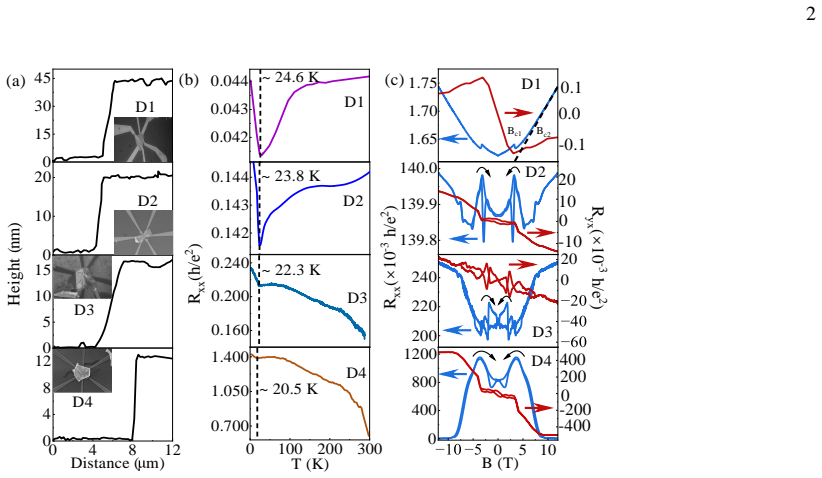
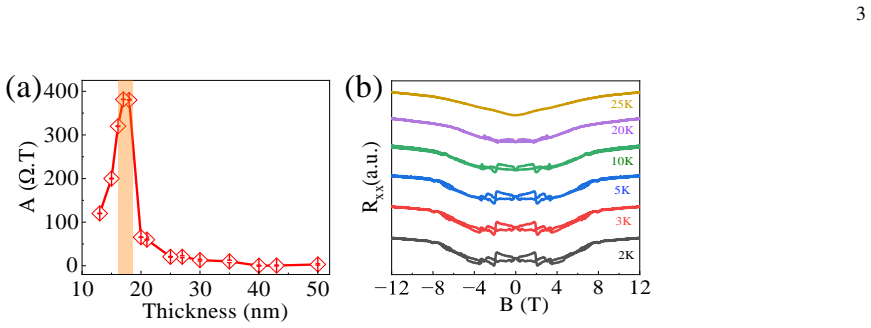
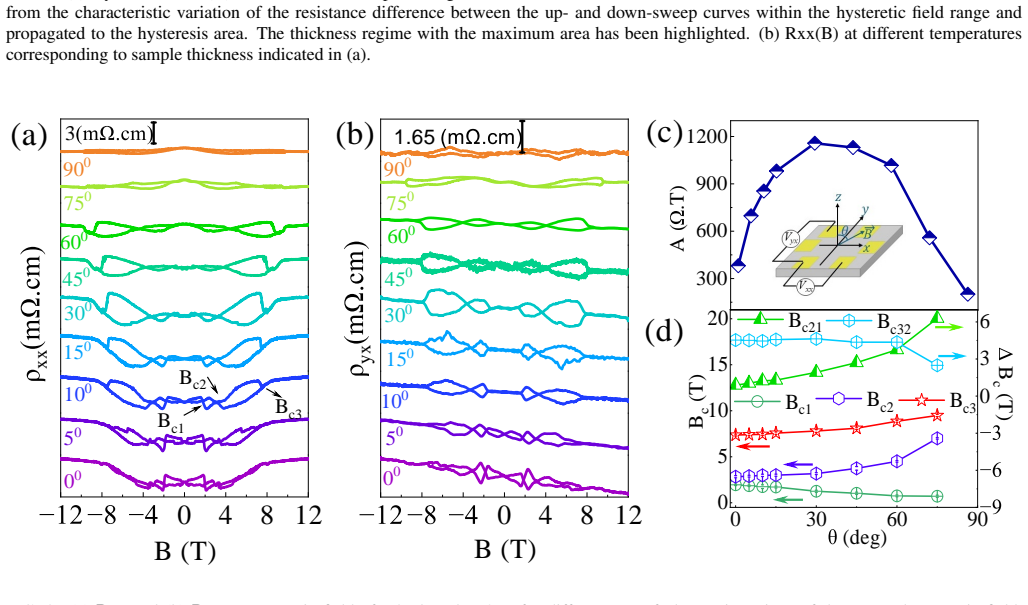
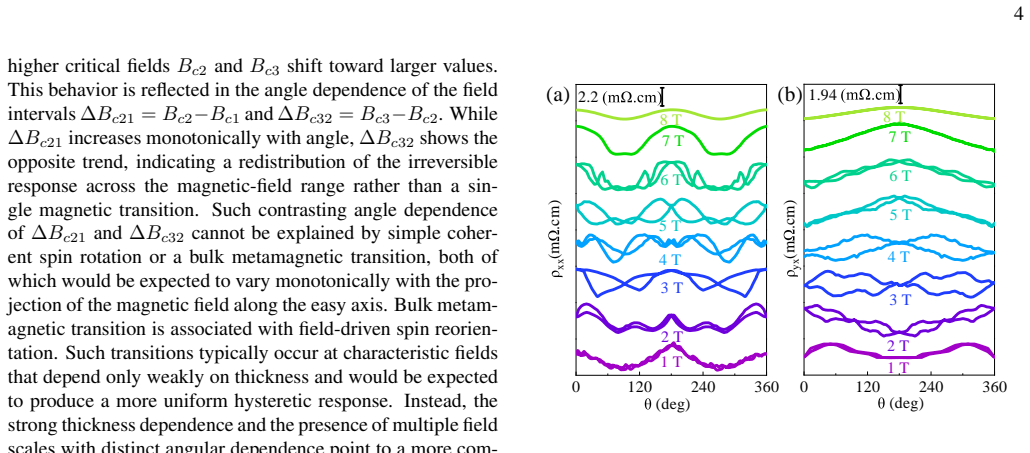
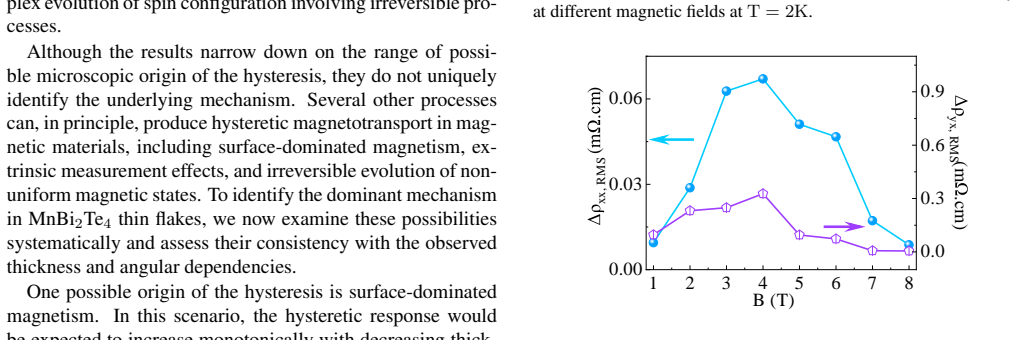
In single-crystalline nanoscale thin flakes of MnBi2Te4, the magnetoresistance displays multi-step hysteresis with pronounced non-monotonic thickness dependence and nontrivial angular anisotropy. The transport data exclude surface-dominated magnetism and simple bulk metamagnetic transitions, instead indicating that magnetic irreversibility is controlled by domain wall pinning and depinning processes inside a spatially non-uniform magnetic landscape. Reduced dimensionality thus emerges as the driver of this irreversibility.
What carries the argument
Multi-step hysteretic magnetoresistance whose thickness and angular dependence identifies domain wall pinning and de-pinning within a spatially non-uniform magnetic landscape.
If this is right
- Thickness dependence of the hysteresis steps shows that uniform bulk metamagnetic transitions do not dominate in thin flakes.
- Angular anisotropy supplies evidence for spatial non-uniformity in the magnetic structure.
- Domain wall pinning and depinning become the governing mechanism for magnetic irreversibility in these two-dimensional antiferromagnets.
- Reduced dimensionality amplifies irreversible magnetic processes compared with three-dimensional bulk crystals.
Where Pith is reading between the lines
- The same pinning mechanism may operate in other van der Waals antiferromagnets once thinned to the nanoscale.
- Thickness or angle could serve as experimental knobs to control domain dynamics and transport response.
- Direct spatial imaging of magnetism on the same flakes would test whether non-uniform landscapes correlate with the transport steps.
Load-bearing premise
The observed multi-step hysteresis and its thickness and angular dependence arise primarily from domain wall pinning and depinning in a non-uniform landscape rather than from defects, surface states, or experimental artifacts.
What would settle it
If the magnetoresistance hysteresis became single-step and lost its dependence on thickness or angle, or if direct imaging revealed uniform reversal without domain walls, the domain pinning account would be ruled out.
Figures
read the original abstract
Controlling magnetic phases in two-dimensional systems, where charge transport is highly sensitive to real-space spin inhomogeneities, is central to understanding emergent magnetic states in reduced dimensions. In this context, thickness-dependent magnetotransport provides access to irreversible magnetic processes that are not captured by reversible transport or bulk magnetization alone. Here we report an extensive study of hysteretic magnetoresistance in single-crystalline nanoscale thin flakes of the layered antiferromagnet MnBi2Te4. The multi-step hysteresis exhibits a pronounced non-monotonic dependence on thickness and displays nontrivial angular anisotropy. The transport signatures rule out surface-dominated magnetism and simple bulk metamagnetic transitions as the primary origin. We argue that the magnetic irreversibility is possibly governed by domain wall pinning and de-pinning processes within a spatially non-uniform magnetic landscape. These results suggest that reduced dimensionality is a key driver of magnetic irreversibility in MnBi2Te4.
Editorial analysis
A structured set of objections, weighed in public.
Referee Report
Summary. The manuscript reports an experimental investigation of angle-dependent hysteretic magnetoresistance in single-crystalline MnBi2Te4 nanoflakes. It documents multi-step hysteresis loops whose features exhibit non-monotonic dependence on flake thickness and nontrivial angular anisotropy. The transport data are used to exclude surface-dominated magnetism and simple bulk metamagnetic transitions, leading to the interpretation that the observed irreversibility is governed by domain-wall pinning and depinning within a spatially non-uniform magnetic landscape, with reduced dimensionality identified as the key driver.
Significance. If the proposed mechanism is confirmed, the work would provide valuable insight into how dimensionality reduction induces magnetic irreversibility in layered antiferromagnets, where charge transport is sensitive to real-space spin textures. The thickness- and angle-dependent transport signatures offer a practical experimental handle on such phenomena, with potential implications for understanding emergent states and for spintronic device concepts in 2D magnetic materials.
major comments (2)
- [Abstract] Abstract: the assertion that transport signatures 'rule out surface-dominated magnetism and simple bulk metamagnetic transitions as the primary origin' rests on qualitative trends in thickness and angular dependence. Without quantitative predictions for the expected signatures of these alternatives, or control measurements (e.g., surface-passivated flakes or intentionally disordered samples), the exclusion remains incomplete and does not yet discriminate positively in favor of the domain-wall scenario.
- [Abstract] Abstract and implied discussion: the central claim that irreversibility is 'possibly governed by domain wall pinning and de-pinning processes within a spatially non-uniform magnetic landscape' is advanced without supporting micromagnetic modeling that would predict the positions and angular evolution of the observed steps, nor any direct spatial mapping (e.g., via magnetic force microscopy) of the purported non-uniformity. This leaves the interpretation as a plausible but untested hypothesis rather than a demonstrated mechanism.
Simulated Author's Rebuttal
We thank the referee for the constructive feedback and positive evaluation of the work's significance. We address the major comments point by point below, providing clarifications and indicating revisions made to the manuscript.
read point-by-point responses
-
Referee: [Abstract] Abstract: the assertion that transport signatures 'rule out surface-dominated magnetism and simple bulk metamagnetic transitions as the primary origin' rests on qualitative trends in thickness and angular dependence. Without quantitative predictions for the expected signatures of these alternatives, or control measurements (e.g., surface-passivated flakes or intentionally disordered samples), the exclusion remains incomplete and does not yet discriminate positively in favor of the domain-wall scenario.
Authors: We agree that the exclusion of surface-dominated magnetism and simple bulk metamagnetic transitions relies on qualitative interpretation of the non-monotonic thickness dependence and angular anisotropy in the multi-step hysteresis. These observations are inconsistent with monotonic thickness scaling expected for surface effects or the simpler, often single-step hysteresis typical of uniform bulk metamagnetic transitions in related antiferromagnets. In the revised manuscript, we have expanded the discussion to include more explicit comparisons with literature signatures of these alternative mechanisms and have softened the phrasing from 'rule out' to 'strongly disfavor' to better reflect the qualitative basis. We also acknowledge the lack of control experiments (such as surface passivation) as a limitation and note it as a direction for future work. Quantitative modeling of expected signatures is not feasible within the current transport study but would be valuable. revision: partial
-
Referee: [Abstract] Abstract and implied discussion: the central claim that irreversibility is 'possibly governed by domain wall pinning and de-pinning processes within a spatially non-uniform magnetic landscape' is advanced without supporting micromagnetic modeling that would predict the positions and angular evolution of the observed steps, nor any direct spatial mapping (e.g., via magnetic force microscopy) of the purported non-uniformity. This leaves the interpretation as a plausible but untested hypothesis rather than a demonstrated mechanism.
Authors: We acknowledge that the domain-wall pinning interpretation is presented as a plausible mechanism ('possibly governed') supported indirectly by the transport data, rather than directly demonstrated. The manuscript already qualifies the claim accordingly. Unfortunately, micromagnetic simulations to predict step positions or direct spatial mapping via MFM are beyond the scope of this experimental transport study and would require additional specialized resources and expertise not available for this work. In revision, we have added further discussion linking the observed angular anisotropy and thickness trends to domain-wall dynamics, drawing on analogies from other reduced-dimensionality magnetic systems to strengthen the hypothesis. revision: no
- Direct confirmation via micromagnetic modeling or spatial mapping (e.g., MFM) of the non-uniform magnetic landscape and domain-wall pinning, as these require experimental and computational resources outside the current transport-focused study.
Circularity Check
No circularity: purely experimental observations with qualitative interpretation.
full rationale
The manuscript is an experimental study of magnetotransport in MnBi2Te4 nanoflakes. It reports thickness- and angle-dependent multi-step hysteretic magnetoresistance, then qualitatively excludes surface-dominated magnetism and simple bulk metamagnetic transitions on the basis of the observed non-monotonicity and anisotropy. The central argument for domain-wall pinning in a spatially non-uniform landscape is presented as an inference from the data signatures rather than from any equation, fitted parameter, or derivation. No self-citations are invoked as load-bearing uniqueness theorems, no ansatzes are smuggled, and no predictions are constructed by renaming fitted inputs. The paper is therefore self-contained against external benchmarks with no reduction of claims to their own inputs by construction.
Axiom & Free-Parameter Ledger
axioms (2)
- domain assumption MnBi2Te4 is a layered antiferromagnet
- domain assumption Charge transport in 2D systems is highly sensitive to real-space spin inhomogeneities
Reference graph
Works this paper leans on
-
[1]
Antiferro- magnetic spintronics,
Vincent Baltz, Aur ´elien Manchon, Mikhail Tsoi, Takahiro Moriyama, Teruo Ono, and Yaroslav Tserkovnyak, “Antiferro- magnetic spintronics,” Reviews of Modern Physics90, 015005 (2018)
work page 2018
-
[2]
Antiferromagnetic materials: From funda- mentals to applications,
Jiahao Liu, Jiaqi Lu, Shouzhong Peng, Zhaochun Liu, Yongzhuo Zhang, Jun Qiao, Shuo Wang, Weixiang Li, Jing- sheng Chen, Zhiming Wang, Run-Wei Li, Yue Zhang, and Weisheng Zhao, “Antiferromagnetic materials: From funda- mentals to applications,” Matter8, 102472 (2025)
work page 2025
-
[3]
Effective elec- trical manipulation of a topological antiferromagnet by orbital torques,
Zhenyi Zheng, Tao Zeng, Tieyang Zhao, Shu Shi, Lizhu Ren, Tongtong Zhang, Lanxin Jia, Youdi Gu, Rui Xiao, Hengan Zhou, Qihan Zhang, Jiaqi Lu, Guilei Wang, Chao Zhao, Hui- hui Li, Beng Kang Tay, and Jingsheng Chen, “Effective elec- trical manipulation of a topological antiferromagnet by orbital torques,” Nature Communications15, 745 (2024)
work page 2024
-
[4]
Antiferromagnetic spintronics,
Tom ´aˇs Jungwirth, Xavier Marti, Patrick Wadley, and Jairo Wunderlich, “Antiferromagnetic spintronics,” Nature Nan- otechnology11, 231–241 (2016)
work page 2016
-
[5]
R. L. Stamps, “Mechanisms for exchange bias,” Journal of Physics D: Applied Physics33, R247–R268 (2000)
work page 2000
-
[6]
Exchange bias effect of ferro- /antiferromagnetic heterostructures,
Florin Radu and Hartmut Zabel, “Exchange bias effect of ferro- /antiferromagnetic heterostructures,” inMagnetic Heterostruc- tures: Advances and Perspectives in Spinstructures and Spin- transport(Springer Berlin Heidelberg, 2008) pp. 97–184
work page 2008
-
[7]
Domain wall dynamics in nanos- tructures,
C. H. Marrows and G. Meier, “Domain wall dynamics in nanos- tructures,” Journal of Physics: Condensed Matter24, 020301 (2012)
work page 2012
-
[8]
G. Catalan, J. Seidel, R. Ramesh, and J. F. Scott, “Domain wall nanoelectronics,” Reviews of Modern Physics84, 119–156 (2012)
work page 2012
-
[9]
Svetislav Mijatovi ´c, Stefan Graovac, Djordje Spasojevi ´c, and Bosiljka Tadi ´c, “Hysteresis loop shape of field-driven antiferromagnetic-ferromagnetic bilayers in experimental con- 6 ditions,” Phys. Rev. B111, 064304 (2025)
work page 2025
-
[10]
Multistep magnetization switching in orthogonally twisted ferromagnetic monolayers,
Carla Boix-Constant, Sarah Jenkins, Ricardo Rama-Eiroa, Elton J. G. Santos, Samuel Ma ˜nas-Valero, and Eugenio Coronado, “Multistep magnetization switching in orthogonally twisted ferromagnetic monolayers,” Nature Materials23, 212– 218 (2024)
work page 2024
-
[11]
Samridh Jaiswal, K. Lee, J¨urgen Langer, Berthold Ocker, Math- ias Kl ¨aui, and Gerhard Jakob, “Tuning of interfacial perpen- dicular magnetic anisotropy and domain structures in magnetic thin film multilayers,” Journal of Physics D: Applied Physics 52, 295001 (2019)
work page 2019
-
[12]
S ´andor Zsurzsa, Moustafa El-Tahawy, L´aszl´o P´eter, L´aszl´o Fer- enc Kiss, Jen ˝o Gubicza, Gy ¨orgy Moln ´ar, and Imre Bakonyi, “Spacer layer thickness dependence of the giant magnetoresis- tance in electrodeposited ni-co/cu multilayers,” Nanomaterials 12, 4276 (2022)
work page 2022
-
[13]
Large negative magnetoresistance in an antiferromagnet,
S. Karki Chhetriet al., “Large negative magnetoresistance in an antiferromagnet,” Physical Review B111, 014431 (2025)
work page 2025
-
[14]
Rethinking hysteresis in mag- netic materials,
Ananya Renuka Balakrishna, “Rethinking hysteresis in mag- netic materials,” MRS Communications14, 835–845 (2024)
work page 2024
-
[15]
Fuminori Honda, Jaroslav Valenta, Ji ˇr´ı Prokleˇska, Jiˇr´ı Posp´ıˇsil, Petr Proschek, Jiˇr´ı Prchal, and Vladim ´ır Sechovsk´y, “Magne- totransport as a probe of phase transformations in metallic an- tiferromagnets: The case of UIrSi 3,” Physical Review B100, 014401 (2019)
work page 2019
-
[16]
Hysteretic effects and magnetotransport of electri- cally switched CuMnAs,
Jan Zub ´aˇc, Zden ˇek Ka ˇspar, Filip Krizek, Tobias F ¨orster, Richard P. Campion, V´ıt Nov´ak, Tom´a ˇs Jungwirth, and Kamil Olejn´ık, “Hysteretic effects and magnetotransport of electri- cally switched CuMnAs,” Phys. Rev. B104, 184424 (2021)
work page 2021
-
[17]
Abnormal magnetoresistance transport prop- erties of van der waals antiferromagnetic FeNbTe 2,
Bingtian Qi, Junjie Guo, Yaqi Miao, Mingzhe Zhong, Bin Li, Zeyu Luo, Xiangguo Wang, Yuzhe Nie, Qilin Xia, and Guanghui Guo, “Abnormal magnetoresistance transport prop- erties of van der waals antiferromagnetic FeNbTe 2,” Frontiers in Physics10, 851838 (2022)
work page 2022
-
[18]
Recent progress in two-dimensional mag- netic materials,
Guang Shiet al., “Recent progress in two-dimensional mag- netic materials,” Nanomaterials14, 1759 (2024)
work page 2024
-
[19]
Magnetic-field-induced robust zero hall plateau state in MnBi2Te4 chern insulator,
Chang Liu, Yongchao Wang, Ming Yang, Jiahao Mao, Hao Li, Yaoxin Li, Jiaheng Li, Haipeng Zhu, Junfeng Wang, Liang Li, Yang Wu, Yong Xu, Jinsong Zhang, and Yayu Wang, “Magnetic-field-induced robust zero hall plateau state in MnBi2Te4 chern insulator,” Nature Communications12, 4647 (2021)
work page 2021
-
[20]
Tongshuai Zhu, Huaiqiang Wang, Haijun Zhang, and Dingyu Xing, “Tunable dynamical magnetoelectric effect in antiferro- magnetic topological insulator MnBi2Te4 films,” npj Computa- tional Materials7, 121 (2021)
work page 2021
-
[21]
Large magnetic gap at the dirac point in Bi2Te3/MnBi2Te4 heterostructures,
E. D. L. Rienks, S. Wimmer, J. S ´anchez-Barriga, O. Caha, P. S. Mandal, J. R ˚uˇziˇcka, A. Ney, H. Steiner, V . V . V olobuev, H. Groiß, M. Albu, G. Kothleitner, J. Michali ˇcka, S. A. Khan, J. Min ´ar, H. Ebert, G. Bauer, F. Freyse, A. Varykhalov, O. Rader, and G. Springholz, “Large magnetic gap at the dirac point in Bi2Te3/MnBi2Te4 heterostructures,” N...
work page 2019
-
[22]
In- trinsic magnetic topological insulators in van der waals layered mnbi2te4-family materials,
Jiaheng Li, Yang Li, Shiqiao Du, Zun Wang, Bing-Lin Gu, Shou-Cheng Zhang, Ke He, Wenhui Duan, and Yong Xu, “In- trinsic magnetic topological insulators in van der waals layered mnbi2te4-family materials,” Science Advances5, eaaw5685 (2019)
work page 2019
-
[23]
Progress on the antiferromagnetic topological insulator MnBi 2Te4,
Shuai Li, Tianyu Liu, Chang Liu, Yayu Wang, Hai-Zhou Lu, and X. C. Xie, “Progress on the antiferromagnetic topological insulator MnBi 2Te4,” National Science Review11, nwac296 (2024)
work page 2024
-
[24]
Mnbi 2te4-family intrinsic magnetic topological mate- rials,
Ke He, “Mnbi 2te4-family intrinsic magnetic topological mate- rials,” npj Quantum Materials5, 90 (2020)
work page 2020
-
[25]
Intrinsic magnetic topo- logical insulators of the MnBi 2Te4 family,
Alexandra Y . Vyazovskaya, Mihovil Bosnar, Evgueni V . Chulkov, and Mikhail M. Otrokov, “Intrinsic magnetic topo- logical insulators of the MnBi 2Te4 family,” Communications Materials6, 88 (2025)
work page 2025
-
[26]
Kai Zhu, Y . Cheng, M. Liao, S. K. Chong, D. Zhang, K. He, K. L. Wang, K. Chang, and P. Deng, “Unveiling the anomalous hall response of the magnetic structure changes in the epitaxial MnBi2Te4 films,” Nano Letters24, 2181–2187 (2024)
work page 2024
-
[27]
Hui Guo, Chenyu Bai, Ke Zhu, Senhao Lv, Zhaoyi Zhai, Jingyuan Qu, Guoyu Xian, Yechao Han, Guojing Hu, Qi Qi, Guangtong Liu, Fang Jiao, Lihong Bao, Xiaotian Bao, Xin- feng Liu, Hui Chen, Xiao Lin, Wu Zhou, Jiadong Zhou, Haitao Yang, and Hong-Jun Gao, “Controllable synthesis of high-quality magnetic topological insulator MnBi 2Te4 and MnBi4Te7 multilayers b...
work page 2024
-
[28]
Topolog- ical response of the anomalous hall effect in MnBi 2Te4 due to magnetic canting,
S.-K. Bac, K. Koller, F. Lux, J. Wang, L. Riney, K. Borisiak, W. Powers, M. Zhukovskyi, T. Orlova, M. Dobrowolska, J. K. Furdyna, N. R. Dilley, L. P. Rokhinson, Y . Mokrousov, R. J. McQueeney, O. Heinonen, X. Liu, and B. A. Assaf, “Topolog- ical response of the anomalous hall effect in MnBi 2Te4 due to magnetic canting,” npj Quantum Materials7, 46 (2022)
work page 2022
-
[29]
V . N. Zverev, N. A. Abdullayev, Z. S. Aliyev, I. R. Amiraslanov, M. M. Otrokov, N. T. Mamedov, and E. V . Chulkov, “Trans- port properties of the magnetic topological insulators family (MnBi2Te4)(Bi2Te3)m (m= 0,1, . . . ,6),” JETP Letters118, 905–910 (2023)
work page 2023
-
[30]
Surface-induced linear magnetoresistance in the an- tiferromagnetic topological insulator MnBi2Te4,
Xiao Lei, L. Zhou, Z. Y . Hao, X. Z. Ma, C. Ma, Y . Q. Wang, P. B. Chen, B. C. Ye, L. Wang, F. Ye, J. N. Wang, J. W. Mei, and H. T. He, “Surface-induced linear magnetoresistance in the an- tiferromagnetic topological insulator MnBi2Te4,” Physical Re- view B102, 235431 (2020)
work page 2020
-
[31]
Peng-Fei Zhu, Xing-Guo Ye, Jing-Zhi Fang, Peng-Zhan Xiang, Rong-Rong Li, Dai-Yao Xu, Zhongming Wei, Jia-Wei Mei, Song Liu, Da-Peng Yu, and Zhi-Min Liao, “From negative to positive magnetoresistance in the intrinsic magnetic topological insulator MnBi2Te4,” Physical Review B101, 075425 (2020)
work page 2020
-
[32]
Magnetization-tuned topological quantum phase transition in MnBi2Te4 devices,
Jun Ge, Yanzhao Liu, Pinyuan Wang, Zhiming Xu, Jiaheng Li, Hao Li, Zihan Yan, Yang Wu, Yong Xu, and Jian Wang, “Magnetization-tuned topological quantum phase transition in MnBi2Te4 devices,” Physical Review B105, L201404 (2022)
work page 2022
-
[33]
Chang Liu, Yongchao Wang, Hao Li, Yang Wu, Yaoxin Li, Ji- aheng Li, Ke He, Yong Xu, Jinsong Zhang, and Yayu Wang, “Robust axion insulator and chern insulator phases in a two- dimensional antiferromagnetic topological insulator,” Nature Materials19, 522–527 (2020)
work page 2020
-
[34]
Dynamics and formation of antiferro- magnetic textures in mnbi 2te4 single crystal,
Min Gyu Kim, Starr Boney, Luke Burgard, Lillian Rutowski, and Claudio Mazzoli, “Dynamics and formation of antiferro- magnetic textures in mnbi 2te4 single crystal,” Materials18, 5337 (2025)
work page 2025
-
[35]
Magnetic imaging of domain walls in the antiferromagnetic topological insulator mnbi 2te4,
Paul M. Sass, Wenbo Ge, Jiaqiang Yan, D. Obeysekera, J. J. Yang, and Weida Wu, “Magnetic imaging of domain walls in the antiferromagnetic topological insulator mnbi 2te4,” Nano Letters20, 2609–2614 (2020)
work page 2020
-
[36]
Yang Shi, Yunhe Bai, Yuanzhao Li, Yang Feng, Qiang Li, Huanyu Zhang, Yang Chen, Yitian Tong, Jianli Luan, Ruixuan Liu, Pengfei Ji, Zongwei Gao, Hangwen Guo, Jinsong Zhang, Yayu Wang, Xiao Feng, Ke He, Xiaodong Zhou, and Jian Shen, “Correlation between magnetic domain structures and quantum anomalous hall effect in epitaxialMnbi 2te4 thin films,” Phys. Rev...
work page 2024
discussion (0)
Sign in with ORCID, Apple, or X to comment. Anyone can read and Pith papers without signing in.