Recognition: unknown
Fermion-fermion scattering in a Rarita-Schwinger model with Yukawa-like interaction
Pith reviewed 2026-05-10 15:39 UTC · model grok-4.3
The pith
Spin-3/2 fermion scattering cross sections are computed in the Rarita-Schwinger model with a Yukawa-like interaction at zero and finite temperature.
A machine-rendered reading of the paper's core claim, the machinery that carries it, and where it could break.
Core claim
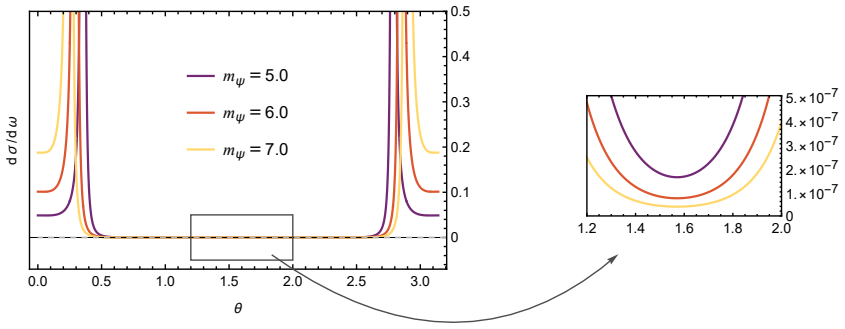
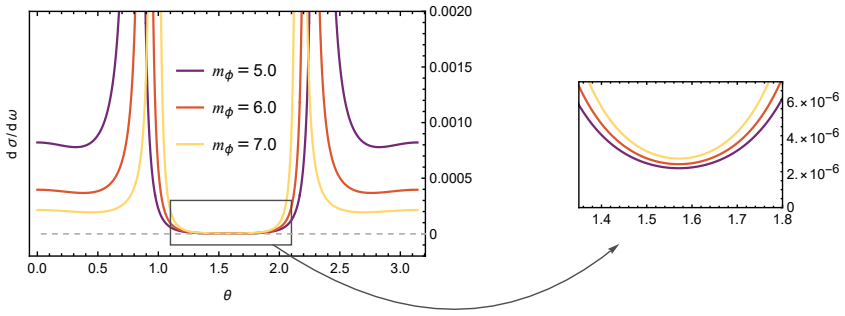
In the massive Rarita-Schwinger model the interaction is introduced by the replacement m → m_ψ + g φ inside the free Lagrangian; the resulting differential and total cross sections for fermion-fermion scattering are obtained both at zero temperature and at finite temperature within the thermofield dynamics formalism, then examined in the short-range (m_φ ≠ 0) and long-range (m_φ = 0) limits to reveal the influence of temperature.
What carries the argument
The substitution m → m_ψ + g φ performed directly in the free Rarita-Schwinger Lagrangian for the spin-3/2 field, which generates the Yukawa-like vertex, together with the thermofield dynamics formalism that incorporates finite-temperature corrections into the propagators.
If this is right
- The cross sections acquire a clear temperature dependence that can be quantified by comparing the zero- and finite-temperature expressions.
- The long-range (massless-mediator) limit produces different functional behavior from the short-range (massive-mediator) limit at any temperature.
- Both differential distributions and integrated total cross sections are available and can be used to extract thermal corrections.
- The influence of temperature is isolated by holding the mediator mass fixed while varying temperature between the two regimes.
Where Pith is reading between the lines
- The same mass-substitution method could be applied to other higher-spin fields to test whether analogous temperature corrections appear.
- The temperature-dependent cross sections might serve as a benchmark for scattering rates in astrophysical environments where spin-3/2 particles are present.
- If the interaction remains consistent, the framework could be extended to study resonances or bound states at finite temperature.
Load-bearing premise
That replacing the mass parameter directly in the free spin-3/2 Lagrangian produces a consistent Yukawa-like interaction without violating the auxiliary constraints required by the Rarita-Schwinger field.
What would settle it
An explicit verification that the derived scattering amplitude satisfies the necessary consistency conditions of the Rarita-Schwinger field at finite temperature, or an experimental measurement of spin-3/2 scattering that fails to match the predicted temperature dependence in either the massive or massless mediator limit.
Figures



read the original abstract
In this work, we investigate the scattering of spin-$3/2$ fermionic particles mediated by a Yukawa-like coupling in the context of the massive Rarita-Schwinger model. The interaction is introduced by replacing $m \to m_{\psi} + g\phi$ in the free spin-$3/2$ Lagrangian. The analysis is performed at both zero and finite temperatures. In the latter case, thermal effects are incorporated using the Thermofield Dynamics (TFD) formalism. In both regimes, we obtain the differential and total cross sections and examine their behavior in the short-range ($m_{\phi} \neq 0$) and long-range ($m_{\phi} = 0$) limits, in order to analyze the influence of zero- and finite-temperature effects.
Editorial analysis
A structured set of objections, weighed in public.
Referee Report
Summary. The paper computes tree-level differential and total cross sections for fermion-fermion scattering mediated by a scalar in a massive Rarita-Schwinger model. The Yukawa-like interaction is introduced by the direct substitution m → m_ψ + g φ in the free RS Lagrangian; results are obtained both at T=0 and at finite temperature via Thermofield Dynamics, with separate analyses for m_φ ≠ 0 (short-range) and m_φ = 0 (long-range) regimes.
Significance. If the interaction preserves the RS constraint structure, the calculation would supply concrete expressions for thermal corrections to spin-3/2 scattering that could be compared with gravitino or resonance phenomenology. The use of TFD for the finite-T case is a standard and reproducible technique once the Feynman rules are accepted.
major comments (2)
- The central technical step—replacing m by m_ψ + gφ directly in the free Rarita-Schwinger Lagrangian—is not accompanied by an explicit verification that the Euler-Lagrange equations continue to enforce the constraints γ·ψ = 0 and the appropriate divergence condition when φ is a dynamical, non-constant field. Because the cross-section results rest on the assumption that the propagator and vertices remain those of a pure spin-3/2 theory, this omission is load-bearing for the validity of the entire calculation.
- No derivation of the Feynman rules, propagator, or the matrix element is supplied, nor are any checks (Ward identities, cancellation of unphysical polarizations, or high-energy behavior) reported. Without these intermediate steps it is impossible to confirm that the quoted differential and total cross sections are free of artifacts from lower-spin modes.
minor comments (1)
- The abstract states that cross sections are obtained but gives no numerical values, plots, or error estimates; the manuscript should include at least one representative plot of dσ/dΩ versus angle or energy together with a table of total cross sections in the two regimes.
Simulated Author's Rebuttal
We thank the referee for the thorough review and insightful comments on our manuscript. We address each major comment below and will incorporate the necessary additions and clarifications in a revised version.
read point-by-point responses
-
Referee: The central technical step—replacing m by m_ψ + gφ directly in the free Rarita-Schwinger Lagrangian—is not accompanied by an explicit verification that the Euler-Lagrange equations continue to enforce the constraints γ·ψ = 0 and the appropriate divergence condition when φ is a dynamical, non-constant field. Because the cross-section results rest on the assumption that the propagator and vertices remain those of a pure spin-3/2 theory, this omission is load-bearing for the validity of the entire calculation.
Authors: We acknowledge that the manuscript did not include an explicit verification of the constraints for a dynamical scalar field. In the revised version we will add a dedicated subsection deriving the Euler-Lagrange equations from the substituted Lagrangian and showing that the constraints γ·ψ = 0 and the divergence condition continue to hold classically when φ is non-constant. This will confirm that the tree-level propagator and Yukawa vertex remain those of a consistent spin-3/2 theory for the purposes of the scattering calculation. revision: yes
-
Referee: No derivation of the Feynman rules, propagator, or the matrix element is supplied, nor are any checks (Ward identities, cancellation of unphysical polarizations, or high-energy behavior) reported. Without these intermediate steps it is impossible to confirm that the quoted differential and total cross sections are free of artifacts from lower-spin modes.
Authors: We agree that the lack of explicit derivations and consistency checks reduces the transparency of the results. The revised manuscript will contain a new appendix that (i) derives the Feynman rules and the massive Rarita-Schwinger propagator employed, (ii) presents the full matrix element for the fermion-fermion scattering process, and (iii) verifies the relevant Ward identity, the cancellation of unphysical spin-1/2 contributions in the polarization sum, and the high-energy scaling to ensure absence of lower-spin artifacts. revision: yes
Circularity Check
No circularity: standard perturbative calculation from defined Lagrangian
full rationale
The paper introduces the Yukawa-like interaction via the explicit replacement m → m_ψ + gφ in the free Rarita-Schwinger Lagrangian, then computes tree-level differential and total cross sections at T=0 and finite T (via TFD) in the usual way. No step equates a derived quantity to a fitted input by construction, no self-citation chain carries the central result, and no ansatz or uniqueness theorem is smuggled in. The derivation chain is self-contained once the interaction Lagrangian is stipulated; any concern about constraint consistency is an external consistency question, not a reduction of the paper's own equations to its inputs.
Axiom & Free-Parameter Ledger
free parameters (2)
- Yukawa coupling g
- scalar mass m_φ
axioms (2)
- domain assumption The free massive Rarita-Schwinger Lagrangian correctly describes spin-3/2 fields and remains consistent when the mass parameter is promoted to a field-dependent quantity.
- standard math Thermofield Dynamics provides a valid real-time formalism for computing thermal corrections to scattering amplitudes.
Reference graph
Works this paper leans on
-
[1]
Higher Spin Field Theory
A. Bengtsson, “Higher Spin Field Theory”, Texts and Monographs in Theoretical Physics, De Gruyter (2020)
2020
-
[2]
One-loop effective actions and higher spins,
L. Bonora, M. Cvitan, P. Dominis Prester, S. Giaccari, B. Lima de Souza and T. Štemberga, “One-loop effective actions and higher spins,” JHEP12(2016), 084 [arXiv:1609.02088 [hep- th]]
-
[3]
One-loop effective actions and higher spins. Part II,
L. Bonora, M. Cvitan, P. Dominis Prester, S. Giaccari and T. Štemberga, “One-loop effective actions and higher spins. Part II,” JHEP01(2018), 080 [arXiv:1709.01738 [hep-th]]
-
[4]
R. Rahman, “Higher Spin Theory - Part I,” PoSModaveVIII, 004 (2012) [arXiv:1307.3199 [hep-th]]
-
[5]
SU(8) family unification with boson-fermion balance,
S. L. Adler, “SU(8) family unification with boson-fermion balance,” Int. J. Mod. Phys. A29 (2014) 1450130 [arXiv:1403.2099 [hep-th]]
-
[6]
A. Campoleoni and S. Fredenhagen, “Higher-spin gauge theories in three spacetime dimen- sions” [arXiv:2403.16567 [hep-th]]
-
[7]
TASI Lectures on the Higher Spin - CFT duality
S. Giombi, “Higher Spin — CFT Duality” [arXiv:1607.02967 [hep-th]]
-
[8]
Lagrangian formulation for arbitrary spin. 1. The boson case,
L. P. S. Singh and C. R. Hagen, “Lagrangian formulation for arbitrary spin. 1. The boson case,” Phys. Rev. D9(1974), 898-909
1974
-
[9]
Lagrangian formulation for arbitrary spin. 2. The fermion case,
L. P. S. Singh and C. R. Hagen, “Lagrangian formulation for arbitrary spin. 2. The fermion case,” Phys. Rev. D9(1974), 910-920
1974
-
[10]
Massless Fields with Integer Spin,
C. Fronsdal, “Massless Fields with Integer Spin,” Phys. Rev. D18(1978), 3624
1978
-
[11]
Massless Fields with Half Integral Spin,
J. Fang and C. Fronsdal, “Massless Fields with Half Integral Spin,” Phys. Rev. D18(1978), 3630
1978
-
[12]
On a theory of particles with half integral spin,
W. Rarita and J. Schwinger, “On a theory of particles with half integral spin,” Phys. Rev.60 (1941), 61
1941
-
[13]
Properties of Supergravity Theory,
D. Z. Freedman and P. van Nieuwenhuizen, “Properties of Supergravity Theory,” Phys. Rev. D14(1976), 912
1976
-
[14]
Gauge Quantization for Spin 3/2 Fields,
A. K. Das and D. Z. Freedman, “Gauge Quantization for Spin 3/2 Fields,” Nucl. Phys. B114 (1976), 271-296
1976
-
[15]
Superspace Or One Thousand and One 23 Lessons in Supersymmetry,
S. J. Gates, M. T. Grisaru, M. Rocek and W. Siegel, “Superspace Or One Thousand and One 23 Lessons in Supersymmetry,” Front. Phys.58(1983), Addison-Wesley [arXiv:hep-th/0108200]
work page internal anchor Pith review arXiv 1983
-
[16]
50 Years of SUSY and SUGRA, circa 1974-2024, and Future Prospects,
P. Nath, “50 Years of SUSY and SUGRA, circa 1974-2024, and Future Prospects,” [arXiv:2603.04664 [hep-ph]]
-
[17]
Covariant description of the Delta in nuclear matter,
F. de Jong and R. Malfliet, “Covariant description of the Delta in nuclear matter,” Phys. Rev. C46(1992), 2567-2581
1992
-
[18]
Fieldtheoryofnucleontohigherspinbaryontransitions,
V.PascalutsaandR.Timmermans, “Fieldtheoryofnucleontohigherspinbaryontransitions,” Phys. Rev. C60(1999), 042201 [arXiv:nucl-th/9905065]
-
[19]
Infrared regularization with spin 3/2 fields,
V. Bernard, T. R. Hemmert and U. G. Meissner, “Infrared regularization with spin 3/2 fields,” Phys. Lett. B565(2003), 137-145 [arXiv:hep-ph/0303198]
-
[20]
Compton scattering off elementary spin 3/2 par- ticles,
E. G. Delgado-Acosta and M. Napsuciale, “Compton scattering off elementary spin 3/2 par- ticles,” Phys. Rev. D80(2009), 054002 [arXiv:0907.1124 [hep-th]]
-
[21]
I. Antoniadis, A. Guillen and F. Rondeau, “Massive gravitino scattering amplitudes and the unitarity cutoff of the new Fayet-Iliopoulos terms,” JHEP01, 043 (2023) [arXiv:2210.00817 [hep-th]]
-
[22]
Lorentz-breaking Rarita-Schwinger model,
M. Gomes, T. Mariz, J. R. Nascimento and A. Y. Petrov, “Lorentz-breaking Rarita-Schwinger model,” Phys. Scripta98(2023) no.12, 125260 [arXiv:2211.12414 [hep-th]]
- [23]
-
[24]
Carroll–Field–Jackiw term in a massless Rarita-Schwinger model,
M. Gomes, J. G. Lima, T. Mariz, J. R. Nascimento and A. Y. Petrov, “Carroll–Field–Jackiw term in a massless Rarita-Schwinger model,” Phys. Lett. B864(2025), 139408 [arXiv:: [2]410.01550 [hep-th]]
2025
-
[25]
Rarita-Schwinger model in Very Special Relativity,
M. C. Araújo, J. Furtado, J. G. Lima and T. Mariz, “Rarita-Schwinger model in Very Special Relativity,” [arXiv:2512.24226 [hep-th]]
-
[26]
Properties of Half-Integral Spin Dirac-Fierz-Pauli Particles,
P. A. Moldauer and K. M. Case, “Properties of Half-Integral Spin Dirac-Fierz-Pauli Particles,” Phys. Rev.102(1956), 279-285
1956
-
[27]
Inconsistency of the local field theory of charged spin 3/2 particles,
K. Johnson and E. C. G. Sudarshan, “Inconsistency of the local field theory of charged spin 3/2 particles,” Annals Phys.13(1961), 126-145
1961
-
[28]
Noncausality and other defects of interaction lagrangians for particles with spin one and higher,
G. Velo and D. Zwanziger, “Noncausality and other defects of interaction lagrangians for particles with spin one and higher,” Phys. Rev.188(1969), 2218-2222
1969
-
[29]
Propagation and quantization of Rarita-Schwinger waves in an 24 external electromagnetic potential,
G. Velo and D. Zwanziger, “Propagation and quantization of Rarita-Schwinger waves in an 24 external electromagnetic potential,” Phys. Rev.186(1969), 1337-1341
1969
-
[30]
Theory of high-spin fields,
A. Aurilia and H. Umezawa, “Theory of high-spin fields,” Phys. Rev.182(1969), 1682-1694
1969
-
[31]
Uniqueness of the interaction involving spin 3/2 particles,
L. M. Nath, B. Etemadi and J. D. Kimel, “Uniqueness of the interaction involving spin 3/2 particles,” Phys. Rev. D3(1971), 2153-2161
1971
-
[32]
Classical Gauged Massless Rarita-Schwinger Fields,
S. L. Adler, “Classical Gauged Massless Rarita-Schwinger Fields,” Phys. Rev. D92(2015) no.8, 085022 [arXiv:1508.03380 [hep-th]]
-
[33]
Quantized Gauged Massless Rarita-Schwinger Fields,
S. L. Adler, “Quantized Gauged Massless Rarita-Schwinger Fields,” Phys. Rev. D92(2015) no.8, 085023 [arXiv:1508.03382 [hep-th]]
-
[34]
Covariance of the Rarita-Schwinger Field with Quantized Scalar Field Interac- tion,
C. R. Hagen, “Covariance of the Rarita-Schwinger Field with Quantized Scalar Field Interac- tion,” Phys. Rev. D10(1974), 3972
1974
-
[35]
On the Interaction of Elementary Particles I,
H. Yukawa, “On the Interaction of Elementary Particles I,” Proc. Phys. Math. Soc. Jap.17 (1935), 48-57
1935
-
[36]
An introduction to quantum field theory
M. E. Peskin. “An introduction to quantum field theory”, CRC press (1995)
1995
-
[37]
Quantum field theory
L. H. Ryder. “Quantum field theory”, Cambridge university press (1996)
1996
-
[38]
Force Potentials in Quantum Field Theory,
Y. Nambu, “Force Potentials in Quantum Field Theory,” Progress of Theoretical Physics5, 4 (1950)
1950
-
[39]
Elastic Scattering of Yukawa Particles. I,
O. Laporte, “Elastic Scattering of Yukawa Particles. I,” Phys. Rev.54, 905 (1938)
1938
-
[40]
High-Energy Scattering for Yukawa Potentials,
H. J. W. Müller and K. Schilcher, “High-Energy Scattering for Yukawa Potentials,” J. Math. Phys.9, 255 (1968)
1968
-
[41]
Elastic scattering from a Yukawa potential in intense, high-frequency laser fields,
M. Gavrila, M. J. Offerhaus and J. Z. Kaminski, “Elastic scattering from a Yukawa potential in intense, high-frequency laser fields,” Phys. Lett. A118, 7 (1986)
1986
-
[42]
Non-Relativistic Phase Shifts for Scat- tering on Generalized Radial Yukawa Potentials,
O. J. Oluwadare, K. E. Thylwe and K. J. Oyewumi “Non-Relativistic Phase Shifts for Scat- tering on Generalized Radial Yukawa Potentials,” Commun. Theor. Phys.65, 434 (2016)
2016
-
[43]
A New approach to quantum statistical mechanics,
T. Matsubara, “A New approach to quantum statistical mechanics,” Prog. Theor. Phys.14, 351-378 (1955)
1955
-
[44]
Thermo field dynamics,
Y. Takahashi and H. Umezawa, “Thermo field dynamics,” Int. J. Mod. Phys. B10, 1755-1805 (1996)
1996
-
[45]
THERMO FIELD DYNAMICS AND CON- DENSED STATES,
H. Umezawa, H. Matsumoto and M. Tachiki, “THERMO FIELD DYNAMICS AND CON- DENSED STATES,” (1982)
1982
-
[46]
Thermal quantum field theory - Algebraic aspects and applications,
F. C. Khanna, A. P. C. Malbouisson, J. M. C. Malbouisson and A. R. Santana, “Thermal quantum field theory - Algebraic aspects and applications,” World Scientific Publishing Com- 25 pany (2009)
2009
-
[47]
TheDerivativeExpansionandtheAnomalyatFiniteTemperature,
A.K.DasandA.Karev, “TheDerivativeExpansionandtheAnomalyatFiniteTemperature,” Phys. Rev. D36, 623 (1987)
1987
-
[48]
Symmetry Behavior at Finite Temperature,
L. Dolan and R. Jackiw, “Symmetry Behavior at Finite Temperature,” Phys. Rev. D9, 3320- 3341 (1974)
1974
-
[49]
Infrared chiral anomaly at finite temperature,
A. Das and J. Frenkel, “Infrared chiral anomaly at finite temperature,” Phys. Lett. B696, 556-559 (2011)[arXiv:1012.1832 [hep-th]]
-
[50]
The thermal chiral anomaly in the Schwinger model,
A. Das and J. Frenkel, “The thermal chiral anomaly in the Schwinger model,” Phys. Lett. B 704, 85-88 (2011) [arXiv:1107.2887 [hep-th]]
-
[51]
D. S. Cabral and A. F. Santos, “e+e−→l+l−scattering at finite temperature in the pres- ence of a classical background magnetic field,” Eur. Phys. J. Plus139(2024) no.2, 190 [arXiv:2402.01457 [hep-ph]]
-
[52]
Temperature effects fore−+e +→µ−+µ+ scattering in very special relativity,
A. F. Santos and F. C. Khanna, “Temperature effects fore−+e +→µ−+µ+ scattering in very special relativity,” Eur. Phys. J. Plus137(2022) no.1, 101 [arXiv:2112.11422 [hep-th]]
-
[53]
Effects of the CPT-even and Lorentz violation on the Bhabha scattering at finite temperature,
P. R. A. Souza, A. F. Santos and F. C. Khanna, “Effects of the CPT-even and Lorentz violation on the Bhabha scattering at finite temperature,” Annals Phys.428(2021), 168451 [arXiv:2103.08404 [hep-th]]
-
[54]
Meson scattering in a non-minimally Lorentz- violating scalar QED at finite temperature,
M. C. Araújo, R. V. Maluf and J. Furtado, “Meson scattering in a non-minimally Lorentz- violating scalar QED at finite temperature,” Eur. Phys. J. C84, no.8, 844 (2024) [arXiv:2406.17078 [hep-th]]
-
[55]
Meson scattering in a Lorentz-violating scalar QED at finite temperature,
M. C. Araújo and R. V. Maluf, “Meson scattering in a Lorentz-violating scalar QED at finite temperature,” Annals Phys.444(2022), 169036 [arXiv:2205.1451 [hep-ph]]
-
[56]
Non-Abelian Aether-Like Term and Applications at Finite Temperature,
A. F. Santos and F. C. Khanna, “Non-Abelian Aether-Like Term and Applications at Finite Temperature,” Adv. High Energy Phys.2022(2022), 6703645 [arXiv:2209.09727 [hep-th]]
-
[57]
Lorentz-violating Yukawa theory at finite temperature,
D. S. Cabral, L. A. S. Evangelista, J. C. R. de Souza, L. H. A. R. Ferreira and A. F. Santos, “Lorentz-violating Yukawa theory at finite temperature,” Phys. Rev. D110, no.9, 095022 (2024) [arXiv:2410.17376 [hep-th]]
-
[58]
Bhabha-like scattering in the Rarita-Schwinger model at finite temperature,
M. C. Araújo, J. G. Lima, J. Furtado and T. Mariz, “Bhabha-like scattering in the Rarita-Schwinger model at finite temperature,” Eur. Phys. J. C85, no.3, 314 (2025) [arXiv:2412.19910 [hep-th]]. 26
discussion (0)
Sign in with ORCID, Apple, or X to comment. Anyone can read and Pith papers without signing in.