Recognition: unknown
Revisiting the angular size-redshift cosmological test with milliarcsecond radio structures in active galactic nuclei
Pith reviewed 2026-05-10 14:21 UTC · model grok-4.3
The pith
VLBI data on compact AGN radio sources shows the angular size-redshift relation is physically real and can constrain Ω_m when scatter is low.
A machine-rendered reading of the paper's core claim, the machinery that carries it, and where it could break.
Core claim
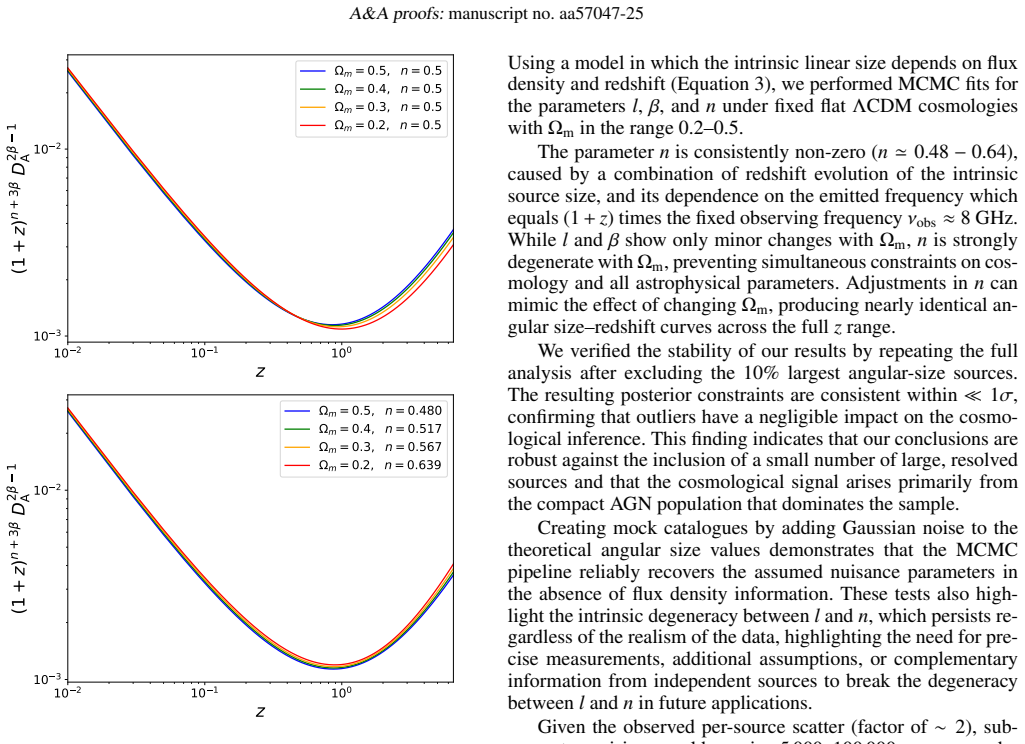
Using an expanded VLBI dataset, the angular size-redshift relation in compact extragalactic radio sources is shown to be physically meaningful because randomized redshift catalogs produce posterior distributions that do not overlap with those from actual observations. Joint MCMC modeling of the relation with an astrophysical parameter describing redshift dependence of source size exhibits degeneracy with Ω_m, but mock catalogs demonstrate that meaningful constraints on Ω_m become possible once observational scatter falls below ∼20 percent. Scaling estimates indicate that samples of several thousand to ∼100,000 sources, together with standardization or refined selection, would be required to
What carries the argument
The angular size-redshift relation for compact radio sources, modeled with a single astrophysical parameter that captures redshift-dependent evolution of intrinsic source size and fitted jointly with Ω_m via MCMC on VLBI angular size measurements.
If this is right
- The measured angular size-redshift relation survives a randomization test and therefore reflects real structure rather than chance alignment.
- The method yields useful constraints on Ω_m only when the scatter in the angular size measurements remains below approximately 20 percent.
- Samples containing several thousand to 100,000 well-measured sources are projected to be necessary before the test can deliver competitive cosmological results.
- Standardization calibration of source sizes or stricter selection criteria would be required to reduce the current degeneracy between astrophysical and cosmological parameters.
Where Pith is reading between the lines
- This radio-based test could be cross-checked against supernova or baryon acoustic oscillation distances to test consistency of the expansion history at high redshift.
- Future wide-field VLBI surveys that lower measurement scatter might allow the degeneracy with source evolution to be broken without external calibration.
- Once constraints are achieved, the same dataset could be reanalyzed under non-flat or evolving dark-energy models to search for deviations from ΛCDM.
Load-bearing premise
A single adjustable astrophysical parameter can capture the redshift evolution of intrinsic source sizes in a way that remains separable from the geometric effects of cosmology during joint fitting.
What would settle it
If new VLBI data processed with the same MCMC procedure produces Ω_m posteriors that overlap substantially with those from catalogs in which redshifts have been randomly shuffled, the claim that the angular size-redshift relation is physically meaningful would be falsified.
Figures


read the original abstract
VLBI measurements of the sizes of compact extragalactic radio sources, jetted active galactic nuclei, provide data for probing the angular size--redshift relation, offering a complementary test to other distance--redshift methods. We analyse a significantly expanded dataset to reassess the angular size--redshift relation and its potential for constraining cosmological model parameters, focusing on the matter density parameter $\Omega_{\mathrm{m}}$ in a flat $\Lambda$ Cold Dark Matter Universe. This is the first major update of the compact-source angular size test in the past quarter of a century, using a dataset an order of magnitude larger than in previous studies. MCMC analysis on real data and on multiple mock catalogues to evaluate parameter constraints in the presence of observational scatter. In addition, we conducted a test with 100 randomized catalogues created by shuffling redshifts while preserving other observables. We also explored how astrophysical parameters depend on fixed cosmological models with different $\Omega_{\mathrm{m}}$ values. The randomization test showed that the posterior distributions from randomized data do not overlap with those from real observations, confirming that the measured angular size--redshift relation is physically meaningful. The astrophysical model parameter that describes the redshift dependence of the source angular size exhibits degeneracy with $\Omega_{\mathrm{m}}$. Simulated mock catalogues indicate that the method is able to constrain $\Omega_{\mathrm{m}}$ if the data scatter is below $\sim20\%$. Scaling estimates suggest that high-quality data of samples of several thousands to $\sim 100\,000$ sources, a standardisation calibration approach, and/or refining sample selection criteria are needed to fully exploit the potential of the angular size--redshift test with this type of objects (abridged).
Editorial analysis
A structured set of objections, weighed in public.
Referee Report
Summary. The manuscript analyzes an expanded VLBI dataset of milliarcsecond-scale radio structures in jetted AGN to revisit the angular size-redshift relation as a cosmological test for Ω_m in flat ΛCDM. MCMC is used to jointly fit Ω_m and an astrophysical parameter governing redshift evolution of intrinsic source size; validation employs mock catalogs (to assess scatter thresholds) and 100 randomized catalogs (redshifts shuffled while preserving other observables). The randomization test shows non-overlapping posteriors relative to real data, and mocks indicate Ω_m constraints are feasible for scatter ≲20%. Degeneracy between the astrophysical parameter and Ω_m is noted, with the conclusion that samples of thousands to ~100,000 sources plus standardization or refined selection are required.
Significance. The update with an order-of-magnitude larger sample and modern statistical validation (MCMC, mocks, randomization) strengthens the case that a physical angular size-redshift signal exists in compact radio sources. If the degeneracy can be controlled and selection systematics quantified, the method offers a potential independent distance probe; the explicit demonstration that low scatter enables Ω_m recovery is a concrete, falsifiable result.
major comments (2)
- [Randomization test and MCMC fitting procedure] The randomization test (shuffling redshifts while keeping other observables) demonstrates that the observed θ(z) trend is not an artifact of the redshift distribution alone. However, because both the astrophysical evolution parameter and Ω_m enter the predicted angular size through the same angular-diameter distance, this test does not establish that the two parameters are separable; the non-overlap of posteriors only confirms a redshift-dependent signal exists, not that marginal constraints on Ω_m are data-driven rather than prior-driven.
- [Mock catalogue analysis] Mock-catalogue results indicate that Ω_m can be recovered when scatter is below ~20%. Because the mocks are constructed with the identical functional form for size evolution and the same scatter model assumed in the real-data fit, they cannot diagnose bias or loss of constraining power due to model misspecification, unmodeled selection effects in the VLBI sample, or deviations from the assumed linear (or power-law) redshift dependence.
minor comments (2)
- [Abstract] The abstract states that 'scaling estimates suggest' larger samples are needed; a short quantitative scaling relation or table showing how constraint width scales with sample size and scatter would make this claim more concrete and easier to evaluate.
- [Methods and results] Notation for the astrophysical evolution parameter (e.g., whether it is a power-law index n in (1+z)^n or a linear coefficient) should be defined explicitly at first use and used consistently in equations and figures.
Simulated Author's Rebuttal
We thank the referee for the constructive comments, which help clarify the scope and limitations of our analysis. We respond point-by-point below and have revised the manuscript to address the concerns raised.
read point-by-point responses
-
Referee: The randomization test (shuffling redshifts while keeping other observables) demonstrates that the observed θ(z) trend is not an artifact of the redshift distribution alone. However, because both the astrophysical evolution parameter and Ω_m enter the predicted angular size through the same angular-diameter distance, this test does not establish that the two parameters are separable; the non-overlap of posteriors only confirms a redshift-dependent signal exists, not that marginal constraints on Ω_m are data-driven rather than prior-driven.
Authors: We appreciate the referee highlighting this important nuance. The randomization test was designed to demonstrate that the angular size-redshift trend is not an artifact of the redshift distribution in the sample. We agree that, given the shared dependence on angular-diameter distance, the test does not fully establish separability of the astrophysical and cosmological parameters, nor does it prove that marginal Ω_m constraints are entirely data-driven. In the revised manuscript we will expand the relevant discussion to explicitly note this limitation, emphasize the acknowledged degeneracy, and present the joint posterior more clearly so readers can assess the role of priors. revision: partial
-
Referee: Mock-catalogue results indicate that Ω_m can be recovered when scatter is below ~20%. Because the mocks are constructed with the identical functional form for size evolution and the same scatter model assumed in the real-data fit, they cannot diagnose bias or loss of constraining power due to model misspecification, unmodeled selection effects in the VLBI sample, or deviations from the assumed linear (or power-law) redshift dependence.
Authors: We agree that the mock catalogues, by construction, assume the same functional form and scatter model used in the fits and therefore assess statistical power under the adopted model rather than testing for biases from misspecification or unmodeled VLBI selection effects. In the revised manuscript we will add an explicit caveat in the discussion section stating that the reported scatter threshold and required sample sizes are conditional on the validity of the assumed size-evolution model, and we will note that future work should explore alternative parametrizations and quantify selection systematics. revision: yes
Circularity Check
No significant circularity in the derivation or validation chain
full rationale
The paper performs standard MCMC joint fitting of the cosmological parameter Ω_m together with an astrophysical evolution parameter on observed angular-size and redshift data from VLBI sources. It validates the presence of a physical signal via a redshift-shuffling randomization test and assesses recoverability via mock catalogues generated under controlled scatter. No equation or procedure reduces the reported constraints to a self-definition, a fitted quantity renamed as an independent prediction, or a load-bearing self-citation. The acknowledged degeneracy between the astrophysical and cosmological parameters is treated as a statistical feature of the joint fit rather than hidden by construction; the randomization and mock tests remain independent of that degeneracy. The overall chain therefore rests on external data and conventional Bayesian inference without internal circular reduction.
Axiom & Free-Parameter Ledger
free parameters (1)
- astrophysical redshift dependence parameter
axioms (1)
- domain assumption Compact extragalactic radio sources have a redshift-dependent angular size evolution that can be parameterized separately from cosmological geometry
Reference graph
Works this paper leans on
-
[1]
& Baan, W
An, T. & Baan, W. A. 2012, ApJ, 760, 77
2012
-
[2]
A., & Wang, A
An, T., Zhang, Y ., Frey, S., Baan, W. A., & Wang, A. 2025, A&A, 704, A93
2025
-
[3]
Bash, F. N. 1968, ApJS, 16, 373
1968
-
[4]
J., Gordon, D., Peck, A
Beasley, A. J., Gordon, D., Peck, A. B., et al. 2002, ApJS, 141, 13
2002
-
[5]
Blandford, R. D. & Rees, M. J. 1978, Phys. Scr, 17, 265
1978
-
[6]
J., Becker, R
Buchalter, A., Helfand, D. J., Becker, R. H., & White, R. L. 1998, ApJ, 494, 503
1998
-
[7]
2018, European Physical Journal C, 78, 749
Cao, S., Biesiada, M., Qi, J., et al. 2018, European Physical Journal C, 78, 749
2018
-
[8]
2017, Astron
Cao, S., Zheng, X., Biesiada, M., et al. 2017, Astron. Astrophys., 606, A15
2017
-
[9]
& Ratra, B
Chen, G. & Ratra, B. 2003, ApJ, 582, 586
2003
-
[10]
1995, MNRAS, 277, 753
Dabrowski, Y ., Lasenby, A., & Saunders, R. 1995, MNRAS, 277, 753
1995
-
[11]
Daly, R. A. 1994, ApJ, 426, 38
1994
-
[12]
Daly, R. A. & Djorgovski, S. G. 2007, Nuclear Physics B Proceedings Supple- ments, 173, 19
2007
-
[13]
Gurvits, L. I. 1993, in Sub-arcsecond Radio Astronomy, ed. R. J. Davis & R. S. Booth, 380
1993
-
[14]
Gurvits, L. I. 1994, ApJ, 425, 442
1994
-
[15]
Gurvits, L. I. 2003, in Astronomical Society of the Pacific Conference Series, V ol. 300, Radio Astronomy at the Fringe, ed. J. A. Zensus, M. H. Cohen, & E. Ros, 285
2003
-
[16]
I., Kellermann, K
Gurvits, L. I., Kellermann, K. I., & Frey, S. 1999, A&A, 342, 378
1999
-
[17]
2022, Chinese Journal of Physics, 78, 297
He, Y ., Pan, Y ., Shi, D.-P., et al. 2022, Chinese Journal of Physics, 78, 297
2022
-
[18]
F., Taylor, G
Helmboldt, J. F., Taylor, G. B., Tremblay, S., et al. 2007, ApJ, 658, 203
2007
-
[19]
Hogg, D. W. 1999 [arXiv:astro-ph/9905116]
work page internal anchor Pith review arXiv 1999
-
[20]
1959, in IAU Symposium, V ol
Hoyle, F. 1959, in IAU Symposium, V ol. 9, URSI Symp. 1: Paris Symposium on Radio Astronomy, ed. R. N. Bracewell, 529
1959
-
[21]
Jackson, J. C. 2004, J. Cosmology Astropart. Phys., 2004, 007
2004
-
[22]
Jackson, J. C. 2008, MNRAS, 390, L1
2008
-
[23]
Jackson, J. C. & Dodgson, M. 1996, MNRAS, 278, 603
1996
-
[24]
Jackson, J. C. & Dodgson, M. 1997, MNRAS, 285, 806
1997
-
[25]
G., Marscher, A
Jorstad, S. G., Marscher, A. P., Morozova, D. A., et al. 2017, ApJ, 846, 98
2017
-
[26]
Kapahi, V . K. 1987, in IAU Symposium, V ol. 124, Observational Cosmology, ed. A. Hewitt, G. Burbidge, & L. Z. Fang, 251–265
1987
-
[27]
Kellermann, K. I. 1972, AJ, 77, 531
1972
-
[28]
L., Readhead, A
Kiehlmann, S., Lister, M. L., Readhead, A. C. S., et al. 2024, ApJ, 961, 240
2024
-
[29]
A., Pushkarev, A
Koryukova, T. A., Pushkarev, A. B., Plavin, A. V ., & Kovalev, Y . Y . 2022, MN- RAS, 515, 1736
2022
-
[30]
Y ., Kellermann, K
Kovalev, Y . Y ., Kellermann, K. I., Lister, M. L., et al. 2005, AJ, 130, 2473
2005
-
[31]
Y ., Petrov, L., Fomalont, E
Kovalev, Y . Y ., Petrov, L., Fomalont, E. B., & Gordon, D. 2007, AJ, 133, 1236
2007
-
[32]
P., Krichbaum, T
Lee, S.-S., Lobanov, A. P., Krichbaum, T. P., et al. 2008, AJ, 136, 159
2008
-
[33]
Legg, T. H. 1970, Nature, 226, 65–67
1970
-
[34]
2017, European Physical Journal C, 77, 677
Li, X., Cao, S., Zheng, X., et al. 2017, European Physical Journal C, 77, 677
2017
-
[35]
& Lin, H.-N
Li, X. & Lin, H.-N. 2018, MNRAS, 474, 313
2018
-
[36]
2021, MNRAS, 505, 2111
Lian, Y ., Cao, S., Biesiada, M., et al. 2021, MNRAS, 505, 2111
2021
-
[37]
Lima, J. A. S. & Alcaniz, J. S. 2002, ApJ, 566, 15
2002
-
[38]
L., Aller, M
Lister, M. L., Aller, M. F., Aller, H. D., et al. 2018, ApJS, 234, 12
2018
-
[39]
2014, in Frontiers of Fundamental Physics 14 (FFP14), 85
Lopez-Corredoira, M. 2014, in Frontiers of Fundamental Physics 14 (FFP14), 85
2014
-
[40]
2017, European Physical Journal C, 77, 891
Ma, Y ., Zhang, J., Cao, S., et al. 2017, European Physical Journal C, 77, 891
2017
-
[41]
Miley, G. K. 1968, Nature, 218, 933–934
1968
-
[42]
Miley, G. K. 1971, MNRAS, 152, 477
1971
-
[43]
G., Lobanov, A
Nair, D. G., Lobanov, A. P., Krichbaum, T. P., et al. 2019, A&A, 622, A92
2019
-
[44]
Peck, A. B. & Taylor, G. B. 2000, ApJ, 534, 90
2000
-
[45]
2012, MNRAS, 419, 1097
Petrov, L. 2012, MNRAS, 419, 1097
2012
-
[46]
M., Phillips, C., & Horiuchi, S
Petrov, L., de Witt, A., Sadler, E. M., Phillips, C., & Horiuchi, S. 2019, MNRAS, 485, 88
2019
-
[47]
2009, Journal of Geodesy, 83, 859
Petrov, L., Gordon, D., Gipson, J., et al. 2009, Journal of Geodesy, 83, 859
2009
-
[48]
Y ., Fomalont, E., & Gordon, D
Petrov, L., Kovalev, Y . Y ., Fomalont, E., & Gordon, D. 2005, AJ, 129, 1163
2005
-
[49]
Y ., Fomalont, E
Petrov, L., Kovalev, Y . Y ., Fomalont, E. B., & Gordon, D. 2006, AJ, 131, 1872
2006
-
[50]
Y ., Fomalont, E
Petrov, L., Kovalev, Y . Y ., Fomalont, E. B., & Gordon, D. 2008, AJ, 136, 580
2008
-
[51]
Petrov, L. Y . & Kovalev, Y . Y . 2025, ApJS, 276, 38
2025
-
[52]
G., Pushkarev, A
Piner, B. G., Pushkarev, A. B., Kovalev, Y . Y ., et al. 2012, ApJ, 758, 84
2012
-
[53]
V ., Kovalev, Y
Plavin, A. V ., Kovalev, Y . Y ., & Pushkarev, A. B. 2022, ApJS, 260, 4
2022
-
[54]
V ., Kovalev, Y
Popkov, A. V ., Kovalev, Y . Y ., Petrov, L. Y ., & Kovalev, Y . A. 2021, AJ, 161, 88
2021
-
[55]
A., Morabito, D
Preston, R. A., Morabito, D. D., Williams, J. G., et al. 1985, AJ, 90, 1599
1985
-
[56]
Pushkarev, A. B. & Kovalev, Y . Y . 2012, A&A, 544, A34
2012
-
[57]
2017, European Physi- cal Journal C, 77, 502
Qi, J.-Z., Cao, S., Biesiada, M., Zheng, X., & Zhu, Z.-H. 2017, European Physi- cal Journal C, 77, 502
2017
-
[58]
2019, MNRAS, 483, 1104
Qi, J.-Z., Cao, S., Zhang, S., et al. 2019, MNRAS, 483, 1104
2019
-
[59]
G., Filippenko, A
Riess, A. G., Filippenko, A. V ., Challis, P., et al. 1998, AJ, 116, 1009
1998
-
[60]
& Casella, G
Robert, C. & Casella, G. 2011, Statistical Science, 26, 102
2011
-
[61]
& Starobinsky, A
Sahni, V . & Starobinsky, A. 2000, International Journal of Modern Physics D, 9, 373
2000
-
[62]
1961, ApJ, 133, 355
Sandage, A. 1961, ApJ, 133, 355
1961
-
[63]
K., Petrov, L., Taylor, G
Schinzel, F. K., Petrov, L., Taylor, G. B., et al. 2015, ApJS, 217, 4
2015
-
[64]
Schmidt, B. P. 2012, Rev. Mod. Phys., 84, 1151
2012
-
[65]
2017, ApJS, 230, 13
Shu, F., Petrov, L., Jiang, W., et al. 2017, ApJS, 230, 13
2017
-
[66]
Singal, A. K. 1993, MNRAS, 263, 139
1993
-
[67]
V ., Kovalev, Y
Sokolovsky, K. V ., Kovalev, Y . Y ., Pushkarev, A. B., Mimica, P., & Perucho, M. 2011, A&A, 535, A24
2011
-
[68]
& Lewis, A
Torrado, J. & Lewis, A. 2019, Cobaya: Bayesian analysis in cosmology, Astro- physics Source Code Library, record ascl:1910.019
2019
-
[69]
& Lewis, A
Torrado, J. & Lewis, A. 2021, J. Cosmology Astropart. Phys., 05, 057
2021
-
[70]
E., Taylor, G
Tremblay, S. E., Taylor, G. B., Ortiz, A. A., et al. 2016, MNRAS, 459, 820
2016
-
[71]
Valentino, E. D. & Said, J. L. 2025, Physics of the Dark Universe, 101965
2025
-
[72]
Vishwakarma, R. G. 2001, Classical and Quantum Gravity, 18, 1159
2001
-
[73]
2019, Physics of the Dark Uni- verse, 26, 100405
Wan, H.-Y ., Cao, S., Melia, F., & Zhang, T.-J. 2019, Physics of the Dark Uni- verse, 26, 100405
2019
-
[74]
H., Mortonson, M
Weinberg, D. H., Mortonson, M. J., Eisenstein, D. J., et al. 2013, Phys. Rep., 530, 87
2013
-
[75]
N., Browne, I
Wilkinson, P. N., Browne, I. W. A., Alcock, D., et al. 1998, in Astrophysics and Space Science Library, V ol. 226, Observational Cosmology with the New Radio Surveys, ed. M. N. Bremer, N. Jackson, & I. Perez-Fournon, 221
1998
-
[76]
N., Polatidis, A
Wilkinson, P. N., Polatidis, A. G., Readhead, A. C. S., Xu, W., & Pearson, T. J. 1994, ApJ, 432, L87
1994
-
[77]
Xu, T., Cao, S., Qi, J., et al. 2018, J. Cosmology Astropart. Phys., 2018, 042
2018
-
[78]
2024, arXiv e-prints, arXiv:2407.05559
Yang, F., Fu, X., Xu, B., et al. 2024, arXiv e-prints, arXiv:2407.05559
-
[79]
Zheng, X., Biesiada, M., Cao, S., Qi, J., & Zhu, Z.-H. 2017, J. Cosmology As- tropart. Phys., 10, 030 Article number, page 9 of 10 A&A proofs:manuscript no. aa57047-25 Appendix A: A flux-density-based approach to computingθ(z) In previous studies, the angular size–redshift relation,θ(z), has typically been formulated in terms of the intrinsic luminosity, ...
2017
discussion (0)
Sign in with ORCID, Apple, or X to comment. Anyone can read and Pith papers without signing in.