Recognition: unknown
Distributional Convergence of Empirical Entropic Optimal Transport and Statistical Applications
Pith reviewed 2026-05-10 13:56 UTC · model grok-4.3
The pith
Empirical entropic optimal transport plans satisfy asymptotic weak convergence for a broad class of functionals including colocalization processes.
A machine-rendered reading of the paper's core claim, the machinery that carries it, and where it could break.
Core claim
We derive asymptotic weak convergence results for a large class of functionals of the EOT plan, in which the colocalization process is included. The proof is based on Hadamard differentiability and the extended delta method.
What carries the argument
Hadamard differentiability of the map from marginal measures to the functional of the EOT plan, followed by the extended delta method applied to the empirical marginals.
If this is right
- Uniform confidence bands can be constructed for colocalization curves derived from the EOT plan.
- Bootstrap consistency holds for the class of Hadamard differentiable functionals of the empirical EOT plan.
- The same limiting distribution applies to any functional satisfying the differentiability condition, not only the colocalization process.
- The theory covers both the optimal transport plan itself and derived summary statistics under the given regularity on cost and entropy.
Where Pith is reading between the lines
- The same differentiability-plus-delta-method route could be checked for other regularized transport problems such as those using different divergences.
- Viewing the EOT plan as a random measure or kernel opens the possibility of functional central limit theorems in settings where the plan is treated as an object in a function space.
- The result suggests concrete sample-size guidelines for colocalization studies once the Lipschitz or smoothness constants of the cost are known.
Load-bearing premise
The functionals of interest, including the colocalization process, must be Hadamard differentiable at the population EOT plan with respect to the underlying marginal probability measures.
What would settle it
A simulation study with increasing sample size that shows the empirical colocalization process fails to approach the predicted Gaussian limit under the paper's stated regularity conditions on the cost function and entropy parameter would falsify the convergence claim.
Figures




read the original abstract
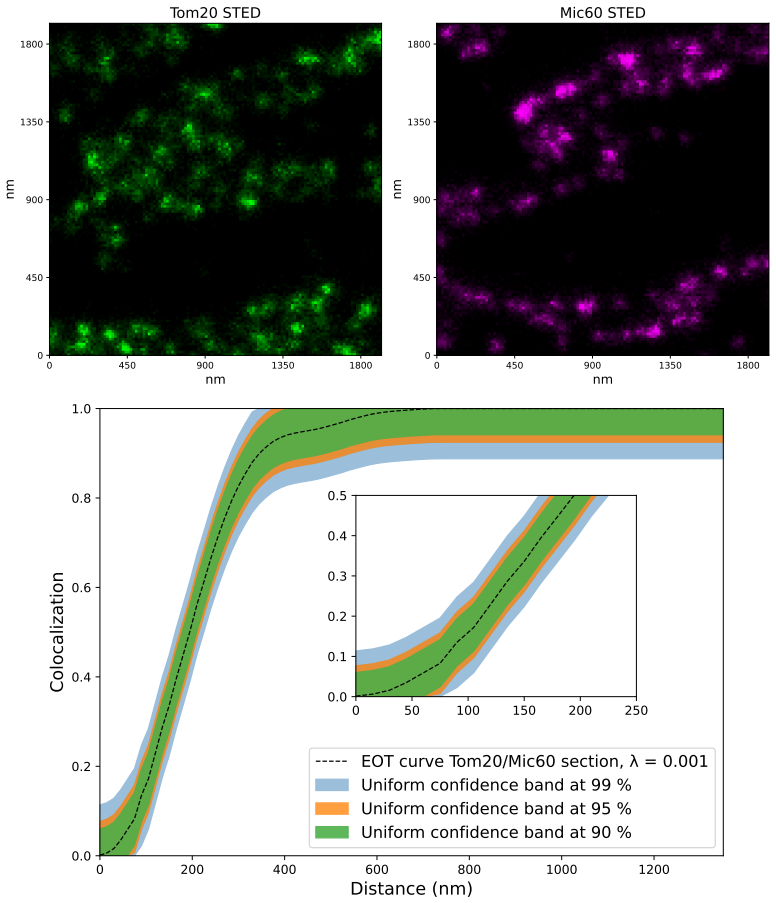
Recently, the statistical properties of empirical Entropic Optimal Transport (EOT) have attracted great interest, as this quantity has been shown to be useful for complex data analysis, among other reasons due to its computational efficiency. In several applications, it has been observed that the EOT plan provides valuable information beyond just the optimal value. For example, in cell biology, colocalization analysis based on the EOT plan has been introduced as a measure for quantification of spatial proximity of different protein assemblies. Despite recent progress in the analysis of its risk properties, a precise understanding of its statistical fluctuations to make it accessible for inference remains elusive to a large extent. In this paper, we derive asymptotic weak convergence result for a large class of functionals of the EOT plan, in which the colocalization process is included. The proof is based on Hadamard differentiability and the extended delta method. As an application, we obtain uniform confidence bands for colocalization curves and bootstrap consistency. Our theory is supported by simulation studies and is illustrated by real world data analysis from mitochondrial protein colocalization.
Editorial analysis
A structured set of objections, weighed in public.
Referee Report
Summary. The manuscript establishes asymptotic weak convergence results for a broad class of functionals of the empirical entropic optimal transport (EOT) plan, including the colocalization process, by applying Hadamard differentiability of the map from marginal distributions to the EOT plan (or functionals thereof) together with the extended delta method. These results are used to derive uniform confidence bands for colocalization curves and bootstrap consistency. The theory is illustrated with simulation studies and a real-data example involving mitochondrial protein colocalization.
Significance. If the Hadamard differentiability conditions hold under the paper's regularity assumptions on the cost, entropy parameter, and marginals, the work would supply a rigorous distributional limit theory for EOT-based statistics, moving beyond existing risk bounds to enable valid inference. The explicit treatment of the colocalization functional is a practical strength given its use in cell biology, and the combination of general functional-analytic arguments with empirical validation is a positive feature.
major comments (2)
- [Section 3, Theorem 3.1] Section 3, Theorem 3.1 and Assumption 3.2: The claim that the colocalization functional is Hadamard differentiable at the population EOT plan relies on sufficient smoothness and strict convexity of the cost together with a fixed positive entropy parameter; however, the verification that the directional derivative remains continuous in the weak topology (or Wasserstein metric) when the entropy parameter is small but positive is not carried out explicitly, which is load-bearing for the subsequent application of the extended delta method to obtain the limiting process.
- [Section 5, Equation (5.2)] Section 5, Equation (5.2) and the mitochondrial data application: The uniform confidence bands and bootstrap consistency for the colocalization curves are derived directly from the weak convergence result, but no diagnostic is provided to confirm that the entropy parameter and cost function satisfy the differentiability conditions in the specific mitochondrial protein setting; without this, the coverage guarantees for the real-data illustration remain conditional on unverified assumptions.
minor comments (2)
- [Introduction] The definition of the colocalization process in the introduction could be accompanied by a brief reminder of its relation to the EOT plan to improve readability for readers outside optimal transport.
- [Simulation studies] In the simulation section, several plots of empirical coverage lack explicit indication of the nominal level (e.g., 95%) on the y-axis, which makes visual assessment slightly harder.
Simulated Author's Rebuttal
We are grateful to the referee for their careful reading and constructive feedback on our manuscript. The comments help clarify the presentation of the Hadamard differentiability arguments and strengthen the real-data application. We address each major comment point by point below and will incorporate revisions to improve rigor.
read point-by-point responses
-
Referee: [Section 3, Theorem 3.1] Section 3, Theorem 3.1 and Assumption 3.2: The claim that the colocalization functional is Hadamard differentiable at the population EOT plan relies on sufficient smoothness and strict convexity of the cost together with a fixed positive entropy parameter; however, the verification that the directional derivative remains continuous in the weak topology (or Wasserstein metric) when the entropy parameter is small but positive is not carried out explicitly, which is load-bearing for the subsequent application of the extended delta method to obtain the limiting process.
Authors: We thank the referee for this precise observation. Under Assumption 3.2, the smoothness and strict convexity of the cost together with fixed ε > 0 ensure Hadamard differentiability of the EOT map via the dual formulation and the regularizing effect of the entropy term. The continuity of the directional derivative in the weak topology follows from the compactness of the space of measures and the fact that the entropy prevents degeneracy for any fixed positive ε (including small values). Nevertheless, we acknowledge that an explicit verification of this continuity was not isolated as a separate step. In the revised manuscript we will add a short lemma (or remark) immediately after the statement of Theorem 3.1 that confirms the continuity of the derivative map under weak convergence of the marginals, thereby making the invocation of the extended delta method fully self-contained. revision: yes
-
Referee: [Section 5, Equation (5.2)] Section 5, Equation (5.2) and the mitochondrial data application: The uniform confidence bands and bootstrap consistency for the colocalization curves are derived directly from the weak convergence result, but no diagnostic is provided to confirm that the entropy parameter and cost function satisfy the differentiability conditions in the specific mitochondrial protein setting; without this, the coverage guarantees for the real-data illustration remain conditional on unverified assumptions.
Authors: We agree that an explicit diagnostic for the mitochondrial example would make the coverage guarantees more convincing. In that application we used the squared Euclidean cost (which is C^∞ and strictly convex) and a fixed positive entropy parameter chosen for numerical stability. To address the referee’s concern, the revised Section 5 will contain a brief paragraph verifying that these choices satisfy Assumption 3.2 and the conditions of Theorem 3.1. We will also report a small sensitivity check over a range of nearby ε values to illustrate that the resulting confidence bands remain stable, thereby grounding the real-data illustration in the verified hypotheses. revision: yes
Circularity Check
No circularity; applies Hadamard differentiability and delta method to EOT
full rationale
The derivation establishes weak convergence of functionals of the empirical EOT plan (including colocalization) by invoking Hadamard differentiability of the map from marginals to the plan/functional, followed by the extended delta method. These are standard external functional-analytic tools applied to the EOT setting under explicitly stated regularity assumptions on the cost, entropy parameter, and marginals. No self-definitional steps, no fitted parameters renamed as predictions, and no load-bearing self-citations appear in the abstract or described proof strategy. The central result does not reduce to its inputs by construction; it is an application of general theorems whose validity is independent of the present paper.
Axiom & Free-Parameter Ledger
axioms (1)
- domain assumption The map from probability measures to the EOT plan is Hadamard differentiable at the population level for the functionals of interest
Reference graph
Works this paper leans on
-
[1]
https://doi.org/10.3150/19-BEJ1188 Carlier, G., & Laborde, M. (2020). A differential approach to the multi-marginal Schr¨ odinger system.SIAM Journal on Mathematical Analysis,52(1), 709–
-
[2]
https://doi.org/10.1137/19M1253800 Chapel, L., Flamary, R., Wu, H., F´ evotte, C., & Gasso, G. (2021). Unbalanced Opti- mal Transport through Non-negative Penalized Linear Regression. In M. Ran- zato, A. Beygelzimer, Y. Dauphin, P. Liang, & J. W. Vaughan (Eds.),Advances in Neural Information Processing Systems(pp. 23270–23282, Vol. 34). Curran Associates,...
-
[3]
https://doi.org/10.1561/2200000073 del Barrio, E., Gonz´ alez-Sanz, A., Loubes, J.-M., & Rodr´ ıguez-V´ ıtores, D. (2025). Dis- tributional limit theory for optimal transport.arXiv preprint arXiv:2505.19104. 27 Dette, H., & Kokot, K. (2022). Detecting relevant differences in the covariance oper- ators of functional time series: A sup-norm approach.Annals ...
-
[4]
https://doi.org/10.1109/tip.2019.2909194 Zeidler, E. (2012).Applied Functional Analysis: Main Principles and Their Applica- tions. Springer New York. https://books.google.de/books?id=abvkBwAAQBAJ Zinchuk, V., & Grossenbacher-Zinchuk, O. (2014). Quantitative colocalization analy- sis of fluorescence microscopy imagest.Current protocols in cell biology,62(1...
-
[5]
Denote, with abuse of notation, byξthe operator onC b(X)× C b(X)defined byξ(f, g)(x, y), where x, y∈ X
Letf, g∈ C b(X)with∥f∥ ∞,∥g∥ ∞ ≤ ∥c∥ ∞ and R X gdν= 0. Denote, with abuse of notation, byξthe operator onC b(X)× C b(X)defined byξ(f, g)(x, y), where x, y∈ X. Thenξis Fr´ echet differentiable with derivativeDξ (f,g) hf , hg (x, y) = ξ(f, g)(x, y) hf (x)+hg(y) λ
-
[6]
Letµ, ν∈ P(X)
Further, assume (LCm). Letµ, ν∈ P(X). Then, the duality mappingψis bounded directional differentiable tangentially to(−µ+P(X)) ×(−ν+P(X))with derivativeψ ′ (µ,ν) =−∂ 2Ψ−1 (µ,ν,ψ(µ,ν)) ∂1Ψ(µ,ν,ψ(µ,ν)). DefineΞ(µ, ν) =ξ f λ µ,ν, gλ µ,ν .Ξis bounded directional differentiable tangen- tially to(−µ+P(X))×(−ν+P(X))with derivative Ξ(µ,ν) (hµ, hν) (x, y) =ξ f λ µ...
2020
-
[7]
As it was pointed in Section 1, the mapψis well defined by existence and uniqueness of solution theorem for the entropic optimal transport problem (1) (see Nutz, 2021)
To prove this result the implicit mapping theorem in Banach spaces is to be used (see Zeidler, 2012, Section 4.8). As it was pointed in Section 1, the mapψis well defined by existence and uniqueness of solution theorem for the entropic optimal transport problem (1) (see Nutz, 2021). More precisely, for fixedµ, ν∈ P(X) there exists a pair f λ µ,ν, gλ µ,ν ∈...
2012
discussion (0)
Sign in with ORCID, Apple, or X to comment. Anyone can read and Pith papers without signing in.