Recognition: unknown
Recursive Completion in Higher K-Models: Front-Seed Semantics, Proof-Relevant Witnesses, and the K-Infinity Model
Pith reviewed 2026-05-10 14:13 UTC · model grok-4.3
The pith
A smaller front-seed coherence package with pentagon contraction recovers the key semantic theorems for the K-infinity homotopy model of the lambda calculus.
A machine-rendered reading of the paper's core claim, the machinery that carries it, and where it could break.
Core claim
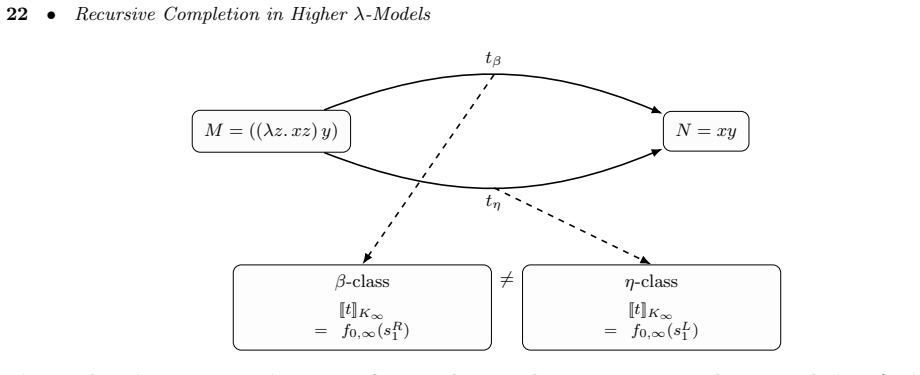
A smaller front-seed coherence package (WL, WR) together with an inner-right-front pentagon contraction already suffices to recover the associator comparison, semantic pentagon, and bridge theorems used in the later semantic arguments. Explicit global reify, reflect, and application formulas for K-infinity are proved, with exact coordinatewise identities at every finite stage. The recursive all-dimensional continuation of the explicit low-dimensional tower is obtained by a finite packaging phase followed by a uniform equality-generated recursion, and the canonical identity-type higher tower on K-infinity forces all higher non-connection once the two witness classes land at distinct points.
What carries the argument
The front-seed coherence package (WL, WR) together with the inner-right-front pentagon contraction, which together recover the associator comparison and semantic pentagon theorems for the K-infinity model.
If this is right
- The associator comparison theorem holds from the reduced coherence package alone.
- The semantic pentagon theorem is recovered without larger coherence data.
- Bridge theorems required for later semantic arguments become available from the same minimal conditions.
- Explicit reify, reflect, and application formulas apply coordinatewise at every finite stage of K-infinity.
- The higher identity-type tower forces non-connections between witness classes that land at distinct points.
Where Pith is reading between the lines
- The reduction in required coherence data could lower the overhead of formalizing higher homotopy models of the lambda calculus in proof assistants.
- The coordinatewise explicit formulas open the possibility of direct computational checks of semantic equalities inside the model.
- The forced non-connection result may clarify how proof-relevant witnesses behave in separation spans for classical logic.
- The finite-packaging-plus-recursion pattern suggests a general template for building higher-dimensional models from low-dimensional data.
Load-bearing premise
The prior extensional Kan semantics and concrete K-infinity homotopy-model construction are taken as given, with the front-seed package and pentagon contraction assumed definable without additional hidden coherence data.
What would settle it
An explicit counter-derivation showing that WL, WR and the inner-right-front pentagon contraction fail to imply the associator comparison theorem would falsify the main reduction claim.
Figures

read the original abstract
Martinez-Rivillas and de Queiroz gave extensional Kan semantics for the untyped lambda-calculus and later constructed the concrete K-infinity homotopy-model. The two main mathematical results of the present paper are these. First, we show that a smaller front-seed coherence package (WL, WR) together with an inner-right-front pentagon contraction already suffices to recover the associator comparison, semantic pentagon, and bridge theorems used in the later semantic arguments. Second, we prove explicit global reify, reflect, and application formulas for K-infinity, with exact coordinatewise identities at every finite stage. We also record two structural clarifications: the recursive all-dimensional continuation of the explicit low-dimensional tower is obtained by a finite packaging phase followed by a uniform equality-generated recursion; and, on a deliberately fixed forward witness language for the classical separation span, the canonical identity-type higher tower on K-infinity forces all higher non-connection once the two witness classes land at distinct points. The paper is fully formalized in Lean 4, and the project sources contain no local uses of sorry, admit, or axiom.
Editorial analysis
A structured set of objections, weighed in public.
Referee Report
Summary. The paper claims that a smaller front-seed coherence package (WL, WR) together with an inner-right-front pentagon contraction suffices to recover the associator comparison, semantic pentagon, and bridge theorems in higher K-models for extensional Kan semantics of the untyped lambda-calculus. It also proves explicit global reify, reflect, and application formulas for the K-infinity model with exact coordinatewise identities at every finite stage. Additional clarifications are provided on the recursive all-dimensional continuation of the explicit low-dimensional tower via finite packaging and uniform equality-generated recursion, and on how the canonical identity-type higher tower forces higher non-connection on a fixed forward witness language. The work is fully formalized in Lean 4 with no uses of sorry, admit, or axiom.
Significance. If the results hold, this contributes to the field by reducing the coherence data needed for semantic arguments in homotopy models of the lambda-calculus, while providing constructive explicit formulas. The complete machine-checked formalization in Lean 4 is a strong point, as it offers independent verification of the derivations from the reduced package and supports the claims about recursive completion and proof-relevant witnesses.
major comments (1)
- [front-seed semantics section] The sufficiency of the (WL, WR) package plus pentagon contraction for recovering the key theorems is load-bearing; the manuscript should make explicit which parts of the prior Martinez-Rivillas and de Queiroz K-infinity construction are used as base, to confirm no additional hidden coherence is required.
minor comments (2)
- The abstract refers to 'two structural clarifications' without indicating their location in the paper; adding section references would improve navigation.
- [K-infinity formulas section] Ensure that the explicit reify, reflect, and application formulas are presented with clear numbering and perhaps a table summarizing the coordinatewise identities at finite stages for better readability.
Simulated Author's Rebuttal
We thank the referee for the careful review and the recommendation of minor revision. The single major comment is addressed below; we agree that the requested clarification will strengthen the manuscript and will incorporate it in the revision.
read point-by-point responses
-
Referee: [front-seed semantics section] The sufficiency of the (WL, WR) package plus pentagon contraction for recovering the key theorems is load-bearing; the manuscript should make explicit which parts of the prior Martinez-Rivillas and de Queiroz K-infinity construction are used as base, to confirm no additional hidden coherence is required.
Authors: We agree that an explicit enumeration of retained base components improves clarity. In the revised manuscript we will add a short paragraph at the opening of the front-seed semantics section (Section 3) that lists the precise elements taken from Martinez-Rivillas and de Queiroz: (i) the underlying Kan-complex structure for the untyped lambda-calculus, (ii) the extensionality axioms governing the interpretation of application and abstraction, and (iii) the low-dimensional coherence data (dimensions 0–2) that initiate the recursive completion. All subsequent derivations of the associator comparison, semantic pentagon, and bridge theorems rely exclusively on the reduced (WL, WR) package together with the inner-right-front pentagon contraction; no further coherence conditions are invoked. The Lean 4 formalization already encodes this separation via the imported base modules and the isolated proofs of the new theorems, thereby providing machine-checked confirmation that no hidden coherence is required. revision: yes
Circularity Check
Minor self-citation to prior model; new derivations independent via Lean formalization
full rationale
The paper explicitly takes the prior extensional Kan semantics and K-infinity construction by Martinez-Rivillas and de Queiroz as given, but derives its central claims—the sufficiency of the reduced (WL, WR) front-seed package plus inner-right-front pentagon contraction for recovering associator comparison, semantic pentagon, and bridge theorems, plus explicit global reify/reflect/application formulas with coordinatewise identities—from this smaller package. These derivations are supported by a complete Lean 4 formalization containing no sorry, admit, or axiom, providing machine-checked grounding independent of the prior inputs. The self-citation is present but not load-bearing for the novel results, which do not reduce by construction to the base model.
Axiom & Free-Parameter Ledger
axioms (1)
- domain assumption Prior extensional Kan semantics and K-infinity homotopy-model construction by Martinez-Rivillas and de Queiroz
Reference graph
Works this paper leans on
-
[1]
Functions of Bounded Variation and Free Discontinuity Problems
S. Abramsky and A. Jung, Domain theory, in:Handbook of Logic in Computer Science, Vol. 3, Oxford University Press, 1995, pp. 1–168.doi: 10.1093/oso/9780198537625.003.0001
-
[2]
H. P. Barendregt,The Lambda Calculus: Its Syntax and Semantics, revised edition, Studies in Logic and the Foundations of Mathematics 103, North-Holland, 1984
1984
-
[3]
M. A. Batanin, Monoidal globular categories as a natural environment for the theory of weakn-categories,Advances in Mathematics136(1):39–103, 1998.doi: 10.1006/aima.1998.1724
-
[4]
T. M. L. de Veras, A. F. Ramos, R. J. G. B. de Queiroz, and A. G. de Oliveira, Computational paths—a weak groupoid,Journal of Logic and Computation35(5):exad071, 2025.doi: 10.1093/logcom/exad071. Also available as arXiv:2007.07769
-
[5]
Grothendieck,Pursuing Stacks, edited by G
A. Grothendieck,Pursuing Stacks, edited by G. Maltsiniotis, Documents math´ ematiques 20, Soci´ et´ e Math´ ematique de France, 2022. (Original manuscript, 1983.)
2022
-
[6]
The Univalent Foundations Program,Homotopy Type Theory: Univalent Foundations of Mathematics, Institute for Advanced Study, 2013
2013
-
[7]
The lean 4 theorem prover and programming language
L. de Moura and S. Ullrich, The Lean 4 theorem prover and programming language, in:Automated Deduction— CADE 28, LNCS 12699, Springer, 2021, pp. 625–635.doi: 10.1007/978-3-030-79876-5 37
-
[8]
J. Lurie,Higher Topos Theory, Princeton University Press, 2009.doi: 10.1515/9781400830558
-
[9]
D. O. Mart´ ınez-Rivillas and R. J. G. B. de Queiroz, Towards a homotopy domain theory,Archive for Mathematical Logic62:559–579, 2023.doi: 10.1007/s00153-022-00856-0. Preprint: arXiv:2007.15082
-
[10]
D. O. Mart´ ınez-Rivillas and R. J. G. B. de Queiroz, TheK ∞ homotopyλ-model, to appear inLogic Journal of the IGPL.doi: 10.48550/arXiv.2505.07103. Preprint: arXiv:2505.07103 [cs.LO], 2025
work page internal anchor Pith review Pith/arXiv arXiv doi:10.48550/arxiv.2505.07103 2025
-
[11]
D. O. Mart´ ınez-Rivillas and R. J. G. B. de Queiroz, The theory of an arbitrary higherλ-model,Bulletin of the Section of Logic52(1):39–58, 2023.doi: 10.18778/0138-0680.2023.11. Also available as arXiv:2111.07092
-
[12]
D. O. Mart´ ınez-Rivillas and R. J. G. B. de Queiroz, The∞-groupoid generated by an arbitrary topologicalλ-model, Logic Journal of the IGPL30:465–488, 2022.doi: 10.1093/jigpal/jzab015
-
[13]
D. S. Scott, Continuous lattices, in:Toposes, Algebraic Geometry and Logic, Lecture Notes in Mathematics 274, Springer, 1972, pp. 97–136. Originally circulated as PRG-7, Oxford University Computing Laboratory, Programming Research Group, 1971
1972
discussion (0)
Sign in with ORCID, Apple, or X to comment. Anyone can read and Pith papers without signing in.