Recognition: unknown
Buchdahl Limit and TOV Equations in Interacting Vacuum Scenarios
Pith reviewed 2026-05-10 15:21 UTC · model grok-4.3
The pith
Interacting vacuum keeps central pressure finite in stars beyond the Buchdahl compactness limit.
A machine-rendered reading of the paper's core claim, the machinery that carries it, and where it could break.
Core claim
Extending the Tolman-Oppenheimer-Volkoff hydrostatic equilibrium equation with a covariant interaction four-vector Q_ν between the fluid and vacuum energy-momentum tensors allows the central pressure to remain finite for compactness parameters that exceed the Buchdahl limit, for appropriate values of the coupling strength in both the density-gradient and curvature-coupled models.
What carries the argument
The interaction term Q_ν, which represents covariant energy exchange and modifies the pressure gradient in the extended TOV equations.
If this is right
- Central pressure stays finite where standard GR predicts divergence at the Buchdahl threshold.
- Ultra-compact stellar objects become possible without encountering singularities.
- Both coupling to matter energy-density gradient and to curvature permit stable solutions in suitable parameter ranges.
- The classical geometric bound on compactness can be bypassed through vacuum-fluid interactions.
Where Pith is reading between the lines
- Such models might allow exotic compact objects that mimic black-hole exteriors without horizons.
- Mass-radius relations for neutron stars could shift measurably under these interactions.
- Gravitational-wave signals from mergers might carry imprints of the modified internal pressure profile.
Load-bearing premise
The phenomenological interaction terms chosen for the vacuum-fluid coupling yield stable and physically acceptable solutions for some values of the coupling parameter.
What would settle it
Numerical integration of the extended TOV equations with either proposed form of Q_ν showing that central pressure still diverges exactly at the Buchdahl compactness for every coupling value.
Figures

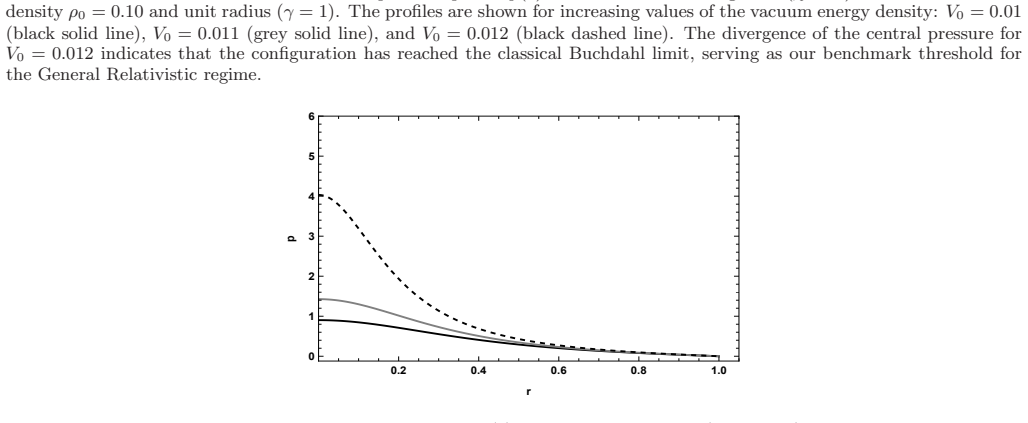


read the original abstract
We investigate the stability of ultra-compact stellar configurations in the context of an interacting vacuum component. By extending the Tolman-Oppenheimer-Volkoff equations to include a covariant energy exchange between the fluid and vacuum sectors, we examine how the classical Buchdahl stability limit is modified. We analyze two phenomenological interaction models: a coupling to the matter energy density gradient and a direct coupling to the spacetime curvature. Numerical integration reveals that while standard General Relativity predicts a central pressure divergence as the compactness approaches the Buchdahl threshold, the interaction term $Q_\nu$ relaxes the pressure gradient and maintains a finite, well-behaved central pressure for proper domains of the coupling parameter. These results demonstrate that an interacting vacuum provides a physical mechanism to bypass classical geometric bounds, potentially supporting ultra-compact objects in regimes previously considered singular.
Editorial analysis
A structured set of objections, weighed in public.
Referee Report
Summary. The manuscript extends the Tolman-Oppenheimer-Volkoff (TOV) equations to incorporate covariant energy exchange between a perfect fluid and an interacting vacuum sector. Two phenomenological interaction terms Q_ν are considered—one proportional to the gradient of the matter energy density and the other to the spacetime curvature scalar. Numerical integration of the modified hydrostatic equilibrium equation demonstrates that, for suitable ranges of the coupling strength, the central pressure remains finite even when the compactness parameter exceeds the classical Buchdahl bound of 8/9, in contrast to the divergence obtained in standard general relativity.
Significance. If the numerical results are robust, the work identifies a concrete mechanism by which an interacting vacuum can relax the hydrostatic pressure gradient and thereby evade the geometric Buchdahl limit. This could be relevant for modeling ultra-compact objects or for exploring the role of vacuum-matter coupling in strong-field regimes. The explicit demonstration that finite central pressure is recovered for nonzero coupling is a clear strength, although the phenomenological status of the interaction terms limits the generality of the conclusion.
major comments (2)
- [Sections describing the interaction models and the modified TOV system] The central claim that the interaction term relaxes the pressure gradient and yields finite central pressure rests on the two specific phenomenological forms of Q_ν. Because these forms are introduced by hand without derivation from an action principle or from a well-defined limit in which they reduce to standard GR, it is unclear whether the reported bypass is a generic feature of interacting vacuum or an artifact of the chosen source terms. The classical Buchdahl derivation assumes separate conservation of T_μν; the extra Q_ν term directly violates that assumption, so the result is tied to the arbitrary choice rather than to the presence of an interacting vacuum sector per se.
- [Numerical results and integration procedure] The abstract and results section state that numerical integration was performed and that central pressure remains finite for proper coupling domains, yet no boundary conditions at the stellar center, integration scheme, step-size control, convergence tests, or error estimates are supplied. Without these, it is impossible to verify that the reported finite-pressure solutions are not numerical artifacts, which directly undermines the load-bearing claim that the Buchdahl limit is bypassed.
minor comments (1)
- [Abstract] The abstract refers to 'proper domains of the coupling parameter' without quoting the numerical interval or the criterion used to define acceptability; this should be stated explicitly.
Simulated Author's Rebuttal
We are grateful to the referee for the insightful comments, which have helped us improve the clarity and robustness of our manuscript. We provide point-by-point responses to the major comments below.
read point-by-point responses
-
Referee: The central claim that the interaction term relaxes the pressure gradient and yields finite central pressure rests on the two specific phenomenological forms of Q_ν. Because these forms are introduced by hand without derivation from an action principle or from a well-defined limit in which they reduce to standard GR, it is unclear whether the reported bypass is a generic feature of interacting vacuum or an artifact of the chosen source terms. The classical Buchdahl derivation assumes separate conservation of T_μν; the extra Q_ν term directly violates that assumption, so the result is tied to the arbitrary choice rather than to the presence of an interacting vacuum sector per se.
Authors: We acknowledge that the interaction terms Q_ν are phenomenological, as is common in the literature on interacting dark energy and vacuum models. Our work demonstrates that for these covariant interaction forms, the hydrostatic equilibrium is modified such that the pressure gradient is relaxed, allowing finite central pressure beyond the Buchdahl limit. We agree that this does not prove it is generic to all interacting vacuum scenarios, but rather shows a possible mechanism within this class of models. In the revised manuscript, we will expand the discussion to explicitly state the phenomenological nature and the limitations of our conclusions, including that the classical Buchdahl theorem relies on separate conservation which is violated here by design. revision: partial
-
Referee: The abstract and results section state that numerical integration was performed and that central pressure remains finite for proper coupling domains, yet no boundary conditions at the stellar center, integration scheme, step-size control, convergence tests, or error estimates are supplied. Without these, it is impossible to verify that the reported finite-pressure solutions are not numerical artifacts, which directly undermines the load-bearing claim that the Buchdahl limit is bypassed.
Authors: We thank the referee for pointing out this omission. The manuscript will be revised to include a dedicated subsection on the numerical methods. Specifically, we will detail the central boundary conditions (regularity requiring dp/dr = 0 at r=0, and finite central density and pressure), the integration scheme (fourth-order Runge-Kutta with adaptive step-size control), convergence tests by varying step sizes, and error estimates based on comparison with known GR limits for small coupling. This will ensure the robustness of the finite central pressure solutions. revision: yes
Circularity Check
No significant circularity; results follow directly from numerical integration of modified TOV equations with explicit phenomenological source terms.
full rationale
The paper introduces two explicit phenomenological forms for the interaction four-vector Q_ν (coupling to the matter density gradient or to curvature), augments the standard TOV hydrostatic equilibrium equation with the resulting extra source term, and performs numerical integration of the resulting first-order system. The reported finite central pressure at compactness exceeding the classical Buchdahl value is a direct numerical consequence of that added term relaxing the pressure gradient; it is not obtained by fitting any parameter to the target outcome and then relabeling the fit as a prediction. No load-bearing uniqueness theorem, self-citation chain, or ansatz imported from prior work by the same author is invoked to justify the central claim. The derivation therefore remains self-contained: the bypass of the geometric bound is an immediate output of the chosen extended differential equations rather than a reduction to the input assumptions by construction.
Axiom & Free-Parameter Ledger
free parameters (1)
- coupling strength parameter
axioms (2)
- domain assumption The interaction between fluid and vacuum can be modeled covariantly by adding a source term Q_ν to the conservation equations.
- ad hoc to paper The two chosen functional forms of Q_ν (density-gradient coupling and curvature coupling) are representative and physically acceptable.
invented entities (1)
-
interacting vacuum component
no independent evidence
Reference graph
Works this paper leans on
-
[1]
R. C. Tolman, Phys. Rev. 55, 364-373 (1939)
1939
-
[2]
J. R. Oppenheimer and G. M. Volkoff, Phys. Rev. 55, 374-381 (1939)
1939
-
[3]
H. A. Buchdahl, Phys. Rev. 116, 1027 (1959)
1959
-
[4]
B. P. Abbott et al. [LIGO Scientific and Virgo], Phys. Rev. Lett. 121, no.16, 161101 (2018) [arXiv:1805.11581 [gr-qc]]
work page Pith review arXiv 2018
- [5]
- [6]
-
[7]
Weinberg, Rev
S. Weinberg, Rev. Mod. Phys. 61, 1-23 (1989)
1989
-
[8]
Quintessence, Cosmic Coincidence, and the Cosmological Constant
I. Zlatev, L. M. Wang and P. J. Steinhardt, Phys. Rev. Lett . 82, 896-899 (1999) [arXiv:astro-ph/9807002 [astro-ph]]
work page Pith review arXiv 1999
-
[9]
E. Di Valentino, O. Mena, S. Pan, L. Visinelli, W. Yang, A. Melchiorri, D. F. Mota, A. G. Riess and J. Silk, Class. Quant. Grav. 38, no.15, 153001 (2021) [arXiv:2103.01183 [astro-ph.CO]]
- [10]
-
[11]
S. Capozziello, M. De Laurentis, S. D. Odintsov and A. St abile, Phys. Rev. D 83, 064004 (2011) [arXiv:1101.0219 [gr-qc]]
- [12]
- [13]
-
[14]
B. Wang, E. Abdalla, F. Atrio-Barandela and D. Pavon, Re pt. Prog. Phys. 79, no.9, 096901 (2016) [arXiv:1603.08299 [astro-ph.CO]]
work page Pith review arXiv 2016
-
[15]
Indications of a late-time interaction in the dark sector
V. Salvatelli, N. Said, M. Bruni, A. Melchiorri and D. Wa nds, Phys. Rev. Lett. 113, no.18, 181301 (2014) [arXiv:1406.7297 [astro-ph.CO]]
work page Pith review arXiv 2014
-
[16]
J. Sol` a Peracaula, A. G´ omez-Valent, J. de Cruz Perez a nd C. Moreno-Pulido, EPL 134, no.1, 19001 (2021) [arXiv:2102.12758 [astro-ph.CO]]
- [17]
- [18]
- [19]
- [20]
- [21]
- [22]
-
[23]
A. Munyeshyaka, J. Ntahompagaze, T. Mutabazi, M. R. Mbo nye, A. Ayirwanda, F. Twagirayezu and A. Abebe, Int. J. Geom. Meth. Mod. Phys. 20, no.03, 2350047 (2023) [arXiv:2210.01184 [gr-qc]]
- [24]
-
[25]
J. Sola Peracaula, A. Gomez-Valent, J. de Cruz Perez and C. Moreno-Pulido, Universe 9, no.6, 262 (2023) [arXiv:2304.11157 [astro-ph.CO]]
- [26]
- [27]
-
[28]
P. Beltracchi and P. Gondolo, Phys. Rev. D 99, no.4, 044037 (2019) [arXiv:1810.12400 [gr-qc]]
-
[29]
Chandrasekhar, Phys
S. Chandrasekhar, Phys. Rev. Lett. 12, 114-116 (1964)
1964
discussion (0)
Sign in with ORCID, Apple, or X to comment. Anyone can read and Pith papers without signing in.