Recognition: unknown
Floquet Many-Body Cages
Pith reviewed 2026-05-10 15:20 UTC · model grok-4.3
The pith
Floquet circuits can be engineered to host many-body cages with topological and time-crystalline properties.
A machine-rendered reading of the paper's core claim, the machinery that carries it, and where it could break.
Core claim
We construct explicit Floquet circuits capable of hosting many-body cages and present a generic strategy to engineer and structure them. For the quantum hard disk model, we realize Floquet many-body cages that carry topological properties and pi-quasienergy modes, which imply time crystalline spatiotemporal order. The results extend directly to general quantum circuits as a tool for nonequilibrium behavior in driven systems.
What carries the argument
Floquet many-body cages, built from explicit driving protocols that preserve localization inside constrained Hilbert spaces.
Load-bearing premise
The proposed Floquet driving protocol preserves the many-body cage structure without inducing heating or ergodicity in the driven constrained system.
What would settle it
An observation or simulation showing that the driven system heats to infinite temperature or loses its cage localization after a few driving periods would falsify the existence of stable Floquet many-body cages.
Figures




read the original abstract
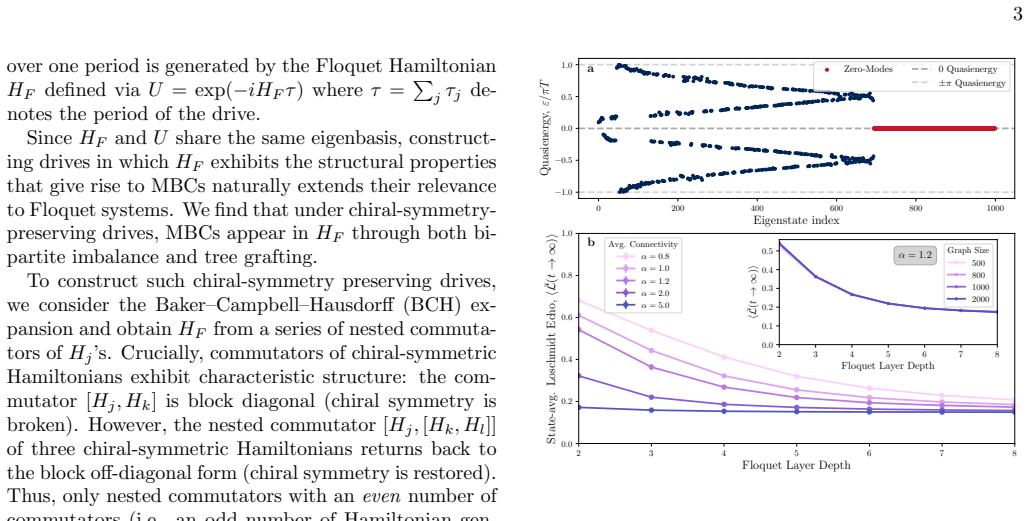
Many-body cages have very recently emerged as a general route for nonergodic behaviour in quantum matter. Here, we show that new types of many-body cages can be engineered in Floquet circuits with the potential to realize novel nonequilibrium quantum states. For that purpose, we first identify an explicit, general construction of Floquet circuits capable of hosting many-body cages. We then present a generic strategy to engineer and structure Floquet many-body cages. We demonstrate the developed scheme for the quantum hard disk model as a generic constrained model system, realizable for instance in Rydberg atom arrays. We construct Floquet circuits yielding Floquet many-body cages with topological properties and $\pi$-quasienergy modes, implying `time crystalline' spatiotemporal order. Our results can be directly extended to general quantum circuits, thus providing a new tool to engineer nonequilibrium behaviour in driven systems.
Editorial analysis
A structured set of objections, weighed in public.
Referee Report
Summary. The paper presents an explicit general construction of Floquet circuits capable of hosting many-body cages, applies a generic strategy to engineer and structure them, and demonstrates the approach on the quantum hard disk model (realizable in Rydberg arrays). The resulting circuits are claimed to produce Floquet many-body cages possessing topological properties and protected π-quasienergy modes, implying time-crystalline spatiotemporal order in driven constrained systems.
Significance. If the construction is shown to preserve the constrained subspace without inducing leakage or heating, the work supplies a concrete new tool for engineering nonergodic nonequilibrium states in Floquet systems. The explicit circuit construction, extension to general quantum circuits, and identification of topological and π-mode features constitute clear strengths that could guide experimental implementations.
major comments (2)
- [§3.2] §3.2 (Floquet operator for the quantum hard disk model): the construction defines a periodic driving protocol but does not supply an explicit proof, commutator calculation, or numerical bound showing that the Floquet operator maps the hard-constraint Hilbert space exactly onto itself for all periods; without this, the claim that many-body cages persist indefinitely remains unverified.
- [§4] §4 (demonstration of π-quasienergy modes and time-crystalline order): the reported quasienergy spectrum and spatiotemporal correlation functions are shown for finite times and system sizes, but no analysis of long-time stability, finite-size scaling of the π-mode gap, or bounds on drive-induced delocalization is provided; this is load-bearing for the time-crystalline claim.
minor comments (2)
- [§2] Notation for the constraint projectors and the Floquet evolution operator should be unified across sections to avoid ambiguity when the general construction is specialized to the hard-disk model.
- The abstract states that the results 'can be directly extended to general quantum circuits,' but the manuscript provides only a brief outline; a short explicit example outside the hard-disk case would strengthen this claim.
Simulated Author's Rebuttal
We thank the referee for their careful reading of our manuscript and for the constructive major comments. We address each point below and outline the revisions we will make.
read point-by-point responses
-
Referee: [§3.2] §3.2 (Floquet operator for the quantum hard disk model): the construction defines a periodic driving protocol but does not supply an explicit proof, commutator calculation, or numerical bound showing that the Floquet operator maps the hard-constraint Hilbert space exactly onto itself for all periods; without this, the claim that many-body cages persist indefinitely remains unverified.
Authors: We thank the referee for highlighting this point. In our construction, each gate is explicitly built to act only on configurations satisfying the hard constraints of the quantum hard disk model (via projectors onto allowed Rydberg states or equivalent). Because every gate commutes with the global constraint projector, the full Floquet operator necessarily maps the constrained subspace onto itself. To make this rigorous and address the referee's request, we will add an explicit proof in a new appendix, including the relevant commutator relations and a short numerical verification for small systems confirming exact subspace preservation over multiple periods. revision: yes
-
Referee: [§4] §4 (demonstration of π-quasienergy modes and time-crystalline order): the reported quasienergy spectrum and spatiotemporal correlation functions are shown for finite times and system sizes, but no analysis of long-time stability, finite-size scaling of the π-mode gap, or bounds on drive-induced delocalization is provided; this is load-bearing for the time-crystalline claim.
Authors: We agree that stronger evidence for long-time stability would reinforce the time-crystalline claim. The manuscript already shows clear π-quasienergy modes and persistent spatiotemporal order for the accessible system sizes and evolution times. In revision we will add (i) finite-size scaling of the π-mode gap and (ii) a discussion of how many-body caging suppresses drive-induced delocalization, providing a qualitative bound based on the fragmentation of the Hilbert space. A fully rigorous proof of infinite-time stability lies beyond the present scope and would require additional analytic tools; we will explicitly note this limitation while emphasizing the numerical and topological protection arguments already present. revision: partial
Circularity Check
No significant circularity detected in the Floquet many-body cage construction
full rationale
The paper's derivation begins with an explicit general construction of Floquet circuits that host many-body cages, followed by a strategy to engineer them in constrained models such as the quantum hard disk model. This is applied directly without fitting parameters to data, without redefining quantities in terms of themselves, and without load-bearing reliance on self-citations or imported uniqueness theorems. The central results (topological properties, π-quasienergy modes) follow from the stated circuit constructions and their action on the constrained Hilbert space, which remain independent of the target outcomes. No steps reduce by construction to the inputs.
Axiom & Free-Parameter Ledger
axioms (2)
- standard math Floquet theory applies to periodically driven quantum systems and allows definition of quasienergy modes.
- domain assumption The quantum hard disk model can be realized in Rydberg atom arrays without additional unwanted interactions.
invented entities (1)
-
Floquet many-body cages
no independent evidence
Forward citations
Cited by 2 Pith papers
-
Graph-theory measures capture weak ergodicity breaking on large quantum systems
Graph-energy centrality applied to Fock-space graphs captures weak ergodicity-breaking transitions in quantum many-body systems and scales to hundreds of sites or the thermodynamic limit.
-
Graph-theory measures capture weak ergodicity breaking on large quantum systems
Graph-energy centrality detects weak ergodicity-breaking transitions in large quantum many-body systems via changes in its distribution and applies to kinetically constrained models showing glassy dynamics.
Reference graph
Works this paper leans on
-
[1]
Browaeys and T
A. Browaeys and T. Lahaye, Many-body physics with individually controlled Rydberg atoms, Nature Physics 16, 132 (2020)
2020
-
[2]
Gross and W
C. Gross and W. S. Bakr, Quantum gas microscopy for single atom and spin detection, Nature Physics17, 1316 (2021)
2021
-
[3]
Foss-Feig, G
M. Foss-Feig, G. Pagano, A. C. Potter, and N. Y. Yao, Progress in trapped-ion quantum simulation, Annual Re- view of Condensed Matter Physics16, 145 (2025)
2025
-
[4]
Kjaergaard, M
M. Kjaergaard, M. E. Schwartz, J. Braum¨ uller, P. Krantz, J. I. J. Wang, S. Gustavsson, and W. D. Oliver, Superconducting Qubits: Current State of Play, Annual Review of Condensed Matter Physics11, 369 (2020)
2020
-
[5]
D. M. Basko, I. L. Aleiner, and B. L. Altshuler, Metal– insulator transition in a weakly interacting many-electron system with localized single-particle states, Annals of physics321, 1126 (2006)
2006
-
[6]
Smith, J
A. Smith, J. Knolle, D. L. Kovrizhin, and R. Moessner, Disorder-free localization, Physical review letters118, 266601 (2017)
2017
-
[7]
Karpov, R
P. Karpov, R. Verdel, Y.-P. Huang, M. Schmitt, and M. Heyl, Disorder-free localization in an interacting 2d lattice gauge theory, Physical Review Letters126, 130401 (2021)
2021
-
[8]
Brighi, M
P. Brighi, M. Ljubotina, and M. Serbyn, Hilbert space fragmentation and slow dynamics in particle-conserving quantum east models, SciPost Physics15, 093 (2023)
2023
-
[9]
P. Sala, T. Rakovszky, R. Verresen, M. Knap, and F. Poll- mann, Ergodicity breaking arising from hilbert space fragmentation in dipole-conserving hamiltonians, Phys- ical Review X10, 011047 (2020)
2020
-
[10]
N. D. Mermin and H. Wagner, Absence of ferromag- netism or antiferromagnetism in one-or two-dimensional 7 isotropic heisenberg models, Physical review letters17, 1133 (1966)
1966
-
[11]
Grover and M
T. Grover and M. P. Fisher, Quantum disentangled liq- uids, Journal of Statistical Mechanics: Theory and Ex- periment2014, P10010 (2014)
2014
-
[12]
Schulz, C
M. Schulz, C. Hooley, R. Moessner, and F. Pollmann, Stark many-body localization, Physical review letters 122, 040606 (2019)
2019
-
[13]
van Nieuwenburg, Y
E. van Nieuwenburg, Y. Baum, and G. Refael, From bloch oscillations to many-body localization in clean in- teracting systems, Proceedings of the National Academy of Sciences116, 9269 (2019)
2019
-
[14]
M. S. Rudner, N. H. Lindner, E. Berg, and M. Levin, Anomalous edge states and the bulk-edge correspondence for periodically driven two-dimensional systems, Physical Review X3, 031005 (2013)
2013
-
[15]
Khemani, A
V. Khemani, A. Lazarides, R. Moessner, and S. L. Sondhi, Phase structure of driven quantum systems, Physical review letters116, 250401 (2016)
2016
-
[16]
V. Khemani, R. Moessner, and S. Sondhi, A brief history of time crystals, arXiv preprint arXiv:1910.10745 (2019)
-
[17]
K. Sacha and J. Zakrzewski, Time crystals: a re- view, Reports on Progress in Physics81, 016401 (2018), arXiv:1704.03735 [quant-ph]
-
[18]
N. Y. Yao and C. Nayak, Time crystals in periodically driven systems, Physics Today71, 40 (2018)
2018
-
[19]
M. P. Zaletel, M. Lukin, C. Monroe, C. Nayak, F. Wilczek, and N. Y. Yao, Colloquium: Quantum and classical discrete time crystals, Rev. Mod. Phys.95, 031001 (2023)
2023
-
[20]
T. Ben-Ami, M. Heyl, and R. Moessner, Many-body cages: disorder-free glassiness from flat bands in fock space, and many-body rabi oscillations, arXiv preprint arXiv:2504.13086 (2025)
-
[21]
T.-L. Tan and Y.-P. Huang, Interference-caged quantum many-body scars: the fock space topological localization and interference zeros, arXiv preprint arXiv:2504.07780 (2025)
-
[22]
E. Nicolau, M. Ljubotina, and M. Serbyn, Fragmen- tation, zero modes, and collective bound states in constrained models, arXiv preprint arXiv:2504.17627 (2025)
-
[23]
Localized Fock Space Cages in Kinetically Constrained Models
C. Jonay and F. Pollmann, Localized fock space cages in kinetically constrained models, arXiv preprint arXiv:2504.20987 (2025)
work page internal anchor Pith review Pith/arXiv arXiv 2025
-
[24]
O. Golinelli, Statistics of delta peaks in the spectral density of large random trees, arXiv preprint cond- mat/0301437 (2003)
-
[25]
Bauer and O
M. Bauer and O. Golinelli, Random incidence matrices: moments of the spectral density, Journal of Statistical Physics103, 301 (2001)
2001
-
[26]
V. D. Naik, F. Ballar Trigueros, and M. Heyl, Quantum hard disks on a lattice, Physical Review B110, L220303 (2024)
2024
-
[27]
Altland and B
A. Altland and B. Simons, Field theory of the random flux model, Nuclear Physics B562, 445 (1999)
1999
- [28]
-
[29]
Hilbert space signatures of non-ergodic glassy dynamics
A. Lunkin, N. S. Ticea, S. Kumar, C. Miao, J. Choi, M. Alghadeer, I. Drozdov, D. Abanin, A. Abbas, R. Acharya, et al., Evidence for a two-dimensional quan- tum glass state at high temperatures, arXiv preprint arXiv:2601.01309 (2026)
work page internal anchor Pith review Pith/arXiv arXiv 2026
-
[30]
Lazarides, A
A. Lazarides, A. Das, and R. Moessner, Fate of many- body localization under periodic driving, Physical review letters115, 030402 (2015)
2015
-
[31]
Ponte, Z
P. Ponte, Z. Papi´ c, F. Huveneers, and D. A. Abanin, Many-body localization in periodically driven systems, Physical review letters114, 140401 (2015)
2015
-
[32]
T. Mori, T. N. Ikeda, E. Kaminishi, and M. Ueda, Thermalization and prethermalization in isolated quan- tum systems: a theoretical overview, Journal of Physics B: Atomic, Molecular and Optical Physics51, 112001 (2018)
2018
-
[33]
Abanin, W
D. Abanin, W. De Roeck, W. W. Ho, and F. Huveneers, A rigorous theory of many-body prethermalization for periodically driven and closed quantum systems, Com- munications in Mathematical Physics354, 809 (2017)
2017
-
[34]
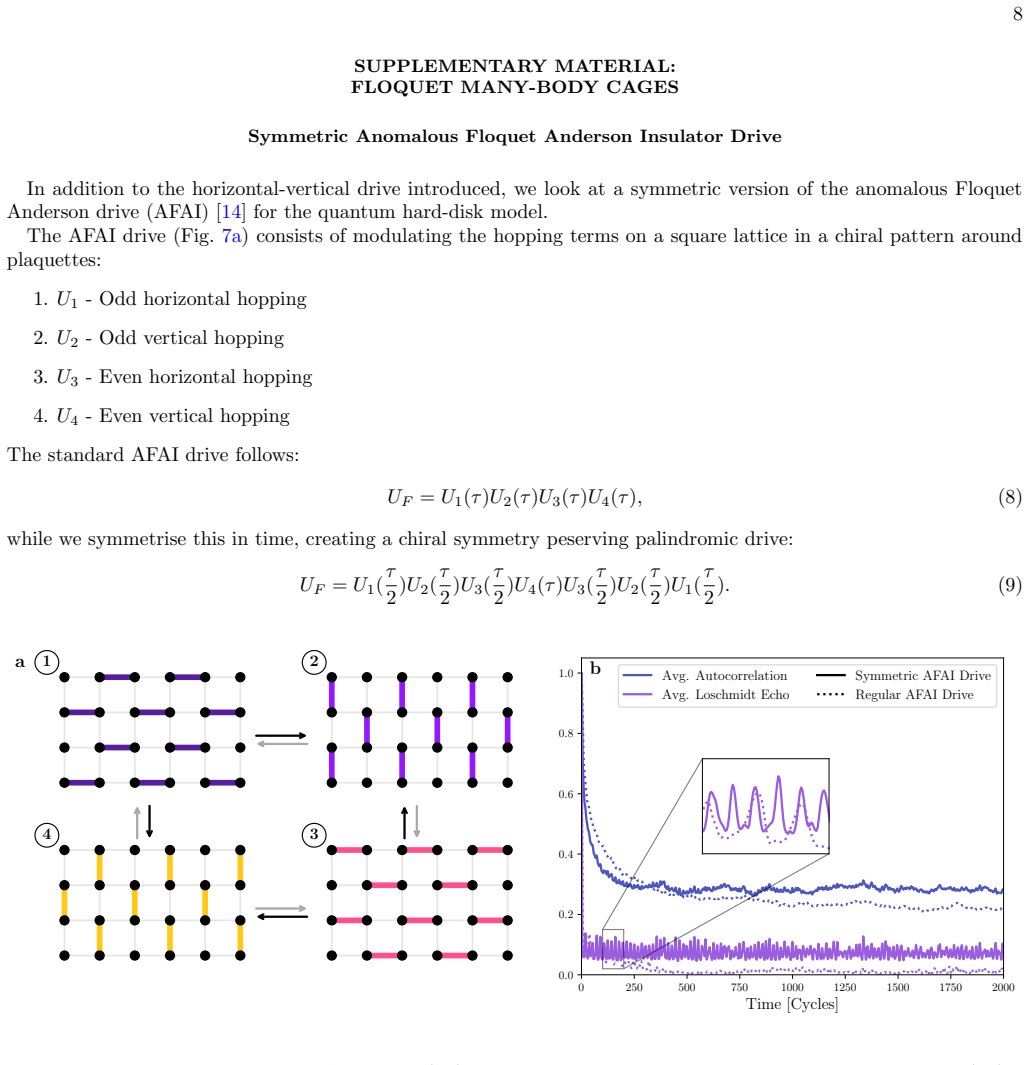
T. Ben-Ami, R. Moessner, and M. Heyl, Dataset for Floquet Many-Body Cages, 10.5281/zenodo.19567710 (2026). 8 SUPPLEMENT AR Y MA TERIAL: FLOQUET MANY-BODY CAGES Symmetric Anomalous Floquet Anderson Insulator Drive In addition to the horizontal-vertical drive introduced, we look at a symmetric version of the anomalous Floquet Anderson drive (AFAI) [14] for ...
discussion (0)
Sign in with ORCID, Apple, or X to comment. Anyone can read and Pith papers without signing in.