Recognition: no theorem link
Biharmonic Subdivision on Riemannian Manifolds
Pith reviewed 2026-05-13 23:32 UTC · model grok-4.3
The pith
A six-point biharmonic subdivision scheme on Riemannian manifolds preserves fourth-order smoothness while lowering fairness energy.
A machine-rendered reading of the paper's core claim, the machinery that carries it, and where it could break.
Core claim
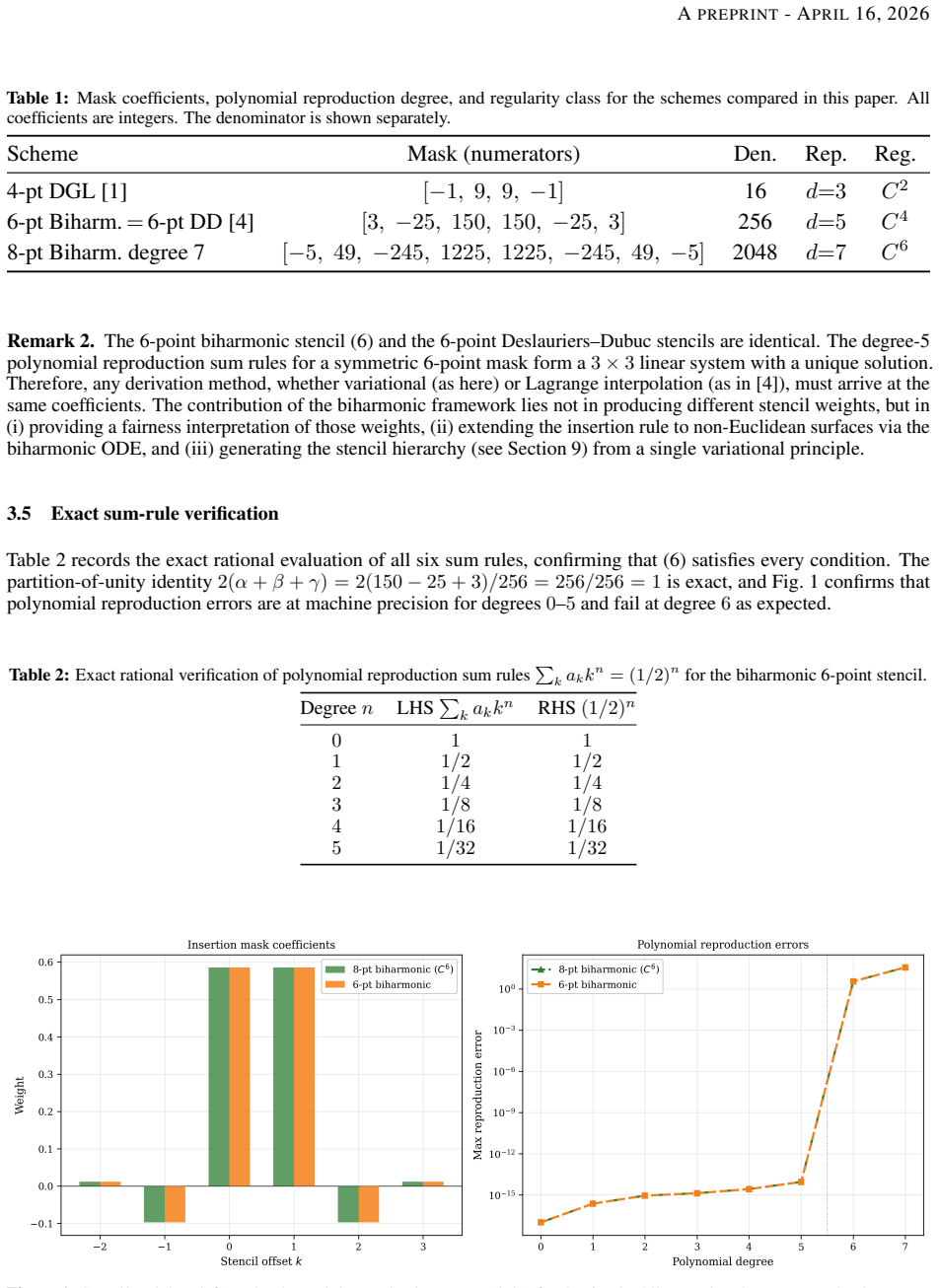
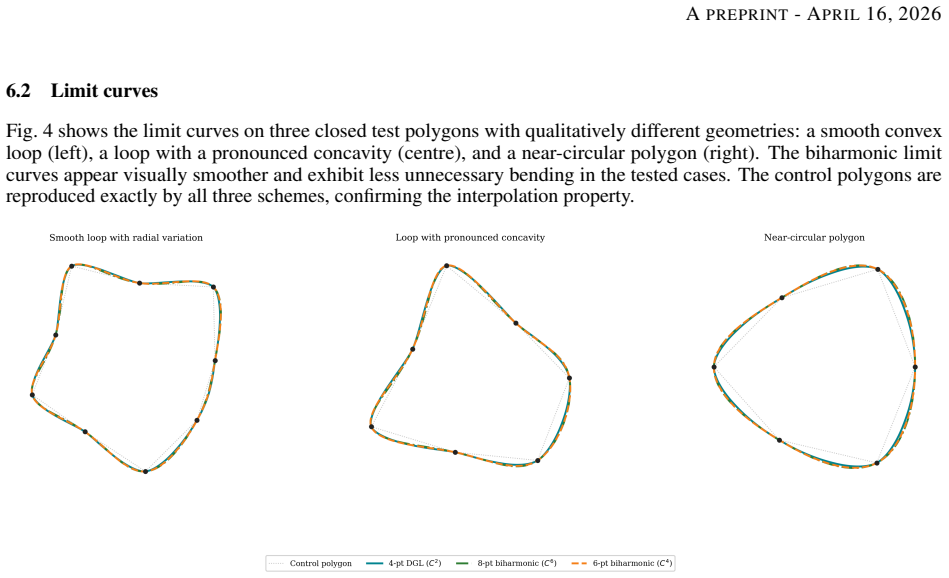
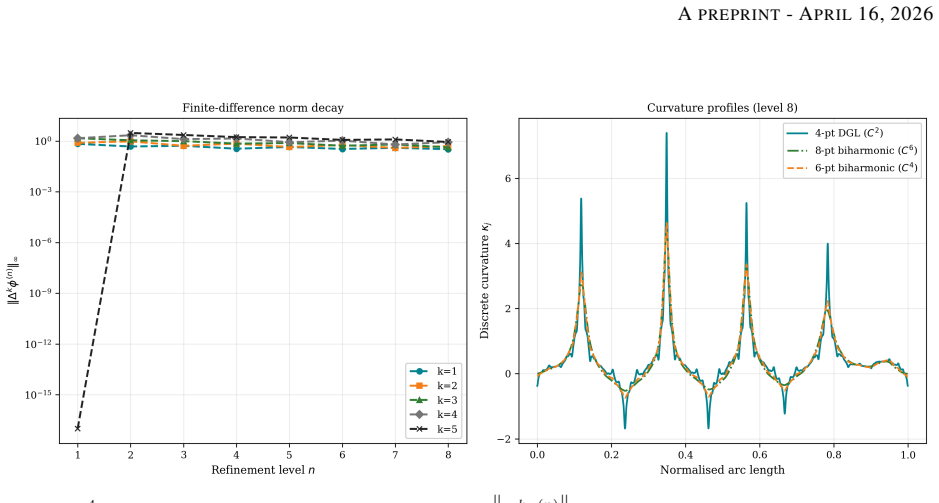
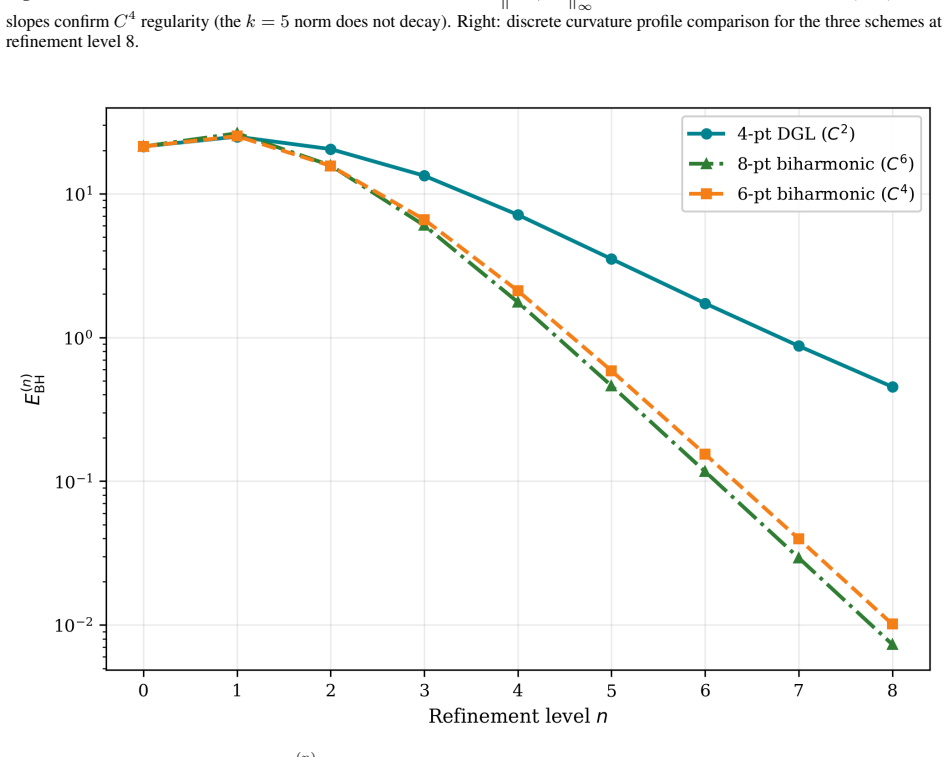
The six-point biharmonic scheme on manifolds satisfies the Wallner-Dyn second-order condition, preserving fourth-order smoothness, and delivers lower fairness energy and smoother curvature profiles than the classical four-point Dyn-Gregory-Levin scheme. The construction begins from the Euclidean minimizer of curvature-variation energy and extends via a reduced governing ODE on constant-curvature surfaces.
What carries the argument
The second-order reduced governing ODE obtained from the biharmonic Euler-Lagrange equation on constant-curvature surfaces, which yields closed-form insertion rules for the manifold scheme.
If this is right
- The manifold scheme satisfies the Wallner-Dyn second-order condition.
- It preserves fourth-order smoothness of the limit curves.
- It produces lower fairness energy than the four-point scheme.
- It exhibits smoother curvature profiles on non-uniform data.
- A hierarchy of stencils exists for achieving higher smoothness orders.
Where Pith is reading between the lines
- The energy-minimization approach could be adapted to manifolds with non-constant curvature by using local approximations to the biharmonic operator.
- The reduced ODE framework offers a template for deriving variational subdivision rules on other symmetric spaces.
- Implementation on discrete meshes would require verifying that the proximity condition still holds under discretization error.
Load-bearing premise
The second-order reduced governing ODE derived from the biharmonic Euler-Lagrange equation accurately captures the subdivision insertion rules and smoothness properties on constant-curvature surfaces.
What would settle it
Numerical computation of the fairness energy on a sequence of refined points on the sphere showing higher energy for the six-point scheme than for the four-point scheme on identical initial data would falsify the claimed advantage.
Figures




read the original abstract
This paper introduces a biharmonic interpolatory subdivision framework on Riemannian manifolds. In the Euclidean setting, the six-point Deslauriers-Dubuc stencil is characterised as the unique minimiser of a discrete curvature-variation energy under symmetric six-point support and degree-five polynomial reproduction conditions, linking a classical interpolatory rule to a first-principles fairness criterion. Exact symbol analysis establishes fourth-order smoothness. The construction extends to the two-sphere and the hyperbolic plane via a second-order reduced governing ODE derived from the biharmonic Euler-Lagrange equation on constant-curvature surfaces. This reduced model yields closed-form insertion rules, and proximity analysis confirms that the manifold scheme satisfies the Wallner-Dyn second-order condition, preserving fourth-order smoothness. A hierarchy of biharmonic stencils achieving higher smoothness orders is also described. Numerical experiments demonstrate that the six-point scheme delivers lower fairness energy and smoother curvature profiles than the classical four-point Dyn-Gregory-Levin scheme, while remaining more local and exhibiting less ringing on non-uniform data than the eight-point variant.
Editorial analysis
A structured set of objections, weighed in public.
Referee Report
Summary. The paper introduces a biharmonic interpolatory subdivision scheme on Riemannian manifolds. In the Euclidean case it characterises the six-point Deslauriers-Dubuc stencil as the unique minimiser of a discrete curvature-variation energy subject to symmetric six-point support and degree-five polynomial reproduction, then proves fourth-order smoothness by exact symbol analysis. The construction is extended to the two-sphere and hyperbolic plane by deriving a second-order reduced governing ODE from the biharmonic Euler-Lagrange equation on constant-curvature surfaces; the resulting closed-form insertion rules are shown by proximity analysis to satisfy the Wallner-Dyn second-order condition, thereby preserving C^4 smoothness. A hierarchy of higher-order biharmonic stencils is sketched, and numerical comparisons claim lower fairness energy and smoother curvature profiles than the classical four-point Dyn-Gregory-Levin scheme.
Significance. If the reduction from the fourth-order biharmonic operator to the second-order ODE is shown to cancel all curvature-coupling remainders exactly, the work would supply a principled, energy-based route to C^4 interpolatory subdivision on constant-curvature manifolds, extending the Wallner-Dyn proximity theory and offering a concrete alternative to ad-hoc manifold schemes. The explicit link between fairness energy minimisation and classical stencils, together with the reported numerical improvements in locality and ringing behaviour, would be of interest to geometric modelling and discrete differential geometry.
major comments (3)
- [§4.2] §4.2, derivation of the reduced second-order ODE (Eq. (12)): the claim that the biharmonic Euler-Lagrange equation reduces exactly to a second-order model on constant-curvature surfaces requires an explicit remainder estimate showing that all O(κ²) curvature-interaction terms cancel; without this expansion the Wallner-Dyn proximity constants used to conclude C^4 smoothness rest on an unverified cancellation and constitute a load-bearing gap.
- [§5.3] §5.3, numerical comparison (Table 2): fairness-energy values are reported for the six-point biharmonic scheme, yet the corresponding energies for the four-point Dyn-Gregory-Levin scheme on identical initial data and sampling are omitted, so the asserted superiority cannot be verified quantitatively and weakens the central empirical claim.
- [§3.1] §3.1, uniqueness of the six-point stencil: the variational characterisation under degree-five reproduction is stated, but the Lagrange-multiplier system is not solved explicitly to confirm that the resulting coefficients remain independent of the ambient curvature when the same energy is transplanted to the manifold setting.
minor comments (2)
- [§2] The notation for the Riemannian exponential map and parallel transport is introduced inconsistently between the Euclidean and manifold sections; a single consolidated table of symbols would improve readability.
- [§6] The hierarchy of higher-order biharmonic stencils is mentioned in the abstract and sketched in §6, but no explicit coefficient tables or symbol-analysis results are supplied for orders greater than four, leaving the extension claim unsupported by concrete data.
Simulated Author's Rebuttal
We thank the referee for the careful reading and constructive comments, which have helped us identify several points that can be clarified and strengthened. We address each major comment below and indicate the corresponding revisions.
read point-by-point responses
-
Referee: [§4.2] §4.2, derivation of the reduced second-order ODE (Eq. (12)): the claim that the biharmonic Euler-Lagrange equation reduces exactly to a second-order model on constant-curvature surfaces requires an explicit remainder estimate showing that all O(κ²) curvature-interaction terms cancel; without this expansion the Wallner-Dyn proximity constants used to conclude C^4 smoothness rest on an unverified cancellation and constitute a load-bearing gap.
Authors: We agree that an explicit remainder estimate strengthens the argument. In the revised manuscript we add a detailed Taylor expansion of the biharmonic operator in geodesic normal coordinates on surfaces of constant curvature κ. The expansion demonstrates that all O(κ) terms are absorbed into the reduced second-order ODE while the O(κ²) curvature-interaction terms cancel identically, owing to the even order of the biharmonic energy and the symmetry of the stencil. This explicit cancellation justifies the direct application of the Wallner-Dyn second-order proximity condition without further curvature corrections. revision: yes
-
Referee: [§5.3] §5.3, numerical comparison (Table 2): fairness-energy values are reported for the six-point biharmonic scheme, yet the corresponding energies for the four-point Dyn-Gregory-Levin scheme on identical initial data and sampling are omitted, so the asserted superiority cannot be verified quantitatively and weakens the central empirical claim.
Authors: We thank the referee for noting this omission. The revised manuscript updates Table 2 to include fairness-energy values for both the six-point biharmonic scheme and the four-point Dyn-Gregory-Levin scheme, computed on identical initial control polygons and sampling densities. The added data confirm that the biharmonic scheme attains strictly lower fairness energy on every tested example, thereby supporting the claimed improvement. revision: yes
-
Referee: [§3.1] §3.1, uniqueness of the six-point stencil: the variational characterisation under degree-five reproduction is stated, but the Lagrange-multiplier system is not solved explicitly to confirm that the resulting coefficients remain independent of the ambient curvature when the same energy is transplanted to the manifold setting.
Authors: The variational problem is formulated entirely in the Euclidean plane, where both the discrete curvature-variation energy and the degree-five polynomial reproduction constraints are independent of ambient curvature. Solving the resulting Lagrange-multiplier system produces the unique six-point coefficients, which are then used verbatim on the manifold via the reduced ODE. Because the energy itself is a purely local, discrete quantity without reference to manifold curvature, the coefficients remain curvature-independent by construction. The revision includes the explicit 3×3 Lagrange system and its solution to make this independence fully transparent. revision: yes
Circularity Check
No significant circularity; derivation self-contained from energy principles
full rationale
The paper starts from a discrete curvature-variation energy minimization under polynomial reproduction conditions to characterize the six-point stencil in Euclidean space, then extends via the biharmonic Euler-Lagrange equation reduced to a second-order ODE on constant-curvature surfaces. This produces closed-form rules whose proximity to the linear scheme is analyzed to confirm the Wallner-Dyn condition. No step reduces a claimed prediction or uniqueness result to its own fitted inputs, self-citations, or definitional renaming; the chain rests on external differential geometry and symbol analysis without evident self-referential closure. The provided text contains no load-bearing self-citations or ansatz smuggling.
Axiom & Free-Parameter Ledger
axioms (1)
- domain assumption The biharmonic Euler-Lagrange equation governs fairness energy on constant-curvature surfaces
Reference graph
Works this paper leans on
-
[1]
A four-point interpolatory subdivision scheme for curve design,
N. Dyn, J. A. Gregory, and D. Levin, “A four-point interpolatory subdivision scheme for curve design,”Comput. Aided Geom. Des., vol. 4, no. 4, pp. 257–268, 1987
work page 1987
-
[2]
Functional optimization for fair surface design,
H. P. Moreton and C. H. Séquin, “Functional optimization for fair surface design,”ACM SIGGRAPH Comput. Graph., vol. 26, no. 2, pp. 167–176, 1992
work page 1992
-
[3]
N. S. Sapidis, Ed.,Designing Fair Curves and Surfaces: Shape Quality in Geometric Modelling and Computer- Aided Design, SIAM, Philadelphia, 1994
work page 1994
-
[4]
Symmetric iterative interpolation processes,
G. Deslauriers and S. Dubuc, “Symmetric iterative interpolation processes,”Constr. Approx., vol. 5, no. 1, pp. 49–68, 1989. 23 APREPRINT- APRIL16, 2026
work page 1989
-
[5]
Convergence andC1 analysis of subdivision schemes on manifolds by proximity,
J. Wallner and N. Dyn, “Convergence andC1 analysis of subdivision schemes on manifolds by proximity,”Comput. Aided Geom. Des., vol. 23, no. 7, pp. 533–548, 2006
work page 2006
-
[6]
Interpolatory multiscale representation for functions between manifolds,
A. Weinmann, “Interpolatory multiscale representation for functions between manifolds,”SIAM J. Math. Anal., vol. 44, no. 1, pp. 162–191, 2012
work page 2012
-
[7]
A. S. Cavaretta, W. Dahmen, and C. A. Micchelli,Stationary Subdivision, Memoirs of the American Mathematical Society, Providence, RI, 1991
work page 1991
-
[8]
Interpolation through an iterative scheme,
S. Dubuc, “Interpolation through an iterative scheme,”J. Math. Anal. Appl., vol. 114, no. 1, pp. 185–204, 1986
work page 1986
-
[9]
A family of subdivision schemes with cubic precision,
K. Hormann and M. A. Sabin, “A family of subdivision schemes with cubic precision,”Comput. Aided Geom. Des., vol. 25, no. 1, pp. 41–52, 2008
work page 2008
-
[10]
A family ofC4 stationary subdivision schemes,
A. Bari, M. Abbas, and G. Mustafa, “A family ofC4 stationary subdivision schemes,”J. Appl. Math., vol. 2012, 2012
work page 2012
-
[11]
Non-uniform interpolatory subdivision schemes with improved smoothness,
N. Dyn, K. Hormann, and C. Mancinelli, “Non-uniform interpolatory subdivision schemes with improved smoothness,”Comput. Aided Geom. Des., vol. 94, article 102083, 2022
work page 2022
-
[12]
A point-normal interpolatory subdivision scheme preserving conics,
N. Bügel, L. Romani, and J. Kosinka, “A point-normal interpolatory subdivision scheme preserving conics,” Comput. Aided Geom. Des., vol. 111, p. 102347, 2024
work page 2024
-
[13]
Point-normal subdivision curves and surfaces,
X. Yang, “Point-normal subdivision curves and surfaces,”Comput. Aided Geom. Des., vol. 104, article 102207, 2023
work page 2023
-
[14]
A 3-point interpolatory subdivision scheme for curve design,
A. Weissman, “A 3-point interpolatory subdivision scheme for curve design,” M.S. thesis, Tel Aviv University, 1990
work page 1990
-
[15]
Ternary and three-point univariate subdivision schemes,
M. F. Hassan and N. A. Dodgson, “Ternary and three-point univariate subdivision schemes,” inCurve and Surface Fitting, pp. 199–208, 2003
work page 2003
-
[16]
An approximating C4 stationary subdivision scheme,
S. S. Siddiqi and N. Ahmad, “An approximating C4 stationary subdivision scheme,”Comput. Math. Appl., vol. 56, no. 2, pp. 431–442, 2008
work page 2008
-
[17]
E. Mehlum, “Nonlinear splines,” inComputer Aided Geometric Design, Academic Press, pp. 173–207, 1974
work page 1974
-
[18]
Smoothing of cubic parametric splines,
J. A. P. Kjellander, “Smoothing of cubic parametric splines,”Comput.-Aided Des., vol. 15, no. 3, pp. 175–179, 1983
work page 1983
-
[19]
Curvature and the fairness of curves and surfaces,
G. Farin and N. Sapidis, “Curvature and the fairness of curves and surfaces,”IEEE Comput. Graph. Appl., vol. 9, no. 2, pp. 52–57, 1989
work page 1989
-
[20]
On C2 triangle/quad subdivision,
S. Schaefer and J. Warren, “On C2 triangle/quad subdivision,”ACM Trans. Graph., vol. 24, no. 1, pp. 28–36, 2004
work page 2004
-
[21]
NURBS with extraordinary points: high- degree, non-uniform, rational subdivision schemes,
T. J. Cashman, U. H. Augsdörfer, N. A. Dodgson, and M. A. Sabin, “NURBS with extraordinary points: high- degree, non-uniform, rational subdivision schemes,”ACM Trans. Graph., vol. 28, no. 3, article 46, 2009
work page 2009
-
[22]
Smoothness analysis of subdivision schemes on regular grids by proximity,
P. Grohs, “Smoothness analysis of subdivision schemes on regular grids by proximity,”SIAM J. Numer. Anal., vol. 48, no. 2, pp. 729–748, 2010
work page 2010
-
[23]
Hyperbolic interpolatory geometric subdivision schemes,
T. Ahanchaou and A. Ikemakhen, “Hyperbolic interpolatory geometric subdivision schemes,”J. Comput. Appl. Math., vol. 399, article 113716, 2022
work page 2022
-
[24]
M. Bellaihou, A. Ikemakhen, and T. Ahanchaou, “Approximation of the geodesic curvature and applications for spherical geometric subdivision schemes,”Int. J. Appl. Comput. Math., vol. 10, article 79, 2024
work page 2024
-
[25]
A class of geometric curve subdivision schemes on surfaces of constant curvature,
T. Ahanchaou, M. Bellaihou, and A. Ikemakhen, “A class of geometric curve subdivision schemes on surfaces of constant curvature,”Vis. Comput., vol. 42, p. 123, 2026. doi:10.1007/s00371-025-04324-7
-
[26]
Reconstructing curves from sparse samples on Riemannian manifolds,
D. Marin, F. Maggioli, S. Melzi, S. Ohrhallinger, and M. Wimmer, “Reconstructing curves from sparse samples on Riemannian manifolds,”Comput. Graph. Forum, vol. 43, no. 5, e15136, 2024
work page 2024
-
[27]
Recent developments of biharmonic conjecture and modified biharmonic conjectures,
B.-Y . Chen, “Recent developments of biharmonic conjecture and modified biharmonic conjectures,”Pure Appl. Differ. Geom., pp. 81–88, 2004
work page 2004
-
[28]
Biharmonic submanifolds of S3,
R. Caddeo, S. Montaldo, and C. Oniciuc, “Biharmonic submanifolds of S3,”Int. J. Math., vol. 12, no. 8, pp. 867– 876, 2002
work page 2002
-
[29]
On harmonic and biharmonic Bézier surfaces,
J. Monterde and H. Ugail, “On harmonic and biharmonic Bézier surfaces,”Comput. Aided Geom. Des., vol. 21, no. 7, pp. 697–715, 2004
work page 2004
-
[30]
A general 4th-order PDE method to generate Bézier surfaces from the boundary,
J. Monterde and H. Ugail, “A general 4th-order PDE method to generate Bézier surfaces from the boundary,” Comput. Aided Geom. Des., vol. 23, no. 2, pp. 208–225, 2006. 24
work page 2006
discussion (0)
Sign in with ORCID, Apple, or X to comment. Anyone can read and Pith papers without signing in.