Recognition: unknown
Weighted Product Inequalities for the Sine Function: A Gamma-Function Approach and Sharp Comparisons
Pith reviewed 2026-05-10 15:30 UTC · model grok-4.3
The pith
The log-convexity of the Gamma function yields a new proof of a weighted sine product inequality and algebraic rules to decide which of two competing upper bounds is sharper.
A machine-rendered reading of the paper's core claim, the machinery that carries it, and where it could break.
Core claim
Using the log-convexity of the Gamma function and Euler's reflection formula, a classical weighted product inequality for the sine function is proved anew; two distinct parameter selections generate competing upper bounds whose relative sharpness is settled by algebraic criteria that can be checked for any number of angles.
What carries the argument
Log-convexity of the Gamma function combined with Euler's reflection formula, applied through two different parameter choices to produce and compare upper bounds on the weighted sine product.
If this is right
- Explicit upper bounds are obtained for the weighted sine product with any number n of angles.
- Separate explicit results and comparisons hold in the 2n-angle case.
- For two angles and for three angles the sharper bound is identified by concrete algebraic conditions.
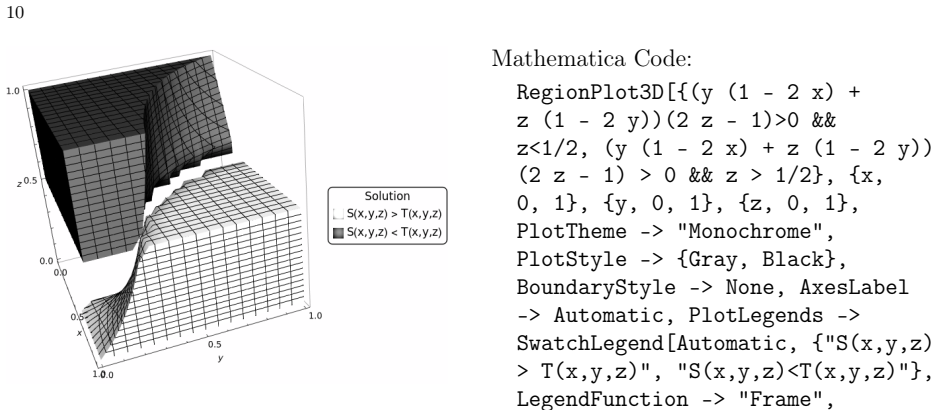
- Several sharp corollaries follow, including the inequality sin(πx) ≤ sin(2πx(1-x)).
Where Pith is reading between the lines
- The algebraic test for relative sharpness can be used to select the better bound in any numerical application without evaluating both expressions.
- The same Gamma-based technique might be tested on related products involving sine or cosine of multiple arguments.
- The corollary relating sin(πx) and sin(2πx(1-x)) may admit direct elementary proofs that avoid the Gamma function entirely.
Load-bearing premise
The log-convexity of the Gamma function and Euler's reflection formula apply directly to the weighted sine product without further restrictions on the angles or weights.
What would settle it
A concrete set of positive weights summing to one and angles in (0, π) for which the sine product exceeds either derived upper bound, or for which the algebraic comparison rule fails to identify the actual smaller bound.
Figures




read the original abstract
Using the log-convexity of the Gamma function and Euler's reflection formula, we give a new proof of a classical weighted sine product inequality. Two different parameter choices yield two competing upper bounds for the same product. We determine precisely, via algebraic criteria, when one bound is sharper than the other. Explicit results are given for the general $n$-angle case, the $2n$-angle case, and for two and three angles. Several sharp corollaries are derived, including $\sin(\pi x)\leq \sin(2\pi x(1-x))$.
Editorial analysis
A structured set of objections, weighed in public.
Referee Report
Summary. The paper gives a new proof of a classical weighted product inequality for sines by applying the log-convexity of the Gamma function together with Euler's reflection formula. Two distinct parameter choices produce competing upper bounds for the same product; algebraic criteria are derived to decide which bound is sharper in each case. Explicit statements are supplied for the general n-angle case, the 2n-angle case, the two-angle and three-angle cases, together with several sharp corollaries, one of which is sin(πx) ≤ sin(2πx(1-x)).
Significance. If the derivations are correct, the manuscript supplies a unified Gamma-function route to a known inequality together with precise, algebraically decidable comparisons between two families of upper bounds. The explicit low-n cases and the listed corollaries are concrete and potentially useful. The approach relies only on two standard, pre-existing Gamma-function facts and introduces no new ad-hoc axioms or entities.
minor comments (3)
- [§2] §2 (proof of the main inequality): the passage from the weighted product to the Gamma ratio is only sketched; write the intermediate steps that invoke log-convexity explicitly so that the reader can verify the domain restrictions on the angles and weights.
- [§4] §4 (comparison of the two bounds): the algebraic criterion that decides which bound is sharper is stated only for the general n case; restate the simplified criterion that applies when all weights are equal, as this is the setting used in the corollaries.
- [Corollary 5.1] Corollary 5.1 (the inequality sin(πx) ≤ sin(2πx(1-x))): the proof is omitted; either supply a one-line reduction to the main theorem or add a short direct verification for x ∈ (0,1).
Simulated Author's Rebuttal
We thank the referee for the positive assessment of our manuscript, including the recognition of the unified Gamma-function proof, the algebraic comparison criteria, and the concrete low-n cases and corollaries. The recommendation for minor revision is noted. No specific major comments appear in the report, so we will address any minor editorial or presentational suggestions in the revised version while preserving the core derivations.
Circularity Check
No significant circularity; derivation uses external standard results
full rationale
The paper derives a new proof of the classical weighted sine product inequality directly from the log-convexity of the Gamma function and Euler's reflection formula, both of which are independent, pre-existing theorems not obtained from the target inequality or any self-referential construction. The subsequent algebraic comparison of two parameter-derived upper bounds is performed via explicit criteria on the parameters and does not reduce to a fitted input renamed as prediction or any self-definition. No load-bearing self-citations, uniqueness theorems imported from the authors' prior work, or ansatzes smuggled via citation are present; the central claims remain self-contained against external mathematical benchmarks.
Axiom & Free-Parameter Ledger
axioms (2)
- standard math Log-convexity of the Gamma function
- standard math Euler's reflection formula
Reference graph
Works this paper leans on
-
[1]
G. D. Anderson, M. K. Vamanamurthy, and M. Vuorinen,Conformal Invariants, Inequalities, and Quasiconformal Maps, Wiley, New York, 1997
1997
-
[2]
Bohr and J
H. Bohr and J. Mollerup,Lærebog i matematisk analyse, Vol. 3, Jul. Gjellerups Forlag, Copenhagen, 1922
1922
-
[3]
P. S. Bullen,Handbook of Means and Their Inequalities, Kluwer Academic Publishers, Dordrecht, 2003
2003
-
[4]
Chen and R
C.-P. Chen and R. B. Paris,Inequalities for the sine and cosine functions, J. Math. Inequal.8 (2014), no. 2, 303–313
2014
-
[5]
Jordan,Cours d’analyse de l’École Polytechnique, 2nd ed., Gauthier-Villars, Paris, 1894
C. Jordan,Cours d’analyse de l’École Polytechnique, 2nd ed., Gauthier-Villars, Paris, 1894
-
[6]
D. S. Mitrinović,Analytic Inequalities, Springer, Berlin, 1970
1970
-
[7]
D. S. Mitrinović, J. E. Pečarić, and A. M. Fink,Classical and New Inequalities in Analysis, Kluwer Academic Publishers, Dordrecht, 1993
1993
-
[8]
Neuman and J
E. Neuman and J. Sándor,On some inequalities involving trigonometric and hyperbolic functions, Math. Inequal. Appl.13(2010), no. 4, 715–723. 15
2010
-
[9]
Qi, D.-W
F. Qi, D.-W. Niu, and B.-N. Guo,Refinements, generalizations, and applications of Jordan’s in- equality and related problems, J. Inequal. Appl.2009, Art. ID 271923, 52 pp
2009
-
[10]
Wallis,Arithmetica Infinitorum, Oxford, 1656
J. Wallis,Arithmetica Infinitorum, Oxford, 1656
-
[11]
Zhu,Sharpening Jordan’s inequality and the Yang Le inequality, Appl
L. Zhu,Sharpening Jordan’s inequality and the Yang Le inequality, Appl. Math. Lett.19(2006), 240–243. Department of Mathematics, University of Ghana, PO. Box LG 62 Legon, Accra, Ghana Email address:almahu@ug.edu.gh Department of Mathematics, University of Ghana, PO. Box LG 62 Legon, Accra, Ghana Email address:bfsehba@ug.edu.gh Department of Mathematics, U...
2006
discussion (0)
Sign in with ORCID, Apple, or X to comment. Anyone can read and Pith papers without signing in.