Recognition: unknown
Programmable Fermionic Quantum Processors with Globally Controlled Lattices
Pith reviewed 2026-05-10 14:56 UTC · model grok-4.3
The pith
Global time-dependent controls over lattice tunneling and interactions realize any fermionic quantum process.
A machine-rendered reading of the paper's core claim, the machinery that carries it, and where it could break.
Core claim
We prove that arbitrary fermionic processes can be realized with time-dependent global control of tunneling and interaction in a Fermi-Hubbard-type model of neutral atoms in optical lattices; constructive protocols generate the full unitary group without local addressing, and the same framework extends to hybrid simulation of models with long-range couplings.
What carries the argument
Constructive sequences of global tunneling and interaction modulations that together generate all unitaries on the fermionic Fock space.
If this is right
- Any desired fermionic unitary becomes programmable by a finite sequence of global parameter changes.
- Hybrid analog-digital simulation of extended Fermi-Hubbard models with long-range interactions is possible inside the same lattice.
- The protocols apply directly to neutral-atom optical lattices and transfer to other platforms with similar global control.
- No local addressing or auxiliary resources are needed to reach universality.
Where Pith is reading between the lines
- Experimental groups could test the protocols on small lattices by checking whether global sweeps reproduce known two-fermion gates.
- Scaling to larger particle numbers may become easier once only global fields are required.
- The same global-control idea might combine with existing analog simulators to add digital flexibility without extra hardware.
Load-bearing premise
That the Lie algebra spanned by the global, time-dependent Hamiltonians is dense enough to reach every possible fermionic unitary.
What would settle it
A direct calculation showing that the commutators of the controllable global Hamiltonians fail to produce a basis for all even-parity fermionic operators on four or more sites.
Figures


read the original abstract
We introduce a framework for realizing universal fermionic quantum processing with globally controlled itinerant fermionic particles. Our approach is tailored to the example of neutral atoms in optical lattices, but transposes to other setups with similar capabilities. We give constructive protocols to realize arbitrary fermionic processes, with time-dependent control over global parameters of the experimental setup, such as tunneling and interaction in a Fermi-Hubbard type model. We first prove the universality of our framework and then discuss implementation variants, such as hybrid analog-digital simulation of extended Fermi-Hubbard models, e.g., with long-range couplings.
Editorial analysis
A structured set of objections, weighed in public.
Referee Report
Summary. The manuscript introduces a framework for programmable fermionic quantum processors using globally controlled lattices of itinerant fermions, tailored to neutral atoms in optical lattices. It claims to prove universality and provides constructive protocols for realizing arbitrary fermionic processes via time-dependent global controls on parameters such as tunneling t(t) and on-site interaction U(t) in a Fermi-Hubbard model, followed by discussions of implementation variants including hybrid analog-digital simulations of extended models with long-range couplings.
Significance. If the universality claim holds, the work would represent a notable advance for quantum information processing and simulation with fermionic systems. By enabling arbitrary operations through only global controls, it could reduce the experimental overhead associated with local addressing in optical-lattice platforms, facilitating more scalable programmable fermionic processors and hybrid simulation schemes.
major comments (1)
- [Universality proof section] The central universality claim (abstract and the proof section) is load-bearing yet appears in tension with lattice symmetry. The instantaneous Hamiltonian H(t) = t(t) T + U(t) V, with T = ∑_{<ij>} (c†_i c_j + h.c.) and V the interaction term, commutes with the lattice translation operator S. Consequently the time-ordered exponential inherits [U(t), S] = 0, restricting reachable unitaries to the symmetric subspace. Arbitrary fermionic processes include symmetry-breaking operations (e.g., a single-site gate or asymmetric superposition). The proof must explicitly state whether an encoding is used whose logical operators evade the symmetry, whether the target set is restricted to translation-invariant unitaries, or whether additional non-global resources are introduced; none of these resolutions is evident from the stated framework.
minor comments (2)
- [Section 2] Notation for the global operators T and V should be introduced with explicit summation indices and clarified whether V is strictly on-site or includes longer-range terms in the extended models discussed later.
- [Abstract] The abstract states that the approach 'transposes to other setups'; a brief sentence listing the minimal experimental requirements (e.g., independent global control of t and U, absence of local addressing) would improve accessibility.
Simulated Author's Rebuttal
We thank the referee for their careful reading of the manuscript and for raising this important point about lattice symmetry in the universality proof. We address the comment below and will revise the manuscript to improve clarity on this issue.
read point-by-point responses
-
Referee: The central universality claim (abstract and the proof section) is load-bearing yet appears in tension with lattice symmetry. The instantaneous Hamiltonian H(t) = t(t) T + U(t) V, with T = ∑_{<ij>} (c†_i c_j + h.c.) and V the interaction term, commutes with the lattice translation operator S. Consequently the time-ordered exponential inherits [U(t), S] = 0, restricting reachable unitaries to the symmetric subspace. Arbitrary fermionic processes include symmetry-breaking operations (e.g., a single-site gate or asymmetric superposition). The proof must explicitly state whether an encoding is used whose logical operators evade the symmetry, whether the target set is restricted to translation-invariant unitaries, or whether additional non-global resources are introduced; none of these resolutions is evident from the stated framework.
Authors: We agree that the physical Hamiltonian commutes with the translation operator S at all times, so the generated unitaries are translationally invariant. Our claim of universality for arbitrary fermionic processes is achieved via an encoding of the logical fermionic modes into the physical lattice. In this encoding, the logical operators are supported on a chosen sublattice (or multi-site blocks) such that the action of the symmetric physical evolution implements the desired logical gates, including those that appear symmetry-breaking when viewed in the logical subspace. We will revise the universality proof section to explicitly describe the encoding, show how the logical operators evade the physical symmetry restriction, and include a short example of a symmetry-breaking logical operation realized by a global-control sequence. revision: yes
Circularity Check
No circularity: constructive universality proof is self-contained
full rationale
The paper claims a constructive proof of universality for arbitrary fermionic unitaries via time-dependent global controls (tunneling and interaction) in a Fermi-Hubbard model. No step reduces a target result to a fitted parameter, self-definition, or load-bearing self-citation by construction. The derivation is presented as explicit protocols that generate the required operations, independent of the target claim itself. The symmetry invariance of the global Hamiltonian is a potential external correctness concern (whether the generated group is truly the full unitary group on the Fock space), but it does not create a circular reduction within the paper's own equations or citations. The framework is self-contained against external benchmarks such as explicit gate constructions.
Axiom & Free-Parameter Ledger
axioms (2)
- domain assumption Neutral atoms in optical lattices are accurately described by a Fermi-Hubbard model whose tunneling and interaction terms can be tuned globally in time.
- standard math Quantum mechanics and the standard rules for fermionic operators hold.
Forward citations
Cited by 1 Pith paper
-
Obstructions to universality in globally controlled qubit graphs
The conjecture that breaking all non-trivial graph automorphisms suffices for universality in globally controlled qubit systems is disproved by connected graphs with trivial automorphism groups whose generated Lie alg...
Reference graph
Works this paper leans on
-
[1]
Troyer and U.-J
M. Troyer and U.-J. Wiese, Physical Review Letters 94, 170201 (2005)
2005
-
[2]
Altman, K
E. Altman, K. R. Brown, G. Carleo, L. D. Carr, E. Demler, C. Chin, B. DeMarco, S. E. Economou, M. A. Eriksson, K.-M. C. Fu,et al., PRX Quantum2, 017003 (2021)
2021
-
[3]
A. J. Daley, I. Bloch, C. Kokail, S. Flannigan, N. Pear- son, M. Troyer, and P. Zoller, Nature607, 667 (2022)
2022
-
[4]
Gross and W
C. Gross and W. S. Bakr, Nature Physics17, 1316 (2021)
2021
-
[5]
Sch¨ afer, T
F. Sch¨ afer, T. Fukuhara, S. Sugawa, Y. Takasu, and Y. Takahashi, Nature Reviews Physics2, 411 (2020)
2020
-
[6]
Hanson, L
R. Hanson, L. P. Kouwenhoven, J. R. Petta, S. Tarucha, and L. M. K. Vandersypen, Reviews of Modern Physics79, 1217 (2007)
2007
-
[7]
Hensgens, T
T. Hensgens, T. Fujita, L. Janssen, X. Li, C. J. Van Diepen, C. Reichl, W. Wegscheider, S. Das Sarma, and L. M. K. Vandersypen, Nature548, 70 (2017)
2017
-
[8]
J. M. Boter, J. P. Dehollain, J. P. van Dijk, Y. Xu, T. Hensgens, R. Versluis, H. W. Naus, J. S. Clarke, M. Veldhorst, F. Sebastiano, and L. M. Vandersypen, Physical Review Applied18, 024053 (2022)
2022
-
[9]
K¨ unne, A
M. K¨ unne, A. Willmes, M. Oberl¨ ander, C. Gorjaew, J. D. Teske, H. Bhardwaj, M. Beer, E. Kammerloher, R. Otten, I. Seidler,et al., Nature Communications15, 4977 (2024)
2024
-
[10]
M. B. Donnelly, Y. Chung, R. Garreis, S. Plugge, D. Pye, M. Kiczynski, J. T´ amara-Isaza, M. M. Mu- nia, S. Sutherland, B. Voisin,et al., Nature650, 574 (2026)
2026
-
[11]
Lloyd, Science261, 1569 (1993)
S. Lloyd, Science261, 1569 (1993)
1993
-
[12]
J. I. Cirac and P. Zoller, Nature404, 579 (2000)
2000
-
[13]
S. C. Benjamin, Physical Review A61, 020301 (2000)
2000
-
[14]
Calarco, U
T. Calarco, U. Dorner, P. S. Julienne, C. J. Williams, and P. Zoller, Physical Review A70, 012306 (2004)
2004
-
[15]
Raussendorf, Physical Review A72, 052301 (2005)
R. Raussendorf, Physical Review A72, 052301 (2005)
2005
-
[16]
D. J. Shepherd, T. Franz, and R. F. Werner, Physical Review Letters97, 020502 (2006)
2006
-
[17]
Lloyd and B
S. Lloyd and B. M. Terhal, New Journal of Physics18, 6 023042 (2016)
2016
-
[18]
T. M. Wintermantel, Y. Wang, G. Lochead, S. Shevate, G. K. Brennen, and S. Whitlock, Physical Review Let- ters124, 070503 (2020)
2020
-
[19]
Cesa and H
F. Cesa and H. Pichler, Physical Review Letters131, 170601 (2023)
2023
-
[20]
Menta, F
R. Menta, F. Cioni, R. Aiudi, M. Polini, and V. Gio- vannetti, Phys. Rev. Res.7, L012065 (2025)
2025
- [21]
-
[22]
Bravyi and A
S. Bravyi and A. Kitaev, Annals of Physics298, 210 (2002)
2002
-
[23]
Weitenberg, M
C. Weitenberg, M. Endres, J. F. Sherson, M. Cheneau, P. Schauß, T. Fukuhara, I. Bloch, and S. Kuhr, Nature 471, 319 (2011)
2011
-
[24]
P. M. Preiss, R. Ma, M. E. Tai, A. Lukin, M. Rispoli, P. Zupancic, Y. Lahini, R. Islam, and M. Greiner, Sci- ence347, 1229 (2015)
2015
-
[25]
A. W. Young, W. J. Eckner, N. Schine, A. M. Childs, and A. M. Kaufman, Science377, 885 (2022)
2022
-
[26]
Tabares, C
C. Tabares, C. Kokail, P. Zoller, D. Gonz´ alez-Cuadra, and A. Gonz´ alez-Tudela, PRX Quantum6, 030356 (2025)
2025
-
[27]
Schl¨ omer, H
H. Schl¨ omer, H. Lange, T. Franz, T. Chalopin, P. Bo- jovi´ c, S. Wang, I. Bloch, T. A. Hilker, F. Grusdt, and A. Bohrdt, PRX Quantum5, 040341 (2024)
2024
-
[28]
Mandel, M
O. Mandel, M. Greiner, A. Widera, T. Rom, T. W. H¨ ansch, and I. Bloch, Nature425, 937 (2003)
2003
-
[29]
F¨ olling, S
S. F¨ olling, S. Trotzky, P. Cheinet, M. Feld, R. Saers, A. Widera, T. M¨ uller, and I. Bloch, Nature448, 1029 (2007)
2007
-
[30]
Cheinet, S
P. Cheinet, S. Trotzky, M. Feld, U. Schnorrberger, M. Moreno-Cardoner, S. F¨ olling, and I. Bloch, Physical Review Letters101, 090404 (2008)
2008
-
[31]
Trotzky, P
S. Trotzky, P. Cheinet, S. F¨ olling, M. Feld, U. Schnor- rberger, A. M. Rey, A. Polkovnikov, E. A. Demler, M. D. Lukin, and I. Bloch, Science319, 295 (2008)
2008
-
[32]
Instead of independently controlling bothδ σ,H δ can be realized by tuning the differential gradientδ ↑ −δ ↓ (e.g., using a magnetic field gradient) and the common- mode oneδ ↑ +δ ↓ (e.g., by tilting the optical lattice)
-
[33]
C. Chin, R. Grimm, P. Julienne, and E. Tiesinga, Re- views of Modern Physics82, 1225 (2010)
2010
-
[34]
D. K. Mark, H.-Y. Hu, J. Kwan, C. Kokail, S. Choi, and S. F. Yelin, Physical Review Letters135, 123402 (2025)
2025
-
[35]
Impertro, S
A. Impertro, S. Huh, S. Karch, J. F. Wienand, I. Bloch, and M. Aidelsburger, Nature Physics21, 895 (2025)
2025
-
[36]
Z. Zhu, Y. Kiefer, S. Jele, M. G¨ achter, G. Bisson, K. Viebahn, and T. Esslinger, Physical Review X15, 041032 (2025)
2025
-
[37]
Kiefer, Z
Y. Kiefer, Z. Zhu, L. Fischer, S. Jele, M. G¨ achter, G. Bisson, K. Viebahn, and T. Esslinger, Nature , 1 (2026)
2026
-
[38]
Bojovi´ c, T
P. Bojovi´ c, T. Hilker, S. Wang, J. Obermeyer, M. Barendregt, D. Tell, T. Chalopin, P. M. Preiss, I. Bloch, and T. Franz, Nature , 1 (2026)
2026
-
[39]
Jaksch, H.-J
D. Jaksch, H.-J. Briegel, J. I. Cirac, C. W. Gardiner, and P. Zoller, Physical Review Letters82, 1975 (1999)
1975
-
[40]
Gonz´ alez-Cuadra, D
D. Gonz´ alez-Cuadra, D. Bluvstein, M. Kalinowski, R. Kaubruegger, N. Maskara, P. Naldesi, T. V. Zache, A. M. Kaufman, M. D. Lukin, H. Pichler,et al., Pro- ceedings of the National Academy of Sciences120, e2304294120 (2023)
2023
-
[41]
Gkritsis, D
F. Gkritsis, D. Dux, J. Zhang, N. Jain, C. Gogolin, and P. M. Preiss, PRX Quantum6, 010318 (2025)
2025
- [42]
-
[43]
Mandel, M
O. Mandel, M. Greiner, A. Widera, T. Rom, T. W. H¨ ansch, and I. Bloch, Physical Review Letters91, 010407 (2003)
2003
-
[44]
Citro and M
R. Citro and M. Aidelsburger, Nature Reviews Physics 5, 87 (2023)
2023
-
[45]
These can be avoided, e.g., by splitting the evolution in two steps with opposite gradient
By evolving with a non-zero gradientδ d, the state ac- quires single-mode phases. These can be avoided, e.g., by splitting the evolution in two steps with opposite gradient
-
[46]
G. K. Brennen, C. M. Caves, P. S. Jessen, and I. H. Deutsch, Physical Review Letters82, 1060 (1999)
1999
-
[47]
The gate can be implemented in a similar way with a control atom in the left well, see Supplemental Mate- rial
-
[48]
We can invert the tunneling strengthJ→−Jwith extra relative phases, implemented by an additional control sequence, see Supplemental Material
-
[49]
These phases can be actively corrected using additional phase gates, or kept track of when compiling the cir- cuit
-
[50]
J. Mongkolkiattichai, L. Liu, S. Dasgupta, K. R. A. Hazzard, and P. Schauss, Quantum gas mi- croscopy of three-flavor Hubbard systems (2025), arXiv:2503.05687 [cond-mat]
-
[51]
B. Yang, H. Sun, C.-J. Huang, H.-Y. Wang, Y. Deng, H.-N. Dai, Z.-S. Yuan, and J.-W. Pan, Science369, 550 (2020)
2020
-
[52]
Chalopin, P
T. Chalopin, P. Bojovi´ c, D. Bourgund, S. Wang, T. Franz, I. Bloch, and T. Hilker, Physical Review Let- ters134, 053402 (2025)
2025
-
[53]
R. Ott, D. Gonz´ alez-Cuadra, T. V. Zache, P. Zoller, A. M. Kaufman, and H. Pichler, Physical Review Let- ters135, 090601 (2025)
2025
-
[54]
A. Schuckert, E. Crane, A. V. Gorshkov, M. Hafezi, and M. J. Gullans, Fault-tolerant fermionic quantum computing (2025), arXiv:2411.08955 [quant-ph]
-
[55]
S. J. Glaser, U. Boscain, T. Calarco, C. P. Koch, W. K¨ ockenberger, R. Kosloff, I. Kuprov, B. Luy, S. Schirmer, T. Schulte-Herbr¨ uggen,et al., European Physical Journal D69, 279 (2015)
2015
-
[56]
Hartke, B
T. Hartke, B. Oreg, N. Jia, and M. Zwierlein, Nature 601, 537 (2022)
2022
-
[57]
A. M. Kaufman and K.-K. Ni, Nature Physics17, 1324 (2021)
2021
-
[58]
J. H. Becher, E. Sindici, R. Klemt, S. Jochim, A. J. Daley, and P. M. Preiss, Physical Review Letters125, 180402 (2020)
2020
-
[59]
Z. Z. Yan, B. M. Spar, M. L. Prichard, S. Chi, H.- T. Wei, E. Ibarra-Garc´ ıa-Padilla, K. R. A. Hazzard, and W. S. Bakr, Physical Review Letters129, 123201 (2022)
2022
-
[60]
R. Tao, M. Ammenwerth, F. Gyger, I. Bloch, and J. Zeiher, Physical Review Letters133, 013401 (2024)
2024
- [61]
- [62]
-
[63]
J. P. Dehollain, U. Mukhopadhyay, V. P. Michal, Y. Wang, B. Wunsch, C. Reichl, W. Wegscheider, M. S. Rudner, E. Demler, and L. M. K. Vandersypen, Nature 579, 528 (2020)
2020
-
[64]
Langrock, J
V. Langrock, J. A. Krzywda, N. Focke, I. Seidler, L. R. Schreiber, and L. Cywi´ nski, PRX Quantum4, 020305 (2023)
2023
-
[65]
Riccardi, R
M. Riccardi, R. Menta, F. Cioni, R. Aiudi, M. Polini, 7 and V. Giovannetti, in2024 IEEE International Conference on Quantum Computing and Engineering (QCE), Vol. 02 (2024) pp. 396–397
2024
-
[66]
Bohrdt, C
A. Bohrdt, C. B. Mendl, M. Endres, and M. Knap, New Journal of Physics19, 063001 (2017)
2017
-
[67]
Swingle, Nature Physics14, 988 (2018)
B. Swingle, Nature Physics14, 988 (2018)
2018
-
[68]
A. R. Cavallar, L. Escalera-Moreno, T. Franz, T. Hilker, J. I. Cirac, P. M. Preiss, and B. F. Schiffer, Phase-Sensitive Measurements on a Fermi-Hubbard Quantum Processor (2025), arXiv:2509.01637 [quant- ph]
work page internal anchor Pith review Pith/arXiv arXiv 2025
-
[69]
Pichler, G
H. Pichler, G. Zhu, A. Seif, P. Zoller, and M. Hafezi, Physical Review X6, 041033 (2016)
2016
-
[70]
Lukin, M
A. Lukin, M. Rispoli, R. Schittko, M. E. Tai, A. M. Kaufman, S. Choi, V. Khemani, J. L´ eonard, and M. Greiner, Science364, 256 (2019)
2019
-
[71]
Naldesi, A
P. Naldesi, A. Elben, A. Minguzzi, D. Cl´ ement, P. Zoller, and B. Vermersch, Physical Review Letters 131, 060601 (2023). END MATTER Moving the control atoms Here, we detail an exact control sequence for the control atom movement, designed to have no net effect on the data fermions [see Fig. 1(c)]. The lattice is de- formed into an array of DWs, within wh...
2023
-
[72]
odd-parity
Double-well Hilbert space Before describing in detail the gate sequences of the main text, we discuss our treatment of the double-well (DW) Hilbert space that appears in the scheme. We consider a single double well with two data modes (left and right), and similarly two control modes. The data modes can initially be in any state, while the control modes s...
-
[73]
detuning
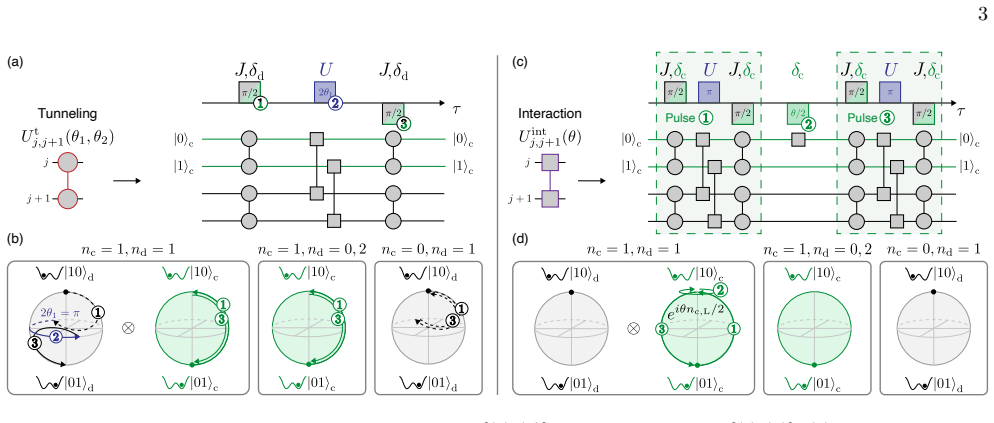
Tunneling gate The tunneling gate should act on two nearest- neighbor data fermions as Ut j,j+1(θ1, θ2)=e −iθ1(e−iθ2 d† j dj+1+H.c.),(S3) while its action on the control fermions is irrelevant as long as they remain (after the full sequence) decoupled from the data fermions. For the protocols discussed here, the position of the control fermions is also pr...
-
[74]
conveyor belt
Interaction gate The last gate of our gate set is the interaction gate, which acts on the fermions as Uint j,j+1(θ)=e −iθnd,j nd,j+1 ,(S14) and keeps the control fermion in the right well (if there is one). The first step of our interaction gate protocol is to apply the tunneling gate sequence with tunneling an- gleθ 1 =π/2 (see previous subsection) with ...
discussion (0)
Sign in with ORCID, Apple, or X to comment. Anyone can read and Pith papers without signing in.