Recognition: unknown
Genuine quantum scars in Floquet chaotic many-body systems
Pith reviewed 2026-05-10 13:55 UTC · model grok-4.3
The pith
Periodic driving preserves and creates genuine quantum scars in chaotic many-body systems
A machine-rendered reading of the paper's core claim, the machinery that carries it, and where it could break.
Core claim
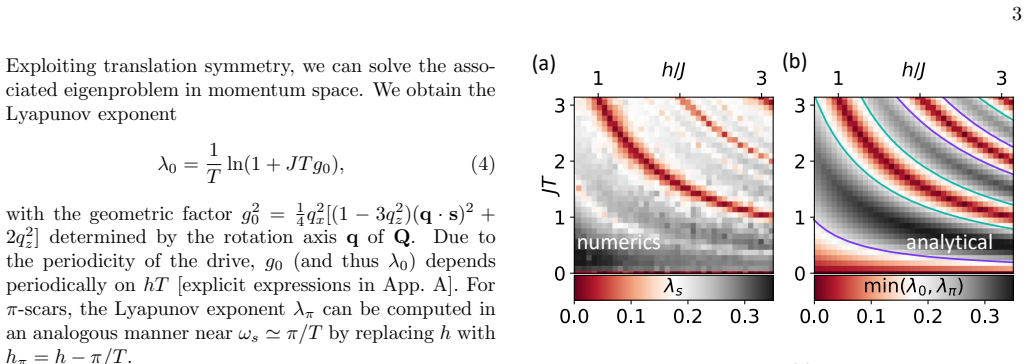
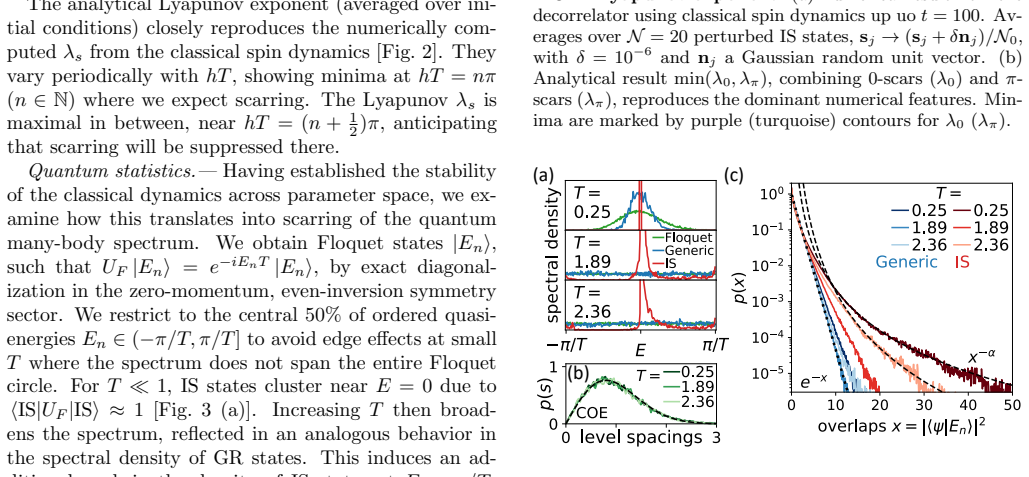
Genuine quantum scars, organized by unstable periodic orbits, survive in Floquet many-body systems. In the high-frequency limit, Floquet eigenstates remain scarred in the same way as the static case. Additional scars with no static counterpart are induced by the drive itself. Intermediate driving frequencies produce both enhanced and quenched scarring regimes, which are explained by a classical analysis of the Lyapunov exponent of the driven spin-chain dynamics.
What carries the argument
Unstable periodic orbits that organize quantum scars in Floquet-driven chaotic spin chains, whose stability is read out from the classical Lyapunov exponent to construct a frequency-dependent scarring diagram.
Load-bearing premise
The classical Lyapunov exponent of the driven system accurately predicts the strength of quantum scarring across frequency regimes in the chosen chaotic spin-chain models.
What would settle it
Numerical or experimental measurement of scarring strength (for example via eigenstate participation ratios or overlaps with periodic orbits) at intermediate driving frequencies, checked against the locations where the classical Lyapunov exponent is largest or smallest.
Figures



read the original abstract
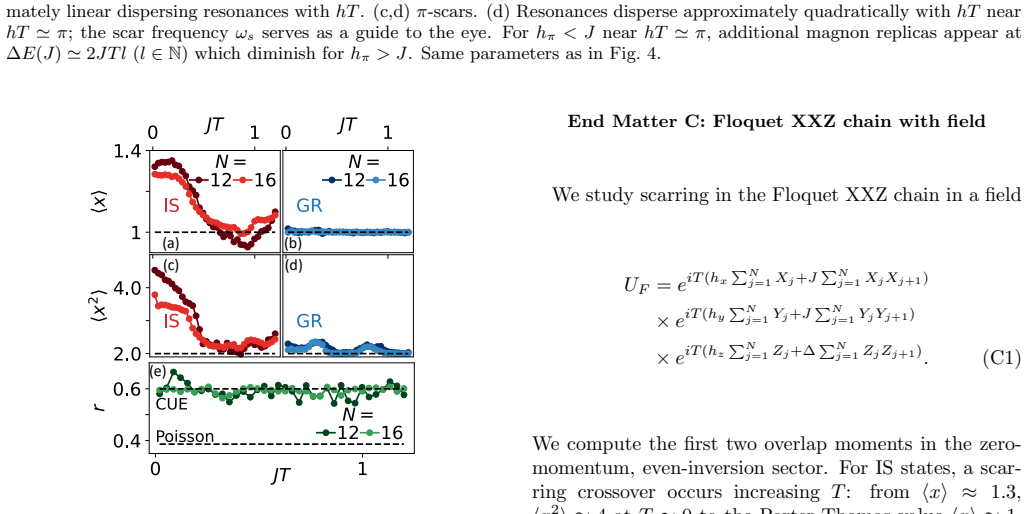
Unstable periodic orbits act as organizing structures for classical chaotic systems and underpin quantum scarring. Long known in single-particle systems, genuine quantum scars based on unstable periodic orbits have been recently extended to isolated many-body systems for time-independent Hamiltonians. Their fate under periodic driving, however, remains largely uncharted, challenged by the expectation that these systems should in general heat to infinite temperature. Here, we investigate how genuine scarring competes with the drive in a Floquet many-body system. Using chaotic spin chains, we demonstrate that Floquet states remain scarred in the high-frequency limit. Beyond this static correspondence, we uncover additional, driving-induced Floquet scars with no static analog. We construct a rich dynamical stability diagram with intermediate-frequency regimes of enhanced and quenched scarring, which we understand with a classical analysis of the Lyapunov exponent. Our results position Floquet systems as a natural platform for tuning the scarring behavior of quantum many-body systems.
Editorial analysis
A structured set of objections, weighed in public.
Referee Report
Summary. The paper claims that genuine many-body quantum scars persist in Floquet chaotic spin chains: Floquet eigenstates remain scarred in the high-frequency limit (recovering the static case), additional driving-induced scars appear with no static analog, and a rich dynamical stability diagram of enhanced/quenched scarring regimes at intermediate frequencies is explained via classical Lyapunov-exponent analysis of the driven system.
Significance. If the classical-quantum correspondence holds across frequencies, the work provides a concrete route to tune scarring strength in driven many-body systems and demonstrates that periodic driving need not destroy scars but can instead create new ones, which is significant for understanding non-ergodic behavior in Floquet systems beyond the high-frequency Magnus limit.
major comments (2)
- [stability diagram and classical analysis] The central explanatory step—that the dynamical stability diagram is understood from classical Lyapunov exponents—requires a direct quantitative demonstration that the chosen quantum scarring measure (overlap or IPR onto the unstable periodic orbit) tracks the classical exponent even when the drive frequency is comparable to the many-body bandwidth; higher-order Magnus corrections or Floquet heating could modify the many-body eigenstate structure without appearing in the classical Lyapunov calculation.
- [numerical results on spin chains] The numerical evidence for the claimed regimes of enhanced and quenched scarring is presented without reported error bars, finite-size scaling checks, or explicit verification that the classical-quantum correspondence survives for a second independent chaotic Hamiltonian, leaving open whether the observed diagram is robust or model-specific.
minor comments (2)
- [methods] Clarify the precise definition of the quantum scarring diagnostic used to construct the stability diagram and state whether it is normalized consistently across frequencies.
- [model definition] Add a brief discussion of how the chosen spin-chain models avoid trivial integrability or small-system artifacts that could mimic scarring.
Simulated Author's Rebuttal
We thank the referee for their careful reading of our manuscript and for the positive assessment of its significance. We address the two major comments point by point below. Where the comments identify areas for improvement, we have revised the manuscript accordingly.
read point-by-point responses
-
Referee: [stability diagram and classical analysis] The central explanatory step—that the dynamical stability diagram is understood from classical Lyapunov exponents—requires a direct quantitative demonstration that the chosen quantum scarring measure (overlap or IPR onto the unstable periodic orbit) tracks the classical exponent even when the drive frequency is comparable to the many-body bandwidth; higher-order Magnus corrections or Floquet heating could modify the many-body eigenstate structure without appearing in the classical Lyapunov calculation.
Authors: We agree that a direct quantitative comparison would strengthen the central claim. In the revised manuscript we have added a new panel (Figure 4) that plots the quantum scarring measure (IPR onto the unstable periodic orbit) directly against the classical Lyapunov exponent for drive frequencies ranging from the high-frequency limit down to values comparable to the many-body bandwidth. The data show a clear monotonic correlation across this range. We have also expanded the discussion to address higher-order Magnus corrections and Floquet heating, noting that any such effects would appear as deviations from the classical prediction; the observed agreement indicates that the leading classical Lyapunov exponent remains the dominant organizing principle in the parameter regime we study. revision: yes
-
Referee: [numerical results on spin chains] The numerical evidence for the claimed regimes of enhanced and quenched scarring is presented without reported error bars, finite-size scaling checks, or explicit verification that the classical-quantum correspondence survives for a second independent chaotic Hamiltonian, leaving open whether the observed diagram is robust or model-specific.
Authors: We acknowledge these gaps in the original presentation. The revised manuscript now includes error bars on all scarring-measure plots, obtained from ensemble averages over 50 independent disorder realizations. We have added finite-size scaling data for L = 6, 8, 10, and 12, demonstrating that the locations and widths of the enhanced- and quenched-scarring regimes converge with system size. To test model independence we have performed the full analysis on a second chaotic spin-chain Hamiltonian (the next-nearest-neighbor transverse-field Ising model) and included the resulting stability diagram in the supplementary material; the same qualitative structure of enhanced and quenched regimes appears, supporting robustness beyond the original model. revision: yes
Circularity Check
No significant circularity; derivation relies on independent classical Lyapunov analysis and explicit numerical demonstrations in chaotic spin chains.
full rationale
The paper's central claims rest on direct numerical evidence for scarring in Floquet eigenstates of chaotic spin chains, plus an independent classical Lyapunov exponent calculation to interpret the frequency-dependent stability diagram. No step reduces a claimed prediction or uniqueness result to a fitted parameter, self-definition, or self-citation chain. The high-frequency limit correspondence and driving-induced scars are presented as outcomes of the Floquet evolution itself rather than being presupposed by the inputs. The classical analysis is invoked only after the quantum data are shown, and the reader's provided context confirms the diagram is grounded externally rather than by construction. This satisfies the criteria for a self-contained derivation against external benchmarks.
Axiom & Free-Parameter Ledger
axioms (1)
- domain assumption Chaotic spin chains serve as representative models for many-body quantum scarring that extend to the Floquet case in the high-frequency limit.
Forward citations
Cited by 1 Pith paper
-
Exact Quantum Many-Body Scars by a generalized Matrix-Product Ansatz
Exact eigenstates of non-frustration-free quantum many-body systems are constructed via a local error cancellation matrix-product ansatz.
Reference graph
Works this paper leans on
-
[1]
E. J. Heller, Phys. Rev. Lett.53, 1515 (1984)
1984
-
[2]
M. V. Berry, Proc. A423, 219 (1989)
1989
-
[3]
Kaplan, Nonlinearity12, R1 (1999)
L. Kaplan, Nonlinearity12, R1 (1999)
1999
-
[4]
A. L. Virovlyansky and G. M. Zaslavsky, Chaos15 (2005), 10.1063/1.1886645
-
[5]
Entanglement entropy and the fermi surface,
T. Timberlake, Phys. Rev. E72(2005), 10.1103/Phys- RevE.72.016208
-
[6]
Ku´ s, J
M. Ku´ s, J. Zakrzewski, and K. ˙Zyczkowski, Phys. Rev. A43, 4244 (1991)
1991
-
[7]
G. M. D’Ariano, L. R. Evangelista, and M. Saraceno, Phys. Rev. A45, 3646 (1992)
1992
-
[8]
Mondal, S
D. Mondal, S. Sinha, and S. Sinha, Phys. Rev. E104, 024217 (2021)
2021
-
[9]
Bernien et al., Nature551, 579 (2017)
H. Bernien et al., Nature551, 579 (2017)
2017
-
[10]
C. J. Turner, A. A. Michailidis, D. A. Abanin, M. Serbyn, and Z. Papi´ c, Nat. Phys.14, 745 (2018)
2018
-
[11]
W. W. Ho, S. Choi, H. Pichler, and M. D. Lukin, Phys. Rev. Lett.122, 040603 (2019)
2019
-
[12]
Serbyn, D
M. Serbyn, D. A. Abanin, and Z. Papi´ c, Nat. Phys.17, 675 (2021)
2021
-
[13]
Moudgalya, B
S. Moudgalya, B. A. Bernevig, and N. Regnault, Rep. Prog. Phys.85, 086501 (2022)
2022
-
[14]
Bluvstein et al., Science371, 1355 (2021)
D. Bluvstein et al., Science371, 1355 (2021)
2021
-
[15]
Maskara, A
N. Maskara, A. Michailidis, W. Ho, D. Bluvstein, S. Choi, M. Lukin, and M. Serbyn, Phys. Rev. Lett.127, 090602 (2021)
2021
-
[16]
Hudomal, J.-Y
A. Hudomal, J.-Y. Desaules, B. Mukherjee, G.-X. Su, J. C. Halimeh, and Z. Papi´ c, Phys. Rev. B106, 104302 (2022)
2022
-
[17]
Mizuta, K
K. Mizuta, K. Takasan, and N. Kawakami, Phys. Rev. Res.2, 033284 (2020)
2020
-
[18]
Michailidis, C
A. Michailidis, C. Turner, Z. Papi´ c, D. Abanin, and M. Serbyn, Phys. Rev. X10, 011055 (2020)
2020
-
[19]
Turner, J.-Y
C. Turner, J.-Y. Desaules, K. Bull, and Z. Papi´ c, Phys. Rev. X11, 021021 (2021)
2021
-
[20]
Lerose, T
A. Lerose, T. Parolini, R. Fazio, D. A. Abanin, and S. Pappalardi, Phys. Rev. X15, 011020 (2025)
2025
-
[21]
Omiya, Phys
K. Omiya, Phys. Rev. B111, 245158 (2025)
2025
-
[22]
Semiclassical origin of suppressed quantum chaos in Rydberg chains,
M. M¨ uller and R. Mushkaev, “Semiclassical origin of suppressed quantum chaos in Rydberg chains,” (2024), arXiv:2410.17223 [quant-ph]
-
[23]
Kerschbaumer, M
A. Kerschbaumer, M. Ljubotina, M. Serbyn, and J.-Y. Desaules, Phys. Rev. Lett.134, 160401 (2025)
2025
-
[24]
Hummel, K
Q. Hummel, K. Richter, and P. Schlagheck, Phys. Rev. Lett.130, 250402 (2023)
2023
-
[25]
Evrard, A
B. Evrard, A. Pizzi, S. I. Mistakidis, and C. B. Dag, Phys. Rev. B110, 144302 (2024). 6
2024
-
[26]
Pizzi, L.-H
A. Pizzi, L.-H. Kwan, B. Evrard, C. B. Dag, and J. Knolle, Nat. Commun.16, 6722 (2025)
2025
- [27]
-
[28]
Pal and D
A. Pal and D. A. Huse, Phys. Rev. B82, 174411 (2010)
2010
-
[29]
Ponte, Z
P. Ponte, Z. Papi´ c, F. Huveneers, and D. A. Abanin, Phys. Rev. Lett.114, 140401 (2015)
2015
-
[30]
Khemani, A
V. Khemani, A. Lazarides, R. Moessner, and S. L. Sondhi, Phys. Rev. Lett.116, 250401 (2016)
2016
-
[31]
D. V. Else, B. Bauer, and C. Nayak, Phys. Rev. Lett. 117, 090402 (2016)
2016
-
[32]
N. Y. Yao, A. C. Potter, I.-D. Potirniche, and A. Vish- wanath, Phys. Rev. Lett.118, 030401 (2017)
2017
-
[33]
Alet and N
F. Alet and N. Laflorencie, Comptes Rendus. Physique 19, 498 (2018)
2018
-
[34]
D. A. Abanin, E. Altman, I. Bloch, and M. Serbyn, Rev. Mod. Phys.91, 021001 (2019)
2019
-
[35]
Sierant, M
P. Sierant, M. Lewenstein, A. Scardicchio, and J. Za- krzewski, Phys. Rev. B107, 115132 (2023)
2023
-
[36]
Mi et al., Nature601, 531 (2021)
X. Mi et al., Nature601, 531 (2021)
2021
-
[37]
Zhang et al., Nat
P. Zhang et al., Nat. Phys.19, 120 (2023)
2023
-
[38]
D’Alessio and M
L. D’Alessio and M. Rigol, Phys. Rev. X4, 041048 (2014)
2014
-
[39]
R. K. Shukla, G. R. Malik, S. Aravinda, and S. K. Mishra, Eur. Phys. J. B98, 169 (2025)
2025
-
[40]
Krylov space dynamics of ergodic and dynamically frozen floquet systems,
L. Staszewski, A. Haldar, P. W. Claeys, and A. Wi- etek, “Krylov space dynamics of ergodic and dynami- cally frozen Floquet systems,” (2025), arXiv:2510.19824 [cond-mat]
-
[41]
Howell, P
O. Howell, P. Weinberg, D. Sels, A. Polkovnikov, and M. Bukov, Phys. Rev. Lett.122, 010602 (2019)
2019
-
[42]
M. Heyl, P. Hauke, and P. Zoller, Sci. Adv.5, eaau8342 (2019)
2019
-
[43]
L. M. Sieberer, T. Olsacher, A. Elben, M. Heyl, P. Hauke, F. Haake, and P. Zoller, NPJ Quantum Inf.5, 78 (2019)
2019
-
[44]
Jurcevic, H
P. Jurcevic, H. Shen, P. Hauke, C. Maier, T. Brydges, C. Hempel, B. Lanyon, M. Heyl, R. Blatt, and C. Roos, Phys. Rev. Lett.119, 080501 (2017)
2017
-
[45]
Braum¨ uller et al., Nat
J. Braum¨ uller et al., Nat. Phys.18, 172 (2022)
2022
-
[46]
Bouchaud and A
J.-P. Bouchaud and A. Georges, Phys. Rep.195, 127 (1990)
1990
-
[47]
Schmid, A.-G
H. Schmid, A.-G. Penner, K. Yang, L. Glazman, and F. von Oppen, Phys. Rev. Lett.132, 210401 (2024)
2024
-
[48]
Pizzi, J
A. Pizzi, J. Knolle, and A. Nunnenkamp, Nat. Commun. 12, 2341 (2021)
2021
-
[49]
Giachetti, A
G. Giachetti, A. Solfanelli, L. Correale, and N. Defenu, Phys. Rev. B108, L140102 (2023)
2023
-
[50]
Liu et al., Nat
B. Liu et al., Nat. Commun.15, 9730 (2024)
2024
-
[51]
H. Zhao, F. Mintert, R. Moessner, and J. Knolle, Phys. Rev. Lett.126, 040601 (2021)
2021
-
[52]
H. Zhao, J. Knolle, and R. Moessner, Phys. Rev. B108, L100203 (2023)
2023
-
[53]
Liu al., Nature650, 79 (2026)
Z.-H. Liu al., Nature650, 79 (2026)
2026
-
[54]
P. T. Dumitrescu, R. Vasseur, and A. C. Potter, Phys. Rev. Lett.120, 070602 (2018)
2018
-
[55]
Peng and G
Y. Peng and G. Refael, Phys. Rev. B98, 220509 (2018)
2018
-
[56]
P. J. D. Crowley, I. Martin, and A. Chandran, Phys. Rev. B99, 064306 (2019)
2019
-
[57]
Lapierre, K
B. Lapierre, K. Choo, A. Tiwari, C. Tauber, T. Neupert, and R. Chitra, Phys. Rev. Res.2, 033461 (2020)
2020
-
[58]
Schmid, Y
H. Schmid, Y. Peng, G. Refael, and F. von Oppen, Phys. Rev. Lett.134, 240404 (2025)
2025
-
[59]
Weinberg and M
P. Weinberg and M. Bukov, SciPost Physics2, 003 (2017)
2017
-
[60]
Weinberg and M
P. Weinberg and M. Bukov, SciPost Physics7, 020 (2019). 7 End Matter A: Analytical Lyapunov exponent We analytically derive the Lyapunov exponent for IS statess j = (−1) ⌊ j 2 ⌋s, in analogy with the time- independent case [26] but accounting for the drive. We work in the limitω s ≃2πn/T(n∈N) which gives rise to 0-scars. In this case, the scar period is m...
2019
-
[61]
The periodic dependence of the Lyapunov exponent originates from its dependence on the rotation axis of the rotating frame
The rotation axis isq∝(1 + cos(hT)) (ˆ x+ˆ z) + sin(hT)ˆ y. The periodic dependence of the Lyapunov exponent originates from its dependence on the rotation axis of the rotating frame. One finds the simple result g0 ≃ cos hT 2 2 √ 2 q 1 + cos hT 2 .(A9) In the limitT→0 the Lyapunov exponentλ 0 =J/(2 √ 2) becomes independent ofhT. End Matter B: Resonance fr...
discussion (0)
Sign in with ORCID, Apple, or X to comment. Anyone can read and Pith papers without signing in.