Recognition: unknown
Bosonic Working Media in a Frustrated Rhombi Chain: Otto and Stirling Cycles from Flat Bands, Caging, and Flux Control
Pith reviewed 2026-05-10 13:27 UTC · model grok-4.3
The pith
Flux tuning creates flat bands in a rhombi chain that boost Otto-cycle work output in bosonic heat engines by suppressing heat released to the cold reservoir.
A machine-rendered reading of the paper's core claim, the machinery that carries it, and where it could break.
Core claim
In the noninteracting Bose-Hubbard model on the rhombi chain, a tunable flux drives the system into the Aharonov-Bohm caging regime where all bands become flat. For the Otto cycle this flat-band limit raises both extracted work and efficiency through a strong reduction in heat transferred to the cold reservoir during the isochoric cooling stroke. The Stirling cycle instead extracts more work across a wider range of fluxes by exploiting entropy variations along the isothermal, flux-swept legs, albeit at reduced efficiency.
What carries the argument
The flux-induced transition from dispersive to flat bands via Aharonov-Bohm caging in the single-particle spectrum, which restructures the thermal occupation of modes and thereby controls the heat and work exchanges during the thermodynamic cycles.
If this is right
- Otto-cycle work output and efficiency increase when the flux approaches the caging regime.
- The efficiency gain occurs through reduced heat rejection to the cold reservoir rather than increased heat uptake from the hot reservoir.
- Stirling-cycle work extraction improves over a broader flux interval through isothermal entropy variations.
- Flat-band formation functions as a direct strategy to increase work extraction in bosonic quantum heat engines.
- Synthetic gauge fields enable spectral engineering that tailors the performance of bosonic quantum thermal machines.
Where Pith is reading between the lines
- The same flux-control approach could apply to other frustrated lattice geometries that host flat bands, potentially yielding analogous thermodynamic improvements.
- Weak interactions, if added, might preserve caging while introducing new optimization channels not examined in the noninteracting limit.
- Current cold-atom platforms with optical lattices and artificial gauge fields could implement these cycles to measure the predicted heat suppression.
Load-bearing premise
The analysis assumes the noninteracting Bose-Hubbard model on the rhombi chain with tunable flux accurately captures the thermal occupation and cycle thermodynamics without interactions or higher-order effects.
What would settle it
An experiment that tracks heat flow to the cold reservoir while tuning the flux toward the caging value and verifies whether that heat flow drops sharply while absorbed heat remains largely unchanged would test the claimed mechanism.
Figures




read the original abstract
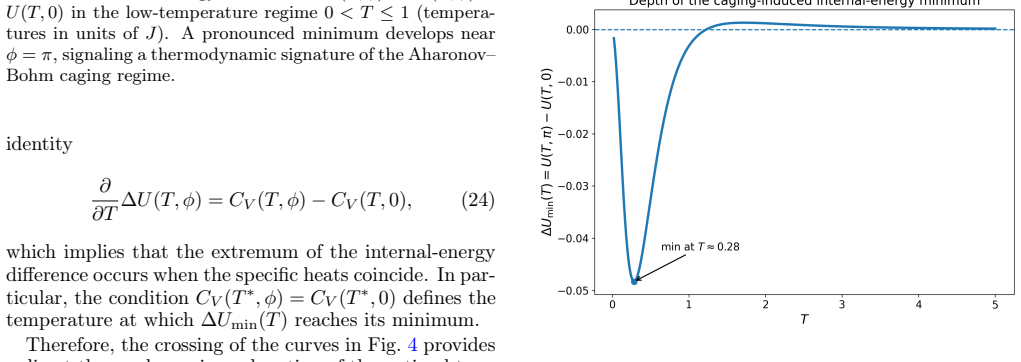
We demonstrate that flat-band engineering provides a direct route to control and optimize the thermodynamic performance of quantum heat engines. We consider noninteracting bosons on a rhombi-chain lattice described by a Bose-Hubbard model in the noninteracting limit, where a magnetic flux serves as a tunable parameter that continuously reshapes the single-particle spectrum. By driving the system toward the fully frustrated Aharonov-Bohm caging regime, the band structure transitions from dispersive to completely flat, strongly modifying the thermal occupation of the modes. We show that this flux-induced spectral restructuring has clear and measurable thermodynamic consequences. In particular, the Otto cycle exhibits a significant enhancement of both work output and efficiency when operating near the caging regime. We identify the underlying mechanism as a pronounced suppression of heat released to the cold reservoir, rather than an increase in absorbed heat, revealing that flat-band formation is an effective strategy to increase work extraction. In contrast, the Stirling cycle is governed by entropy variations along isothermal, flux-driven processes, leading to greater work extraction over a broader parameter range but at lower efficiency. These results establish geometric frustration and Aharonov-Bohm caging as thermodynamic resources and show that spectral engineering via synthetic gauge fields offers a viable, experimentally accessible pathway to tailor the performance of bosonic quantum thermal machines.
Editorial analysis
A structured set of objections, weighed in public.
Referee Report
Summary. The manuscript examines noninteracting bosons on a rhombi-chain lattice governed by the Bose-Hubbard Hamiltonian with tunable magnetic flux. It shows that flux-driven transition to the Aharonov-Bohm caging regime produces flat bands that reshape the single-particle spectrum, thereby altering thermal occupations. This leads to enhanced work output and efficiency in the Otto cycle via suppressed heat rejection to the cold reservoir, while the Stirling cycle achieves greater work extraction over a wider flux range but at reduced efficiency. The thermodynamic quantities are obtained directly from the flux-dependent spectrum within the grand-canonical ensemble.
Significance. If the explicit cycle calculations hold, the work establishes geometric frustration and synthetic gauge fields as controllable thermodynamic resources for bosonic quantum heat engines. The direct mapping from single-particle flat-band formation to measurable changes in work and heat flows provides a clear, experimentally relevant route in ultracold-atom platforms. The restriction to the noninteracting limit permits exact spectral control without fitting parameters beyond the flux, which strengthens the mechanistic interpretation.
major comments (2)
- [Otto cycle analysis (likely §4)] The central claim of Otto-cycle enhancement rests on the flux-induced suppression of heat release to the cold bath. The manuscript should explicitly tabulate or plot the absorbed heat Q_h and rejected heat Q_c versus flux (near and away from the caging point) to confirm that the efficiency gain is not accompanied by a compensating drop in Q_h; without this comparison the mechanism remains qualitative.
- [Stirling cycle section] The Stirling cycle is stated to yield larger work over a broader parameter range. The manuscript must specify the isothermal flux-sweep protocol and the entropy change formula used; if the work is computed solely from the difference in grand potentials at the two temperatures, the absence of an explicit expression for the flux-dependent chemical potential or particle number constraint could affect the reported work values.
minor comments (3)
- [Abstract and model section] The abstract states that the enhancement occurs 'near the caging regime' but does not quote the specific flux value or range; the main text should define this regime quantitatively (e.g., via the bandwidth or localization length) for reproducibility.
- [Model Hamiltonian] Notation for the magnetic flux (likely φ or Φ) and the hopping amplitudes should be introduced once and used consistently; any redefinition between the single-particle Hamiltonian and the thermodynamic expressions should be flagged.
- [Figures] Figure captions for the band-structure plots should include the exact flux values shown and the temperature range used for the thermal occupations to allow direct comparison with the cycle results.
Simulated Author's Rebuttal
We thank the referee for the thorough review and positive recommendation for minor revision. We have carefully considered the comments and made the necessary revisions to strengthen the manuscript. Below we provide point-by-point responses to the major comments.
read point-by-point responses
-
Referee: [Otto cycle analysis (likely §4)] The central claim of Otto-cycle enhancement rests on the flux-induced suppression of heat release to the cold bath. The manuscript should explicitly tabulate or plot the absorbed heat Q_h and rejected heat Q_c versus flux (near and away from the caging point) to confirm that the efficiency gain is not accompanied by a compensating drop in Q_h; without this comparison the mechanism remains qualitative.
Authors: We agree with the referee that an explicit comparison is essential to validate the proposed mechanism. In the revised version of the manuscript, we have included a new figure in Section 4 that plots Q_h, Q_c, and the extracted work W as functions of the magnetic flux Φ, for values both near the Aharonov-Bohm caging point and away from it. These plots demonstrate that the increase in efficiency is indeed due to a significant reduction in the magnitude of Q_c, while Q_h remains largely unchanged or even slightly increases near the caging regime. We have also added a table summarizing the key thermodynamic quantities at representative flux values. The text has been updated to discuss these results quantitatively. revision: yes
-
Referee: [Stirling cycle section] The Stirling cycle is stated to yield larger work over a broader parameter range. The manuscript must specify the isothermal flux-sweep protocol and the entropy change formula used; if the work is computed solely from the difference in grand potentials at the two temperatures, the absence of an explicit expression for the flux-dependent chemical potential or particle number constraint could affect the reported work values.
Authors: We appreciate this clarification request. The Stirling cycle is realized through two isothermal processes at temperatures T_h and T_c, during which the flux is swept while keeping the average particle number fixed in the grand-canonical ensemble. The work output is calculated as the difference in the grand potential Ω between the initial and final flux values at each temperature, W = -(Ω_final - Ω_initial). To maintain fixed N, the chemical potential μ is determined self-consistently as a function of T and Φ from the particle number equation N = -∂Ω/∂μ. The entropy change along the isothermal path is given by ΔS = - (∂Ω/∂T)_Φ. We have now added these explicit expressions and a description of the protocol to the revised manuscript in the Stirling cycle section. This ensures the reported work values account for the particle number constraint. revision: yes
Circularity Check
No significant circularity; derivation is self-contained from the model spectrum
full rationale
The paper starts from the standard noninteracting Bose-Hubbard Hamiltonian on the rhombi chain with flux as an external parameter, computes the single-particle spectrum (including flat-band formation and caging), and obtains all thermodynamic quantities (work, heat, efficiency) for the Otto and Stirling cycles directly from the flux-dependent eigenvalues and grand-canonical occupations. No parameter is fitted to the target cycle performance, no prediction is defined in terms of itself, and no load-bearing step reduces to a self-citation or ansatz smuggled from prior author work. The reported suppression of heat rejection near the caging regime is a direct consequence of the reduced density of states at the cold temperature, not a redefinition of inputs.
Axiom & Free-Parameter Ledger
free parameters (1)
- magnetic flux
axioms (1)
- domain assumption Bose-Hubbard model in the noninteracting limit
Reference graph
Works this paper leans on
-
[1]
Kosloff, Entropy15, 2100 (2013)
R. Kosloff, Entropy15, 2100 (2013)
2013
-
[2]
Vinjanampathy and J
S. Vinjanampathy and J. Anders, Contemporary Physics 57, 545 (2016)
2016
-
[3]
Bhattacharjee and A
S. Bhattacharjee and A. Dutta, European Physical Jour- nal B94, 239 (2021)
2021
-
[4]
Mukherjee and U
V. Mukherjee and U. Divakaran, Journal of Physics: Condensed Matter33, 454001 (2021)
2021
-
[5]
Deffner and E
S. Deffner and E. Lutz, Physical Review Letters105, 170402 (2010)
2010
-
[6]
Deffner and E
S. Deffner and E. Lutz, Physical Review Letters107, 140404 (2011)
2011
-
[7]
Deffner and E
S. Deffner and E. Lutz, Physical Review Letters111, 010402 (2013)
2013
-
[8]
Deffner and S
S. Deffner and S. Campbell, Morgan & Claypool (2019)
2019
-
[9]
Esposito, U
M. Esposito, U. Harbola, and S. Mukamel, Reviews of Modern Physics81, 1665 (2009)
2009
-
[10]
Campisi, P
M. Campisi, P. Hänggi, and P. Talkner, Reviews of Mod- ern Physics83, 771 (2011)
2011
-
[11]
Seifert, Reports on Progress in Physics75, 126001 (2012)
U. Seifert, Reports on Progress in Physics75, 126001 (2012)
2012
-
[12]
Goold, M
J. Goold, M. Huber, A. Riera, L. del Rio, and P. Skrzypczyk, Journal of Physics A49, 143001 (2016)
2016
-
[13]
Talkner, E
P. Talkner, E. Lutz, and P. Hänggi, Physical Review E 75, 050102 (2007)
2007
-
[14]
Jarzynski, Annual Review of Condensed Matter Physics2, 329 (2011)
C. Jarzynski, Annual Review of Condensed Matter Physics2, 329 (2011)
2011
-
[15]
J. M. Horowitz and M. Esposito, Physical Review X4, 031015 (2014)
2014
-
[16]
H. T. Quan, Y.-x. Liu, C. P. Sun, and F. Nori, Physical Review E76, 031105 (2007)
2007
-
[17]
T. D. Kieu, Physical Review Letters93, 140403 (2004)
2004
-
[18]
O. Abah, J. Roßnagel, G. Jacob, S. Deffner, F. Schmidt- Kaler, K. Singer, and E. Lutz, Physical Review Letters 109, 203006 (2012)
2012
-
[19]
Roßnagel, O
J. Roßnagel, O. Abah, F. Schmidt-Kaler, K. Singer, and E. Lutz, Science352, 325 (2016)
2016
-
[20]
Leykam, A
D. Leykam, A. Andreanov, and S. Flach, Advances in Physics: X3, 1473052 (2018)
2018
-
[21]
Derzhko, J
O. Derzhko, J. Richter, and M. Maksymenko, Interna- tional Journal of Modern Physics B29, 1530007 (2015)
2015
-
[22]
Flach, D
S. Flach, D. Leykam, J. D. Bodyfelt, P. Matthies, and A. S. Desyatnikov, Europhysics Letters105, 30001 (2014)
2014
-
[23]
Sutherland, Physical Review B34, 5208 (1986)
B. Sutherland, Physical Review B34, 5208 (1986)
1986
-
[24]
Ahmed, A
A. Ahmed, A. Ramachandran, I. M. Khaymovich, and A. Sharma, Physical Review B106, 205119 (2022)
2022
-
[25]
A. M. Marques, G. Pelegrí, R. G. Dias, V. Ahufinger, and J. Mompart, Physical Review Research5, 023110 (2023)
2023
-
[26]
Vidal, R
J. Vidal, R. Mosseri, and B. Douçot, Physical Review Letters81, 5888 (1998)
1998
-
[27]
Vidal, B
J. Vidal, B. Douçot, and R. Mosseri, Physical Review B 61, R16357 (2000)
2000
-
[28]
Mosseri, B
R. Mosseri, B. Douçot, and J. Vidal, Physical Review B 106, 155120 (2022)
2022
-
[29]
Pelegrí, A
G. Pelegrí, A. M. Marques, V. Ahufinger, and J. Mom- part, Physical Review A99, 023613 (2019)
2019
-
[30]
Pelegrí, A
G. Pelegrí, A. M. Marques, V. Ahufinger, and J. Mom- part, Physical Review Research2, 033267 (2020)
2020
-
[31]
N. Roy, A. Ramachandran, and A. Sharma, Physical Re- view Research2, 043395 (2020)
2020
-
[32]
Mukherjee, M
S. Mukherjee, M. Di Liberto, P. Öhberg, R. R. Thomson, and N. Goldman, Physical Review Letters121, 075502 (2018)
2018
-
[33]
Kremer, I
M. Kremer, I. Petrides, E. Meyer, M. Heinrich, O. Zilber- berg, and A. Szameit, Nature Communications11, 907 (2020)
2020
-
[34]
H. Li, Z. Dong, S. Longhi, Q. Liang, D. Xie, and B. Yan, Physical Review Letters129, 220403 (2022)
2022
-
[35]
H. Wang, H. Li, Z. Liu, M. Lu, and Y.-F. Chen, Physical Review B106, 104203 (2022)
2022
-
[36]
X. Zhou, Z. Wang, Y. Yang, Y. Xie, G. Guo, and G. Guo, Physical Review B107, 035152 (2023)
2023
-
[37]
I. T. Rosen, O. Painter, and A. A. Houck, Physical Re- view X15, 021091 (2025)
2025
-
[38]
Aidelsburger, M
M. Aidelsburger, M. Atala, M. Lohse, J. T. Barreiro, B. Paredes, and I. Bloch, Physical Review Letters111, 185301 (2013)
2013
-
[39]
Miyake, G
H. Miyake, G. A. Siviloglou, C. J. Kennedy, W. C. Burton, and W. Ketterle, Physical Review Letters111, 185302 (2013). 16
2013
-
[40]
Dalibard, F
J. Dalibard, F. Gerbier, G. Juzeli¯ unas, and P. Öhberg, Reviews of Modern Physics83, 1523 (2011)
2011
-
[41]
Goldman and J
N. Goldman and J. Dalibard, Physical Review X4, 031027 (2014)
2014
-
[42]
Ozawa, H
T. Ozawa, H. M. Price, A. Amo, N. Goldman, M. Hafezi, L. Lu, M. C. Rechtsman, D. Schuster, J. Simon, O. Zil- berberg, and I. Carusotto, Reviews of Modern Physics 91, 015006 (2019)
2019
-
[43]
M. P. A. Fisher, P. B. Weichman, G. Grinstein, and D. S. Fisher, Physical Review Letters85, 3906 (2000)
2000
-
[44]
Cartwright, G
C. Cartwright, G. De Chiara, and M. Rizzi, Physical Re- view B98, 184508 (2018)
2018
discussion (0)
Sign in with ORCID, Apple, or X to comment. Anyone can read and Pith papers without signing in.