Recognition: unknown
Properties of states in textsuperscript{19}Ne important for the textsuperscript{18}F(p,α)textsuperscript{15}O reaction rate
Pith reviewed 2026-05-10 13:13 UTC · model grok-4.3
The pith
Measurements of six near-threshold states in 19Ne revise uncertainties in the 18F(p,α)15O reaction rate for novae.
A machine-rendered reading of the paper's core claim, the machinery that carries it, and where it could break.
Core claim
We have determined the properties of important resonances in 19Ne which govern the 18F(p,α)15O reaction rate and the production of 18F in novae. Measured α and proton angular distributions from states populated in the 19F(3He,t)19Ne reaction identified six near-threshold proton s-wave 18F+p (Lp=0) states, and the asymptotic normalization of these states was studied using the symmetry-adapted no-core shell model. We have improved our understanding of states contributing to the 18F(p,α)15O reaction rate and show that earlier studies significantly underestimated the uncertainties.
What carries the argument
The six near-threshold proton s-wave 18F+p (Lp=0) states whose asymptotic normalization coefficients are obtained from the symmetry-adapted no-core shell model.
If this is right
- The 18F(p,α)15O reaction rate at nova temperatures carries larger uncertainties than reported in earlier evaluations.
- These six s-wave states provide the dominant contribution to the rate in the relevant temperature window.
- Updated rates will alter predicted 18F abundances and the expected intensity of the 511-keV line from novae.
- The combination of angular-distribution data and the shell-model approach supplies the normalization needed for reliable rate calculations.
Where Pith is reading between the lines
- Nova models that incorporate the revised rate will produce different 18F yields and therefore different predictions for observable gamma-ray signatures.
- The same experimental and modeling strategy could be applied to other proton-induced reactions on unstable nuclei that control nucleosynthesis in explosive environments.
- If future experiments or larger model spaces reveal systematic shifts in the asymptotic normalization coefficients, the rate uncertainties would widen further.
Load-bearing premise
The six identified near-threshold states dominate the 18F(p,α)15O reaction rate at nova temperatures and the shell-model calculation supplies accurate asymptotic normalization coefficients without large systematic errors.
What would settle it
A direct measurement of the 18F(p,α)15O cross section at energies corresponding to nova temperatures that yields a rate outside the new uncertainty range would falsify the claim that these states and their calculated coefficients set the rate.
Figures


read the original abstract
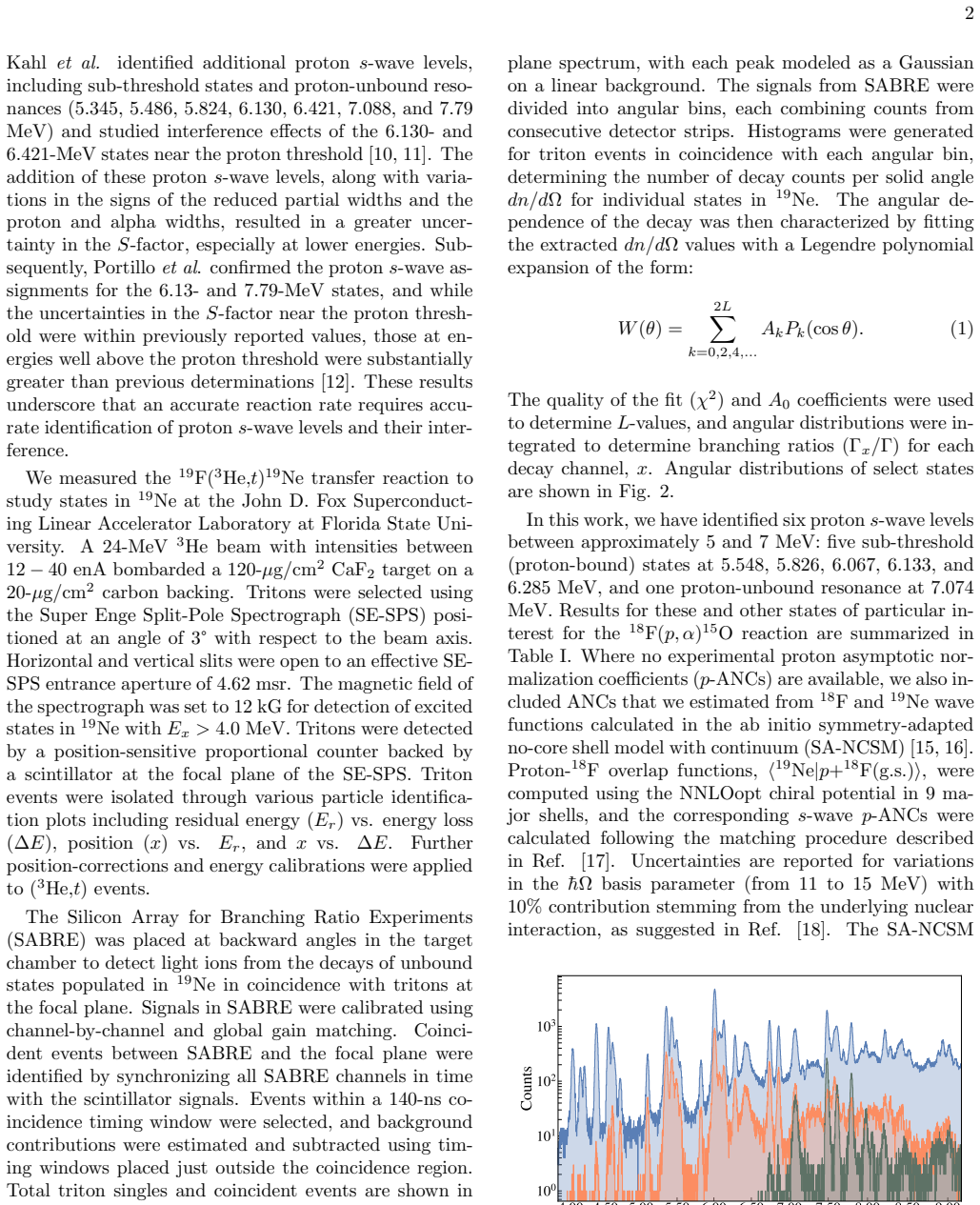
Observation of the 511-keV positron-annihilation line would be a powerful probe of classical novae, with the primary source of positrons likely from the $\beta^+$ decay of \textsuperscript{18}F. We have determined the properties of important resonances in $^{19}$Ne which govern the \textsuperscript{18}F($p,\alpha$)\textsuperscript{15}O reaction rate and the production of \textsuperscript{18}F in novae. Measured $\alpha$ and proton angular distributions from states populated in the \textsuperscript{19}F(\textsuperscript{3}He,$t$)\textsuperscript{19}Ne reaction identified six near-threshold proton $s$-wave \textsuperscript{18}F$+p$ ($L_p=0$) states, and the asymptotic normalization of these states was studied using the symmetry-adapted no-core shell model. We have improved our understanding of states contributing to the \textsuperscript{18}F($p,\alpha$)\textsuperscript{15}O reaction rate and show that earlier studies significantly underestimated the uncertainties.
Editorial analysis
A structured set of objections, weighed in public.
Referee Report
Summary. The manuscript reports the identification of six near-threshold proton s-wave states in 19Ne via angular distribution measurements in the 19F(3He,t)19Ne reaction. It employs the symmetry-adapted no-core shell model (SA-NCSM) to determine the asymptotic normalization coefficients (ANCs) for these states and concludes that earlier studies significantly underestimated the uncertainties in the 18F(p,α)15O reaction rate relevant for classical novae.
Significance. If validated, these results would provide a more reliable basis for calculating the 18F(p,α)15O reaction rate at nova temperatures, impacting models of 18F production and the observability of the 511 keV line from novae. The experimental identification of the states adds to the nuclear data, but the overall significance hinges on the accuracy of the SA-NCSM ANCs, which are critical for the rate but potentially subject to model systematics.
major comments (2)
- [§4 (Theoretical calculations)] §4 (Theoretical calculations): The SA-NCSM results for the ANCs of the six s-wave states are presented without quantification of systematic uncertainties due to model-space truncation or effective interaction choice. Since near-threshold states are particularly sensitive to the asymptotic tail, this could introduce errors larger than the claimed reduction in uncertainty, undermining the assertion that prior uncertainties were underestimated.
- [§5 (Reaction rate implications)] §5 (Reaction rate implications): No quantitative comparison is provided between the new reaction rate (with uncertainties) and previous evaluations, such as a table of rate values or uncertainty factors at relevant temperatures (e.g., 0.1-0.4 GK). This makes it impossible to assess the magnitude of the improvement or verify the central claim.
minor comments (2)
- [Abstract] Abstract: The abstract mentions 'studied using' SA-NCSM but does not specify how the ANCs were extracted or combined with experimental data.
- [Figure 2] Figure 2: The angular distribution figures would be clearer if the fitted curves and contributions from individual states were labeled more distinctly.
Simulated Author's Rebuttal
We thank the referee for their careful and constructive review. The comments identify areas where additional detail will strengthen the presentation of our results on the 19Ne states and their impact on the 18F(p,α)15O rate. We address each major comment below and indicate the revisions we will make.
read point-by-point responses
-
Referee: §4 (Theoretical calculations): The SA-NCSM results for the ANCs of the six s-wave states are presented without quantification of systematic uncertainties due to model-space truncation or effective interaction choice. Since near-threshold states are particularly sensitive to the asymptotic tail, this could introduce errors larger than the claimed reduction in uncertainty, undermining the assertion that prior uncertainties were underestimated.
Authors: We agree that the original manuscript did not provide an explicit quantification of systematic uncertainties arising from model-space truncation and interaction choice. The SA-NCSM calculations were performed in the largest feasible model spaces (N_max up to 8) using the NNLO_sat chiral interaction, with convergence checked by comparing ANC values between successive N_max. For near-threshold states the asymptotic normalization is extracted from the tail in the largest space, where the wave function is already well developed. To address the concern directly, the revised §4 will include a new paragraph and supplementary table showing the variation of the six ANCs with N_max and a conservative systematic uncertainty estimate (derived from the observed convergence rate and from analogous calculations in 18F and 20Ne). We will also note that the same framework reproduces known spectroscopic factors and ANCs in lighter nuclei to within 15-20%. These additions will allow readers to judge whether the new uncertainties are indeed smaller than those adopted in prior rate evaluations. revision: yes
-
Referee: §5 (Reaction rate implications): No quantitative comparison is provided between the new reaction rate (with uncertainties) and previous evaluations, such as a table of rate values or uncertainty factors at relevant temperatures (e.g., 0.1-0.4 GK). This makes it impossible to assess the magnitude of the improvement or verify the central claim.
Authors: We accept that a direct numerical comparison is necessary to substantiate the claim that earlier studies underestimated the uncertainties. The revised manuscript will add a new table in §5 that lists the 18F(p,α)15O reaction rate and its uncertainty factor at temperatures 0.1, 0.2, 0.3, and 0.4 GK, together with the corresponding values from the most recent prior evaluations (Iliadis et al. 2010 and subsequent updates). A companion figure will display the rate with uncertainty bands for both the present and previous work. These additions will quantify the reduction in uncertainty and allow the reader to evaluate the improvement at nova temperatures. revision: yes
Circularity Check
Primarily experimental angular distributions supplemented by independent SA-NCSM calculation; no load-bearing circular reduction
full rationale
The derivation chain consists of direct experimental identification of six near-threshold s-wave states via measured α and proton angular distributions in the 19F(3He,t)19Ne reaction, followed by computation of asymptotic normalization coefficients using the symmetry-adapted no-core shell model. No paper equation or step equates a reported ANC, resonance strength, or revised rate uncertainty to a quantity fitted from the same dataset. The SA-NCSM input is an external theoretical framework whose validity is not shown to reduce to a self-citation chain internal to this work. The claim that prior studies underestimated uncertainties is a comparison to literature values rather than a self-referential prediction. This yields only a minor self-citation score with no circularity in the central results.
Axiom & Free-Parameter Ledger
axioms (1)
- domain assumption Symmetry-adapted no-core shell model accurately computes asymptotic normalization coefficients for near-threshold 18F+p states in 19Ne
Reference graph
Works this paper leans on
-
[1]
J. Jose, M. Hernanz, and C. Iliadis, Nuclear Physics A 777, 550 (2006)
2006
-
[2]
T. F.-L. Collaboration, Science345, 554 (2014)
2014
-
[3]
Cheung, P
C. Cheung, P. Jean, S. Shore, L. Stawarz, R. Cor- bet, J. Knodlseder, S. Starrfield, D. Wood, R. Desiante, F. Longo, G. Pivato, and K. Wood, The Astrophysical Journal826, 142 (2016). 6
2016
-
[4]
Hernanz, J
M. Hernanz, J. Jose, A. Coc, J. Gomez-Gomar, and J. Is- ern, The Astrophysical Journal526, L97 (1999)
1999
-
[5]
J. A. Tomsick, S. E. Boggs, A. Zoglauer, D. Hart- mann, M. Ajello, E. Burns, C. Fryer, C. Karwin, C. Kierans, A. Lowell, J. Malzac, J. Roberts, P. Saint- Hilaire, A. Shih, T. Siegert, C. Sleator, T. Takahashi, F. Tavecchio, E. Wulf, J. Beechert, H. Gulick, A. Joens, H. Lazar, E. Neights, J. C. M. Oliveros, S. Mat- sumoto, T. Melia, H. Yoneda, M. Amman, D....
-
[6]
A. Coc, M. Hernanz, J. Jose, and J. P. Thibaud, Astron- omy & Astrophysics357, 561 (2000)
2000
-
[7]
S. H. Kim, K. Y. Chae, C. H. Kim, C. D. Nesaraja, and M. S. Smith, Phys. Rev. C112, 064323 (2025)
2025
-
[8]
D. W. Bardayan, K. A. Chipps, S. Ahn, J. C. Black- mon, R. J. deBoer, U. Greife, K. L. Jones, A. Kon- tos, R. L. Kozub, L. Linhardt, B. Manning, M. Matos, P. D. O’Malley, S. Ota, S. D. Pain, W. A. Peters, S. T. Pittman, A. Sachs, K. T. Schmitt, M. S. Smith, and P. Thompson, Physics Letters B751, 311 (2015)
2015
-
[9]
A. S. Adekola, D. W. Bardayan, J. C. Blackmon, C. R. Brune, K. Y. Chae, C. Domizioli, U. Greife, Z. Heinen, M. J. Hornish, K. L. Jones, R. L. Kozub, R. J. Livesay, Z. Ma, T. N. Massey, B. Moazen, C. D. Nesaraja, S. D. Pain, J. F. Shriner Jr., N. D. Smith, M. S. Smith, J. S. Thomas, D. W. Visser, and A. V. Voinov, Physical Re- view C83, 052801(R) (2011)
2011
-
[10]
D. Kahl, P. J. Woods, Y. Fujita, H. Fujita, K. Abe, T. Adachi, D. Frekers, T. Ito, N. Kikukawa, M. Na- gashima, P. Puppe, D. Sera, T. Shima, Y. Shimbara, A. Tamii, and J. H. Thies, European Physics Journal A 55, 4 (2019)
2019
-
[11]
D. Kahl, J. Jose, and P. Woods, Astronomy & Astro- physics653, A64 (2021)
2021
-
[12]
Portillo, R
F. Portillo, R. Longland, A. L. Cooper, S. Hunt, A. M. Laird, C. Marshall, and K. Setoodehnia, Physical Review C107, 035809 (2023)
2023
-
[13]
thesis, Louisiana State University (2025)
KhangPham, 19Ne Excited States in Explosive Nucle- osynthesis, Ph.D. thesis, Louisiana State University (2025)
2025
-
[14]
E. Good, B. Sudarsan, K. Macon, C. Deibel, L. Baby, J. Blackmon, C. Benetti, J. Esparza, N. Gerken, K. Hanselman, G. McCann, A. Morelock, J. Perello, K. Pham, E. Rubino, E. Temanson, and I. Widenhover, Nuclear Instruments and Methods in Physics Research Section A: Accelerators, Spectrometers, Detectors, and Associated Equipment1003, 165299 (2021)
2021
-
[15]
Launey, A
K. Launey, A. Mercenne, and T. Dytrych, Annual Review of Nuclear and Particle Science71, 253 (2021)
2021
-
[16]
K. D. Launey, G. H. Sargsyan, A. Mercenne, J. E. Es- cher, and D. C. Mumma, Progress in Particle and Nuclear Physics148, 104233 (2026)
2026
-
[17]
Sargsyan, K
G. Sargsyan, K. Launey, R. Shaffer, S. Marley, N. Dudeck, A. Mercenne, T. Dytrych, and J. Draayer, Physical Review C108, 054303 (2023)
2023
-
[18]
K. S. Becker, K. D. Launey, A. Ekstrom, and T. Dytrych, Front. Phys.11, 1064601 (2023)
2023
-
[19]
D. W. Bardayan, J. C. Batchelder, J. C. Blackmon, A. E. Champagne, T. Davinson, R. Fitzgerald, W. R. Hix, C. Iliadis, R. L. Kozub, Z. Ma, S. Parete-Koon, P. D. Parker, N. Shu, M. S. Smith, and P. J. Woods, Physical Review Letters89, 26 (2002)
2002
-
[20]
M. R. Hall, D. W. Bardayan, T. Baugher, A. Lepailleur, S. D. Pain, A. Ratkiewicz, S. Ahn, J. M. Allen, J. T. An- derson, A. D. Ayangeakaa, J. C. Blackmon, S. Burcher, M. P. Carpenter, S. M. Cha, K. Y. Chae, K. A. Chipps, J. A. Cizewski, M. Febbraro, O. Hall, J. Hu, C. L. Jiang, K. L. Jones, E. J. Lee, P. D. O’Malley, S. Ota, B. C. Rasco, D. Santiago-Gonza...
2019
-
[21]
Parikh, A
A. Parikh, A. M. Laird, N. de Sereville, K. Wimmer, T. Faestermann, R. Hertenberger, D. Seiler, H. F. Wirth, P. Adsley, B. R. Fulton, F. Hammache, J. Kiener, and I. Stefan, Physical Review C92(2015)
2015
-
[22]
V. Z. Goldberg, A. K. Nurmukhanbetova, A. Volya, D. K. Nauruzbayev, G. E. Serikbayeva, and G. V. Rogachev, Phys. Rev. C105, 014615 (2022)
2022
-
[23]
La Cognata, M
M. La Cognata, M. Fisichella, A. Pietro Di, P. Figuera, V. Z. Goldberg, S. Cherubini, J. P. F. Garcia, M. Gulino, L. Lamia, D. Lattuada, M. Lattuada, R. G. Pizzone, G. G. Rapisarda, S. Romano, R. Spart´ a, C. Spitaleri, D. Torresi, A. Tumino, and M. Zadro, Phys. Rev. C99, 034301 (2019)
2019
-
[24]
S. Utku, J. G. Ross, N. P. T. Bateman, D. W. Bardayan, A. A. Chen, J. Gorres, A. J. Howard, C. Iliadis, P. D. Parker, M. S. Smith, R. B. Vogelaar, M. Wiescher, and K. Yildiz, Physical Review C57, 2731 (1998)
1998
-
[25]
A. M. Laird, A. Parikh, A. St. J. Murphy, K. Wim- mer, A. A. Chen, C. M. Deibel, T. Faestermann, S. P. Fox, B. R. Fulton, R. Hertenberger, D. Irvine, J. Jose, R. Longland, D. J. Mountford, B. Sambrook, D. Seiler, and H. F. Wirth, Physical Review Letters110(2013)
2013
-
[26]
C. E. Beer, A. M. Laird, A. St. J. Murphy, M. A. Bent- ley, L. Buchman, B. Davids, T. Davinson, C. A. Diget, S. P. Fox, B. R. Fulton, U. Hager, D. Howell, L. Martin, C. Ruiz, G. Ruprecht, P. Salter, C. Vockenhuber, and P. Walden, Physical Review C83, 042801(R) (2011)
2011
-
[27]
de Sereville, C
N. de Sereville, C. Angulo, A. Coc, N. L. Achouri, E. Casarejos, T. Davinson, P. Descouvemont, P. Figuera, S. Fox, F. Hammache, J. Kiener, A. Laird, A. Lefebvre- Schuhl, P. Leleux, P. Mumby-Croft, N. A. Orr, I. Stefan, K. Vaughan, and V. Tatischeff, Physical Review C79, 015801 (2009)
2009
-
[28]
D. W. Bardayan, J. C. Blackmon, W. Bradfield-Smith, C. R. Brune, A. E. Champagne, T. Davinson, B. A. John- son, R. L. Kozub, C. S. Lee, R. Lewis, P. D. Parker, A. C. Shotter, M. S. Smith, D. W. Visser, and P. J. Woods, Physical Review C63, 065802 (2001)
2001
-
[29]
Azuma, E
R. Azuma, E. Uberseder, E. Simpson, C. Brune, H. Con- stantini, R. de Boer, J. Gorres, M. Heil, P. Leblanc, C. Ugalde, and M. Wiescher, Physical Review C81, 045805 (2010)
2010
-
[30]
De Sereville, C
N. De Sereville, C. Angulo, A. Coc, N. Achouri, E. Casarejos, T. Davinson, P. Descouvemont, P. Figuera, 7 S. Fox, F. Hammache, J. Kiener, A. Laird, A. Lefebvre- Schuhl, P. Leleux, P. Mumby-Croft, N. Orr, L. Stefan, K. Vaughan, and Y. Tatischeff, Physical Review C79, 015801 (2009)
2009
-
[31]
Cyburt, A
R. Cyburt, A. Amthor, R. Ferguson, Z. Meisel, K. Smith, S. Warren, A. Heger, R. Hoffman, T. Rauscher, and A. Sakharuk, The Astrophysical Journal Supplement Se- ries189, 240 (2010)
2010
discussion (0)
Sign in with ORCID, Apple, or X to comment. Anyone can read and Pith papers without signing in.