Recognition: unknown
Production of {Λ} hyperons in 4.0A GeV and 4.5A GeV carbon-nucleus interactions at the Nuclotron
Pith reviewed 2026-05-10 13:32 UTC · model grok-4.3
The pith
Measurements of Lambda hyperon yields in carbon-nucleus collisions at 4.0A GeV and 4.5A GeV provide spectra and distributions for model testing.
A machine-rendered reading of the paper's core claim, the machinery that carries it, and where it could break.
Core claim
The authors extract transverse momentum spectra and rapidity distributions of Lambda hyperons produced in 4.0A GeV and 4.5A GeV carbon-nucleus interactions at the Nuclotron using the BM@N setup. The measured yields are presented and placed alongside predictions from the DCM-SMM, UrQMD, and PHSD transport models together with existing data from comparable energies.
What carries the argument
Reconstruction of Lambda hyperons via their decay into a proton and a negative pion, followed by extraction of transverse momentum spectra and rapidity distributions from the selected events.
If this is right
- The new distributions supply concrete test cases that can be used to adjust parameters in the DCM-SMM, UrQMD, and PHSD models.
- Consistency between these data and earlier measurements at similar energies would support the reliability of the extraction procedure.
- Discrepancies with any of the three models would point to specific shortcomings in how those codes treat hyperon production or rescattering.
- The target dependence of the yields offers a direct check on how the models scale with nuclear size.
Where Pith is reading between the lines
- The measurements could serve as input for estimating hyperon production rates in other fixed-target runs at the same accelerator.
- If the models reproduce the data across targets, the same codes gain credibility for predicting yields in collisions involving slightly heavier beams at these energies.
Load-bearing premise
The identification and counting of Lambda hyperons from detector signals is accurate enough that the reported spectra and distributions can be compared directly to model calculations without large unaccounted biases.
What would settle it
A reprocessing of the raw data or an independent measurement at the same energies that produces transverse momentum spectra differing by more than the stated uncertainties from the published distributions would undermine the reported yields.
Figures







read the original abstract
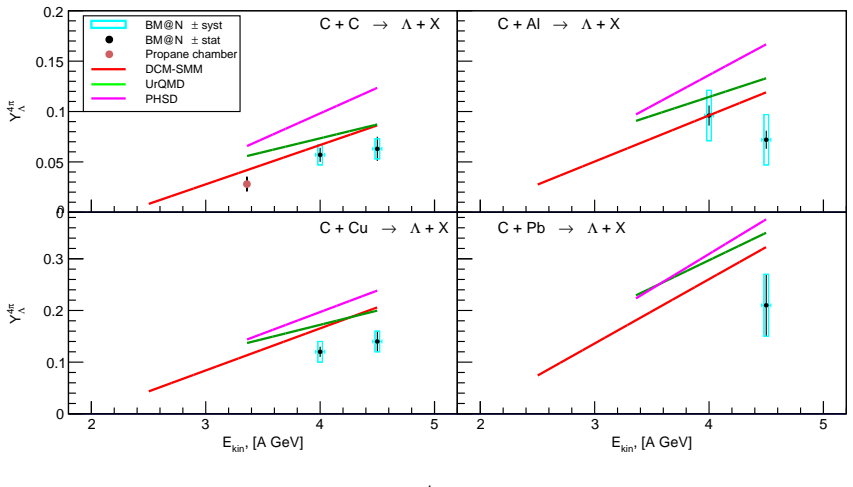
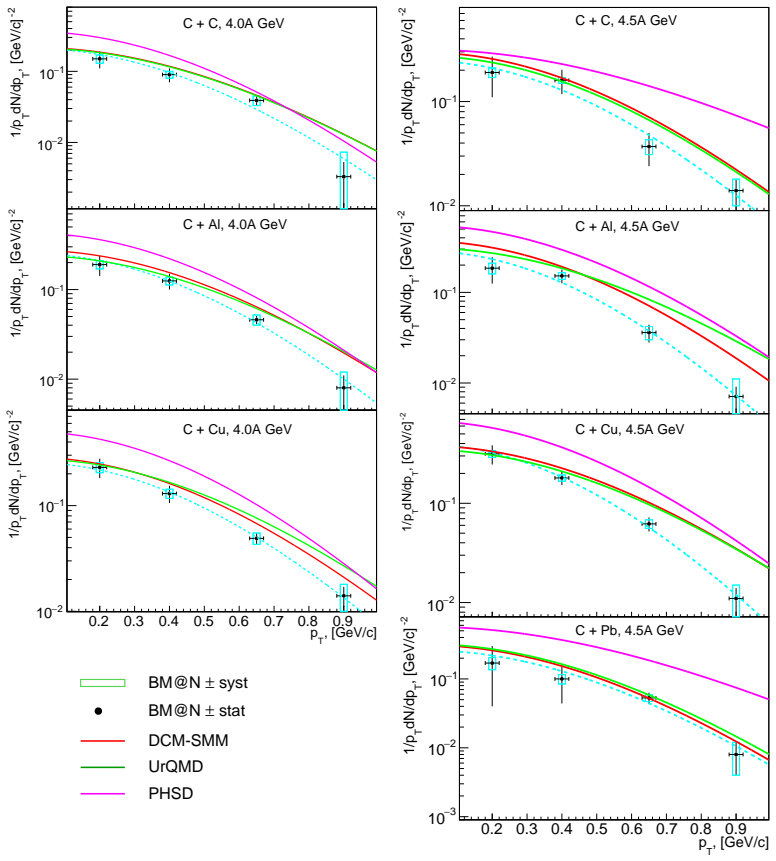
The BM@N experiment (Baryonic Matter at the Nuclotron) is the first fixed-target experiment at the JINR NICA accelerator complex. In this work, data on the interactions of a carbon-ion beam with kinetic energies of 4.0A~GeV and 4.5A~GeV with C, Al, Cu, and Pb targets are used to measure transverse momentum spectra and rapidity distributions of $\Lambda$ hyperon yields. The results are compared with the predictions of DCM-SMM, UrQMD, and PHSD transport models and with the $\Lambda$ yield measurements in other experiments at similar collision energies.
Editorial analysis
A structured set of objections, weighed in public.
Referee Report
Summary. The manuscript reports measurements of transverse momentum spectra and rapidity distributions of Λ hyperons produced in carbon-ion beam interactions at 4.0A GeV and 4.5A GeV with C, Al, Cu, and Pb targets using the BM@N experiment at the Nuclotron. Yields are extracted via V0 reconstruction from pπ− pairs, invariant-mass fitting, Monte Carlo efficiency corrections, and acceptance corrections. Results are overlaid with predictions from the DCM-SMM, UrQMD, and PHSD transport models and compared to Λ data from other experiments at similar energies.
Significance. If the reported yields and distributions hold, the data fill a gap in strangeness production measurements in the few-GeV/nucleon regime relevant to NICA physics. The multi-target dataset enables A-dependence studies, and the model comparisons provide a benchmark for transport codes without parameter tuning, which can guide refinements in hyperon production and propagation modeling.
minor comments (3)
- [§4] §4 (Data analysis): The description of background subtraction in the invariant-mass spectra should explicitly state the functional form used for the combinatorial background and how its uncertainty is propagated into the final yields.
- [Table 2] Table 2: The tabulated systematic uncertainties list contributions from tracking efficiency and material budget but do not quantify the uncertainty arising from the choice of Monte Carlo event generator used for efficiency correction; this should be added or justified as negligible.
- [Figure 7] Figure 7: The rapidity distributions for different targets are shown with model curves, but the legend does not clearly distinguish the three transport models from each other or from data points; improve labeling for readability.
Simulated Author's Rebuttal
We thank the referee for the positive assessment of our manuscript, the recognition of its relevance to NICA physics, and the recommendation for minor revision. The multi-target dataset and model comparisons are indeed intended to provide benchmarks for transport codes in the few-GeV/nucleon regime. No specific major comments were enumerated in the report, so we have no individual points requiring point-by-point rebuttal or revision at this stage. We will incorporate any minor editorial or technical suggestions in the revised version.
Circularity Check
No circularity: pure experimental measurement with external model comparisons
full rationale
The paper reports measured transverse momentum spectra and rapidity distributions of Λ hyperons extracted from detector data in fixed-target C+A collisions. Yields are obtained via standard V0 reconstruction, invariant-mass fitting, efficiency corrections from Monte Carlo, and acceptance corrections. Results are compared to independent transport models (DCM-SMM, UrQMD, PHQMD) and prior experiments without parameter tuning or internal derivation chains. No self-definitional steps, fitted inputs renamed as predictions, or load-bearing self-citations appear in the measurement pipeline. The central claims are directly falsifiable against external data and models.
Axiom & Free-Parameter Ledger
axioms (1)
- domain assumption Standard assumptions in high-energy physics for Lambda hyperon reconstruction, background subtraction, and efficiency correction from detector data.
Reference graph
Works this paper leans on
-
[1]
Arsene et al.,Dynamical phase trajectories for relativistic nuclear collisions,Phys
I. Arsene et al.,Dynamical phase trajectories for relativistic nuclear collisions,Phys. Rev. C75(2007) 034902 [nucl-th/0609042]
-
[2]
Blaschke et al.,Topical issue on Exploring Strongly Interacting Matter at High Densities — NICA White Paper,Eur
D. Blaschke et al.,Topical issue on Exploring Strongly Interacting Matter at High Densities — NICA White Paper,Eur. Phys. J. A52(2016) 267
2016
-
[3]
BM@N Conceptual Design Report, http://nica.jinr.ru/files/BM@N/BMN CDR.pdf
-
[4]
M. Merschmeyer et al. (FOPI Collaboration),K 0 andΛproduction in Ni + Ni colli- sions near threshold,Phys. Rev. C76(2007) 024906 [nucl-ex/0703036]
-
[5]
G. Agakishiev et al. (HADES Collaboration),Hyperon production in Ar + KCl colli- sions at 1.76A GeV,Eur. Phys. J. A47(2011) 21 [nucl-ex/1010.1675]
-
[6]
M. Abdulhamid et al. (STAR Collaboration),Strangeness production in √sNN=3 GeV Au + Au collisions at RHIC,JHEP10(2024) 139 [nucl-ex/2407.10110]
-
[7]
Global $\Lambda$ hyperon polarization in nuclear collisions: evidence for the most vortical fluid
L. Adamczyk et al. (STAR Collaboration),GlobalΛhyperon polarization in nu- clear collisions: evidence for the most vortical fluid,Nature54862–65 (2017) [nucl- ex/1701.06657]
work page Pith review arXiv 2017
-
[8]
S. Acharya et al. (ALICE Collaboration),Global polarization ofΛand Λhyperons in Pb - Pb collisions at √sN N = 2.76 and 5.02 TeV,Phys. Rev. C105(2022) 2 029902 [nucl-ex/1909.01281]
-
[9]
J. Adam et al. (STAR Collaboration),Strange hadron production in Au + Au collisions at √sNN = 7.7, 11.5, 19.6, 27, and 39 GeV,Phys. Rev. C102(2020) 3 034909 [nucl- ex/1906.03732]. 19
-
[10]
J. Chen et al.,Properties of the QCD matter-an experimental review of selected results from the RHIC BES program,Nucl. Sci. Tech.35(2024) 214 [nucl-ex/2407.02935]
-
[11]
S. Afanasiev et al. (BM@N Collaboration),Production ofπ + andK + mesons in argon-nucleus interactions at 3.2A GeV,JHEP07(2023) 174 [hep-ex/2303.16243]
-
[12]
S. Afanasiev et al. (BM@N Collaboration),Production of protons, deuterons and tritons in argon-nucleus interactions at 3.2 A GeV,JHEP08(2025) 95 [ hep- ex/2504.02759]
-
[13]
Baranov et al.,GEM tracking system of the BM@N experiment,JINST12(2017) C06041
D. Baranov et al.,GEM tracking system of the BM@N experiment,JINST12(2017) C06041
2017
-
[14]
BM@N project, https://bmn.jinr.int/detector/project/BMN project.pdf
-
[15]
S. Afanasiev et al. (BM@N Collaboration),The BM@N spectrometer at the NICA ac- celerator complex,Nucl. Instrum. Meth. A1065(2024) 169532 [hep-ex/2312.17573]
-
[16]
Kapishin et al
M. Kapishin et al. (BM@N Collaboration),The fixed target experiment for studies of baryonic matter at the Nuclotron (BM@N),Phys. Atom. Nuclei80(2017) 10 1613
2017
-
[17]
Kapishin et al
M. Kapishin et al. (BM@N Collaboration),Studies of baryonic matter at the BM@N experiment (JINR),Nucl. Phys. A982(2019) 967
2019
-
[18]
Amelin, K
N. Amelin, K. Gudima, and V . Toneev,Ultrarelativistic nucleus-nucleus collisions within a dynamical model of independent quark-gluon strings,Sov. J. Nucl. Phys.51 (1990) 1093
1990
- [19]
-
[20]
Agostinelli et al.,Geant4 - A Simulation Toolkit,Nucl
S. Agostinelli et al.,Geant4 - A Simulation Toolkit,Nucl. Instrum. Meth. A506(2003) 250-303
2003
-
[21]
Batyuk, K
P. Batyuk, K. Gertsenberger, S. Merts, O. Rogachevsky,The BmnRoot framework for experimental data processing in the BM@N experiment at NICA,EPJ Web of Conferences214(2019) 05027
2019
-
[22]
https://garfieldpp.web.cern.ch
-
[23]
Baranov et al.,First results from BM@N technical run with deuteron beam,Phys
D. Baranov et al.,First results from BM@N technical run with deuteron beam,Phys. Part. Nucl. Lett.15(2018) 2 148
2018
-
[24]
Akishina and I
V . Akishina and I. Kisel,Time-based Cellular Automaton track finder for the CBM experiment,J. Phys. Conf. Ser.599(2015) 1, 012024
2015
-
[25]
Alishina, Yu
K. Alishina, Yu. Stepanenko,Study ofΛHyperon Production in Collisions of Heavy Ions with Solid Targets in the BM@N Experiment,Phys. Part. Nuclei Lett.21(2024) 683. 20
2024
-
[26]
Angelov et al.,Analysis of Behavior of Cross-section andpi−Meson Multiplicity at the Interaction of p, d, He, C Relativistic Nuclei With Carbon and Tantalum,Sov
H. Angelov et al.,Analysis of Behavior of Cross-section andpi−Meson Multiplicity at the Interaction of p, d, He, C Relativistic Nuclei With Carbon and Tantalum,Sov. J. Nucl. Phys.33(1981) 552
1981
-
[27]
Bradt and B
H. Bradt and B. Peters,The Heavy Nuclei of the Primary Cosmic Radiation,Phys. Rev.77(1950) 54
1950
-
[28]
Barashenkov,Interaction cross sections of elementary particles, (1968), translated from the Russian by Y
V . Barashenkov,Interaction cross sections of elementary particles, (1968), translated from the Russian by Y . Oren, Israel Program for Scientific Translations
1968
-
[29]
Aksinenko et al
V . Aksinenko et al. (SKM-200 Collaboration),Streamer chamber study of the cross sections and multiplicities in nucleus–nucleus interactions at the incident momentum of 4.5 GeV/c per nucleon,Nucl. Phys. A348(1980) 518-534
1980
-
[30]
Microscopic Models for Ultrarelativistic Heavy Ion Collisions
S. Bass et al.,Microscopic models for ultrarelativistic heavy ion collisions,Prog. Part. Nucl. Phys.41(1998) 255 [nucl-th/9803035]
work page Pith review arXiv 1998
-
[31]
E. Bratkovskaya et al.PHQMD Model for the Formation of Nuclear Clusters and Hypernuclei in Heavy Ion Collisions,Bull. Russ. Acad. Sci. Phys.84(2020) 957 [nucl- th/1911.09496]
-
[32]
Arakelian et al.,Communication of the Joint Institute for Nuclear ResearchP1-83- 354(1983) Dubna (in Russian)
S. Arakelian et al.,Communication of the Joint Institute for Nuclear ResearchP1-83- 354(1983) Dubna (in Russian)
1983
-
[33]
Armutlijsky et al.,Communication of the Joint Institute for Nuclear ResearchP1- 85-220(1985) Dubna (in Russian)
D. Armutlijsky et al.,Communication of the Joint Institute for Nuclear ResearchP1- 85-220(1985) Dubna (in Russian)
1985
-
[34]
Cassing and E
W. Cassing and E. Bratkovskaya,Hadronic and electromagnetic probes of hot and dense nuclear matter,Phys. Rep.308(1999) 65
1999
-
[35]
V . Kolesnikov, V . Kireyeu, V . Lenivenko, A. Mudrokh, K. Shtejer, D. Zinchenko, and E. Bratkovskaya,A New Review of Excitation Functions of Hadron Production in pp Collisions in the NICA Energy Range,PEPAN Letters17(2020) 142 [nucl- ex/1912.01979]
-
[36]
V . Kireyeu, I. Grishmanovskii, V . Kolesnikov, V . V oronyuk, E. Bratkovskaya,Hadron production in elementary nucleon–nucleon reactions from low to ultra-relativistic en- ergies,Eur. Phys. J. A56(2020) 223 [hep-ph/2006.14739]
-
[37]
J. Adamczewski-Musch et al. (HADES Collaboration),Sub-threshold production of K0 S mesons andΛhyperons in Au + Au collisions at √sN N = 2.4GeV,Phys. Lett. B 793(2019) 457 [nucl-ex/1812.07304]. 21
discussion (0)
Sign in with ORCID, Apple, or X to comment. Anyone can read and Pith papers without signing in.